
Zoom Connector for SSIS
Zoom Connector can be used to integrate Zoom REST API in your App / BI Tools. You can read/write data about Meetings, Invite, Users, Accounts and more.
In this article you will learn how to quickly and efficiently integrate Zoom data in SSIS without coding. We will use high-performance Zoom Connector to easily connect to Zoom and then access the data inside SSIS.
Let's follow the steps below to see how we can accomplish that!
Zoom Connector for SSIS is based on ZappySys API Connector Framework which is a part of SSIS PowerPack. It is a collection of high-performance SSIS connectors that enable you to integrate data with virtually any data provider supported by SSIS, including SQL Server. SSIS PowerPack supports various file formats, sources and destinations, including REST/SOAP API, SFTP/FTP, storage services, and plain files, to mention a few (if you are new to SSIS and SSIS PowerPack, find out more on how to use them).
Video Tutorial - Integrate Zoom data in SSIS
This video covers the following topics and more, so please watch carefully. After watching the video, follow the steps outlined in this article:
- How to download and install the required PowerPack for Zoom integration in SSIS
- How to configure the connection for Zoom
- Features of the ZappySys API Source (Authentication / Query Language / Examples / Driver UI)
- How to use the Zoom in SSIS

Prerequisites
Before we begin, make sure the following prerequisites are met:
- SSIS designer installed. Sometimes it is referred as BIDS or SSDT (download it from Microsoft).
- Basic knowledge of SSIS package development using Microsoft SQL Server Integration Services.
- SSIS PowerPack is installed (if you are new to SSIS PowerPack, then get started!).
Read data from Zoom in SSIS (Export data)
In this section we will learn how to configure and use Zoom Connector in API Source to extract data from Zoom.
-
Begin with opening Visual Studio and Create a New Project.
-
Select Integration Service Project and in new project window set the appropriate name and location for project. And click OK.
In the new SSIS project screen you will find the following:
- SSIS ToolBox on left side bar
- Solution Explorer and Property Window on right bar
- Control flow, data flow, event Handlers, Package Explorer in tab windows
- Connection Manager Window in the bottom
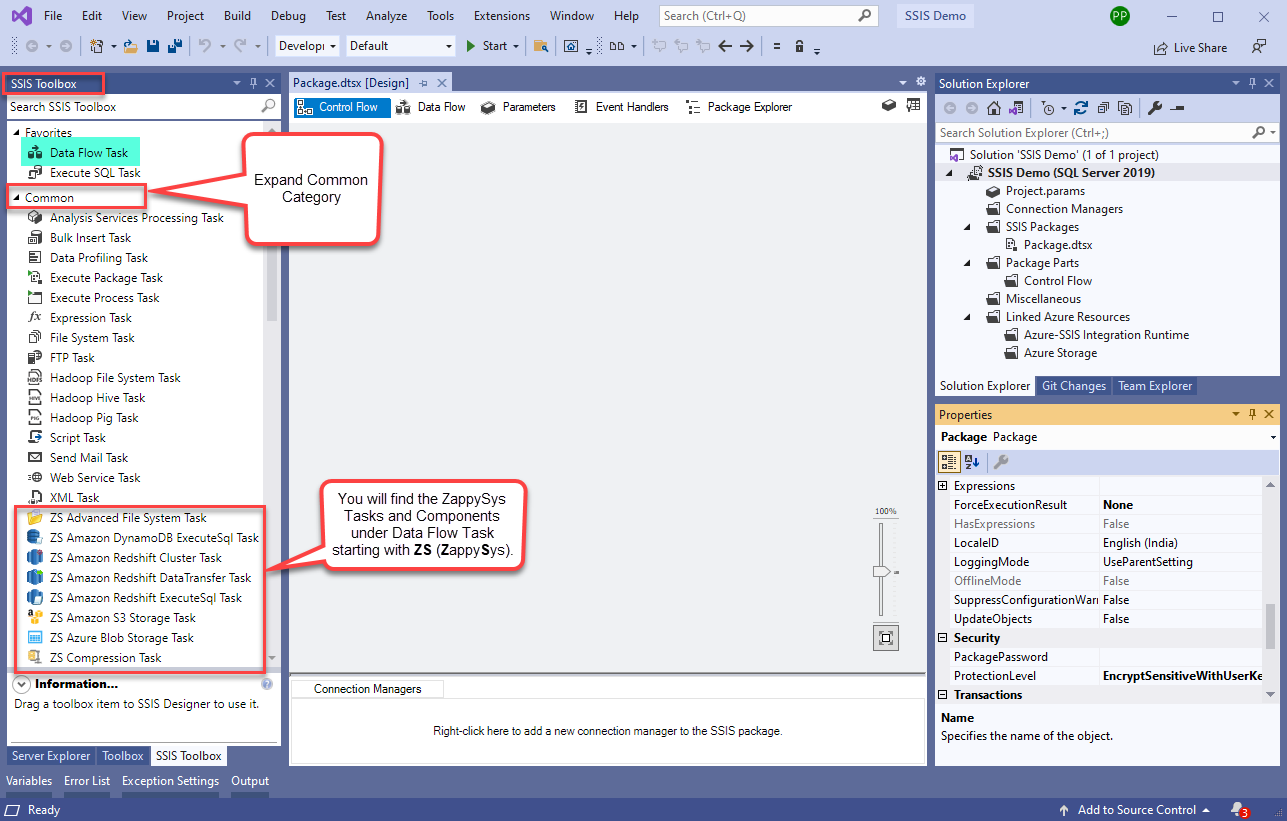 Note: If you don't see ZappySys SSIS PowerPack Task or Components in SSIS Toolbox, please refer to this help link.
 -
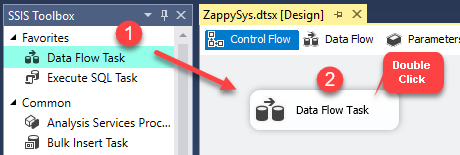
Now, Drag and Drop SSIS Data Flow Task from SSIS Toolbox. Double click on the Data Flow Task to see Data Flow designer.
-
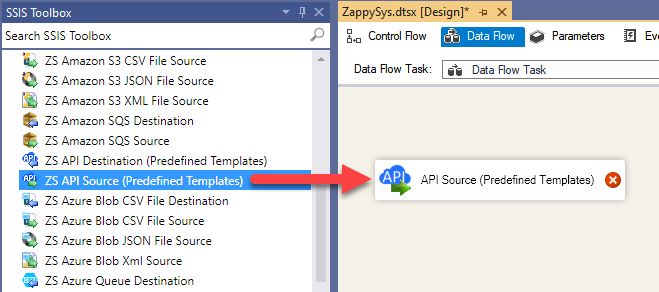
From the SSIS toolbox drag and API Source (Predefined Templates) on the data flow designer surface, and double click on it to edit it:
-
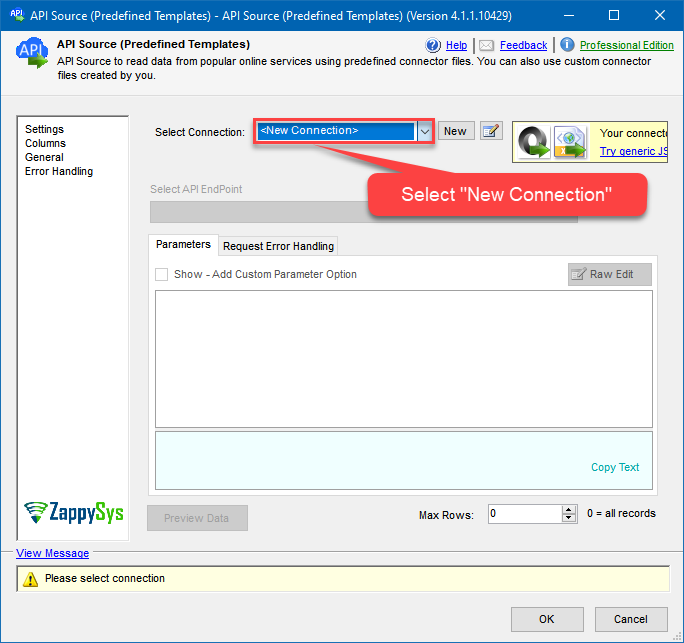
Select New Connection to create a new connection:
-
Use a preinstalled Zoom Connector from Popular Connector List or press Search Online radio button to download Zoom Connector. Once downloaded simply use it in the configuration:
Zoom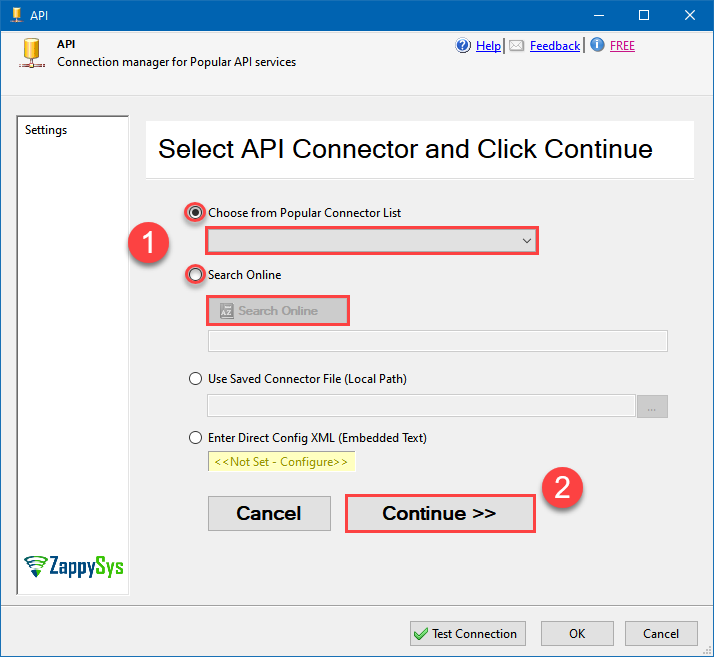
-
Now it's time to configure authentication. Firstly, configure authentication settings in Zoom service and then proceed by configuring API Connection Manager. Start by expanding an authentication type:
Zoom authentication
OAuth App must be created under Admin Console > Channel > API > Settings. [API reference]
Follow the steps below to create a Zoom OAuth app and obtain the required credentials (Client ID and Client Secret):
- Go to the Zoom App Marketplace and sign in with your Zoom account.
- From the top navigation bar, open the Develop dropdown and select Build App.
- In the What kind of app are you creating window, select General App, click the Create button.
- Enter a name for your app and select the app type.
(E.g. Zoom-General App) - Click Create to continue.
- In the Redirect URL for OAuth field, enter the following URI and add it to the allow list:
https://zappysys.com/oauth/ - Copy your Client ID and Client Secret, then paste them into the ZappySys API Component/Driver UI under the required parameters.
- From the Scopes window, please add the appropriate Granular scopes. You can search for the scopes listed below and enable them as needed.
Scope Levels:- User-Level: Grants access only to the authenticated user’s data. Suitable for apps where users connect with their own Zoom account.
- Admin-Level: Grants access to data across all users in the account, provided the user has admin permissions. Best for organization-wide apps.
- Master-Level: Grants access at the highest level, typically for apps that need full account control (including sub-accounts). Requires Master Account credentials.
Recommended Scopes:
User-Level- user:read:settings
- meeting:read:list_meetings
- meeting:read:meeting
- meeting:read:list_registrants
- meeting:read:past_meeting
- meeting:read:list_registration_questions
- webinar:read:list_webinars
- webinar:read:webinar
- webinar:read:list_registrants
- report:read:user
- user:read:settings:admin
- user:write:user:admin
- meeting:read:list_meetings:admin
- meeting:read:meeting:admin
- meeting:read:list_registrants:admin
- meeting:read:past_meeting:admin
- meeting:read:list_registration_questions:admin
- user:read:list_users:admin
- webinar:read:list_webinars:admin
- webinar:read:webinar:admin
- webinar:read:list_registrants:admin
- report:read:user:admin
- user:read:settings:master
- meeting:read:list_meetings:master
- meeting:read:meeting:master
- meeting:read:list_registrants:master
- user:read:list_users:master
- webinar:read:list_webinars:master
- webinar:read:webinar:master
- webinar:read:list_registrants:master
- report:read:user:master
- That’s it! After adding the scopes, click Continue to complete the process.
- In the ZappySys API Component/Driver UI, enter your Zoom app Client ID and Client Secret, then click Generate Token to obtain the access tokens.
- You’re done!
API Connection Manager configuration
Just perform these simple steps to finish authentication configuration:
-
Set Authentication Type to
User Credentials (Access Your Data) [OAuth] - Optional step. Modify API Base URL if needed (in most cases default will work).
- Fill in all the required parameters and set optional parameters if needed.
- Press Generate Token button to generate the tokens.
- Finally, hit OK button:
ZoomUser Credentials (Access Your Data) [OAuth]https://api.zoom.us/v2Required Parameters Client Id Fill-in the parameter... Client Secret Fill-in the parameter... Redirect Url Fill-in the parameter... Token Url Fill-in the parameter... Authorization Url Fill-in the parameter... Optional Parameters Retry Mode RetryWhenStatusCodeMatch Retry Status Code 429 Retry Count Max 5 Retry Multiply Wait Time True 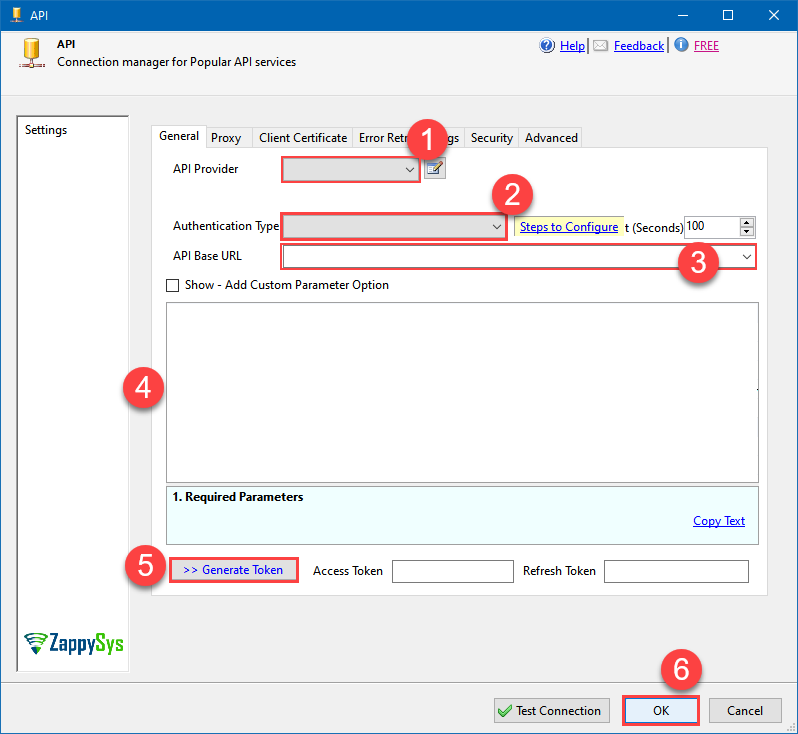
Zoom authentication
Server-to-Server OAuth authentication method that lets applications access the Zoom API directly without user login or consent, using a Client ID and Secret to generate short-lived tokens. [API reference]
Follow the steps below to create a Zoom OAuth app and obtain the required credentials (Client ID and Client Secret):
- Go to the Zoom App Marketplace and sign in with your Zoom account.
- From the top navigation bar, open the Develop dropdown and select Build App.
- In the What kind of app are you creating window, select Server to Server OAuth App, click the Create button.
- Enter a name for your app and select the app type.
(E.g. Basic OAuth App) - Click Create to continue.
- Copy your Account ID, Client ID, and Client Secret, then paste them into the ZappySys API Component/Driver UI under the required parameters.
- In the Information window, enter the company name, developer name, and email address, then click Continue.
- From the Scopes window, please add the appropriate Granular scopes. You can search for the scopes listed below and enable them as needed.
Scope Levels:- Admin-Level: Grants access to data across all users in the account, provided the user has admin permissions. Best for organization-wide apps.
- Master-Level: Grants access at the highest level, typically for apps that need full account control (including sub-accounts). Requires Master Account credentials.
Recommended Scopes:
Admin-Level- user:read:settings:admin
- user:write:user:admin
- meeting:read:list_meetings:admin
- meeting:read:meeting:admin
- meeting:read:list_registrants:admin
- meeting:read:past_meeting:admin
- meeting:read:list_registration_questions:admin
- user:read:list_users:admin
- webinar:read:list_webinars:admin
- webinar:read:webinar:admin
- webinar:read:list_registrants:admin
- report:read:user:admin
- user:read:settings:master
- meeting:read:list_meetings:master
- meeting:read:meeting:master
- meeting:read:list_registrants:master
- user:read:list_users:master
- webinar:read:list_webinars:master
- webinar:read:webinar:master
- webinar:read:list_registrants:master
- report:read:user:master
- That’s it! After adding the scopes, click Continue to complete the process.
- In the ZappySys API Component/Driver UI, enter your Zoom app Account ID, Client ID, and Client Secret, then click Test Connection.
- You’re done!
API Connection Manager configuration
Just perform these simple steps to finish authentication configuration:
-
Set Authentication Type to
App Credentials (Access Account Level Data) [OAuth] - Optional step. Modify API Base URL if needed (in most cases default will work).
- Fill in all the required parameters and set optional parameters if needed.
- Finally, hit OK button:
ZoomApp Credentials (Access Account Level Data) [OAuth]https://api.zoom.us/v2Required Parameters Account Id Fill-in the parameter... Client Id Fill-in the parameter... Client Secret Fill-in the parameter... Token Url Fill-in the parameter... Optional Parameters Retry Mode RetryWhenStatusCodeMatch Retry Status Code 429 Retry Count Max 5 Retry Multiply Wait Time True 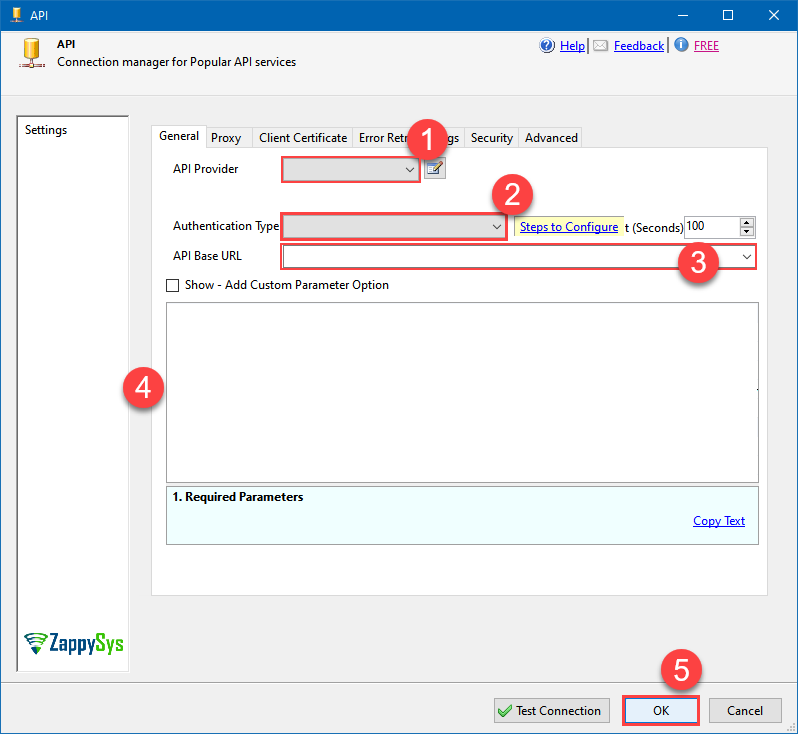
Zoom authentication
OAuth App must be created under Admin Console > Channel > API > Settings. [API reference]
Perform the following steps to get the Zoom OAuth credentials (i.e. Client ID and Client Secret)
- Go to Zoom Marketplace Portal and sign in there.
- Once you successfully login then select "Build App" option from Develop dropdown from top left on the page.
- Click on Create button of OAuth panel section of page.
- Enter the name for your application and choose app type (Recommneded "Account-Level App") option for your API
- Then proceed with clicking Create button.
- In Redirect URL for OAuth enter this https://zappysys.com/oauth/ as Redirect URI and add it to allow lists.
- Copy Client ID and Client Secret here and paste it into Connection Manager Required Paramters section in respective place holders
- Add appropiate scopes from the Scopes menu option to the right side of page for your API as below :
NOTE: If you need to read/write data for all users (not just 'me') then add
:adminsuffix in the scope (e.g.meeting:read:admin)- meeting:read
- meeting:write
- user:read
- user:write
- user_info:read
- meeting:read
- chat_channel:read
- chat_channel:write
- chat_contact:read
- chat_message:read
- chat_message:write
- contact:read
- pac:read
- pac:write
- phone:read
- phone:write
- phone_call_control:read
- phone_call_control:write
- phone_call_log:read
- phone_call_log:write
- phone_e911:read
- phone_recording:read
- phone_recording:write
- phone_sms:read
- phone_sms:write
- phone_voicemail:read
- phone_voicemail:write
- recording:read
- recording:write
- tsp:read
- tsp:write
- user:read
- user:write
- user_info:read
- user_zak:read
- webinar:read
- webinar:write
- report:read:user
- Click Generate Token button on Connection Manager UI to generate tokens.
- That's it!
API Connection Manager configuration
Just perform these simple steps to finish authentication configuration:
-
Set Authentication Type to
User Credentials (Access Your Data) - With Legacy Scopes [OAuth] - Optional step. Modify API Base URL if needed (in most cases default will work).
- Fill in all the required parameters and set optional parameters if needed.
- Press Generate Token button to generate the tokens.
- Finally, hit OK button:
ZoomUser Credentials (Access Your Data) - With Legacy Scopes [OAuth]https://api.zoom.us/v2Required Parameters ClientId Fill-in the parameter... ClientSecret Fill-in the parameter... RedirectUrl Fill-in the parameter... TokenUrl Fill-in the parameter... AuthorizationUrl Fill-in the parameter... Optional Parameters Scope RetryMode RetryWhenStatusCodeMatch RetryStatusCodeList 429 RetryCountMax 5 RetryMultiplyWaitTime True
-
Select the desired endpoint, change/pass the properties values, and click on Preview Data button to make the API call.
API Source - ZoomZoom Connector can be used to integrate Zoom REST API in your App / BI Tools. You can read/write data about Meetings, Invite, Users, Accounts and more.
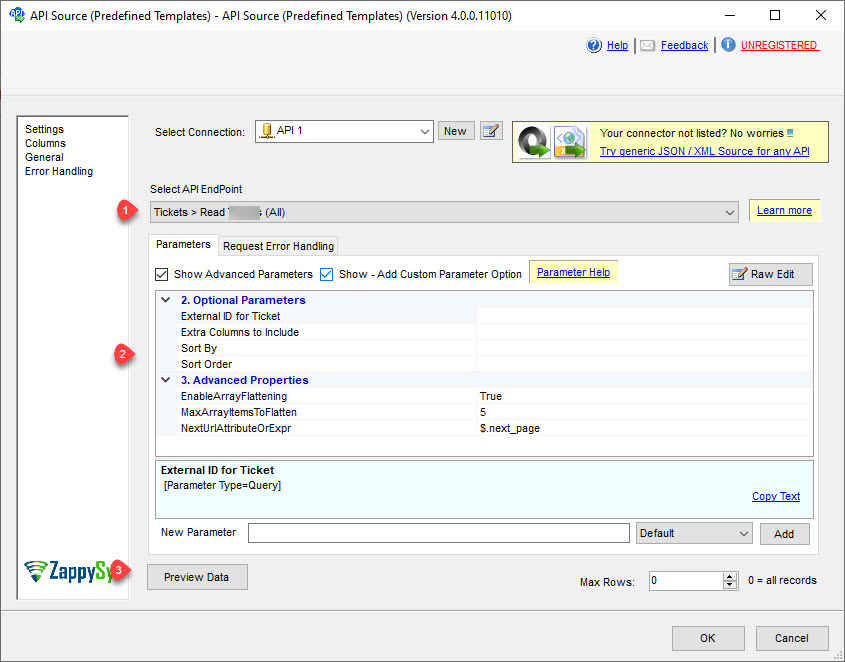
-
That's it! We are done! Just in a few clicks we configured the call to Zoom using Zoom Connector.
You can load the source data into your desired destination using the Upsert Destination , which supports SQL Server, PostgreSQL, and Amazon Redshift. We also offer other destinations such as CSV , Excel , Azure Table , Salesforce , and more . You can check out our SSIS PowerPack Tasks and components for more options. (*loaded in Trash Destination)
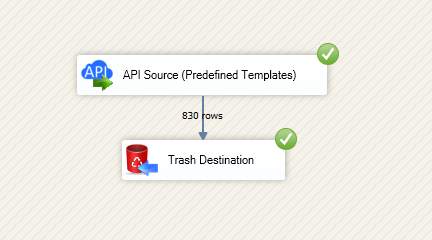
Write data to Zoom using SSIS (Import data)
In this section we will learn how to configure and use Zoom Connector in the API Destination to write data to Zoom.
Video tutorial
This video covers following and more so watch carefully. After watching this video follow the steps described in this article.
- How to download SSIS PowerPack for Zoom integration in SSIS
- How to configure connection for Zoom
- How to write or lookup data to Zoom
- Features about SSIS API Destination
- Using Zoom Connector in SSIS
Step-by-step instructions
In upper section we learned how to read data, now in this section we will learn how to configure Zoom in the API Source to POST data to the Zoom.
-
Begin with opening Visual Studio and Create a New Project.
-
Select Integration Service Project and in new project window set the appropriate name and location for project. And click OK.
In the new SSIS project screen you will find the following:
- SSIS ToolBox on left side bar
- Solution Explorer and Property Window on right bar
- Control flow, data flow, event Handlers, Package Explorer in tab windows
- Connection Manager Window in the bottom
Note: If you don't see ZappySys SSIS PowerPack Task or Components in SSIS Toolbox, please refer to this help link. -
Now, Drag and Drop SSIS Data Flow Task from SSIS Toolbox. Double click on the Data Flow Task to see Data Flow designer.
-
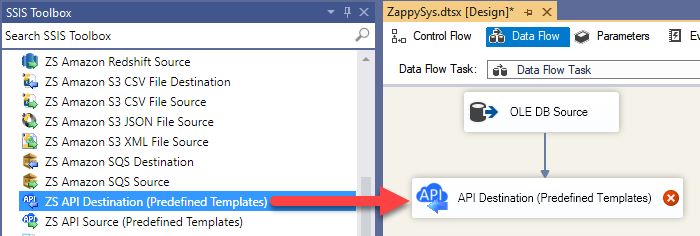
Read the data from the source, using any desired source component. You can even make an API call using the ZappySys JSON/XML/API Source and read data from there. In this example, we will use an OLE DB Source component to read real-time data from a SQL Server database.
-
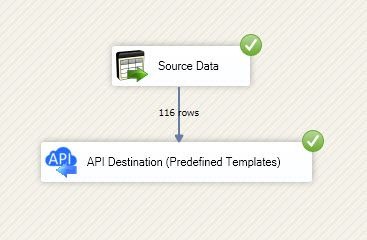
From the SSIS Toolbox drag and drop API Destination (Predefined Templates) on the Data Flow Designer surface and connect source component with it, and double click to edit it.
-
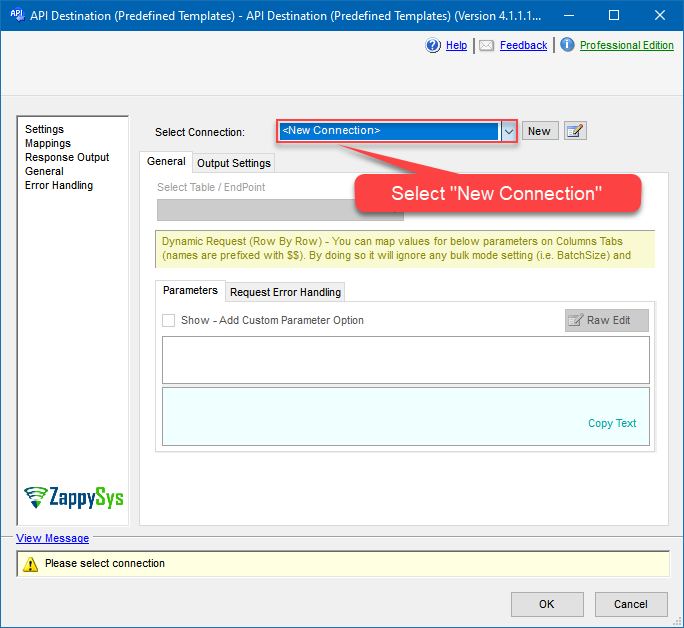
Select New Connection to create a new connection:
API Destination - ZoomZoom Connector can be used to integrate Zoom REST API in your App / BI Tools. You can read/write data about Meetings, Invite, Users, Accounts and more.
-
To configure the Zoom connector, choose one of the following methods:
- Choose from Popular Connector List: Select a pre-installed service directly from the dropdown menu.
- Search Online: Use this to find and download a new connector file to your computer.
- Use Saved/Downloaded File: Once the file is downloaded, browse your local drive to load it into the configuration.
After that, just click Continue >>:
Zoom
-
Proceed with selecting the desired Authentication Type. Then select API Base URL (in most cases default one is the right one). Finally, fill in all the required parameters and set optional parameters if needed. You may press a link Steps to Configure which will help set certain parameters. More info is available in Authentication section.
Zoom authentication
OAuth App must be created under Admin Console > Channel > API > Settings. [API reference]
Follow the steps below to create a Zoom OAuth app and obtain the required credentials (Client ID and Client Secret):
- Go to the Zoom App Marketplace and sign in with your Zoom account.
- From the top navigation bar, open the Develop dropdown and select Build App.
- In the What kind of app are you creating window, select General App, click the Create button.
- Enter a name for your app and select the app type.
(E.g. Zoom-General App) - Click Create to continue.
- In the Redirect URL for OAuth field, enter the following URI and add it to the allow list:
https://zappysys.com/oauth/ - Copy your Client ID and Client Secret, then paste them into the ZappySys API Component/Driver UI under the required parameters.
- From the Scopes window, please add the appropriate Granular scopes. You can search for the scopes listed below and enable them as needed.
Scope Levels:- User-Level: Grants access only to the authenticated user’s data. Suitable for apps where users connect with their own Zoom account.
- Admin-Level: Grants access to data across all users in the account, provided the user has admin permissions. Best for organization-wide apps.
- Master-Level: Grants access at the highest level, typically for apps that need full account control (including sub-accounts). Requires Master Account credentials.
Recommended Scopes:
User-Level- user:read:settings
- meeting:read:list_meetings
- meeting:read:meeting
- meeting:read:list_registrants
- meeting:read:past_meeting
- meeting:read:list_registration_questions
- webinar:read:list_webinars
- webinar:read:webinar
- webinar:read:list_registrants
- report:read:user
- user:read:settings:admin
- user:write:user:admin
- meeting:read:list_meetings:admin
- meeting:read:meeting:admin
- meeting:read:list_registrants:admin
- meeting:read:past_meeting:admin
- meeting:read:list_registration_questions:admin
- user:read:list_users:admin
- webinar:read:list_webinars:admin
- webinar:read:webinar:admin
- webinar:read:list_registrants:admin
- report:read:user:admin
- user:read:settings:master
- meeting:read:list_meetings:master
- meeting:read:meeting:master
- meeting:read:list_registrants:master
- user:read:list_users:master
- webinar:read:list_webinars:master
- webinar:read:webinar:master
- webinar:read:list_registrants:master
- report:read:user:master
- That’s it! After adding the scopes, click Continue to complete the process.
- In the ZappySys API Component/Driver UI, enter your Zoom app Client ID and Client Secret, then click Generate Token to obtain the access tokens.
- You’re done!
API Connection Manager configuration
Just perform these simple steps to finish authentication configuration:
-
Set Authentication Type to
User Credentials (Access Your Data) [OAuth] - Optional step. Modify API Base URL if needed (in most cases default will work).
- Fill in all the required parameters and set optional parameters if needed.
- Press Generate Token button to generate the tokens.
- Finally, hit OK button:
ZoomUser Credentials (Access Your Data) [OAuth]https://api.zoom.us/v2Required Parameters Client Id Fill-in the parameter... Client Secret Fill-in the parameter... Redirect Url Fill-in the parameter... Token Url Fill-in the parameter... Authorization Url Fill-in the parameter... Optional Parameters Retry Mode RetryWhenStatusCodeMatch Retry Status Code 429 Retry Count Max 5 Retry Multiply Wait Time True
Zoom authentication
Server-to-Server OAuth authentication method that lets applications access the Zoom API directly without user login or consent, using a Client ID and Secret to generate short-lived tokens. [API reference]
Follow the steps below to create a Zoom OAuth app and obtain the required credentials (Client ID and Client Secret):
- Go to the Zoom App Marketplace and sign in with your Zoom account.
- From the top navigation bar, open the Develop dropdown and select Build App.
- In the What kind of app are you creating window, select Server to Server OAuth App, click the Create button.
- Enter a name for your app and select the app type.
(E.g. Basic OAuth App) - Click Create to continue.
- Copy your Account ID, Client ID, and Client Secret, then paste them into the ZappySys API Component/Driver UI under the required parameters.
- In the Information window, enter the company name, developer name, and email address, then click Continue.
- From the Scopes window, please add the appropriate Granular scopes. You can search for the scopes listed below and enable them as needed.
Scope Levels:- Admin-Level: Grants access to data across all users in the account, provided the user has admin permissions. Best for organization-wide apps.
- Master-Level: Grants access at the highest level, typically for apps that need full account control (including sub-accounts). Requires Master Account credentials.
Recommended Scopes:
Admin-Level- user:read:settings:admin
- user:write:user:admin
- meeting:read:list_meetings:admin
- meeting:read:meeting:admin
- meeting:read:list_registrants:admin
- meeting:read:past_meeting:admin
- meeting:read:list_registration_questions:admin
- user:read:list_users:admin
- webinar:read:list_webinars:admin
- webinar:read:webinar:admin
- webinar:read:list_registrants:admin
- report:read:user:admin
- user:read:settings:master
- meeting:read:list_meetings:master
- meeting:read:meeting:master
- meeting:read:list_registrants:master
- user:read:list_users:master
- webinar:read:list_webinars:master
- webinar:read:webinar:master
- webinar:read:list_registrants:master
- report:read:user:master
- That’s it! After adding the scopes, click Continue to complete the process.
- In the ZappySys API Component/Driver UI, enter your Zoom app Account ID, Client ID, and Client Secret, then click Test Connection.
- You’re done!
API Connection Manager configuration
Just perform these simple steps to finish authentication configuration:
-
Set Authentication Type to
App Credentials (Access Account Level Data) [OAuth] - Optional step. Modify API Base URL if needed (in most cases default will work).
- Fill in all the required parameters and set optional parameters if needed.
- Finally, hit OK button:
ZoomApp Credentials (Access Account Level Data) [OAuth]https://api.zoom.us/v2Required Parameters Account Id Fill-in the parameter... Client Id Fill-in the parameter... Client Secret Fill-in the parameter... Token Url Fill-in the parameter... Optional Parameters Retry Mode RetryWhenStatusCodeMatch Retry Status Code 429 Retry Count Max 5 Retry Multiply Wait Time True
Zoom authentication
OAuth App must be created under Admin Console > Channel > API > Settings. [API reference]
Perform the following steps to get the Zoom OAuth credentials (i.e. Client ID and Client Secret)
- Go to Zoom Marketplace Portal and sign in there.
- Once you successfully login then select "Build App" option from Develop dropdown from top left on the page.
- Click on Create button of OAuth panel section of page.
- Enter the name for your application and choose app type (Recommneded "Account-Level App") option for your API
- Then proceed with clicking Create button.
- In Redirect URL for OAuth enter this https://zappysys.com/oauth/ as Redirect URI and add it to allow lists.
- Copy Client ID and Client Secret here and paste it into Connection Manager Required Paramters section in respective place holders
- Add appropiate scopes from the Scopes menu option to the right side of page for your API as below :
NOTE: If you need to read/write data for all users (not just 'me') then add
:adminsuffix in the scope (e.g.meeting:read:admin)- meeting:read
- meeting:write
- user:read
- user:write
- user_info:read
- meeting:read
- chat_channel:read
- chat_channel:write
- chat_contact:read
- chat_message:read
- chat_message:write
- contact:read
- pac:read
- pac:write
- phone:read
- phone:write
- phone_call_control:read
- phone_call_control:write
- phone_call_log:read
- phone_call_log:write
- phone_e911:read
- phone_recording:read
- phone_recording:write
- phone_sms:read
- phone_sms:write
- phone_voicemail:read
- phone_voicemail:write
- recording:read
- recording:write
- tsp:read
- tsp:write
- user:read
- user:write
- user_info:read
- user_zak:read
- webinar:read
- webinar:write
- report:read:user
- Click Generate Token button on Connection Manager UI to generate tokens.
- That's it!
API Connection Manager configuration
Just perform these simple steps to finish authentication configuration:
-
Set Authentication Type to
User Credentials (Access Your Data) - With Legacy Scopes [OAuth] - Optional step. Modify API Base URL if needed (in most cases default will work).
- Fill in all the required parameters and set optional parameters if needed.
- Press Generate Token button to generate the tokens.
- Finally, hit OK button:
ZoomUser Credentials (Access Your Data) - With Legacy Scopes [OAuth]https://api.zoom.us/v2Required Parameters ClientId Fill-in the parameter... ClientSecret Fill-in the parameter... RedirectUrl Fill-in the parameter... TokenUrl Fill-in the parameter... AuthorizationUrl Fill-in the parameter... Optional Parameters Scope RetryMode RetryWhenStatusCodeMatch RetryStatusCodeList 429 RetryCountMax 5 RetryMultiplyWaitTime True
-
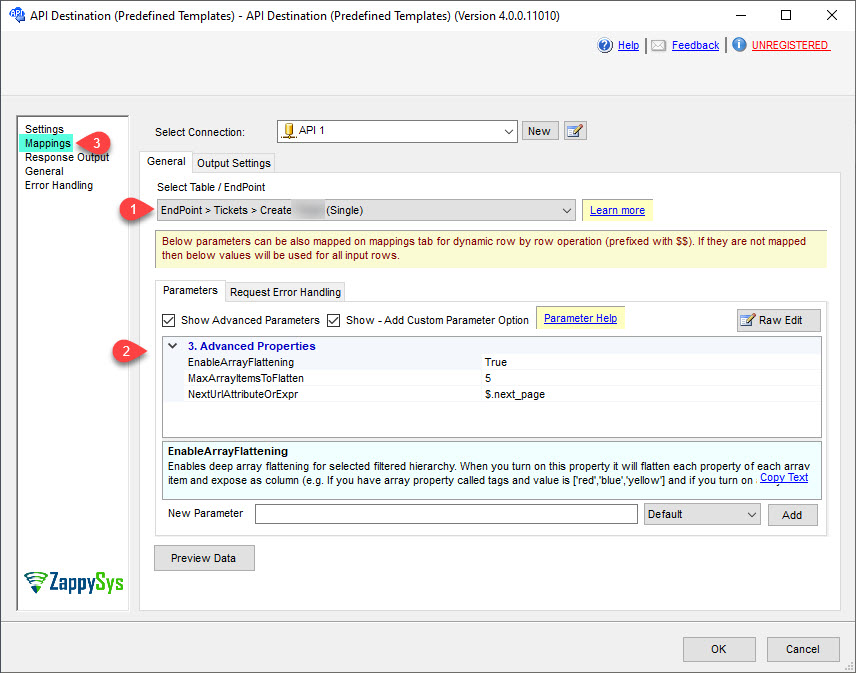
Select the desired endpoint, change/pass the properties values, and go to the Mappings tab to map the columns.
API Destination - ZoomZoom Connector can be used to integrate Zoom REST API in your App / BI Tools. You can read/write data about Meetings, Invite, Users, Accounts and more.
-
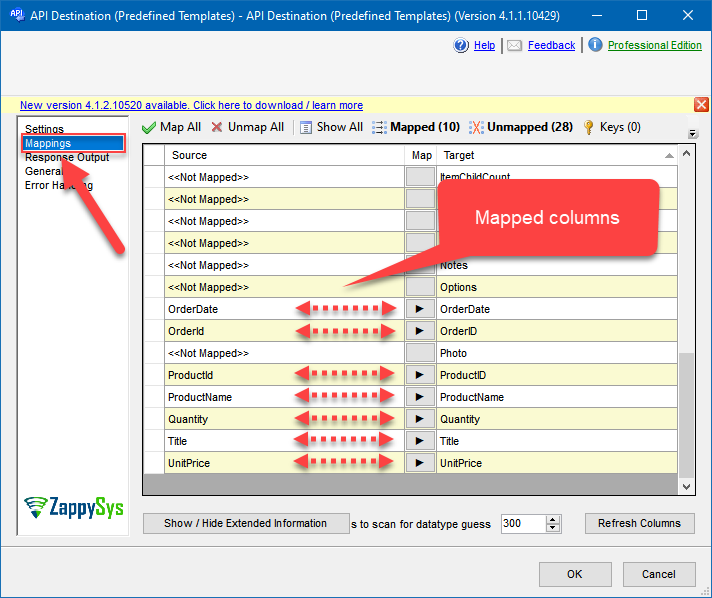
Finally, map the desired columns:
API Destination - ZoomZoom Connector can be used to integrate Zoom REST API in your App / BI Tools. You can read/write data about Meetings, Invite, Users, Accounts and more.
-
That's it; we successfully configured the POST API Call. In a few clicks we configured the Zoom API call using ZappySys Zoom Connector
Load Zoom data into SQL Server using Upsert Destination (Insert or Update)
Once you configured the data source, you can load Zoom data into SQL Server using Upsert Destination.
Upsert Destination can merge or synchronize source data with the target table.
It supports Microsoft SQL Server, PostgreSQL, and Redshift databases as targets.
Upsert Destination also supports very fast bulk upsert operation along with bulk delete.
Upsert operation
- a database operation which performs INSERT or UPDATE SQL commands
based on record's existence condition in the target table.
It
Upsert Destination supports INSERT, UPDATE, and DELETE operations,
so it is similar to SQL Server's MERGE command, except it can be used directly in SSIS package.
-
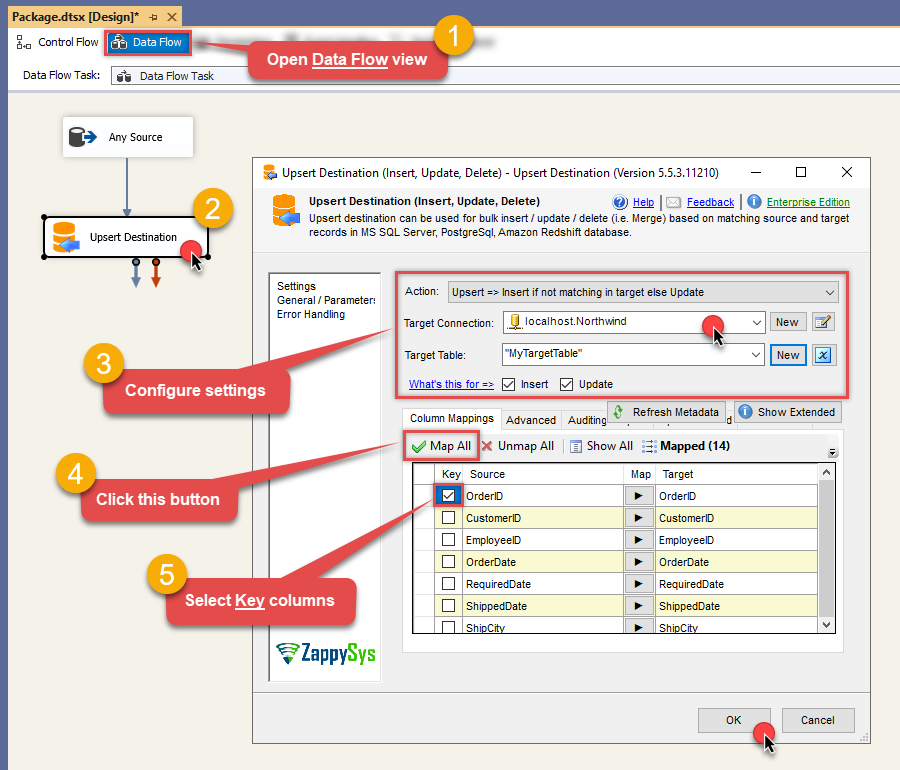
From the SSIS Toolbox drag-and-drop Upsert Destination component onto the Data Flow designer background.
-
Connect your SSIS source component to Upsert Destination.
-
Double-click on Upsert Destination component to open configuration window.
-
Start by selecting the Action from the list.
-
Next, select the desired target connection or create one by clicking <New [provider] Connection> menu item from the Target Connection dropdown.
-
Then select a table from the Target Table list or click New button to create a new table based on the source columns.
-
Continue by checking Insert and Update options according to your scenario (e.g. if Update option is unchecked, no updates will be made).
-
Finally, click Map All button to map all columns and then select the Key columns to match the columns on:
-
Click OK to save the configuration.
-
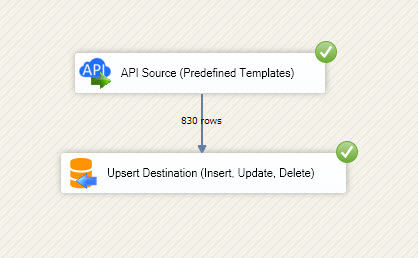
Run the package and Zoom data will be merged with the target table in SQL Server, PostgreSQL, or Redshift:
-
Done!
Deploy and schedule SSIS package
After you are done creating SSIS package, most likely, you want to deploy it to SQL Server Catalog and run it periodically. Just follow the instructions in this article:
Running SSIS package in Azure Data Factory (ADF)
To use SSIS PowerPack in ADF, you must first prepare Azure-SSIS Integration Runtime. Follow this link for detailed instructions:
Actions supported by Zoom Connector
Learn how to perform common Zoom actions directly in SSIS with these how-to guides:
- GET Current User (Me)
- Get Meeting By Id
- GET Settings
- Get Webinar Settings
- Get Webinar Settings By Id
- List Meeting Registrants
- List Meetings
- List Meetings (All Users)
- List Past Meetings (All Users)
- List Registration Questions
- List Users
- List Webinar Registrants
- List Webinars
- Past Meeting
- Make Generic API Request
- Make Generic API Request (Bulk Write)
Centralized data access via Data Gateway
In some situations, you may need to provide Zoom data access to multiple users or services. Configuring the data source on a Data Gateway creates a single, centralized connection point for this purpose.
This configuration provides two primary advantages:
-
Centralized data access
The data source is configured once on the gateway, eliminating the need to set it up individually on each user's machine or application. This significantly simplifies the management process.
-
Centralized access control
Since all connections route through the gateway, access can be governed or revoked from a single location for all users.
| Data Gateway |
Local ODBC
data source
|
|
|---|---|---|
| Simple configuration | ||
| Installation | Single machine | Per machine |
| Connectivity | Local and remote | Local only |
| Connections limit | Limited by License | Unlimited |
| Central data access | ||
| Central access control | ||
| More flexible cost |
If you need any of these requirements, you will have to create a data source in Data Gateway to connect to Zoom, and to create an ODBC data source to connect to Data Gateway in SSIS.
Let's not wait and get going!
Creating Zoom data source in Gateway
In this section we will create a data source for Zoom in Data Gateway. Let's follow these steps to accomplish that:
-
Download and install ODBC PowerPack.
-
Search for
gatewayin Windows Start Menu and open ZappySys Data Gateway Configuration: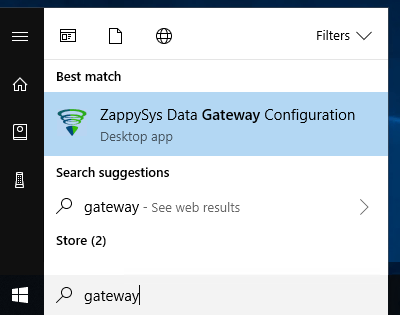
-
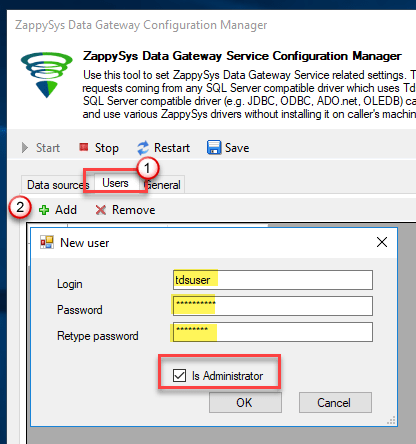
Go to Users tab and follow these steps to add a Data Gateway user:
- Click Add button
-
In Login field enter username, e.g.,
john - Then enter a Password
- Check Is Administrator checkbox
- Click OK to save
-
Now we are ready to add a data source:
- Click Add button
- Give Datasource a name (have it handy for later)
- Then select Native - ZappySys API Driver
- Finally, click OK
ZoomDSNZappySys API Driver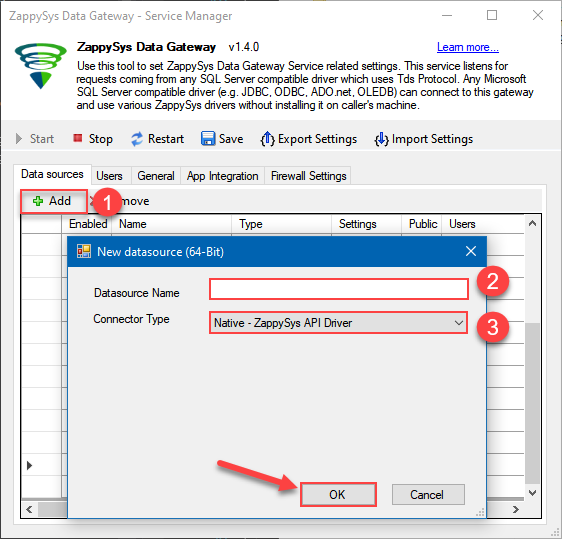
-
When the ZappySys API Driver configuration window opens, configure the Data Source the same way you configured it in ODBC Data Sources (64-bit), in the beginning of this article.
-
Very important step. Now, after creating or modifying the data source make sure you:
- Click the Save button to persist your changes.
- Hit Yes, once asked if you want to restart the Data Gateway service.
This will ensure all changes are properly applied:
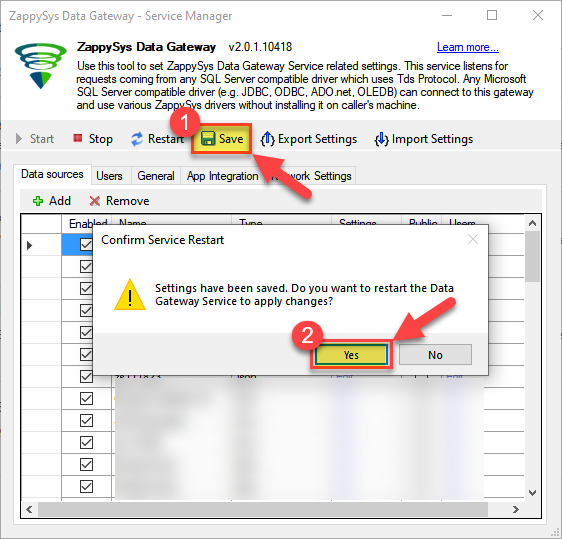 Skipping this step may result in the new settings not taking effect and, therefore you will not be able to connect to the data source.
Creating ODBC data source for Data Gateway
In this part we will create ODBC data source to connect to Data Gateway from SSIS. To achieve that, let's perform these steps:
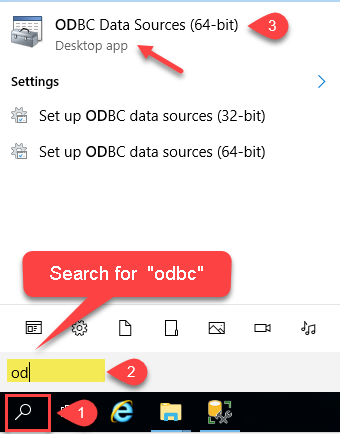
-
Open ODBC Data Sources (x64):
-
Create a User data source (User DSN) based on ODBC Driver 17 for SQL Server:
ODBC Driver 17 for SQL Server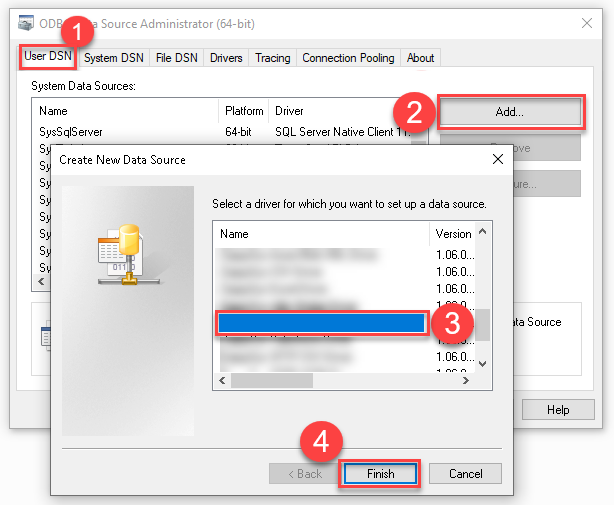 If you don't see ODBC Driver 17 for SQL Server driver in the list, choose a similar version driver.
 -
Then set a Name of the data source (e.g.
Gateway) and the address of the Data Gateway:GatewayDSNlocalhost,5000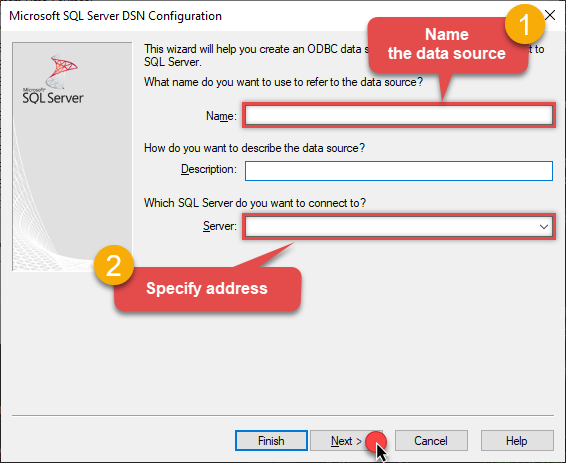 Make sure you separate the hostname and port with a comma, e.g.
localhost,5000. -
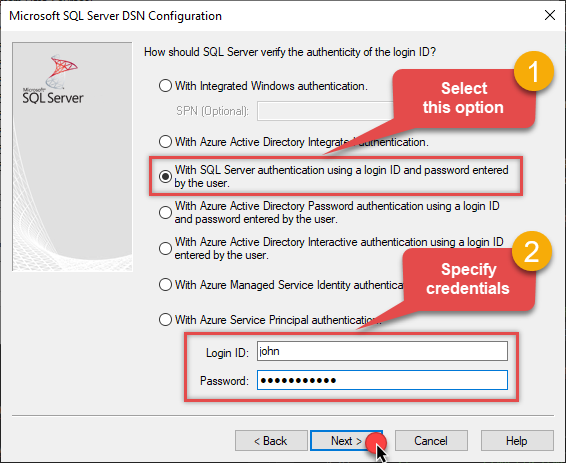
Proceed with authentication part:
- Select SQL Server authentication
-
In Login ID field enter the user name you used in Data Gateway, e.g.,
john - Set Password to the one you configured in Data Gateway
-
Then set the default database property to
ZoomDSN(the one we used in Data Gateway):ZoomDSN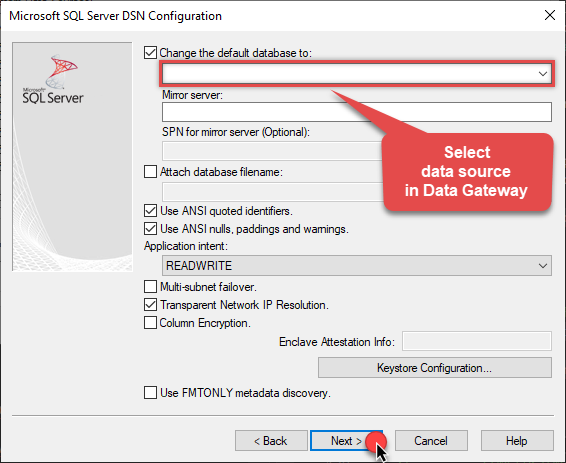
-
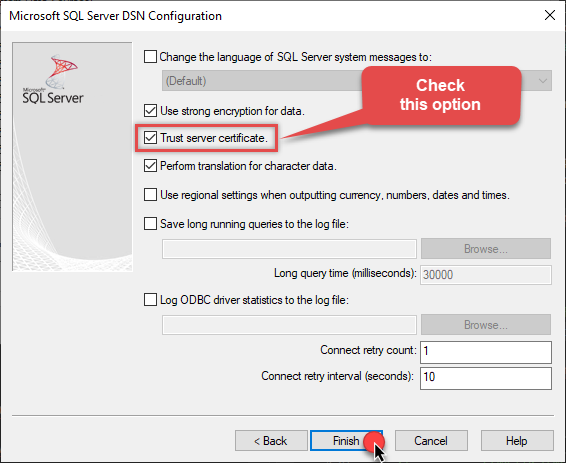
Continue by checking Trust server certificate option:
-
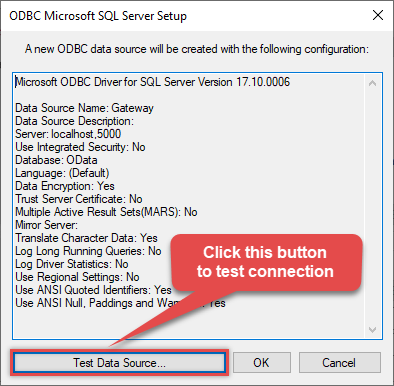
Once you do that, test the connection:
-
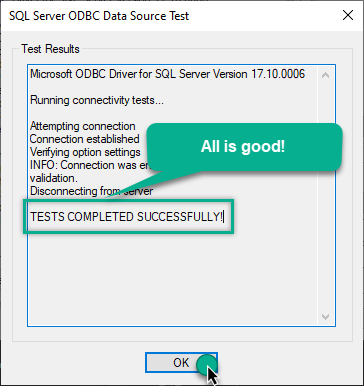
If connection is successful, everything is good:
-
Done!
We are ready to move to the final step. Let's do it!
Accessing data in SSIS via Data Gateway
Finally, we are ready to read data from Zoom in SSIS via Data Gateway. Follow these final steps:
-
Go back to SSIS.
-
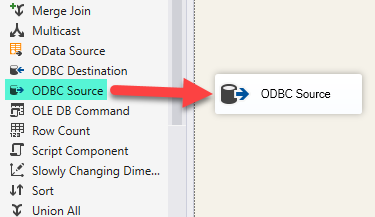
From the SSIS toolbox drag and drop ODBC Source on the dataflow designer surface:
-
Double-click on ODBC Source component to configure it.
-
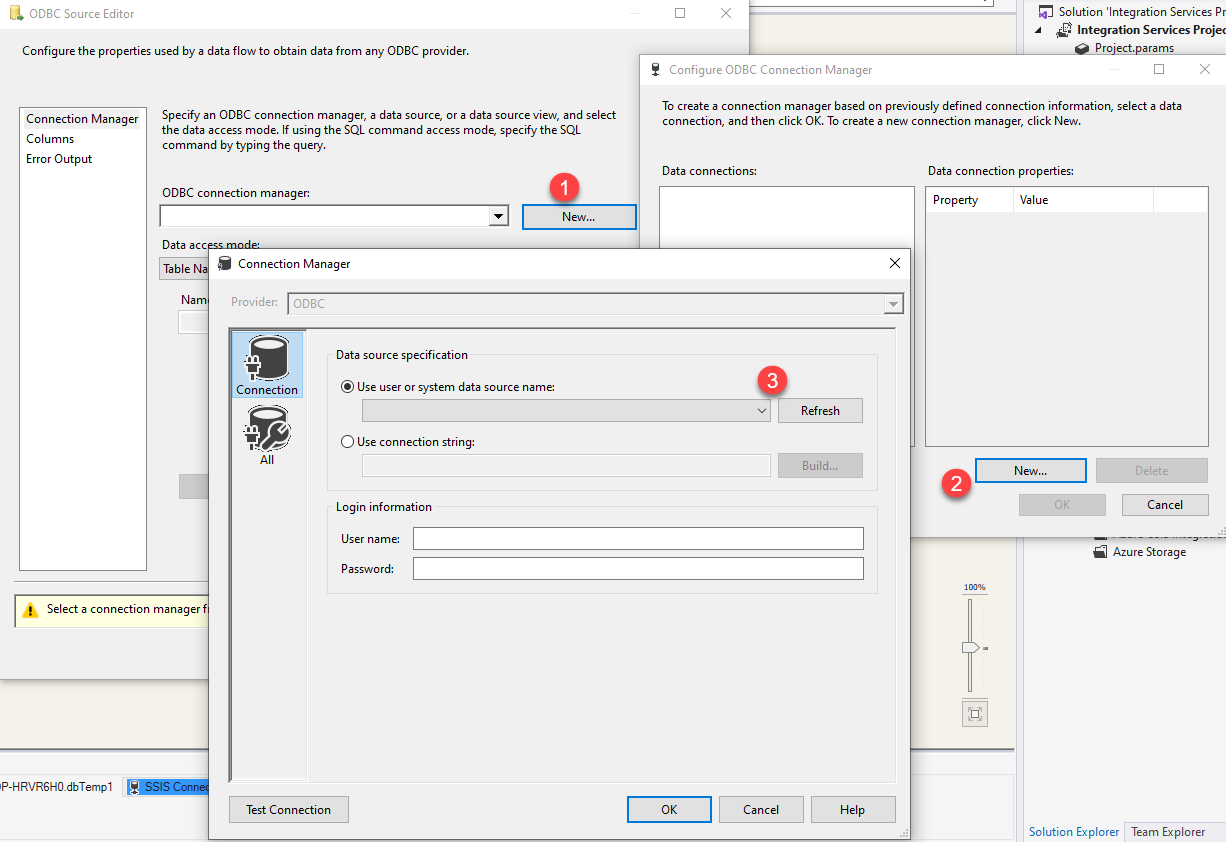
Click on New... button, it will open Configure ODBC Connection Manager window. Once it opens, click on New... button to create a new ODBC connection to Zoom ODBC data source:
-
Then choose the data source from the list and click Test Connection button. If the connection test is successful, close the window, and then click OK button to finish the configuration:
GatewayDSN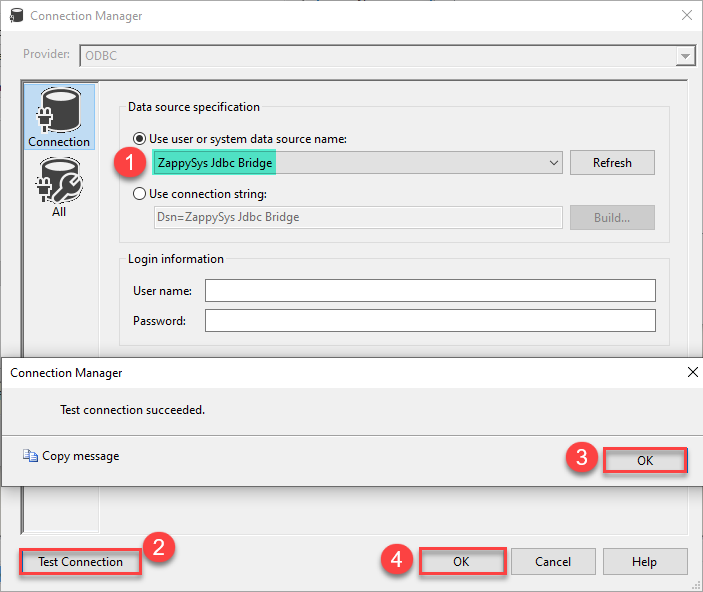
-
Read the data the same way we discussed at the beginning of this article.
-
That's it!
Now you can connect to Zoom data in SSIS via the Data Gateway.
john and your password.
Conclusion
In this article we showed you how to connect to Zoom in SSIS and integrate data without any coding, saving you time and effort.
We encourage you to download Zoom Connector for SSIS and see how easy it is to use it for yourself or your team.
If you have any questions, feel free to contact ZappySys support team. You can also open a live chat immediately by clicking on the chat icon below.
Download Zoom Connector for SSIS Documentation