SSIS API Destination
Write data to popular APIs, or run row-by-row lookups, using a predefined connector file, without learning the internals of API calls.
API Destination writes data to popular API services (Insert, Update, Delete, Lookup, Upsert or Select) using a predefined connector file, without learning the internals of API calls. It can return the API response as a flat table for downstream components, and sends data in bulk when the API supports it.
The trial includes API Destination and every other PowerPack component
- Data Flow Destination in SSIS
- Runs in your environment
- Also runs in Azure Data Factory
- Fully functional 30-day trial


At a glance
What API Destination can do
API Destination writes data to popular API services using a predefined connector file, without learning the internals of API calls. It can also run row-by-row lookups and return the API response as a flat table.
Write to popular APIs
Write data to popular online services in a few clicks using a predefined connector file.
- Zendesk, OData, Zoho CRM, Google Sheets, BigQuery, Jira, Amazon MWS, SharePoint and more
- Works with 50+ Enterprise API connectors (Shopify, Jira, HubSpot, Google Sheets and more)
- No need to learn API configuration, pagination or authentication details
Insert, update, delete & more
Choose the operation for the data load; if the API supports it, data is sent in bulk.
Operation: Insert, Update, Delete, Lookup, Upsert or Select- Default operation is Insert
Source-to-target mapping
Map upstream columns to API fields on the Mappings tab.
- Some columns are mapped automatically the first time
- Map
$$parameters to upstream columns for row-by-row operations
API response output
Return the API response as a flat table for downstream components.
OutputRawoutputs raw response data instead of parsed columnsDoNotCreateOutputsremoves unused outputs and warnings, and can speed things up
Parallel API requests
Send multiple API requests using parallel threads.
EnableParallelRequestsMaxParallelThreads: 0 to 64 (0 = default of 3, 1 = sequential)
Flexible connectors
Create the API connection from a popular connector, an online search, a local file or Direct Config XML.
- Easily modify an existing connector file
- Create your own reusable connector file for a custom API
Dynamic parameters
Make parameter values dynamic at runtime in three ways.
- Map upstream columns to parameters on the Mappings screen
- ZappySys Placeholder Engine or SSIS Expressions
Parametersoverrides endpoint defaults
SQL Server 2012–2025 & ADF
Runs in your environment on SQL Server 2012–2025 and Azure-SSIS.
- SQL Server 2025, 2022, 2019, 2017, 2016, 2014, 2012 (32/64-bit)
- Azure Data Factory (SSIS IR)
- Design packages in Visual Studio 2017, 2019, 2022, or 2026
- Windows only (64-bit OS): Windows 7–11 or Windows Server 2012–2025
Error handling & logging
Decide when to continue on HTTP errors and capture bad rows.
- Continue on 404, specific status codes (e.g.
404|405) or response text - Error output with RedirectRow on errors or truncation
LoggingMode(Normal to Debugging) andPrefixTimestamp
See all features
- Write data to popular online services (Zendesk, OData, Zoho CRM, Google Sheets, BigQuery, Jira, Amazon MWS, SharePoint and more) in a few clicks
- Works with 50+ Enterprise API connectors using predefined connector files
- No need to learn complex API configuration, pagination or authentication details
- Operations: Insert, Update, Delete, Lookup, Upsert and Select
- Sends data in bulk when the API supports it
- Source-to-target mapping with automatic mapping of some columns
- Row-by-row operations by mapping
$$parameters to upstream columns - API response returned as a flat table, or as raw data with
OutputRaw - Parallel API requests with up to 64 threads
- Easily modify an existing connector file, or create your own reusable connector file for a custom API
- Parameterize with the Placeholder Engine or SSIS Expressions
- Continue on 404, specific status codes or response text
- Error output to redirect bad rows on error or truncation
- Logging modes (Normal, Medium, Detailed, Debugging) with optional timestamp prefix
Support for SQL Server 2025, 2022, 2019, 2017, 2016, 2014, 2012 (32/64-bit) and Azure Data Factory
SQL Server 2012–2025
How it works
From the toolbox to your first run.
Key steps from the API Destination page and help file, with the screens you will see in SSDT.
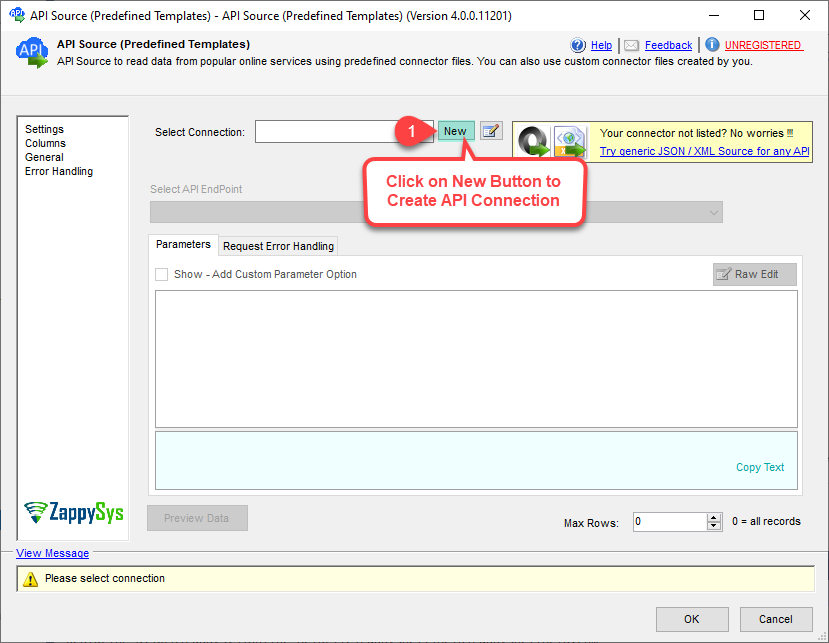
Create the API connection from the destination UI.
Connect any upstream source to API Destination, double-click it and click New to create the connection. You can also right-click the Connection Managers panel, choose New Connection and add the ZS-API Connection Manager.
- One API connection works with both API Source and API Destination
- Create it from the component UI (recommended) or the Connection Managers panel
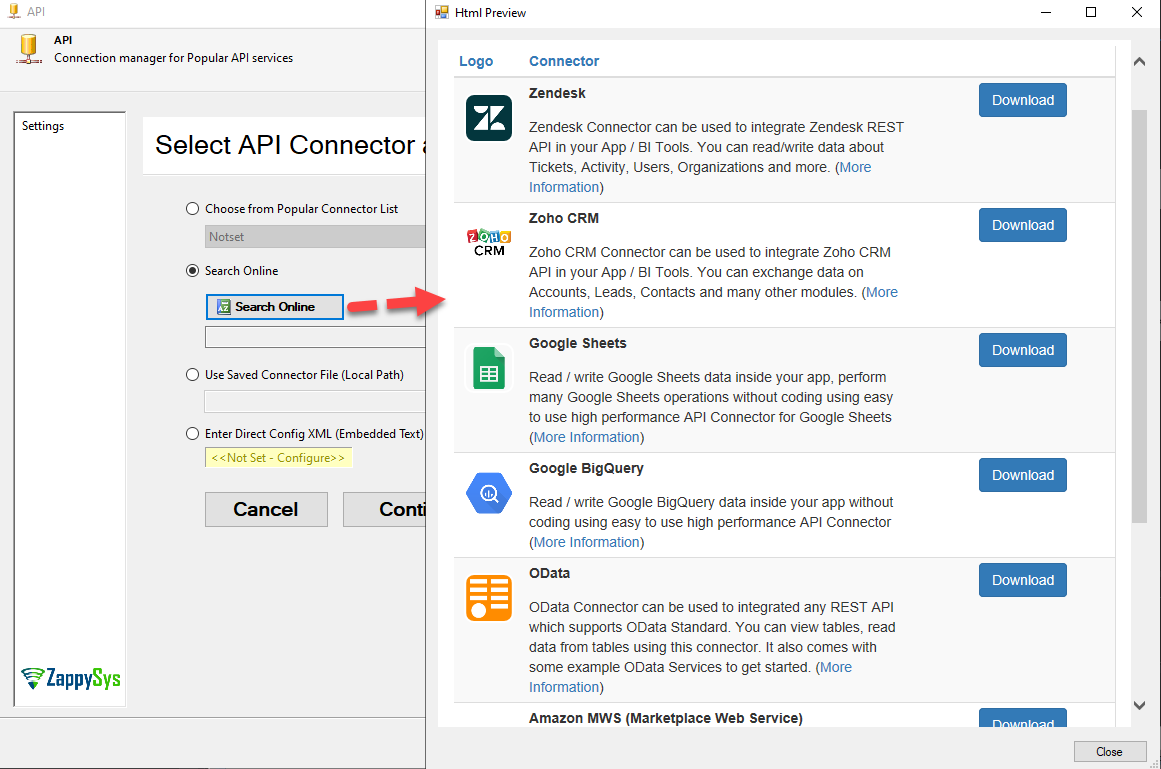
Choose a connector file four ways.
In the API Connection Manager, pick a connector from the Popular Connectors dropdown (for example OData), select Search Online to find the one you need, select a local connector file, or paste a valid connection in Direct Config XML.
- Popular Connectors dropdown
- Search Online
- Local connector file
- Direct Config XML
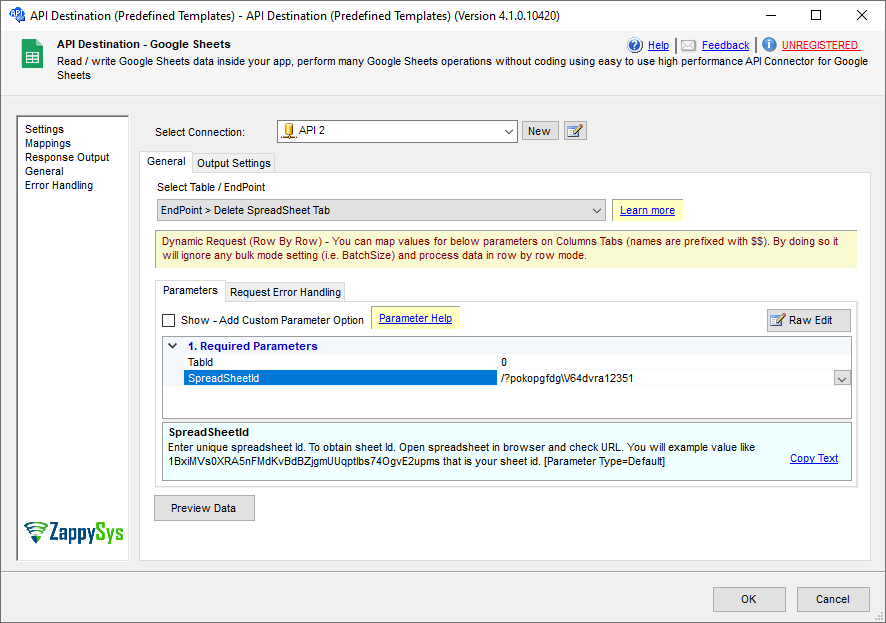
Select the table and the operation.
Select the connection, choose the table or endpoint from the Table / EndPoints dropdown (for example Sheets with the Google Sheets connector) and set Operation: Insert (default), Update, Delete, Lookup, Upsert or Select.
- Data is sent in bulk when the API supports it
- Endpoint parameters can override connector defaults
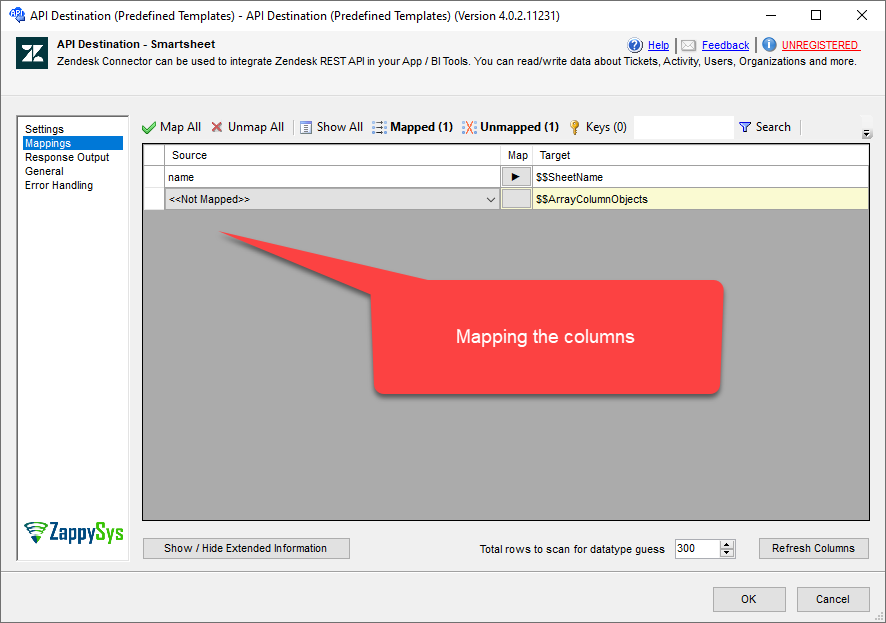
Map upstream columns to API fields.
On the Mappings tab some columns are mapped automatically the first time; verify them. For dynamic row-by-row operations you can also map parameters (names starting with $$) to upstream columns. Check the Response Output tab for the columns returned downstream.
- Mapping a
$$parameter always runs row by row, even if the target supports bulk - Alternatively set parameters with the Placeholder Engine or SSIS Expressions
Inside the UI
Key settings, as they appear in SSDT.
Real screens from the API Destination product page. Step through them, or open any shot at full size.
API Destination – Drag and Drop
API Destination – Drag and Drop
Articles
Worked examples that use API Destination.
Compatibility and requirements
Designed to stay inside your SSIS runtime.
- SQL Server 2012 through 2025, 32-bit and 64-bit
- Windows only, 64-bit OS required. SQL Server Express and Web editions do not include SSIS
- Azure Data Factory SSIS Integration Runtime
- Self-hosted: credentials and data stay in your environment (external API calls still reach that service)
- Fully functional 30-day trial of SSIS PowerPack
FAQ
Questions teams ask before they drop API Destination on the canvas.
What is API Destination?
API Destination is an SSIS Data Flow destination that writes data to popular API services (Insert, Update, Delete, Lookup, Upsert or Select) using a predefined connector file, so you don’t need to learn the internals of API calls. It can return the API response as a flat table for downstream components, and sends data in bulk when the API supports it.
Which APIs can it write to?
Any service with an API connector file: popular connectors such as Zendesk, OData, Zoho CRM, Google Sheets, BigQuery, Jira, Amazon MWS and SharePoint, connectors found with Search Online, a local connector file, or Direct Config XML. You can modify an existing connector file or create your own reusable one for a custom API (or use the generic JSON Source or XML Source). Browse the connector list.
Which edition includes API Destination?
API Destination and the ZappySys API Connector Library it uses are included in the Enterprise Edition of SSIS PowerPack. The 30-day trial includes every component. See compare editions.
Does mapping a parameter make it run row by row?
Yes. Mapping a parameter (a name starting with $$) to an upstream column on the Mappings screen gives it a dynamic value per row, but it always invokes row-by-row operation, whether or not the target supports bulk. You can also set parameter values with the ZappySys Placeholder Engine or SSIS Expressions; see the parameterization guide.
How are API errors and bad rows handled?
You can continue on a 404, on any error, on specific status codes (for example 404|405) or when a substring is found in the response. The component also supports an error output: with RedirectRow on Error and Truncation you capture bad rows with the exact reason. By default it fails on any data error or truncation.
Which SQL Server versions can I run it on?
SQL Server 2025, 2022, 2019, 2017, 2016, 2014, and 2012 (32- and 64-bit), plus Azure Data Factory with an SSIS Integration Runtime (packages must target SQL Server 2017). See Compatibility and requirements.
See also
More from SSIS PowerPack.




What customers say
Start your free trial today
Install SSIS PowerPack and drag API Destination onto the Data Flow.
Write data to popular APIs, or run row-by-row lookups, using a predefined connector file, without learning the internals of API calls.
- Data Flow Destination in SSISAPI Destination appears in the toolbox after you install PowerPack.
- Fully functional 30-day trialSSIS PowerPack, running in your environment.
- Live supportHelp during your trial and after purchase.
Open Help FileBrowse all SSIS PowerPack tasks
New purchases may be eligible for refund review within 30 days. See the refund policy.
Talk to an engineer before or during your trial.