SSIS Salesforce Destination
Bulk insert, update, upsert and delete Salesforce records from any SSIS source, without programming.
Map columns with drag and drop and run Insert, Update, Upsert or Delete against any Salesforce object. Switch on Bulk API mode for millions of rows or multiple threads for faster loads, capture inserted and updated rows in separate outputs, fire assignment rules for Case, Lead or Account, and connect with OAuth for MFA-protected orgs.
The trial includes Salesforce Destination and every other PowerPack component
- Data Flow Destination in SSIS
- Runs in your environment
- Also runs in Azure Data Factory
- Fully functional 30-day trial


At a glance
What Salesforce Destination can do
Salesforce Destination loads data from any SSIS source into Salesforce objects with bulk Insert, Update, Upsert (by Id, External ID or IdLookup field) and Delete, using the standard API or the Bulk API.
Load data into Salesforce
Load data into Salesforce.com from any source with a drag and drop interface, without programming.
- Simple drag and drop column mapping
BatchSize: rows sent in each request
Insert, update, upsert & delete
Perform multiple write operations, including Bulk Insert, Update, Upsert and Delete.
Operation: Insert, Update, UpdateOrInsert or DeleteUpsertKeyField: Id, External ID or IdLookup field
Bulk API mode
Use the Salesforce BULK API to load millions of rows.
EnableBulkApiModeandBulkApiVersion(V1 or V2)MaxRowsPerJobto avoid memory errorsConcurrencyMode: Parallel or Serial (helps with row locks)
Multi-threaded loading
Enable multiple threads for faster data loading.
EnableParallelProcessingMaxParallelThreads: 1 to 40
Upsert outputs & errors
Capture inserted and updated rows when you upsert, and redirect failed rows.
- Outputs for new, updated and failed records
- Progress every N rows and a row count summary at the end
Assignment rules
Run an assignment rule after insert or update for Case, Lead or Account.
AssignmentRuleIdfor a specific ruleUseDefaultAssignmentRulefor the default rule
Null & save options
Control how NULLs, long values and duplicates are written.
IgnoreFieldsIfInputNull/FieldsToSetNullIfInputNullAllOrNone,AllowFieldTruncation,AllowSaveOnDuplicateson the connection
SQL Server 2012–2025 & ADF
Runs in your environment on SQL Server 2012–2025 and Azure-SSIS.
- SQL Server 2025, 2022, 2019, 2017, 2016, 2014, 2012 (32/64-bit)
- Azure Data Factory (SSIS IR)
- Design packages in Visual Studio 2017, 2019, 2022, or 2026
- Windows only (64-bit OS): Windows 7–11 or Windows Server 2012–2025
Secure Salesforce connection
Highly secure data transfer using TLS 1.2 encryption.
- OAuth Access Token support (helpful for 2FA / MFA)
- Production, Sandbox or Developer orgs
- Error retry and proxy settings
See all features
- Load data into Salesforce.com from any source with drag and drop user interface
- Multiple write operations (Bulk Insert, Update, Delete, Upsert)
- Upsert by Id, External ID or IdLookup field
- BULK API mode (millions of rows can be loaded with this mode), V1 or V2
- Multiple threads for faster data loading
- Highly secure data transfer using TLS 1.2 encryption
- Capture outputs for updated or inserted rows in Upsert operation
- OAuth Access Token support (helpful for 2FA / MFA)
- Execute assignment rule after Update / Insert for Case, Lead or Account
- Report progress every N rows and a row count summary at the end
- Option to ignore NULL input values or set selected fields to NULL
- Error output for failed records
Support for SQL Server 2025, 2022, 2019, 2017, 2016, 2014, 2012 (32/64-bit) and Azure Data Factory
SQL Server 2012–2025
How it works
From the toolbox to your first run.
Connect, choose the operation and key, map columns, then route new, updated and failed rows.
Connect to Salesforce.
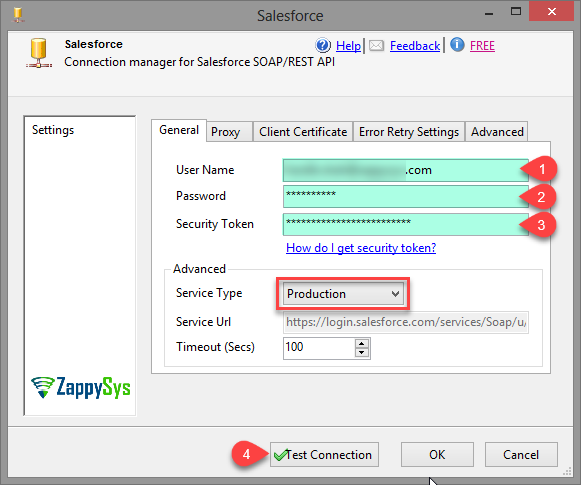
Add a ZS-SALESFORCE connection and choose OAuth 2.0 (interactive, useful with MFA / 2FA) or OAuth 2.0 Client Credentials; the user name, password and security token method is legacy. Pick Production, Sandbox or Developer and click Test Connection.
- Shared with Salesforce Source and Salesforce API Task
- TLS 1.2 encrypted transfer
- Retry and proxy settings
Insert new records and update existing ones.
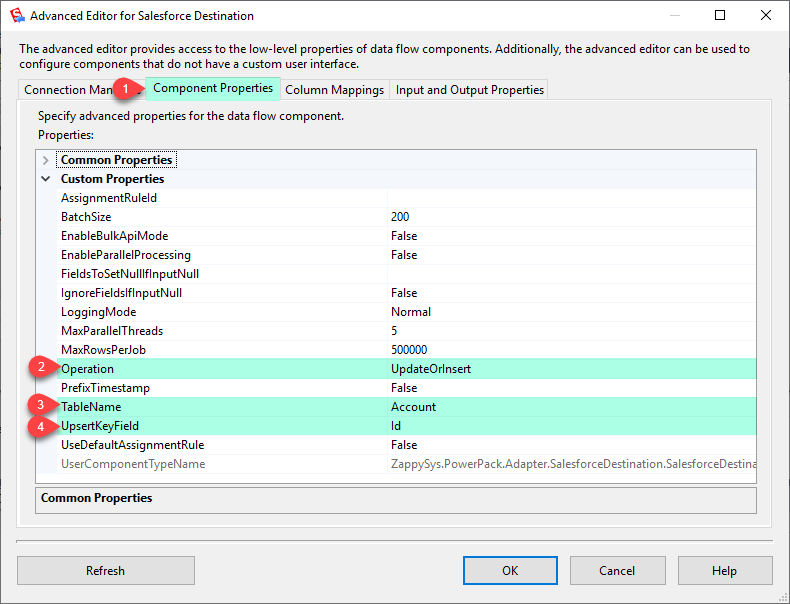
Set Operation to UpdateOrInsert, pick the object and set UpsertKeyField to Id, an External ID field or an IdLookup field. Connect the blue output to capture new and updated rows and the red output for bad records.
- External ID field avoids storing Salesforce Ids
- Progress every N rows and a summary at the end

Map input columns to Salesforce fields.
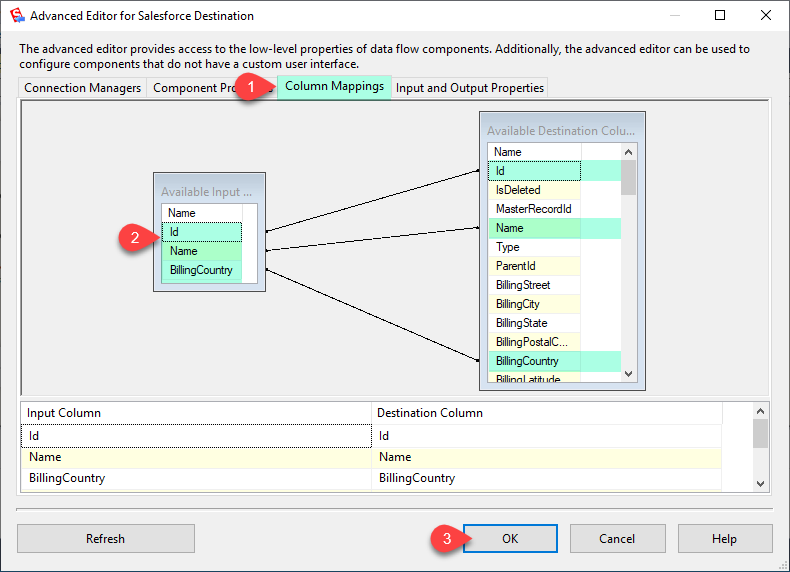
Drag input columns onto the Salesforce fields on the Mappings tab. For Update and Delete map the record Id; for Upsert map the key field you chose.
IgnoreFieldsIfInputNullto skip null inputsFieldsToSetNullIfInputNullfor selected fields
Tune for large loads.
Turn on EnableBulkApiMode for large volumes and choose BulkApiVersion V1 or V2; reduce MaxRowsPerJob if you see out-of-memory errors, and use Serial ConcurrencyMode if Salesforce reports row locks. Without Bulk API, set BatchSize and enable parallel processing (1 to 40 threads).
- Bulk API V1 uses fixed 10,000-row batches
- Parallel threads are ignored in Bulk API mode
Inside the UI
Key settings, as they appear in SSDT.
Real screens from the Salesforce Destination product page. Step through them, or open any shot at full size.
Salesforce Connection Manager
One connection manager shared by Salesforce Source, Salesforce Destination, Salesforce API Task, JSON Source and XML Source.
Articles
Worked examples that use Salesforce Destination.
Compatibility and requirements
Designed to stay inside your SSIS runtime.
- SQL Server 2012 through 2025, 32-bit and 64-bit
- Windows only, 64-bit OS required. SQL Server Express and Web editions do not include SSIS
- Azure Data Factory SSIS Integration Runtime
- Self-hosted: credentials and data stay in your environment (external API calls still reach that service)
- Fully functional 30-day trial of SSIS PowerPack
FAQ
Questions teams ask before they drop Salesforce Destination on the canvas.
What is Salesforce Destination?
Salesforce Destination is an SSIS data flow destination that loads data from any source into Salesforce objects with bulk Insert, Update, Upsert and Delete operations, using simple drag and drop mapping.
Which key can I use for upsert?
Set UpsertKeyField to the Id field, an External ID field or an IdLookup field. An External ID lets you upsert without storing Salesforce Ids in your source; the load tutorial shows how to create one.
When should I use Bulk API mode?
For large volumes. Set EnableBulkApiMode and pick BulkApiVersion V1 or V2 (V2 helps with locking issues). Lower MaxRowsPerJob if you hit memory errors, and use Serial ConcurrencyMode if you get row-lock errors. For smaller loads the standard mode may be faster.
Can I see which rows were inserted, updated or failed?
Yes. In upsert mode, new and updated records go to the output and failed records to the error output. Progress is reported every N rows, with a summary of total, inserted, updated, deleted and error counts at the end.
Which SQL Server versions can I run it on?
SQL Server 2025, 2022, 2019, 2017, 2016, 2014, and 2012 (32- and 64-bit), plus Azure Data Factory with an SSIS Integration Runtime (packages must target SQL Server 2017). See Compatibility and requirements.



What customers say
Start your free trial today
Install SSIS PowerPack and drag Salesforce Destination onto the Data Flow.
Bulk insert, update, upsert and delete Salesforce records from SQL Server, files or any SSIS source.
- Data Flow Destination in SSISSalesforce Destination appears in the toolbox after you install PowerPack.
- Fully functional 30-day trialSSIS PowerPack, running in your environment.
- Live supportHelp during your trial and after purchase.
Open Help FileBrowse all SSIS PowerPack tasks
New purchases may be eligible for refund review within 30 days. See the refund policy.
Talk to an engineer before or during your trial.