SSIS Excel File Destination
Write data to Excel files from any source, no Office driver needed.
SSIS Excel File Destination (Advanced Excel Destination) can be used to write data to Excel file from any source (e.g. SQL Server, Oracle, MySQL). When you use this component you don’t need any additional Microsoft Office Driver to write to excel.
The trial includes Excel File Destination and every other PowerPack component
- Data Flow Destination in SSIS
- Runs in your environment
- Also runs in Azure Data Factory
- Fully functional 30-day trial


At a glance
What Excel File Destination can do
SSIS Excel File Destination (Advanced Excel Destination) can be used to write data to Excel file from any source (e.g. SQL Server, Oracle, MySQL). When you use this component you don’t need any additional Microsoft Office Driver to write to excel.
Write Excel without Office
Write data to an Excel workbook from any source, such as SQL Server, Oracle, MySQL or JSON, without any additional Microsoft Office driver.
- Office 2007 Excel files (
*.XLSX) - Runs in 64-bit mode without any additional driver, unlike native SSIS Excel
Target sheet & start cell
Choose the sheet to write to and the cell where data starts.
TableNamefor the target sheetRangeStartCell, e.g.A1orC3
Append & preserve formatting
Append records after existing data on the target sheet and keep the target cell formatting.
Appendstarts after existing dataPreserveFormattingkeeps cell format when the sheet is cleared
Clear before write
Make sure no previous content is left on the sheet before writing.
RangeToClearBeforeWrite, e.g.A1:M25ClearTargetSheetclears all used cellsOverwritereplaces the existing file
Write formulas
Treat values that start with an equal sign as Excel formulas.
TreatValueAsFormula, e.g.=A1+C1
Date display formats
Set custom display formats for date and date/time values.
DateFormat(defaultyyyy-MM-dd)DateTimeFormat(defaultyyyy-MM-dd HH:mm:ss)- Standard or custom .NET format specifiers
Password-protected workbooks
Write to password-protected workbooks through the ZappySys Excel Connection Manager, which native SSIS Excel does not support.
OpenPasswordandEditPasswordCreateFileIfMissingcreates the Excel file automatically
SQL Server 2012–2025 & ADF
Runs in your environment on SQL Server 2012–2025 and Azure-SSIS.
- SQL Server 2025, 2022, 2019, 2017, 2016, 2014, 2012 (32/64-bit)
- Azure Data Factory (SSIS IR)
- Design packages in Visual Studio 2017, 2019, 2022, or 2026
- Windows only (64-bit OS): Windows 7–11 or Windows Server 2012–2025
See all features
- Write to an Excel workbook from any source such as SQL Server, Oracle, JSON
- No additional Microsoft Office driver needed
- Support for Office 2007 Excel files (
*.XLSX) - Append mode that preserves target cell formatting
- Write from a specified cell location
- Clear a range or the whole target sheet before writing
- Overwrite an existing file
- Treat values starting with = as formulas
- Custom date and date/time display formats
- Support for 64-bit mode without any additional driver, unlike native SSIS Excel
- Support for password-protected workbooks
- Automatically create a missing Excel file
- Select the input columns to write
Support for SQL Server 2025, 2022, 2019, 2017, 2016, 2014, 2012 (32/64-bit) and Azure Data Factory
SQL Server 2012–2025
How it works
From the toolbox to your first run.
Key steps from the Excel File Destination page and help file, with the screens you will see in SSDT.
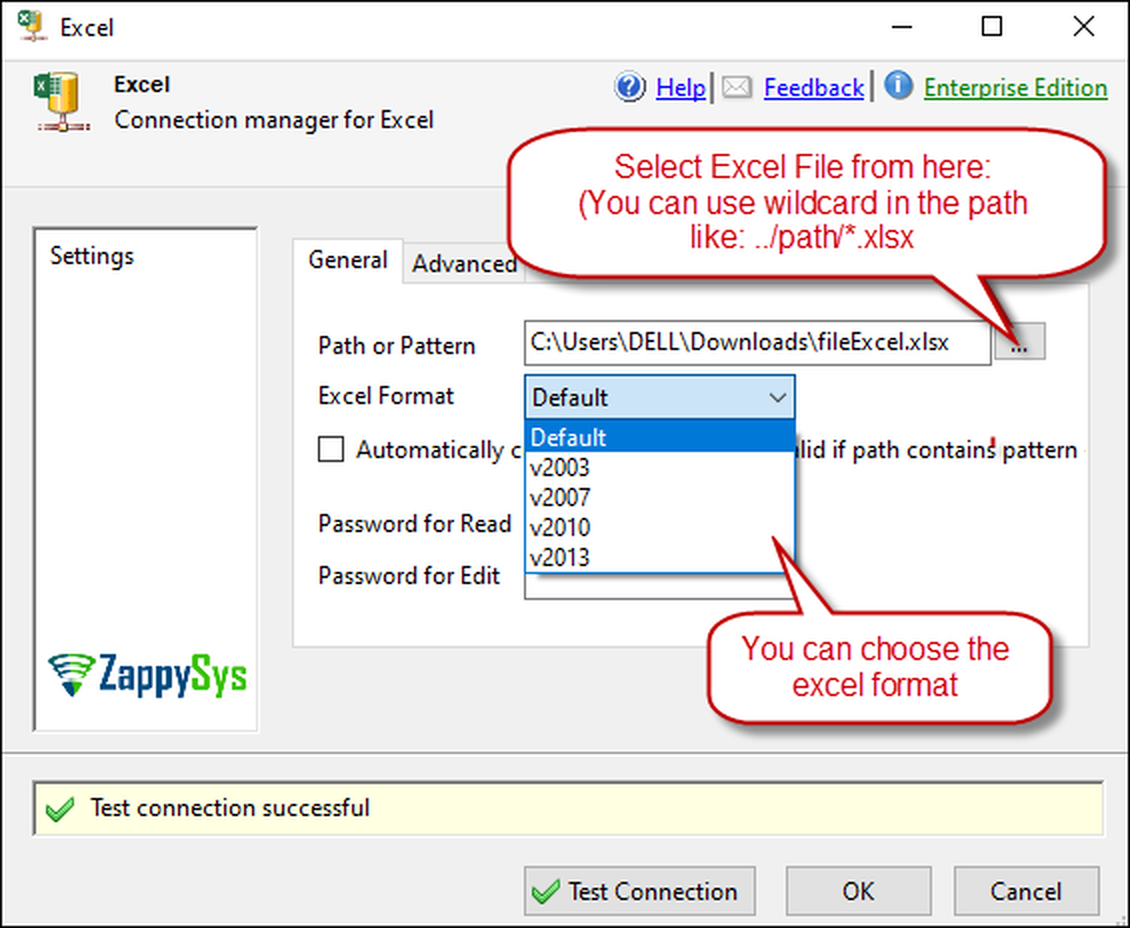
Point the ZappySys Excel connection at the target file.
In the ZS-EXCEL connection manager, set the path of the workbook to write, choose the Excel format, and enter the read / edit passwords if the workbook is protected. Excel Destination writes to a single file; wildcard patterns are only for Excel Source.
CreateFileIfMissingcreates the file automaticallyOpenPasswordandEditPasswordfor protected workbooks
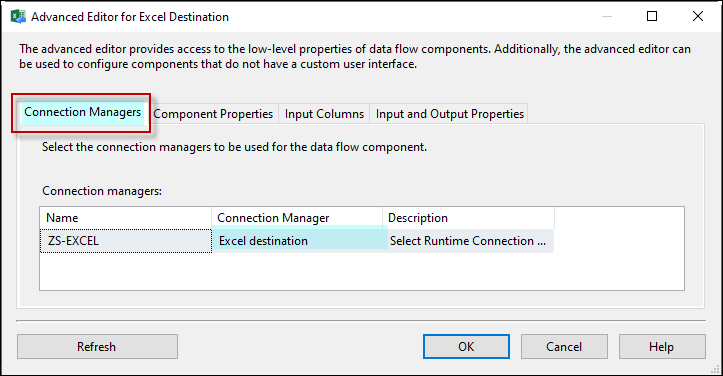
Assign the Excel connection to the destination.
Double-click Excel File Destination and, on the Connection Managers tab, select the Excel connection you created.
- Connect any upstream source first: SQL Server, Oracle, JSON, CSV and more
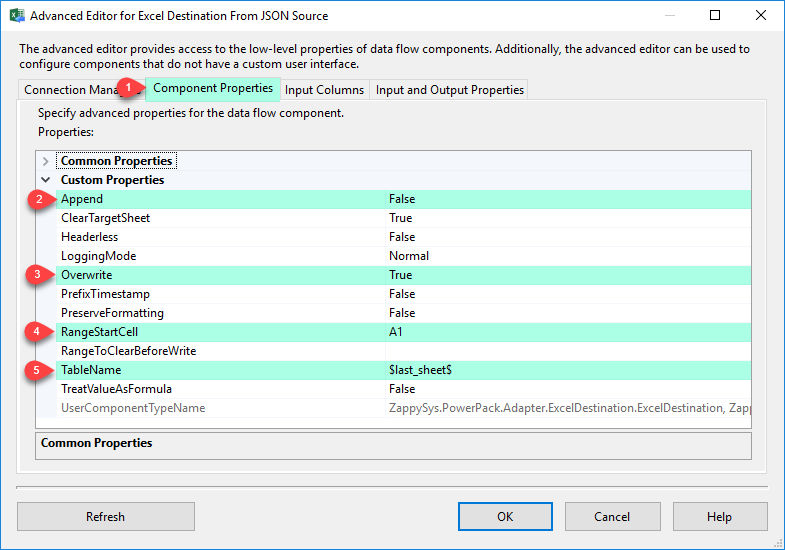
Choose the sheet, start cell and write mode.
On Component Properties set TableName to the target sheet (e.g. $last_sheet$), RangeStartCell to A1, and Append / Overwrite to control how existing data is handled.
ClearTargetSheetorRangeToClearBeforeWritePreserveFormattingkeeps cell formatsTreatValueAsFormulafor values starting with=
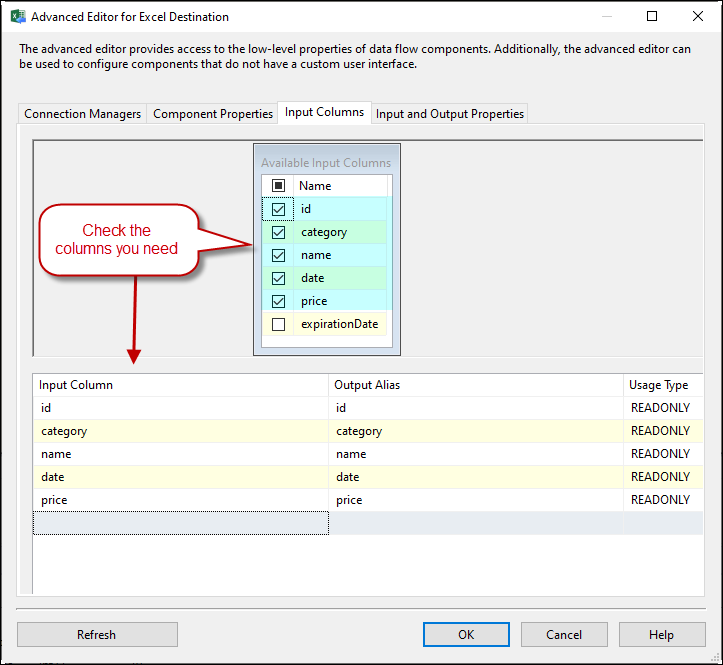
Pick the columns to write.
On Input Columns, tick the columns you want in the Excel sheet, click OK and run the package; the data is written to the workbook.
- Columns are written from the start cell onward
Inside the UI
Key settings, as they appear in SSDT.
Real screens from the Excel File Destination product page. Step through them, or open any shot at full size.
Excel connection
Set the workbook path, Excel format and optional read / edit passwords in the ZappySys Excel connection.
Articles
Worked examples that use Excel File Destination.
Compatibility and requirements
Designed to stay inside your SSIS runtime.
- SQL Server 2012 through 2025, 32-bit and 64-bit
- Windows only, 64-bit OS required. SQL Server Express and Web editions do not include SSIS
- Azure Data Factory SSIS Integration Runtime
- Self-hosted: credentials and data stay in your environment (external API calls still reach that service)
- Fully functional 30-day trial of SSIS PowerPack
FAQ
Questions teams ask before they drop Excel File Destination on the canvas.
What is Excel File Destination?
A Data Flow Destination in SSIS PowerPack (Advanced Excel Destination) that writes data from any source, such as SQL Server, Oracle, MySQL or JSON, to an Excel workbook (*.xlsx). It does not need any Microsoft Office driver and runs in 64-bit mode.
Can I write to a specific sheet and cell?
Yes. Set TableName to the sheet (or $first_sheet$, $last_sheet$, a sheet number such as $2$, or a named range) and RangeStartCell to the first cell, e.g. C3.
How do I append or replace existing data?
Use Append to add rows after existing data on the sheet, or clear old content with ClearTargetSheet or RangeToClearBeforeWrite (e.g. A1:M25). PreserveFormatting keeps the target cell format, and Overwrite replaces the whole file.
Does it support password-protected workbooks or new files?
Yes. The Excel Connection Manager has OpenPassword and EditPassword, and CreateFileIfMissing creates the workbook automatically. The destination writes to one file; wildcard paths only work with Excel Source.
Which SQL Server versions can I run it on?
SQL Server 2025, 2022, 2019, 2017, 2016, 2014, and 2012 (32- and 64-bit), plus Azure Data Factory with an SSIS Integration Runtime (packages must target SQL Server 2017). See Compatibility and requirements.




What customers say
Start your free trial today
Install SSIS PowerPack and drag Excel File Destination onto the Data Flow.
Write data from SQL Server, Oracle, JSON or any other source to Excel workbooks, without installing Microsoft Office drivers.
- Data Flow Destination in SSISExcel File Destination appears in the toolbox after you install PowerPack.
- Fully functional 30-day trialSSIS PowerPack, running in your environment.
- Live supportHelp during your trial and after purchase.
Open Help FileBrowse all SSIS PowerPack tasks
New purchases may be eligible for refund review within 30 days. See the refund policy.
Talk to an engineer before or during your trial.