
Prerequisites
Before we begin, make sure the following prerequisites are met:
- SQL Server Data Tools (SSDT) designer installed for Visual Studio.
- SQL Server Integration Services Projects 2022+ Visual Studio extension installed.
- SSIS PowerPack is installed.
Upsert documents in SSIS
-
Open Visual Studio and click Create a new project.
-
Select Integration Services Project. Enter a name and location for your project, then click OK.
-
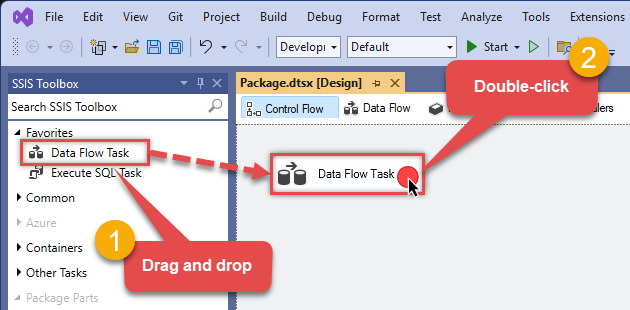
From the SSIS Toolbox, drag and drop a Data Flow Task onto the Control Flow surface, and double-click it:
-
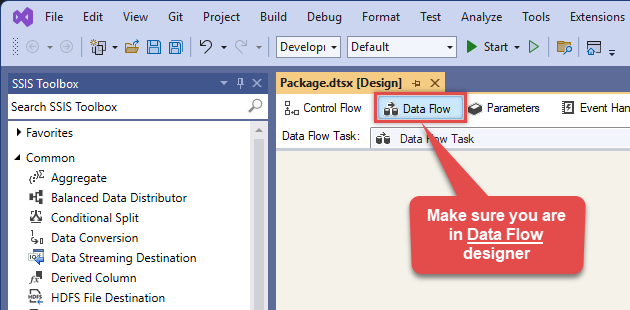
Make sure you are in the Data Flow Task designer:
-
Read the data from the source, using any desired source component. You can even make an API call using the ZappySys JSON/XML/API Source and read data from there. In this example, we will use an OLE DB Source component to read real-time data from a SQL Server database.
-
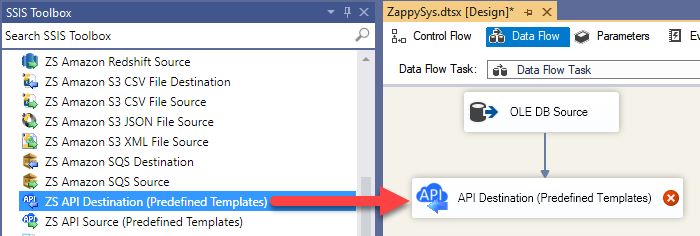
From the SSIS Toolbox drag and drop API Destination (Predefined Templates) on the Data Flow Designer surface and connect source component with it, and double click to edit it.
-
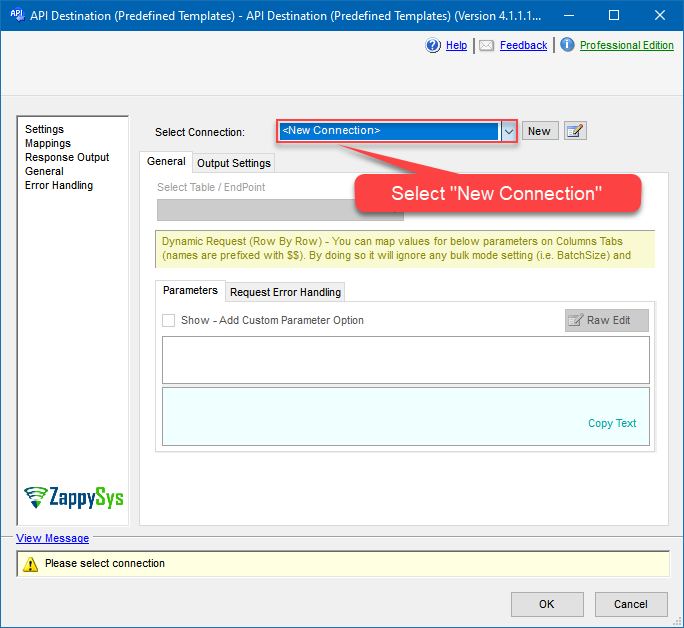
Select New Connection to create a new connection:
API Destination - ElasticSearchRead and write Elasticsearch data effortlessly. Integrate, manage, and automate indexes and documents — almost no coding required.
-
To configure the ElasticSearch connector, choose one of the following methods:
- Choose from Popular Connector List: Select a pre-installed service directly from the dropdown menu.
- Search Online: Use this to find and download a new connector file to your computer.
- Use Saved/Downloaded File: Once the file is downloaded, browse your local drive to load it into the configuration.
After that, just click Continue >>:
ElasticSearch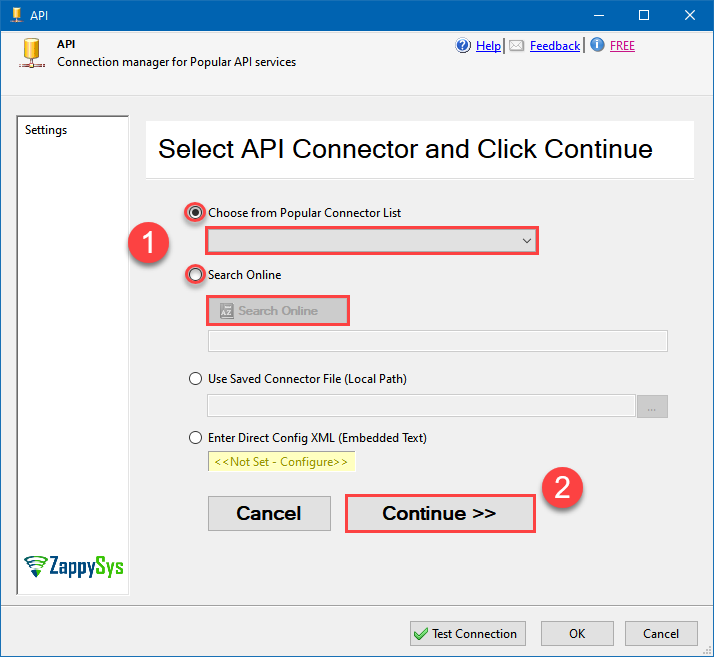
-
Proceed with selecting the desired Authentication Type. Then select API Base URL (in most cases default one is the right one). Finally, fill in all the required parameters and set optional parameters if needed. You may press a link Steps to Configure which will help set certain parameters. More info is available in Authentication section.
Basic Authentication (UserId/Password)
ElasticSearch authentication
Use HTTP Basic Authentication with any Elasticsearch-compatible cluster (self-hosted, Elastic Cloud, OpenSearch, or other managed hosts).
- Set Service URL to your cluster base URL (for example
https://your-host:9200or the HTTPS URL from your provider). - Enter User Name and Password for a user that can call the Elasticsearch REST API. Some managed hosts label these as Access Key / Access Secret — use those values in the same fields.
- If you use a self-signed certificate and see a trust error, set Ignore certificate related errors to True (only if you trust the server).
- Click Test connection.
Optional — Bonsai example: On Bonsai, open
https://app.bonsai.io/clusters/{your-instance-id}/tokens, copy Access Key and Access Secret into User Name and Password, then test. Sample data (if needed):https://{your-cluster-id}.apps.bonsaisearch.net/app/home#/tutorial_directory.API Connection Manager configuration
Just perform these simple steps to finish authentication configuration:
-
Set Authentication Type to
Basic Authentication (UserId/Password) [Http] - Optional step. Modify API Base URL if needed (in most cases default will work).
- Fill in all the required parameters and set optional parameters if needed.
- Finally, hit OK button:
ElasticSearchBasic Authentication (UserId/Password) [Http]http://localhost:9200Optional Parameters User Name (or Access Key) Password (or Access Secret) Ignore certificate related errors 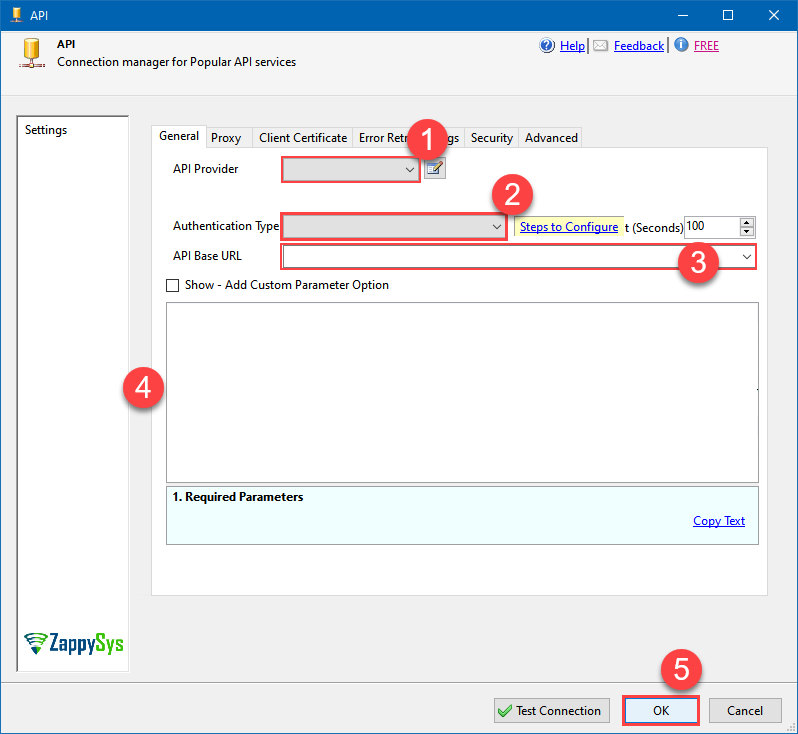 Find full details in the ElasticSearch Connector authentication reference.
Windows Authentication (No Password)
ElasticSearch authentication
No instructions available.
API Connection Manager configuration
Just perform these simple steps to finish authentication configuration:
-
Set Authentication Type to
Windows Authentication (No Password) [Http] - Optional step. Modify API Base URL if needed (in most cases default will work).
- Fill in all the required parameters and set optional parameters if needed.
- Finally, hit OK button:
ElasticSearchWindows Authentication (No Password) [Http]http://localhost:9200Optional Parameters Ignore certificate related errors
Find full details in the ElasticSearch Connector authentication reference. - Set Service URL to your cluster base URL (for example
-
Select [Dynamic Table] table from the dropdown, then select Upsert as operation, and hit Preview Data:
 API Destination - ElasticSearchRead and write Elasticsearch data effortlessly. Integrate, manage, and automate indexes and documents — almost no coding required.ElasticSearch[Dynamic Table]Upsert
Optional Parameters RowHeaderFooterContinueOnError True RowHeader 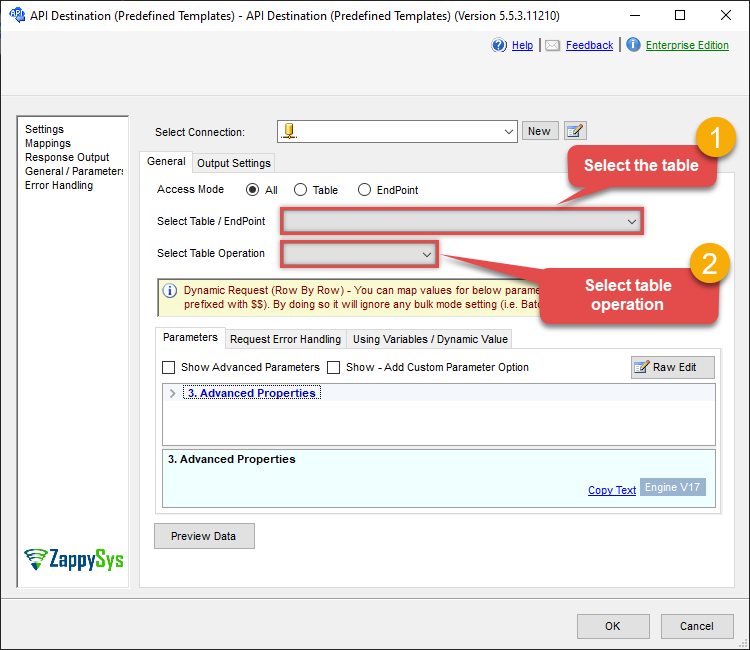
-
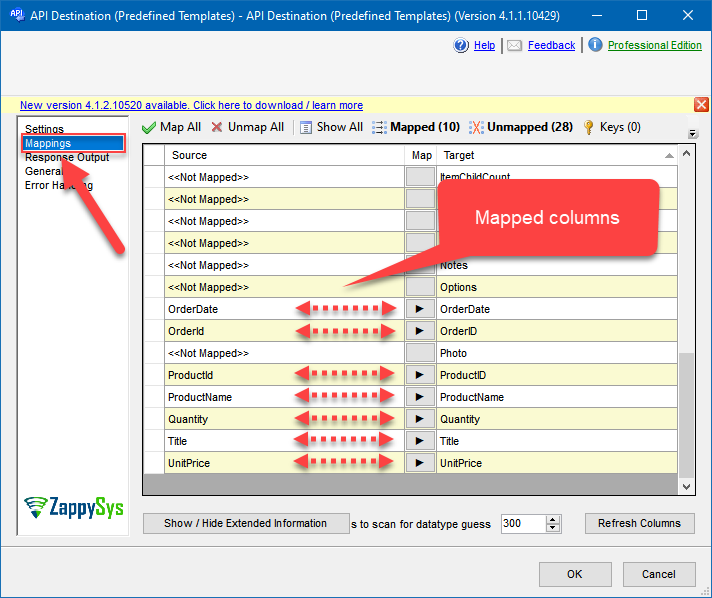
Finally, map the desired columns:
API Destination - ElasticSearchRead and write Elasticsearch data effortlessly. Integrate, manage, and automate indexes and documents — almost no coding required.
-
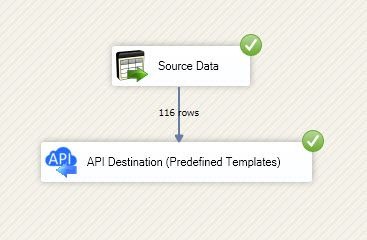
That's it; we successfully configured the POST API Call. In a few clicks we configured the ElasticSearch API call using ZappySys ElasticSearch Connector
Deploy SSIS package to Azure Data Factory (ADF)
Once your SSIS package is complete,
deploy it to the
Azure-SSIS runtime
within Azure Data Factory.
The setup process requires you
to upload the
SSIS PowerPack
installer to Azure Blob Storage
and then customize the runtime configuration using the main.cmd file.
For a complete walkthrough of these steps,
see our detailed guide on the
Azure Data Factory (SSIS) and ElasticSearch integration.
ElasticSearch Connector actions
Need another use case? Pick the next ElasticSearch action in Azure Data Factory (SSIS) below.
- Count documents
- Create Index
- Delete documents
- Delete Index
- Get document by ID from Index or Alias
- Get documents from Index or Alias
- Get Index or Alias metadata
- Insert documents
- List aliases
- List indexes
- Search / Query documents
- Update documents
- Make Generic REST API Request
- Make Generic REST API Request (Bulk Write)
Conclusion
You now know how to upsert documents in Azure Data Factory (SSIS) without writing complex code. ElasticSearch SSIS Connector handled pagination and authentication automatically.
Ready to get started? Download the trial or ping us via chat if you need help: