SSIS Amazon Redshift Data Transfer Task
Bulk import data into Amazon Redshift from flat files or any relational database, staged in Amazon S3 and loaded with the Redshift COPY command.
Amazon Redshift Data Transfer Task bulk imports data into Amazon Redshift. Source data can be a flat file or an ODBC, OLEDB or ADO.net source. The task stages the data in Amazon S3 and loads it with the Redshift COPY command, using multiple threads to upload data in parallel and optionally compressing data files to speed up the process.
The trial includes Amazon Redshift Data Transfer Task and every other PowerPack component
- Control Flow Task in SSIS
- Runs in your environment
- Also runs in Azure Data Factory
- Fully functional 30-day trial


At a glance
What Amazon Redshift Data Transfer Task can do
Amazon Redshift Data Transfer Task can be used for bulk import data to Amazon Redshift. Source data can be Flat File, ODBC, OLEDB or ADO.net source. This task uses multiple threads to upload data in parallel and optionally compress data files to speedup process.
Bulk load from any database
Load millions of records to Amazon Redshift from any database system, such as SQL Server, Oracle, MySQL or DB2.
- Source connection can be OLEDB, ADO.net or ODBC (through ADO.net)
SourceQueryextracts the data to loadMaxRowsAllFileslimits the total rows, like TOP or LIMIT
Load local flat files
Bulk import local CSV files, compressed or not, to Amazon Redshift.
- Wildcards in
SourcePath(e.g.c:\data\file*.txt) IncludeFilesFromSubFoldersscans folders recursivelyIsSourceFilesCompressedfor files already in GZIP format
Parallel upload & file split
Uses multiple threads to upload data files to the S3 staging area in parallel.
MaxParallelThreads(default: CPU cores × 8)SplitFilesandMaxRowsPerFilesplit large extracts into multiple files
Compression to cut cost
Compresses data files to GZIP before upload to reduce bandwidth and data transfer cost.
AlwaysCompressFilesBeforeTransferis on by default
Client & server side encryption
Encrypt data files staged in Amazon S3: client side with your own AES 256 key, or server side with an AWS managed key.
- Client side: set on the Encryption tab of the Amazon Storage Connection Manager
- Server side: set on the Encryption tab of the task
- Use AES 256 for Redshift loads (RSA 1024 is not supported by Redshift)
Automatic file archiving
Choose what happens to source, source stage and target stage files after the load.
- Archive method: None, Delete or Move
- Archive folder paths accept timestamp placeholders such as
{{YYYY}}and{{MM}}
Rich error handling
Control how load errors are handled to troubleshoot Redshift loading issues.
MaxAllowedErrorsBeforeFailandAllowInvalidCharacterswith a replacement characterTestLoadchecks data files without loading themDoNotDeleteStageFilesOnCopyFailurekeeps stage files for a manual retry
SQL Server 2012–2025 & ADF
Runs in your environment on SQL Server 2012–2025 and Azure-SSIS.
- SQL Server 2025, 2022, 2019, 2017, 2016, 2014, 2012 (32/64-bit)
- Azure Data Factory (SSIS IR)
- Design packages in Visual Studio 2017, 2019, 2022, or 2026
- Windows only (64-bit OS): Windows 7–11 or Windows Server 2012–2025
Redshift COPY options
Load with the Redshift COPY command and tune it from the UI.
TruncateTargetBeforeLoadto reload the target table- Date format, NULL handling, quotes and delimiter options
LoadOptionsfor any extra COPY options
See all features
- Load on-premises data to Amazon Redshift in a few clicks
- Load millions of records to Amazon Redshift from any database system (e.g. SQL Server, Oracle, MySQL, DB2)
- Load data to Amazon Redshift from local flat files, compressed or non-compressed
- Source can be a flat file, ODBC, OLEDB or ADO.net connection
- Uses multiple threads to upload data files in parallel
- Split large extracts into multiple files with
MaxRowsPerFile - Automatic GZIP file compression to reduce bandwidth and cost
- Support for client side and server side encryption
- Automatic archiving of source and stage files (None, Delete or Move)
- Truncate the target table before load
- Rich error handling: max allowed errors, invalid character replacement, test load
- Detailed execution log with a timing summary for each load step
Support for SQL Server 2025, 2022, 2019, 2017, 2016, 2014, 2012 (32/64-bit) and Azure Data Factory
SQL Server 2012–2025
How it works
From the toolbox to your first run.
Key steps from the Amazon Redshift Data Transfer Task page and help file, with the screens you will see in SSDT.
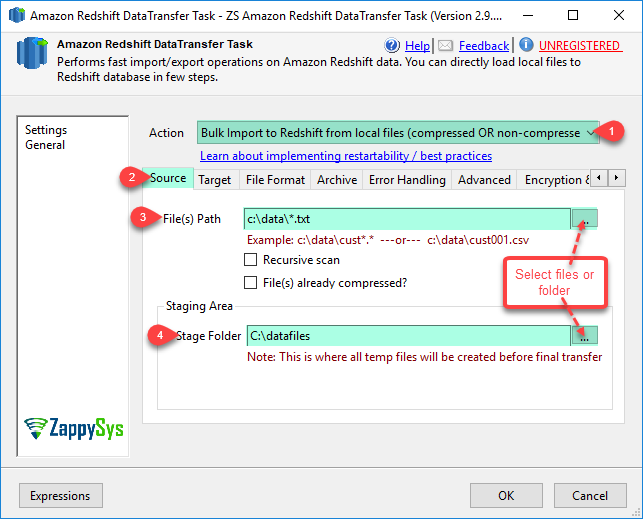
Redshift data transfer task UI – Source from file
Set Action to Bulk import to Redshift from local files (compressed or non-compressed).
On the Source tab, select the files with a wildcard pattern (for example c:\data\file*.txt) and a local staging folder. To load from a database instead, choose the RDBMS action, pick an OLEDB or ADO.net connection and enter a SQL query.
Redshift data transfer task UI – Select file format and datetime handling
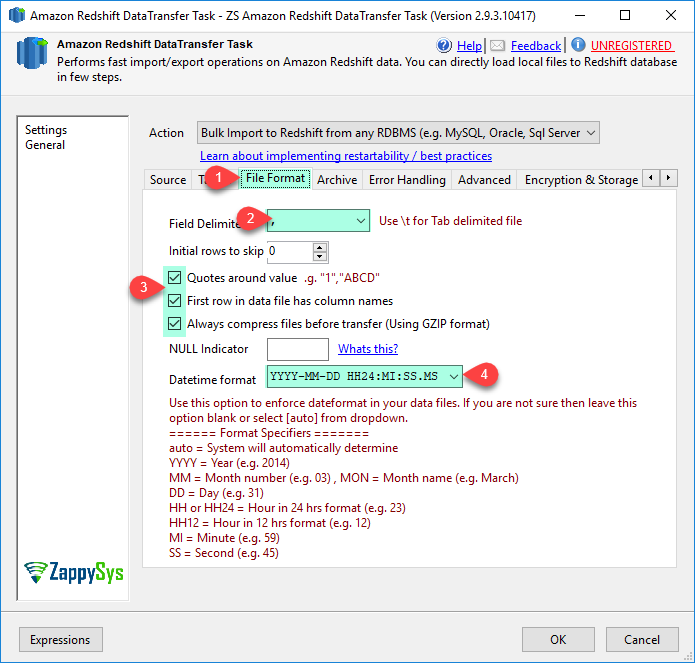
On the File Format tab, select the field delimiter and the date/time format.
Related properties control whether the first row has column names, quotes around values, and how empty or blank strings are treated as NULL.
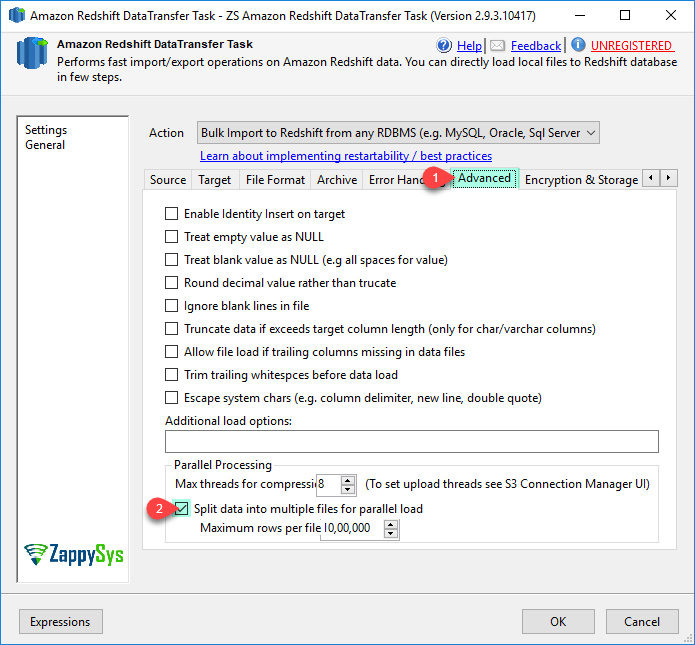
Redshift data transfer task UI – Advanced options for Redshift
The Advanced options tab holds Redshift COPY settings, such as truncating the target table before the load.
Use LoadOptions to pass any extra Redshift COPY option not available in the UI, for example ENCODING UTF8 STATUPDATE OFF.
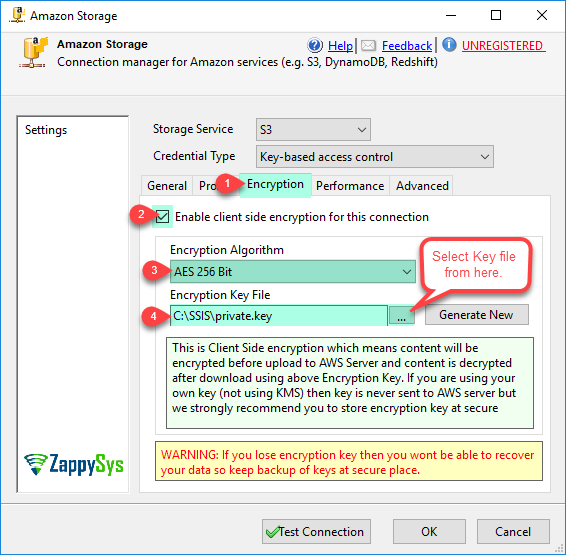
Load encrypted files using client side encryption
Client side encryption encrypts data with your own AES 256 key before it is uploaded to S3; set it on the Encryption tab of the Amazon Storage Connection Manager.
Server side encryption (AWS managed key) is set on the Encryption tab of the task. RSA 1024 is not supported by Redshift, so pick AES for a connection used for Redshift loads.
Inside the UI
Key settings, as they appear in SSDT.
Real screens from the Amazon Redshift Data Transfer Task product page. Step through them, or open any shot at full size.
Redshift data transfer task UI – Source from file
Source tab for local files: pick files with a wildcard pattern and a staging folder.
Articles
Worked examples that use Amazon Redshift Data Transfer Task.
Compatibility and requirements
Designed to stay inside your SSIS runtime.
- SQL Server 2012 through 2025, 32-bit and 64-bit
- Windows only, 64-bit OS required. SQL Server Express and Web editions do not include SSIS
- Azure Data Factory SSIS Integration Runtime
- Self-hosted: credentials and data stay in your environment (external API calls still reach that service)
- Fully functional 30-day trial of SSIS PowerPack
FAQ
Questions teams ask before they drop Amazon Redshift Data Transfer Task on the canvas.
What is Amazon Redshift Data Transfer Task?
Amazon Redshift Data Transfer Task bulk imports data into Amazon Redshift from a flat file or an ODBC, OLEDB or ADO.net source. It uses multiple threads to upload data in parallel and can compress data files to speed up the process.
What can Amazon Redshift Data Transfer Task do?
It loads millions of records into Amazon Redshift from any database system (for example SQL Server, Oracle, MySQL or DB2) or from local flat files, with automatic compression, client side and server side encryption, automatic archiving of source and stage files, and rich error handling and logging.
How does the load work?
The task extracts or reads the data into local staging files, compresses them to GZIP, uploads them to an Amazon S3 staging path and then runs the Redshift COPY command with a manifest file. Stage files can be deleted, moved or kept afterwards.
Can I load several tables in parallel?
The help does not recommend it. The COPY command already loads the S3 files listed in the manifest in parallel, so avoid other parallel activities while a table is loaded.
Which SQL Server versions can I run it on?
SQL Server 2025, 2022, 2019, 2017, 2016, 2014, and 2012 (32- and 64-bit), plus Azure Data Factory with an SSIS Integration Runtime (packages must target SQL Server 2017). See Compatibility and requirements.





What customers say
Start your free trial today
Install SSIS PowerPack and drag Amazon Redshift Data Transfer Task onto the Control Flow.
Bulk import data into Amazon Redshift from flat files or any relational database, staged in Amazon S3 and loaded with the Redshift COPY command.
- Control Flow Task in SSISAmazon Redshift Data Transfer Task appears in the toolbox after you install PowerPack.
- Fully functional 30-day trialSSIS PowerPack, running in your environment.
- Live supportHelp during your trial and after purchase.
Open Help FileBrowse all SSIS PowerPack tasks
New purchases may be eligible for refund review within 30 days. See the refund policy.
Talk to an engineer before or during your trial.