SSIS Amazon S3 Cloud Storage Task
Perform various operations with Amazon S3 Storage objects.
SSIS Amazon S3 Task (SSIS AWS S3 Task) can be used to perform various operations with Amazon S3 Storage objects (buckets and files) (e.g. Download, Upload, Copy, Move, Rename, Delete etc). You can also get single property of any S3 file or get list of files as ADO.net Table and which can be easily loop through using ForEachLoop Task. Most of operations in this task support recursive search using wild card pattern (e.g. Myfile*.txt). Amazon S3 is one of the most popular Cloud Storage Services available right now.
The trial includes Amazon S3 Cloud Storage Task and every other PowerPack component
- Control Flow Task in SSIS
- Runs in your environment
- Also runs in Azure Data Factory
- Fully functional 30-day trial


At a glance
What Amazon S3 Cloud Storage Task can do
SSIS Amazon S3 Task (SSIS AWS S3 Task) can be used to perform various operations with Amazon S3 Storage objects (buckets and files) (e.g. Download, Upload, Copy, Move, Rename, Delete etc).
30+ S3 operations
Perform operations on Amazon S3 buckets and files from the Control Flow.
- Download, Upload, Copy, Move, Rename and Delete files
- Create or delete buckets, create a file from a value or variable
- Set file permissions
Fast parallel transfers
Download and upload small or very large files; Download, Upload, Copy and Delete run multi threaded.
- Thread count set with
MaxParallelThreadson the S3 connection DeleteSourceWhenDoneremoves the source after upload or download
Wildcard & regex filtering
Select many files at once with wildcard patterns and optional recursive search.
- Wildcards like
mybucket/myfile*.txt, plusRecursive IncludeRegXPattern/ExcludeRegXPatternWhereClause,SortByandMaxItems(e.g. get the latest file)
File lists for ForEach loops
Get a list of files or buckets as an ADO.NET DataTable to loop through with the ForEach Loop.
GetAmazonFileListAsADONETDataTableandGetAmazonBucketListAsADONETDataTable
Get file properties
Read a single property of any S3 file into a result variable.
- File size, count, exists flag and last modified date
- Content type, metadata, or file content as string or binary
- Bucket exists flag
Permissions & metadata
Apply ACL permissions, content types and metadata to new or updated files.
Permission: Private, PublicRead, AuthenticatedRead, BucketOwnerFullControl and moreAutoSetContentTypeorUserDefinedContentTypes- Key/value metadata with
MetadataKeyValue
Client & server side encryption
Encrypt content uploaded to or downloaded from Amazon S3.
EncryptionAlgorithm: AES256, RSA1024 or KMSEncryptionKeyFileholds the key file path, or the KMS Key ID
SQL Server 2012–2025 & ADF
Runs in your environment on SQL Server 2012–2025 and Azure-SSIS.
- SQL Server 2025, 2022, 2019, 2017, 2016, 2014, 2012 (32/64-bit)
- Azure Data Factory (SSIS IR)
- Design packages in Visual Studio 2017, 2019, 2022, or 2026
- Windows only (64-bit OS): Windows 7–11 or Windows Server 2012–2025
IAM Role & flexible credentials
Connect with access keys, temporary credentials, or the IAM Role of an EC2 instance.
CredentialType: key-based, temporary token or default (IAM Role or anonymous)- Source and target paths from a direct value, variable or file connection
See all features
- 30+ Amazon S3 operations for buckets and files (e.g. Download, Upload, Copy, Delete)
- Download or upload small or very large files between S3 and the local machine
- Delete, Rename, List, Get Property, Copy, Move, Create and Set Permission operations
- Download, Upload, Copy and Delete are multi threaded (parallel operations)
- Recursive search using wildcard patterns (e.g. Myfile*.txt) with regex include/exclude filters
- Filter, sort and limit file lists (e.g. find the latest file)
- Get a list of files or buckets as an ADO.NET table to loop with the ForEach Loop
- Get file size, count, exists flag, last modified date, content type, metadata or content into a variable
- Set ACL permissions, content type and key/value metadata on new files
- Encrypt data using client side and server side encryption options (AES 256, RSA 1024)
- Generate PreSigned URLs to transfer files to other cloud systems
- Support for IAM Role for EC2 instances
- Continue on error option for partial transfer or delete failures
Support for SQL Server 2025, 2022, 2019, 2017, 2016, 2014, 2012 (32/64-bit) and Azure Data Factory
SQL Server 2012–2025
How it works
From the toolbox to your first run.
Key steps from the Amazon S3 Cloud Storage Task page and help file, with the screens you will see in SSDT.
Choose what the task does with your S3 files and buckets.
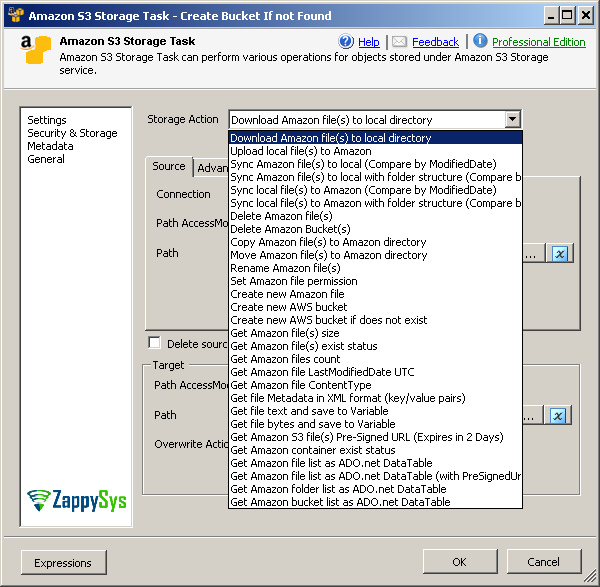
Drag Amazon S3 Storage Task onto the Control Flow, double-click it and pick a Storage Action, for example DownloadFileFromAmazon (the default), UploadFileToAmazon, CopyAmazonFileToAmazon or DeleteAmazonFile.
Browse the source file with the S3 file picker, or use a wildcard such as mybucket/myfile*.txt, then set the target path.
- Download, upload, copy, move, rename and delete files
- Create or delete buckets; create a file from a value or variable
- Get size, count, exists flag, last modified date, metadata or content into a variable
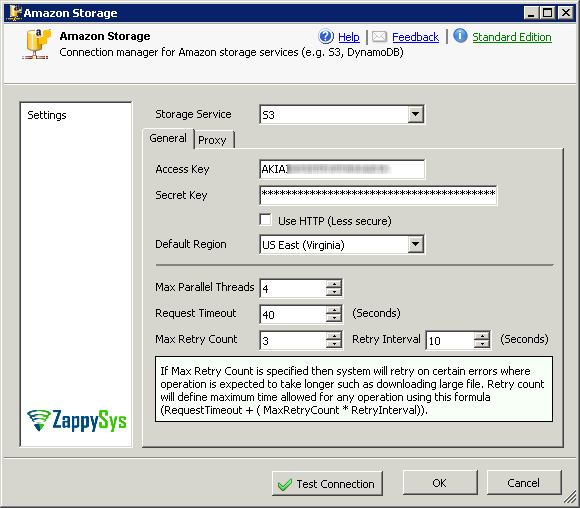
Connect to Amazon S3 with your AWS credentials.
Under Source (or Target) Connection click New to create an Amazon Storage connection. Enter your Access Key and Secret Key, click Test Connection and then OK.
The same connection type also supports temporary token credentials and the default IAM Role of an EC2 instance.
Select exactly the files you need.
Combine a wildcard path and Recursive with IncludeRegXPattern / ExcludeRegXPattern, a SQL-like WhereClause (e.g. Size>100 and Extension IN ('.txt','.csv')), SortBy and MaxItems.
Sorting by last modified date and returning one item is how you download only the latest file.

Set permissions, content type and encryption for new files.
On the Storage and Security tab choose the ACL Permission applied to uploaded, copied, moved, renamed or created files (e.g. Private, PublicRead, BucketOwnerFullControl) and how the content type is set.
Client side and server side encryption (AES 256, RSA 1024 or KMS) is configured on the Amazon Storage connection.

Inside the UI
Key settings, as they appear in SSDT.
Real screens from the Amazon S3 Cloud Storage Task product page. Step through them, or open any shot at full size.
Drag and Drop Amazon S3 Storage Task on the designer surface
From the SSIS Toolbox, drag Amazon S3 Storage Task onto the Control Flow designer surface.
Articles
Worked examples that use Amazon S3 Cloud Storage Task.
Compatibility and requirements
Designed to stay inside your SSIS runtime.
- SQL Server 2012 through 2025, 32-bit and 64-bit
- Windows only, 64-bit OS required. SQL Server Express and Web editions do not include SSIS
- Azure Data Factory SSIS Integration Runtime
- Self-hosted: credentials and data stay in your environment (external API calls still reach that service)
- Fully functional 30-day trial of SSIS PowerPack
FAQ
Questions teams ask before they drop Amazon S3 Cloud Storage Task on the canvas.
What is Amazon S3 Cloud Storage Task?
SSIS Amazon S3 Task (SSIS AWS S3 Task) can be used to perform various operations with Amazon S3 Storage objects (buckets and files) (e.g. Download, Upload, Copy, Move, Rename, Delete etc). You can also get single property of any S3 file or get list of files as ADO.net Table and which can be easily loop through using ForEachLoop Task. Most of operations in this task support recursive search using wild card pattern (e.g. Myfile*.txt). Amazon S3 is one of the most popular Cloud Storage Services available right now.
How do I loop through S3 files with a ForEach Loop?
Set the Storage Action to GetAmazonFileListAsADONETDataTable (or GetAmazonBucketListAsADONETDataTable) and store the result in an Object variable. Then loop through it with the native ForEach Loop’s ADO enumerator.
Can I pick files by name pattern, size or date?
Yes. Use a wildcard path with Recursive, then narrow it with IncludeRegXPattern / ExcludeRegXPattern and a WhereClause such as Size>100 and Extension IN ('.txt','.csv'). SortBy and MaxItems return the top items, for example the latest file.
Are large transfers fast?
Download, Upload, Copy and Delete run multi threaded. The number of threads for downloads and uploads is set with MaxParallelThreads on the S3 connection.
Can I read a file property into a variable?
Yes. Actions such as GetAmazonFileSize, GetAmazonFileCount, GetAmazonFileExistsFlag, GetAmazonFileLastModifiedDate and GetAmazonFileDataAsString store the result in the task’s ResultVariable.
Which SQL Server versions can I run it on?
SQL Server 2025, 2022, 2019, 2017, 2016, 2014, and 2012 (32- and 64-bit), plus Azure Data Factory with an SSIS Integration Runtime (packages must target SQL Server 2017). See Compatibility and requirements.



What customers say
Start your free trial today
Install SSIS PowerPack and drag Amazon S3 Cloud Storage Task onto the Control Flow.
Perform various operations with Amazon S3 Storage objects.
- Control Flow Task in SSISAmazon S3 Cloud Storage Task appears in the toolbox after you install PowerPack.
- Fully functional 30-day trialSSIS PowerPack, running in your environment.
- Live supportHelp during your trial and after purchase.
Open Help FileBrowse all SSIS PowerPack tasks
New purchases may be eligible for refund review within 30 days. See the refund policy.
Talk to an engineer before or during your trial.