SSIS Amazon Redshift Source
Read data from Amazon Redshift.
SSIS Amazon Redshift Source can be used to read data from Amazon Redshift. You can use simple Table mode or write custom SQL Query to extract desired data.
The trial includes Amazon Redshift Source and every other PowerPack component
- Data Flow Source in SSIS
- Runs in your environment
- Also runs in Azure Data Factory
- Fully functional 30-day trial


At a glance
What Amazon Redshift Source can do
SSIS Amazon Redshift Source can be used to read data from Amazon Redshift. You can use simple Table mode or write custom SQL Query to extract desired data.
Read Redshift in Data Flow
Read data from Amazon Redshift inside the SSIS Data Flow, without S3 staging.
- Send the rows to any SSIS destination or transformation
- Use the Amazon Redshift Destination when you also need to write back
Table or Query mode
Use simple Table mode or write a custom SQL query to extract the data you need.
AccessMode: Table or Query- Pick the table from the Tables dropdown
Dynamic queries
Insert SSIS variables anywhere in the query with placeholders.
- e.g.
select * from mytable where id='{{User::MyVar}}' - Variables can supply column names as well as values
Preview & max rows
Preview data at design time and limit how many rows are fetched.
MaxRows: 0 = unlimited
Secure Redshift connection
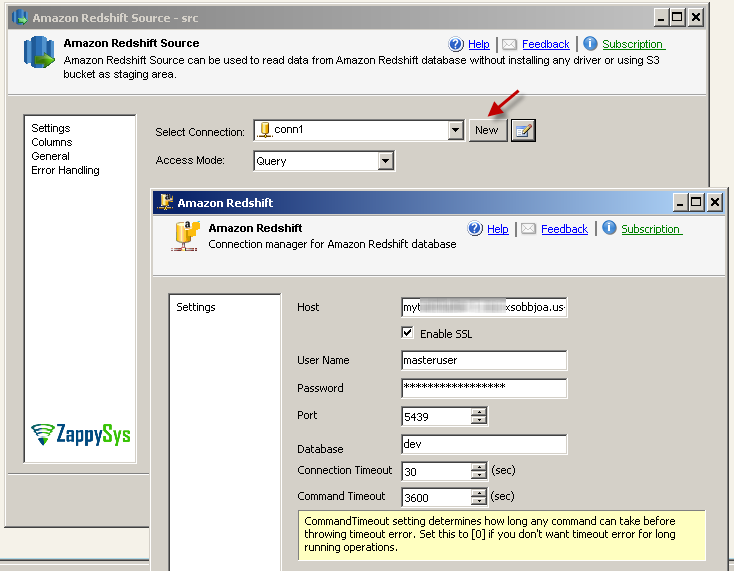
Connect with host, database, user name and password through the Amazon Redshift Connection Manager.
- Enable SSL
- X509 client certificate from a certificate store or file
Connection performance
Tune how the connection behaves while the package runs.
- Connection pooling for better performance
RetainSameConnectionkeeps one connection open for the whole package- Separate command and connect timeouts
Logging control
Control how much information is logged during package execution.
LoggingMode: Normal, Medium, Detailed or DebuggingPrefixTimestampadds a timestamp to log messages
SQL Server 2012–2025 & ADF
Runs in your environment on SQL Server 2012–2025 and Azure-SSIS.
- SQL Server 2025, 2022, 2019, 2017, 2016, 2014, 2012 (32/64-bit)
- Azure Data Factory (SSIS IR)
- Design packages in Visual Studio 2017, 2019, 2022, or 2026
- Windows only (64-bit OS): Windows 7–11 or Windows Server 2012–2025
See all features
- Read data from Amazon Redshift in the SSIS Data Flow without S3 staging
- Multiple modes (Table or Query) to read data from Amazon Redshift
- Data preview and max rows
- Dynamic query using SSIS variable placeholders (e.g.
{{User::MyVar}}) - SSL and X509 client certificate support on the Amazon Redshift Connection Manager
- Connection pooling and
RetainSameConnectionto share one open connection across tasks - Command and connect timeout settings
- Logging modes (Normal, Medium, Detailed, Debugging) with optional timestamp prefix
Support for SQL Server 2025, 2022, 2019, 2017, 2016, 2014, 2012 (32/64-bit) and Azure Data Factory
SQL Server 2012–2025
How it works
From the toolbox to your first run.
Key steps from the Amazon Redshift Source page and help file, with the screens you will see in SSDT.
Connect to your Redshift cluster.
Drag Amazon Redshift Source onto the Data Flow and create an Amazon Redshift connection: enter the host name, user name, password and database, check Enable SSL if needed, and click Test Connection.
Read a whole table.
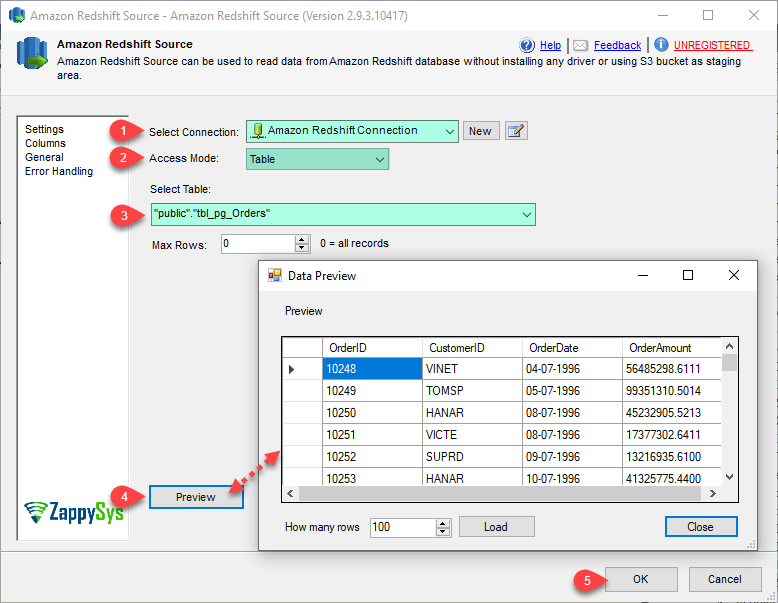
Double-click the source, select the connection, set AccessMode to Table and pick the table from the dropdown.
Click Preview to check the data; MaxRows limits how many rows are fetched (0 = unlimited).
Write a SQL query, with SSIS variables if you need them.
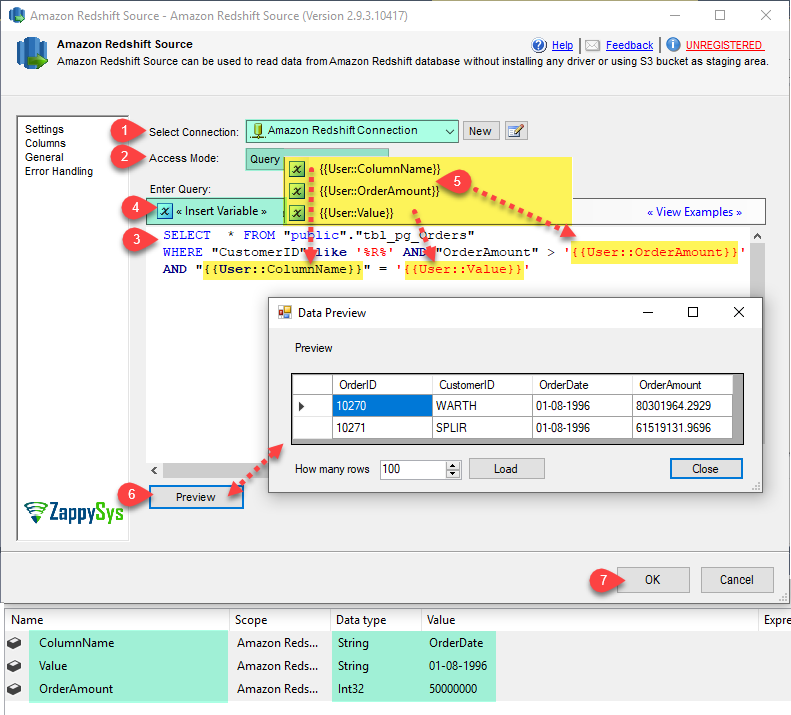
Set AccessMode to Query and type your SQL (click View Examples for samples). Insert SSIS variables anywhere with placeholders, for values or even column names:
SELECT * FROM "public"."tbl_pg_Orders" WHERE "OrderAmount" > '{{User::OrderAmount}}' AND "{{User::ColumnName}}" = '{{User::Value}}'
Inside the UI
Key settings, as they appear in SSDT.
Real screens from the Amazon Redshift Source product page. Step through them, or open any shot at full size.
Amazon Redshift Source – Create new connection
Create the Amazon Redshift connection with host, database, user name and password.
Articles
Worked examples that use Amazon Redshift Source.
Compatibility and requirements
Designed to stay inside your SSIS runtime.
- SQL Server 2012 through 2025, 32-bit and 64-bit
- Windows only, 64-bit OS required. SQL Server Express and Web editions do not include SSIS
- Azure Data Factory SSIS Integration Runtime
- Self-hosted: credentials and data stay in your environment (external API calls still reach that service)
- Fully functional 30-day trial of SSIS PowerPack
FAQ
Questions teams ask before they drop Amazon Redshift Source on the canvas.
What is Amazon Redshift Source?
SSIS Amazon Redshift Source can be used to read data from Amazon Redshift. You can use simple Table mode or write custom SQL Query to extract desired data.
Do I need S3 staging to read Redshift data?
No. The source reads Redshift data directly in the SSIS Data Flow, without S3 staging. See How to Read / Write Amazon Redshift Data in SSIS.
How do I pass SSIS variables into the query?
Set AccessMode to Query and use placeholders such as {{User::MyVar}} anywhere in the SQL, for example select * from mytable where id='{{User::MyVar}}'. A variable can supply a column name as well as a value.
Can I connect over SSL?
Yes. The Amazon Redshift Connection Manager has an Enable SSL option and can use an X509 client certificate from a certificate store or file. See the connection manager help.
Which SQL Server versions can I run it on?
SQL Server 2025, 2022, 2019, 2017, 2016, 2014, and 2012 (32- and 64-bit), plus Azure Data Factory with an SSIS Integration Runtime (packages must target SQL Server 2017). See Compatibility and requirements.





What customers say
Start your free trial today
Install SSIS PowerPack and drag Amazon Redshift Source onto the Data Flow.
Read data from Amazon Redshift.
- Data Flow Source in SSISAmazon Redshift Source appears in the toolbox after you install PowerPack.
- Fully functional 30-day trialSSIS PowerPack, running in your environment.
- Live supportHelp during your trial and after purchase.
Open Help FileBrowse all SSIS PowerPack tasks
New purchases may be eligible for refund review within 30 days. See the refund policy.
Talk to an engineer before or during your trial.