SSIS MongoDB Source
Read MongoDB collections in SSIS with a familiar SQL query, or with native MongoDB queries and aggregation pipelines.
Query MongoDB with SQL-style syntax or the native query language, run aggregation (Group By) pipelines, and flatten nested arrays with JSONPath such as $.Orders[*].OrderItems[*]. Output columns or raw JSON documents, connect with SSL or X509 certificates, and read MongoDB views (SSIS 2014 or higher).
The trial includes MongoDB Source and every other PowerPack component
- Data Flow Source in SSIS
- Runs in your environment
- Also runs in Azure Data Factory
- Fully functional 30-day trial


At a glance
What MongoDB Source can do
MongoDB Source reads data from MongoDB collections into the SSIS data flow using SQL-style or native queries, and turns nested documents and arrays into rows and columns.
SQL-style queries
Query MongoDB with a familiar SQL style query language instead of a proprietary query syntax.
AccessMode: Table or Query- Filter on nested fields with
ArrayName.ElementName - SQL is translated to a native query behind the scenes
Native MongoDB queries
Use native MongoDB query syntax for the full capability of db.collection.find(...).
- Comparison, logical, geospatial, evaluation, array and bitwise operators
- Header options such as
MaxRows,Columns,HintandTimeout
Aggregation (Group By)
Run aggregation framework pipelines, the MongoDB equivalent of Group By queries.
Method: Find, Aggregate or DistinctAllowDiskUselets a pipeline exceed the 100MB RAM limit
Extract nested arrays
Extract data from nested arrays and sub documents with a JSONPath filter.
EnableJsonPath+Filter(e.g.$.Orders[*].OrderItems[*])IncludeParentColumnsadds parent attributes to each rowIncludeParentColumnsWhenChildMissingworks like a LEFT OUTER JOIN
Raw JSON output
Output raw JSON documents instead of columns.
OutputMode: Columns, RawDocuments or RawDocumentsShellModeIndentOutputmakes the JSON easy to read
Flatten & skip attributes
Control which attributes become columns and how deep the scan goes.
EnableArrayFlatteningwithMaxArrayItemsToFlattenExcludedPropertiesandMaxLevelsToScanMetaDataScanModecontrols data type and length detection
Date parsing & filters
Parse MongoDB dates the way you need and filter documents by date.
DateParseHandling: keep as string, DateTime or DateTimeOffset (keeps time zone)DateFormatStringfor custom date formats
SQL Server 2012–2025 & ADF
Runs in your environment on SQL Server 2012–2025 and Azure-SSIS.
- SQL Server 2025, 2022, 2019, 2017, 2016, 2014, 2012 (32/64-bit)
- Azure Data Factory (SSIS IR)
- Design packages in Visual Studio 2017, 2019, 2022, or 2026
- Windows only (64-bit OS): Windows 7–11 or Windows Server 2012–2025
SSL & X509 authentication
Multiple authentication methods, including SSL and client X509 certificates.
- Compatible with MongoDB 2.x, 3.x, 4.x and higher
- Read MongoDB View data (SSIS 2014 or higher)
See all features
- Fast data read/extract from MongoDB using a familiar SQL style query language
- Native MongoDB query language for advanced query operations
- Aggregation framework (Group By) support, plus Distinct
- Extract data from nested arrays using JSONPath (e.g.
$.Orders[*].OrderItems[*]) - Option to include parent attributes when inner documents are extracted with JSONPath
- Output raw JSON documents rather than columns (with indent option)
- Advanced options to skip attributes by name or depth
- Deep array flattening into columns (
EnableArrayFlattening) - Date parsing options (DateTime, DateTimeOffset or string) and custom date formats
- Multiple authentication methods, including SSL and client X509 certificate
- Compatible with MongoDB 2.x, 3.x and 4.x (and higher)
- Read MongoDB View data (requires SSIS 2014 or higher)
- Error output for bad values and truncation
Support for SQL Server 2025, 2022, 2019, 2017, 2016, 2014, 2012 (32/64-bit) and Azure Data Factory
SQL Server 2012–2025
How it works
From the toolbox to your first run.
Write a query, choose how nested data is filtered, pick the columns, then run the data flow.
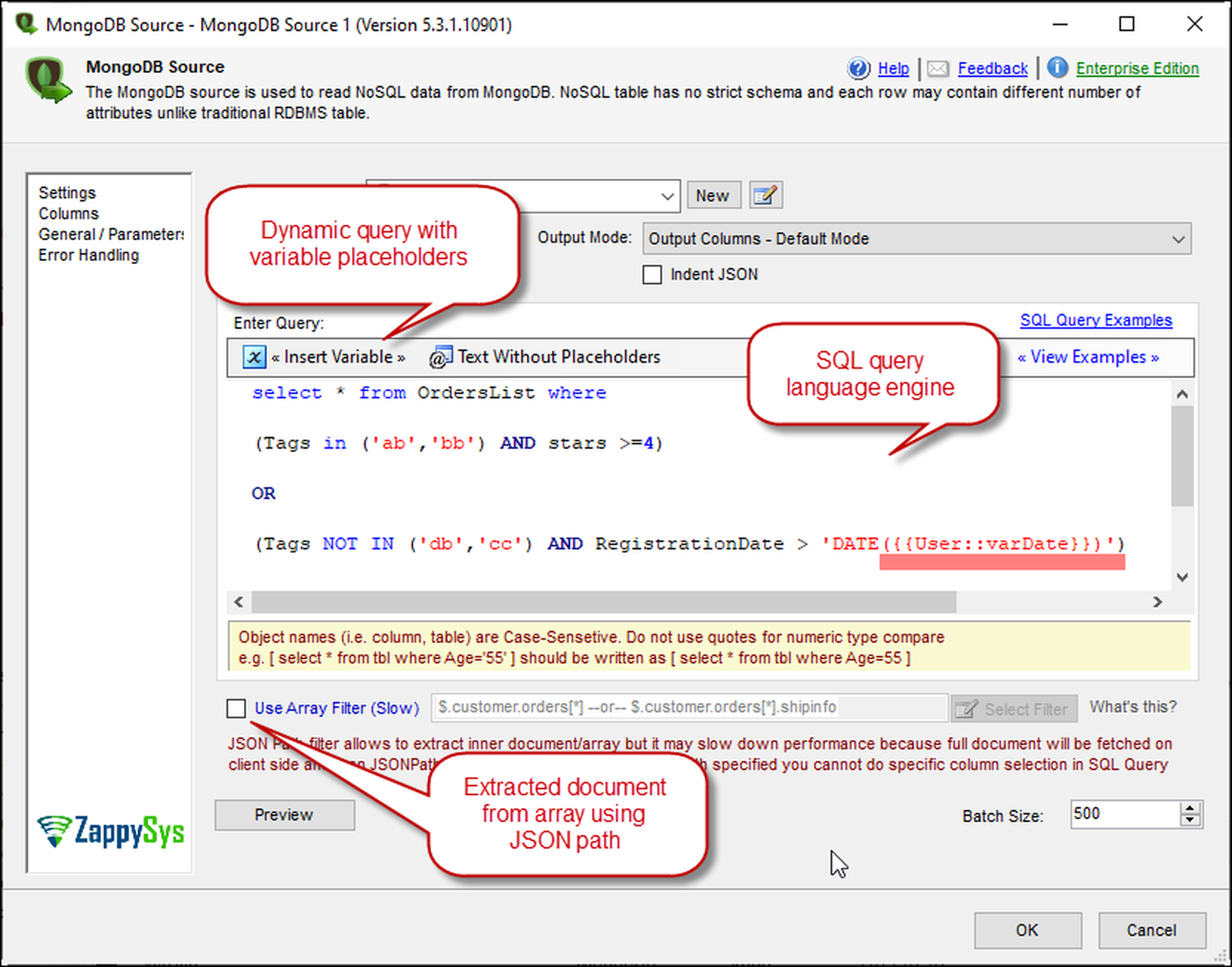
Query MongoDB with SQL.
Set Access Mode to Query and write SQL such as SELECT * FROM Employees WHERE LocationDetails.Country = 'Denmark'. Use ArrayName.ElementName for nested fields and square brackets for collection names with special characters, e.g. [Employees-OldData]. The SQL is translated to a native MongoDB query for you.
- Table or Query access mode
- Native JSON query and aggregation pipelines too
MaxRows,Columns,Hint,Timeoutoptions in native mode
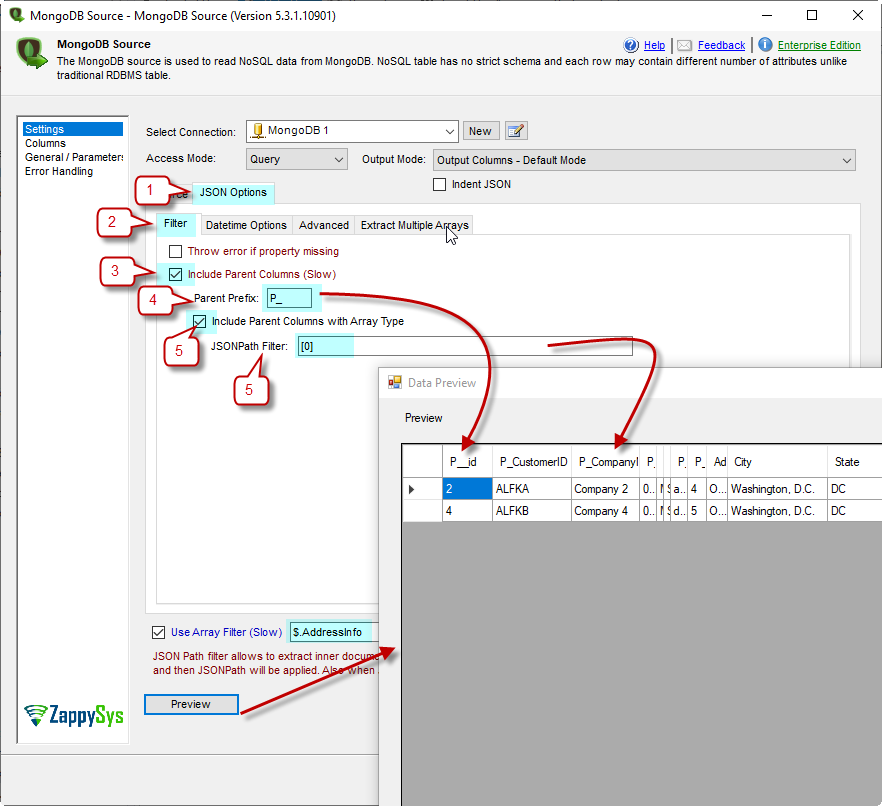
Extract nested arrays with JSONPath.
Enable the JSONPath filter and enter an expression such as $.Customers[*].Orders[*] to turn an inner array into rows. Include parent columns on each row, and optionally keep parents that have no children (works like a LEFT OUTER JOIN).
IncludeParentColumnsEnableArrayFlatteningwithMaxArrayItemsToFlatten- Skip attributes by name or depth
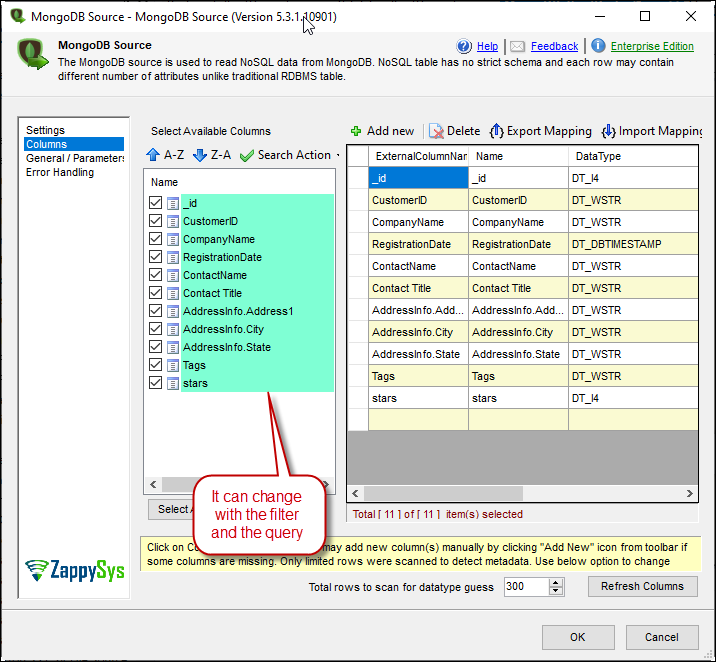
Review and select output columns.
MongoDB Source scans sample documents to detect columns, data types and lengths. Remove the columns you do not need and adjust types on the Columns tab; MetaDataScanMode controls how lengths are guessed.
- Dates parsed as DateTime, DateTimeOffset or string
- Error output for bad values and truncation
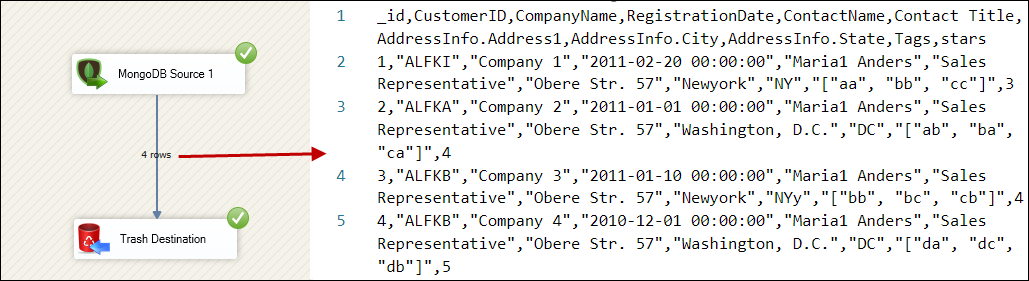
Run the data flow and check the rows.
Connect MongoDB Source to any destination, such as an OLE DB destination for SQL Server, and execute the package. Nested documents arrive as flat rows ready to load.
- Raw JSON document output mode is also available
Inside the UI
Key settings, as they appear in SSDT.
Real screens from the MongoDB Source product page. Step through them, or open any shot at full size.
MongoDB Source – Query data using SQL
Write a SQL query against a collection; the WHERE clause can use nested fields such as LocationDetails.Country.
Articles
Worked examples that use MongoDB Source.
Compatibility and requirements
Designed to stay inside your SSIS runtime.
- SQL Server 2012 through 2025, 32-bit and 64-bit
- Windows only, 64-bit OS required. SQL Server Express and Web editions do not include SSIS
- Azure Data Factory SSIS Integration Runtime
- Self-hosted: credentials and data stay in your environment (external API calls still reach that service)
- Fully functional 30-day trial of SSIS PowerPack
FAQ
Questions teams ask before they drop MongoDB Source on the canvas.
What is MongoDB Source?
MongoDB Source is an SSIS data flow source that reads data from MongoDB collections using SQL-style or native MongoDB queries, including aggregation pipelines, and outputs rows and columns or raw JSON documents.
Do I need to learn the MongoDB query language?
No. You can write SQL such as SELECT * FROM Employees WHERE LocationDetails.Country = 'Denmark' and it is translated to a native query. For advanced cases you can still use native syntax with query operators, or Method: Aggregate / Distinct.
How do I read data from a nested array?
Enable the JSONPath filter and enter an expression such as $.Orders[*].OrderItems[*]. You can include parent columns, and keep parents without children (LEFT OUTER JOIN behavior). See Read MongoDB data from an array.
Can I extract two different arrays in one data flow?
MongoDB Source has one output, so one filter. Read raw documents once, send them to a Multicast, and parse each array with its own JSON Parser Transform filter. See Extract multiple arrays from MongoDB.
Which MongoDB versions are supported?
MongoDB 2.x, 3.x, 4.x and higher. Reading MongoDB views requires SSIS 2014 or higher.
Which SQL Server versions can I run it on?
SQL Server 2025, 2022, 2019, 2017, 2016, 2014, and 2012 (32- and 64-bit), plus Azure Data Factory with an SSIS Integration Runtime (packages must target SQL Server 2017). See Compatibility and requirements.



What customers say
Start your free trial today
Install SSIS PowerPack and drag MongoDB Source onto the Data Flow.
Read MongoDB collections, aggregations and nested arrays into SQL Server or any SSIS destination.
- Data Flow Source in SSISMongoDB Source appears in the toolbox after you install PowerPack.
- Fully functional 30-day trialSSIS PowerPack, running in your environment.
- Live supportHelp during your trial and after purchase.
Open Help FileBrowse all SSIS PowerPack tasks
New purchases may be eligible for refund review within 30 days. See the refund policy.
Talk to an engineer before or during your trial.