SSIS Export Excel File Task
Create Excel reports and workbooks from SSIS, dynamically.
Export multiple tables, views, or SQL queries to Excel with no drivers and no metadata issues of the native SSIS Excel task. Split output into files or tabs, use a custom template, and password-protect workbooks, all without coding.
The trial includes Export Excel File Task and every other PowerPack component
- No drivers needed
- Runs in your environment
- Also runs in Azure Data Factory
- 32-bit and 64-bit, fully managed















At a glance
What Export Excel File Task can do
Export Excel File Task is a one-stop solution to create Excel reports and workbooks from SSIS. You do not need any drivers, and you avoid the metadata issues of the native SSIS Excel task.
Tables, views, and queries
Export many objects to Excel at once.
- Multiple tables / views by pattern (e.g.
Sales%orSalesJan|SalesFeb) - SQL query output to an Excel file
- Multi-line SQL statements for template datasets
Fully dynamic
No Data Flow strict metadata.
- Completely dynamic approach
- Works on 32-bit and 64-bit without change
- Native SSIS Excel functionality is 32-bit only
Template engine
Custom formatted reports.
- Highly flexible template engine
- Design the report in Excel, then fill it with data
Split output
Split exported data automatically.
- By size or number of records
- By column into files or workbook tabs (e.g. SplitBy=Country)
Where to write
Control the target workbook.
- Start at a specific cell (e.g. A5)
- Clear a range before writing (e.g. A1:D5000)
Protect & package
Secure and compress output.
- Password protected Excel files
- Compression and append
Office versions
All major Office versions.
- For example Office 2003, 2007, and 2013
SQL Server 2012–2025 & ADF
Runs in your environment on SQL Server 2012–2025 and Azure-SSIS.
- SQL Server 2025, 2022, 2019, 2017, 2016, 2014, 2012 (32/64-bit)
- Azure Data Factory (SSIS IR)
- Design packages in Visual Studio 2017, 2019, 2022, or 2026
- Windows only (64-bit OS): Windows 7–11 or Windows Server 2012–2025
See all features
- Export multiple tables / views to Excel files (e.g.
Sales%orSalesJan|SalesFeb) - Support for all major Office versions (e.g. Office 2003, 2007, 2013)
- Export SQL query output to an Excel file
- Completely dynamic approach without the limitation of Data Flow strict metadata
- Export custom formatted reports using a highly flexible template engine
- Export data to a specific starting location in the sheet (e.g. A5 starts writing at the 5th row, 1st column)
- Password protected Excel files
- Clear a range of cells before writing to an existing workbook (e.g. A1:D5000 clears columns A to D, rows 1 to 5000)
- Automatically split exported data into multiple files by size or number of records
- Automatically split exported data into multiple files or tabs by column (e.g. SplitBy=Country creates a new file per country; with SplitOnTab, a new tab instead)
- Compression and append
- Fully managed: works on 32-bit and 64-bit without change (native SSIS Excel functionality is 32-bit only)
- Multi-line SQL statements for template-based export in dataset SQL (i.e.
ds1=some sql1; some sql2 | ds2=some sql…) Support for SQL Server 2025, 2022, 2019, 2017, 2016, 2014, 2012 (32/64-bit) and Azure Data Factory
SQL Server 2012–2025
Three steps, or a template
Source, target, split, or template.
Pick what to export, where to write it, and how to split it, or design a template for a formatted report.
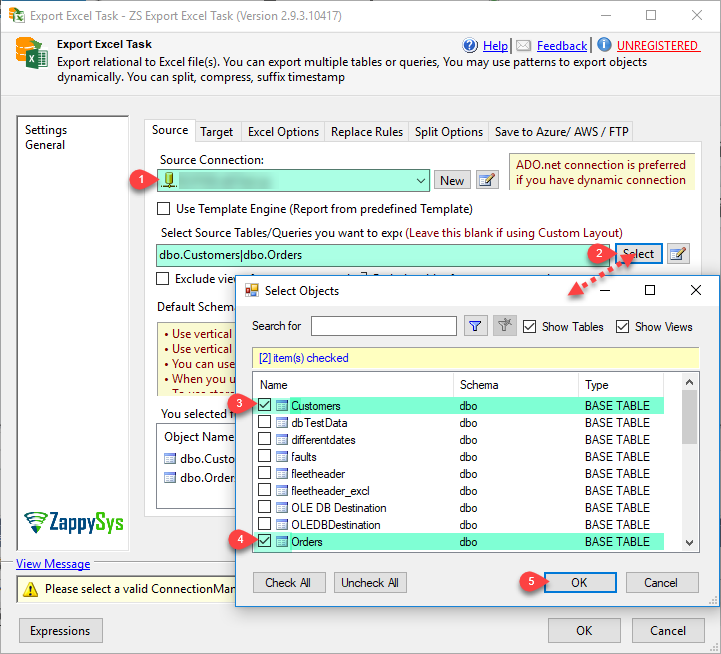
Choose tables, views, or a query.
Select a source connection, then pick the tables and views to export, or enter a query. Each object can become its own sheet.
- Select objects from a list
- Patterns such as
Sales%
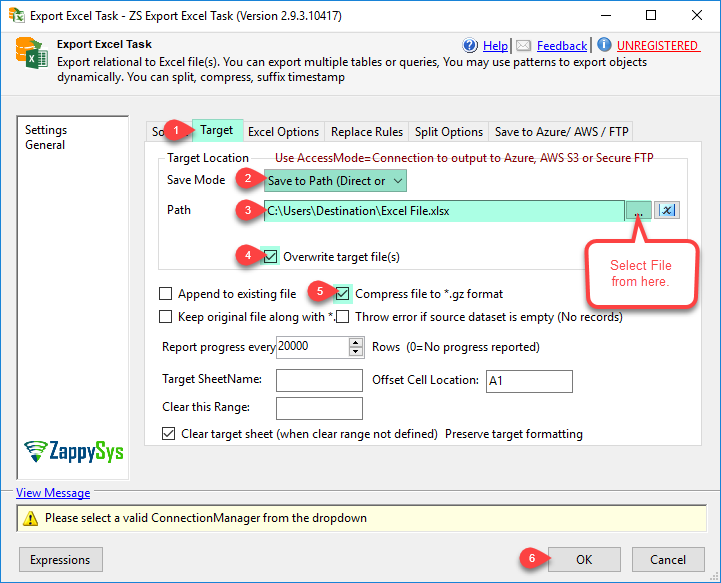
Set the file and options.
Set the target path and other options: overwrite the target file and optionally compress it to *.gz. Excel options control date formatting and more.
- Overwrite target file(s)
- Compress file to gzip format
Split into files or tabs.
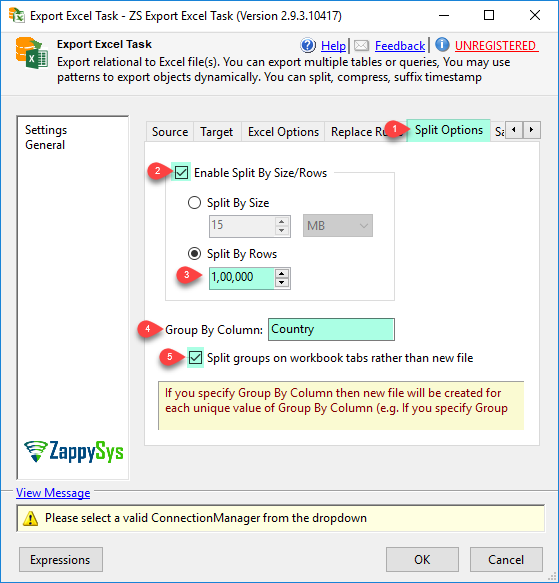
Enable split by size or rows, or set a Group By Column. With the workbook tabs option, each group goes to its own tab rather than a new file.
- Split by size or rows
- Group by column into files or tabs
Fill a formatted report.
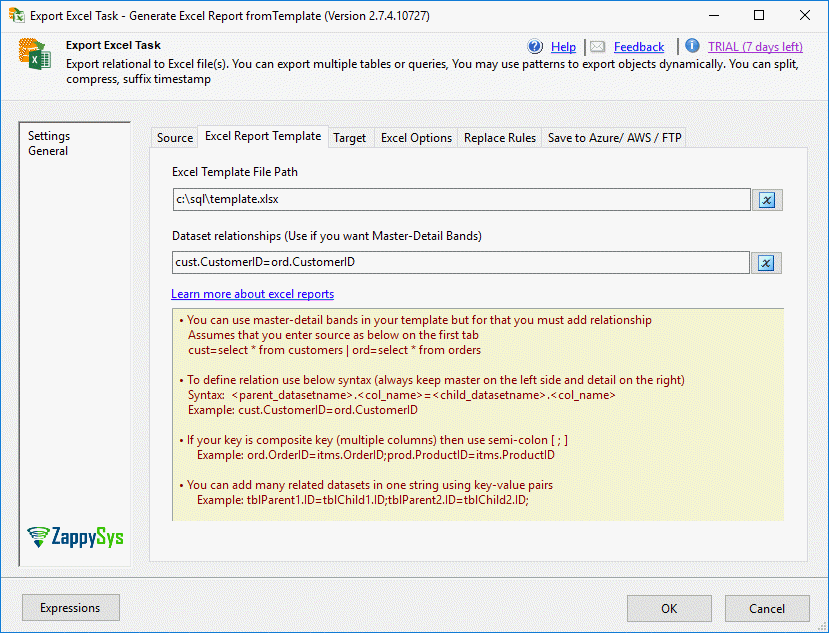
Use a predefined template to export a custom formatted report. Design the template in Excel, then map datasets to it.
- Datasets from SQL
- Formatting kept from the template
Inside the UI
Key settings, as they appear in SSDT.
Real screens from the Export Excel File Task product page and help file. Step through them, or open any shot at full size.
Generate Excel files for selected tables / views
Pick the objects to export.
Split example
One workbook, one tab per country.
From the help file and its screenshots: group exported rows by Country and write each group to its own workbook tab.
-
Split Options tab
Settings shown in the help screenshot.
Enable Split By Size/Rows : checked Split By Rows : 1,00,000 Group By Column : Country Split groups on workbook tabs rather than new file : checked -
Group By Column
Group by
CountryWithout the tabs option, a new file is created for each unique value of the column.
-
Austria tab
RecordID Customer Zip Country 20 ERNSH 8010 Austria 59 PICCO 5020 Austria Sheet names come from the Country values.
Settings and output from the Export Excel File Task help file (SplitOnTab property and split screenshots).
Articles
Worked examples that use Export Excel File Task.
Compatibility and requirements
Designed to stay inside your SSIS runtime.
- SQL Server 2012 through 2025, 32-bit and 64-bit
- Windows only, 64-bit OS required. SQL Server Express and Web editions do not include SSIS
- Azure Data Factory SSIS Integration Runtime
- Self-hosted: credentials and data stay in your environment (external API calls still reach that service)
- Fully functional 30-day trial of SSIS PowerPack
FAQ
Questions teams ask before they drop Export Excel File Task on the canvas.
Do I need any drivers installed?
No drivers are needed, and the task avoids the metadata issues of the native SSIS Excel task.
Can I export several tables at once?
Yes. Export multiple tables or views by pattern, such as Sales% or SalesJan|SalesFeb, or export a SQL query.
Can I split the output?
Yes. Split by size or number of records, or by a column such as Country, into separate files or workbook tabs.
Can I write to a specific cell?
Yes. Set a starting location such as A5, and optionally clear a range such as A1:D5000 before writing.
Does it work in 64-bit?
Yes. It is fully managed and works on 32-bit and 64-bit without change. Native SSIS Excel functionality is 32-bit only.
Which SQL Server versions can I run it on?
SQL Server 2025, 2022, 2019, 2017, 2016, 2014, and 2012 (32- and 64-bit), plus Azure Data Factory with an SSIS Integration Runtime (packages must target SQL Server 2017). See Compatibility and requirements.
Where is the full property reference?
Open the Export Excel File Task help file.




What customers say
Start your free trial today
Install SSIS PowerPack and drag Export Excel Task onto the Control Flow.
Pick tables, set a target, and run, with no coding required.
- Control Flow Task in SSISExport Excel File Task appears in the toolbox after you install PowerPack.
- Fully functional 30-day trialSSIS PowerPack, running in your environment.
- Live supportHelp during your trial and after purchase.
Open Help FileBrowse all SSIS PowerPack tasks
New purchases may be eligible for refund review within 30 days. See the refund policy.
Talk to an engineer before or during your trial.