How to integrate JDBC data source with UiPath


Learn how to quickly and efficiently connect JDBC-ODBC Bridge with UiPath for smooth data access.
Read and write JDBC data effortlessly. Connect ODBC applications to Java-based services using standard JDBC drivers (.jar) for analytics, reporting, and data pipelines — almost no coding required. You can do it all using the high-performance JDBC-ODBC Bridge Driver for UiPath (often referred to as the JDBC-ODBC Bridge Connector). We'll walk you through the entire setup.
Ready to dive in? Download the product to jump right in, or follow the step-by-step guide below to see how it works.
Prerequisites
Before we begin, make sure you meet the following prerequisite: Java Runtime Environment (JRE) or Java Development Kit (JDK) must be installed on your system.
-
Minimum required version: Java 8
-
Recommended Java version: Java 21
If your JDBC Driver targets a different Java version (e.g., 11 / 17 / 21), install the corresponding or newer Java version.
Download your Java application JDBC driver
To connect to your Java application in , you will have to download JDBC driver for it, which we will use in later steps. Let's perform these little steps right away:
- Visit your Java application website or MVN Repository.
-
Download the JDBC driver, and save it locally,
e.g. to
D:\Drivers\JDBC\app-jdbc.jar. - Done! That was easy, wasn't it? Let's proceed to the next step.
Create data source using JDBC-ODBC Bridge ODBC Driver
Step-by-step instructions
To get data from JDBC-ODBC Bridge using UiPath, we first need to create an ODBC data source. We will later read this data in UiPath. Perform these steps:
-
Download and install ODBC PowerPack (if you haven't already).
-
Search for
odbcand open the ODBC Data Sources (64-bit):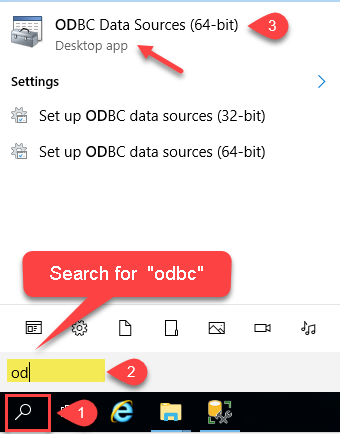
-
Create a User data source (User DSN) based on the ZappySys JDBC Bridge Driver driver:
ZappySys JDBC Bridge Driver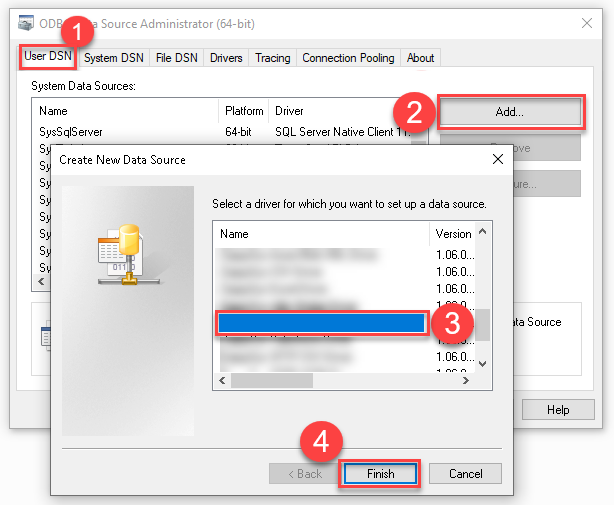
- Create and use a User DSN if the client application runs under a User Account. This is the ideal option at design time (e.g., when developing in Visual Studio). Use it for both types of applications (64-bit and 32-bit).
- Create and use a System DSN if the client application runs under a System Account (e.g., as a Windows Service). This is usually the required option in a production environment. If your Windows Service is a 32-bit application, you must use the 32-bit ODBC Data Source Administrator to configure this
-
Now, we need to configure the JDBC connection in the new ODBC data source. Simply enter the Connection string, credentials, configure other settings, and then click Test Connection button to test the connection:
JdbcOdbcBridgeDSNjdbc:exampleApp://app-service-host-name.com:1234com.provider.exampleApp.jdbc.AppDriverD:\Drivers\JDBC\app-jdbc.jaradmin*************[{"Name":"AppParameter","Value":"12345"}]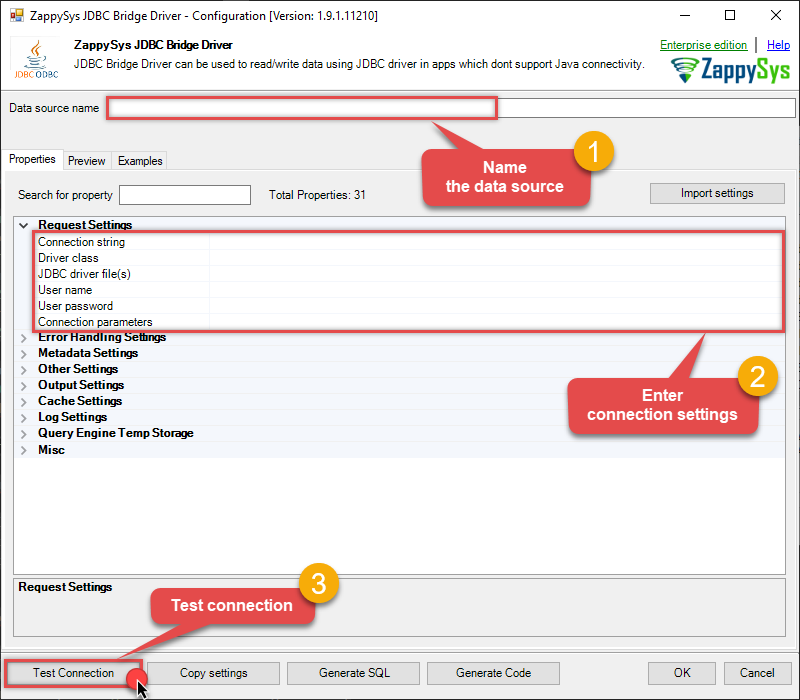
Use these values when setting parameters:
-
Connection string :jdbc:exampleApp://app-service-host-name.com:1234 -
Driver class :com.provider.exampleApp.jdbc.AppDriver -
JDBC driver file(s) :D:\Drivers\JDBC\app-jdbc.jar -
User name :admin -
User password :************* -
Connection parameters :[{"Name":"AppParameter","Value":"12345"}]
-
-
You should see a message saying that connection test is successful:
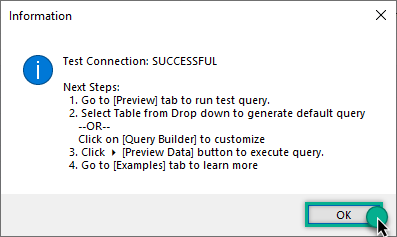
Otherwise, if you are getting an error, check out our Community for troubleshooting tips.
-
We are at the point where we can preview a SQL query. For more SQL query examples visit JDBC Bridge documentation:
JdbcOdbcBridgeDSNSELECT * FROM orders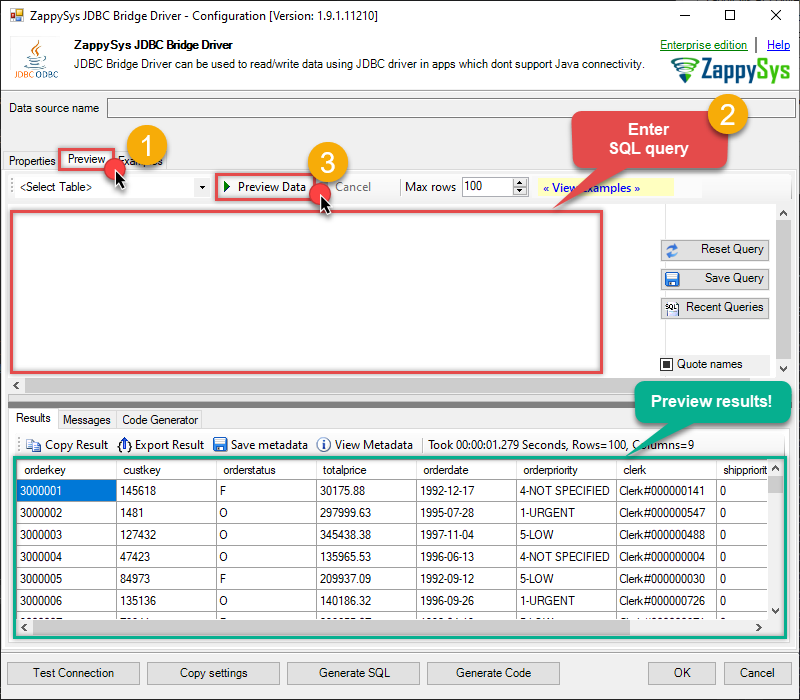
SELECT * FROM ordersYou can also click on the <Select Table> dropdown and select a table from the list.The ZappySys JDBC Bridge Driver acts as a transparent intermediary, passing SQL queries directly to the JDBC driver, which then handles the query execution. This means the Bridge Driver simply relays the SQL query without altering it.
Some JDBC drivers don't support
INSERT/UPDATE/DELETEstatements, so you may get an error saying "action is not supported" or a similar one. Please, be aware, this is not the limitation of ZappySys JDBC Bridge Driver, but is a limitation of the specific JDBC driver you are using. -
Click OK to finish creating the data source.
Video Tutorial

Read JDBC-ODBC Bridge data in UiPath Studio (workstation)
Here we will be reading JDBC-ODBC Bridge data on your workstation. To accomplish that we will create and run UiPath process package locally. Later on, we'll explore how to publish the package to Orchestrator and run it remotely. For now, let's focus on working locally and get started!
-
Open UiPath Studio.
-
Before we really begin the work, make sure UiPath Studio is set as your profile (blue application icon).
-
In case, it is set to UiPath StudioX, you can change it in UiPath StudioX Settings:
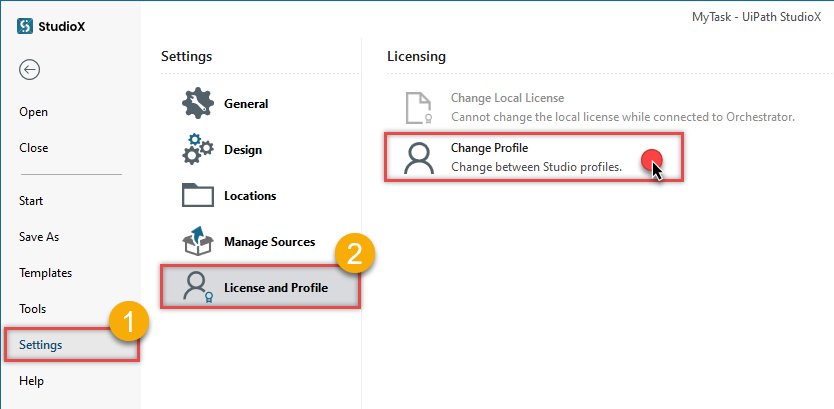
Simply select UiPath Studio option:
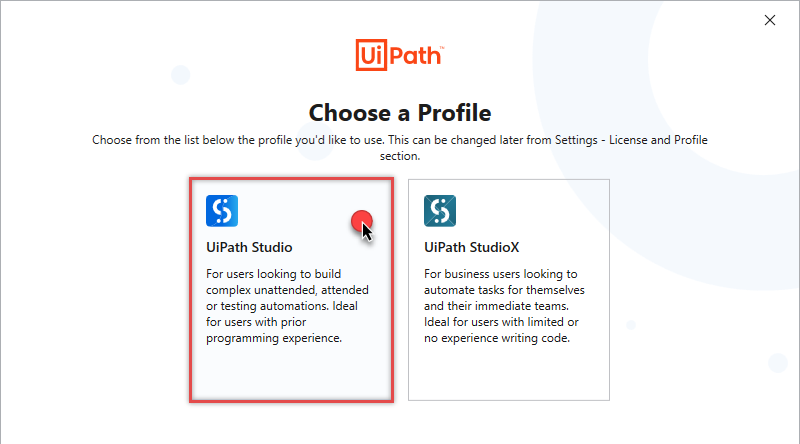
-
Start by creating a new project based on UiPath Process template:
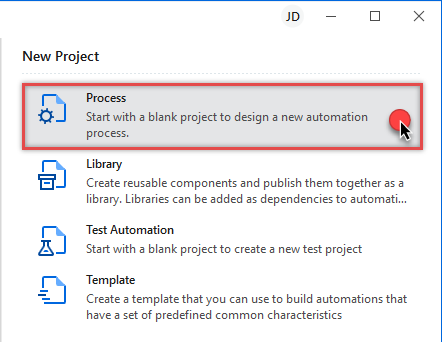
-
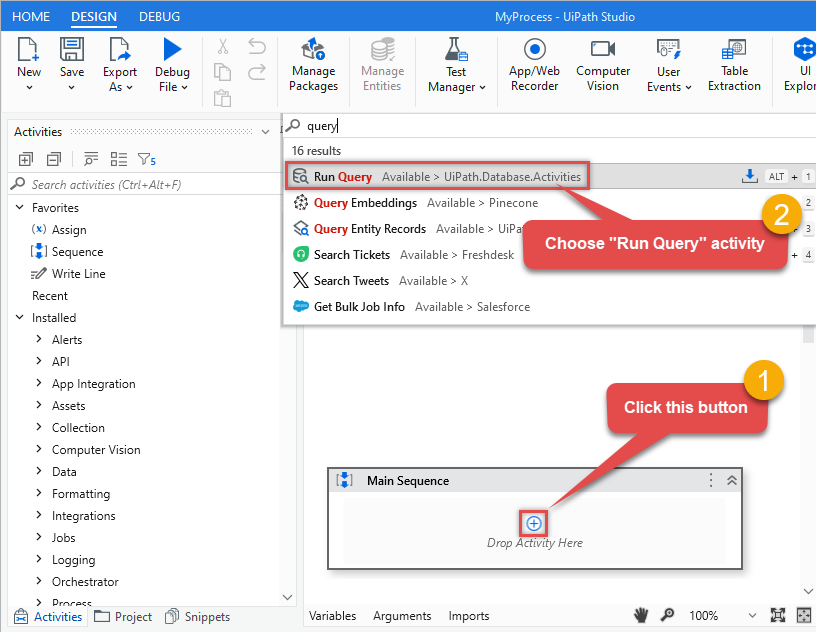
Add Run Query activity in Main Sequence box:
-
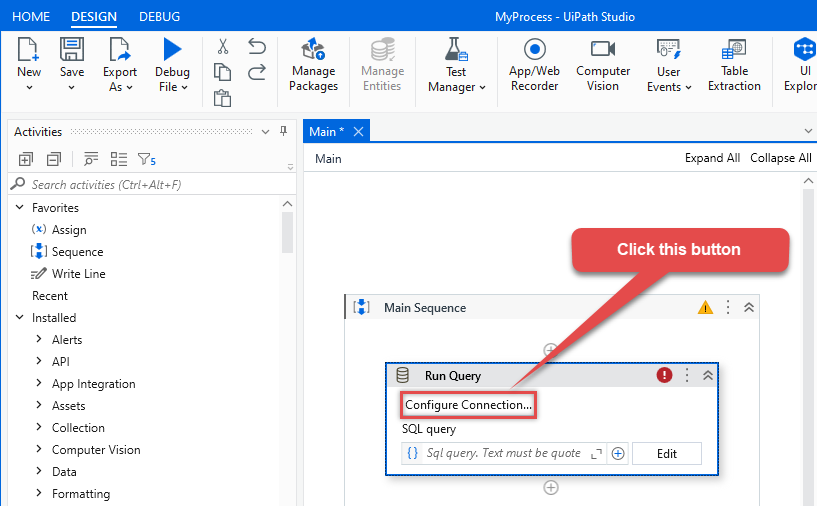
Click Configure Connection... button to create an ODBC connection:
-
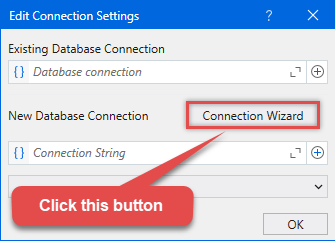
Continue by clicking Connection Wizard:
-
When the window opens, select ODBC-based driver, provider, and then choose ODBC data source:
JdbcOdbcBridgeDSNJdbcOdbcBridgeDSN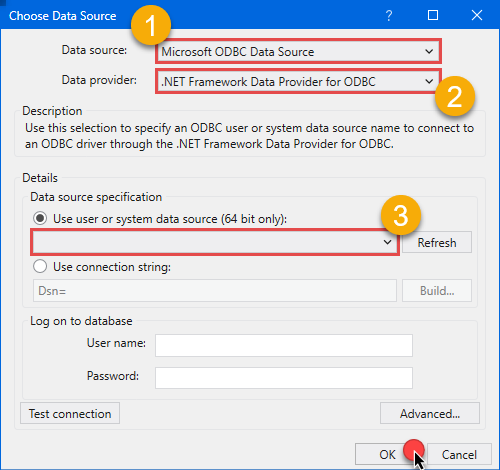 You can also select Use connection string option and use whole ODBC connection string instead. Obtain the connection string by pressing Copy Settings button in your data source configuration.
 -
Once you do that, it's time to configure a SQL query:
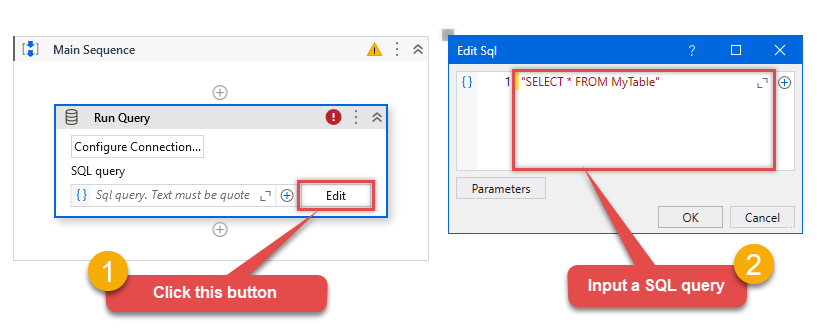 Make sure, you enclose the query in double quotes!
 -
Proceed by adding a Write CSV activity after Run Query:
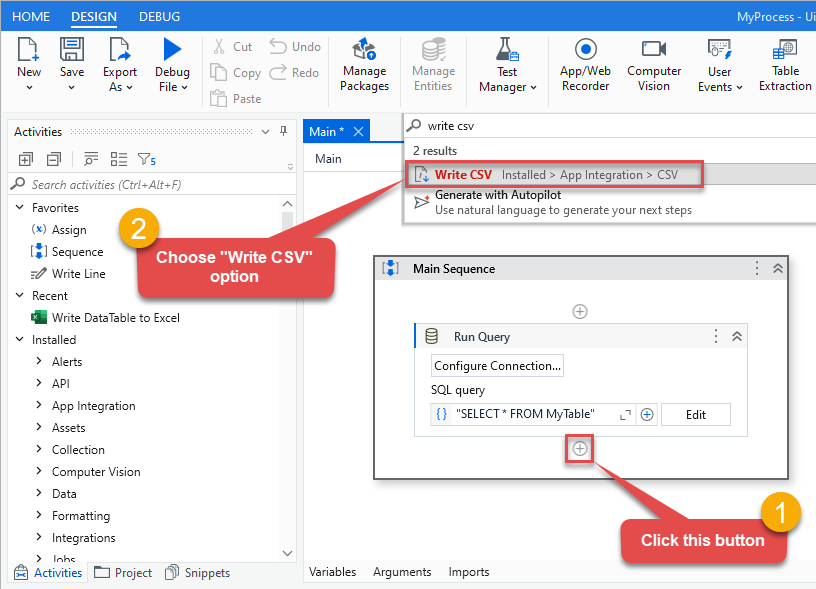 In this article we are using Write CSV, but you can freely add any other destination of your choice, e.g. Write DataTable to Excel.
 -
Once you do that, configure the added Write CSV, this will write JDBC-ODBC Bridge data to a CSV file:
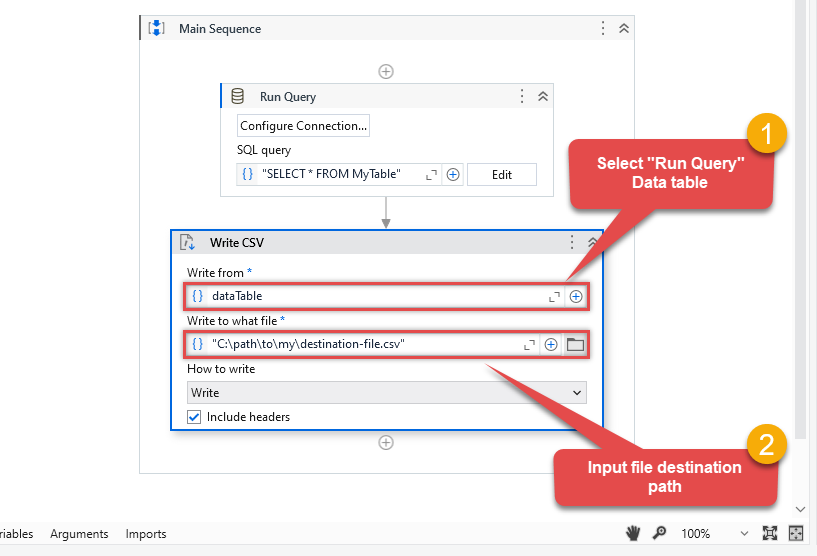
-
It's time for fun! Which means it's time for debugging! Just run the package locally to debug:
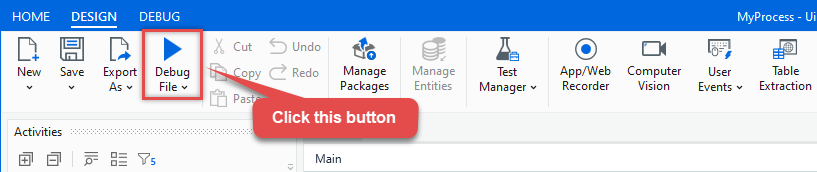
-
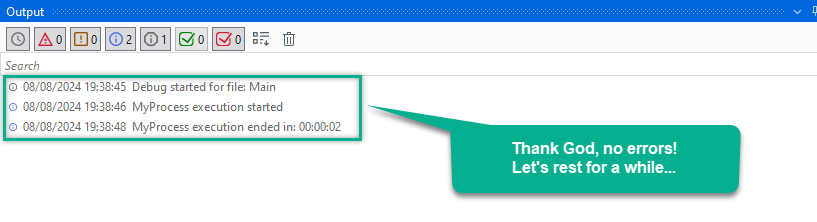
Finally, ensure there are no execution errors!
Run UiPath package using Orchestrator (via robot)
UiPath also offers the ability to execute packages remotely using Orchestrator and a robot. This is achieved by publishing the package to UiPath Orchestrator, installing UiPath Assistant on the remote machine, connecting it to Orchestrator, enabling us to run the package remotely. It may sound complicated at first glance, but further steps will clear things out. Let's not waste our precious time and delve into the details!
Publish process package from UiPath Studio
- First of all, open the UiPath process package we created in the previous step
-
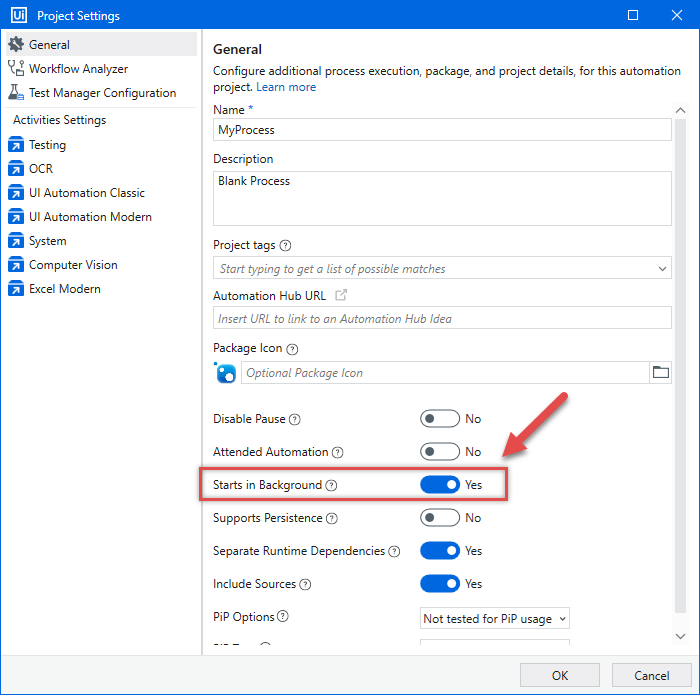
Set the option that our process package Starts in Background:
-
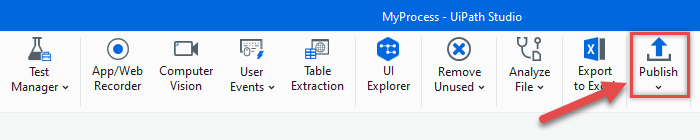
We are ready to Publish it:
-
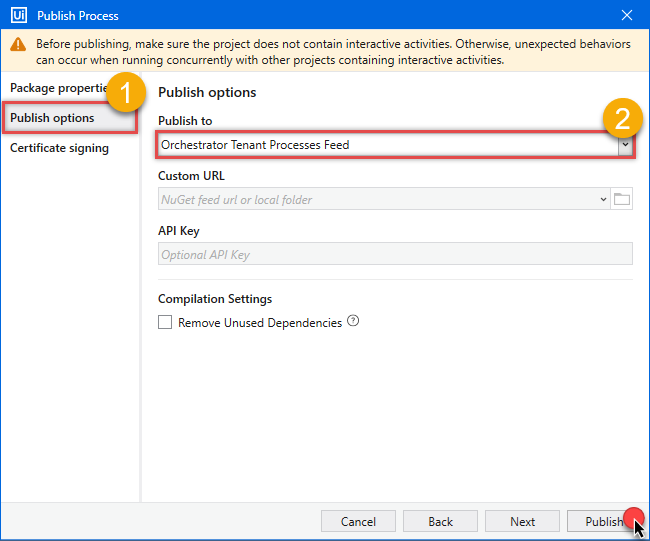
Make sure, you publish it to the Shared folder in UiPath Orchestrator Tenant workspace:
-
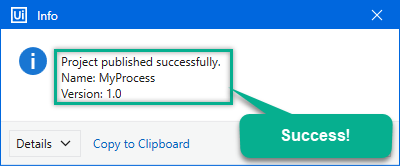
Finally, success! We are ready for the next step - creating UiPath robot - so we can automate the job:
Create robot in UiPath Orchestrator
-
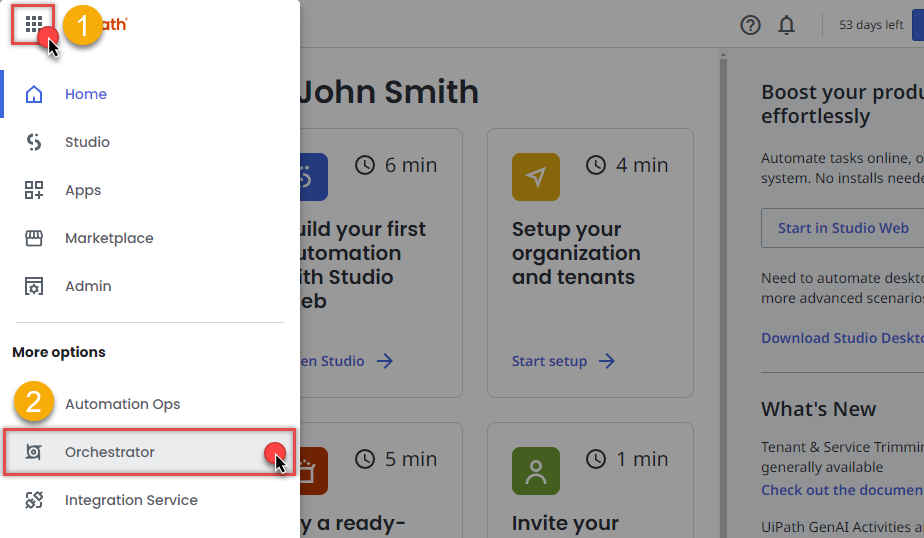
First of all, let's open UiPath Orchestrator from UiPath Automation Cloud console:
-
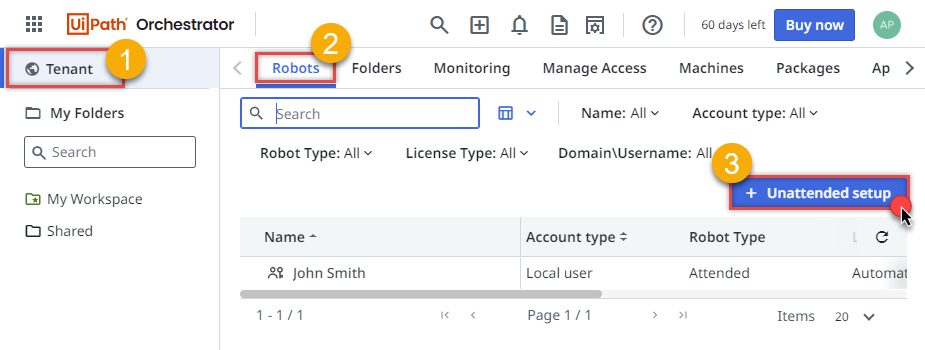
It's time to create a robot, which will run unattended packages:
-
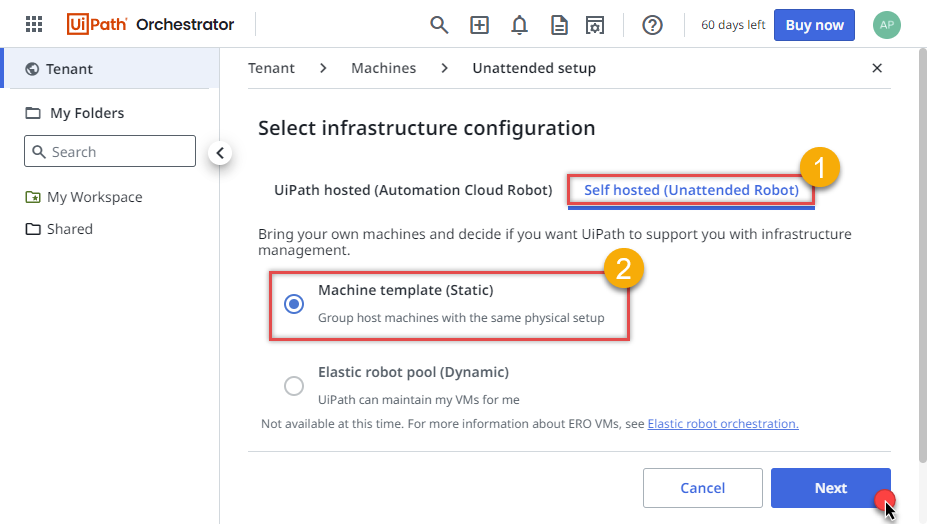
But first we have to create a runtime. Choose to host our robot on-premise, not in UiPath infrastructure:
-
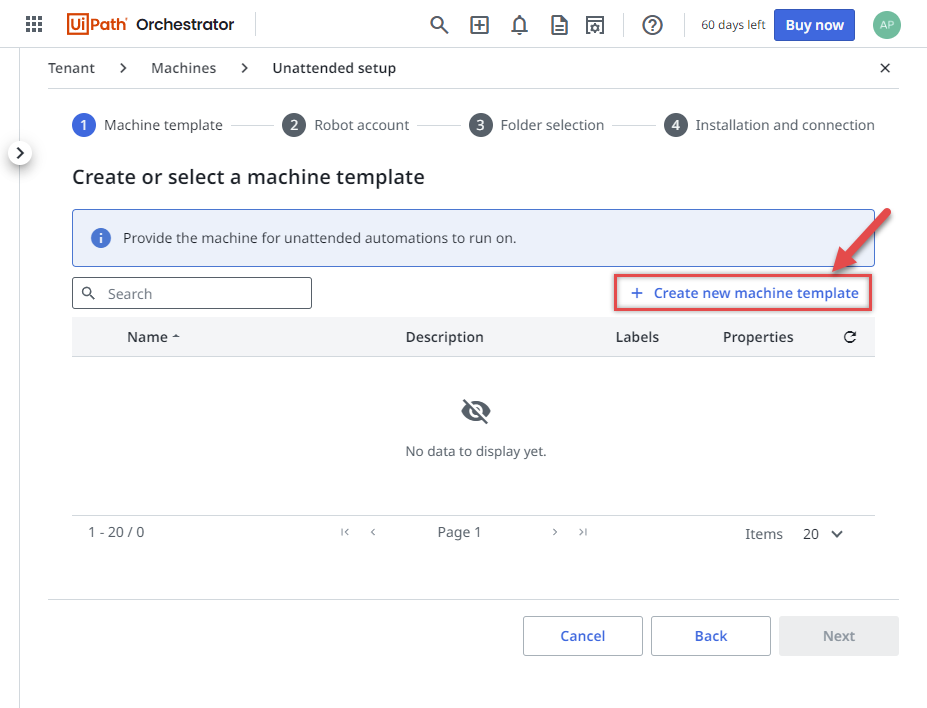
Let's move along and Create new machine template, this will create a machine in UiPath Orchestrator:
-
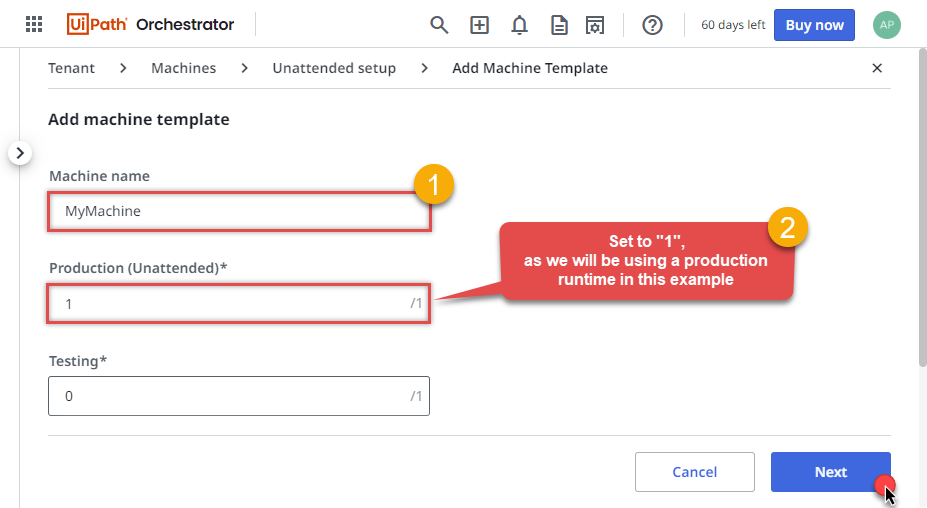
Configure the machine to run in Production environment:
-
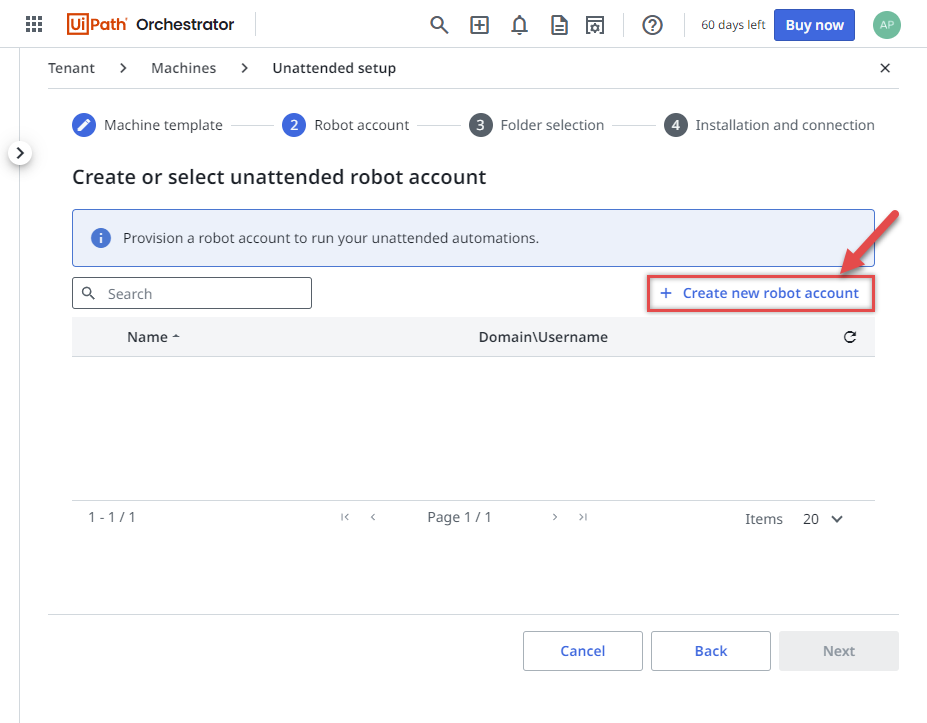
We are ready to Create new robot account in the new machine:
-
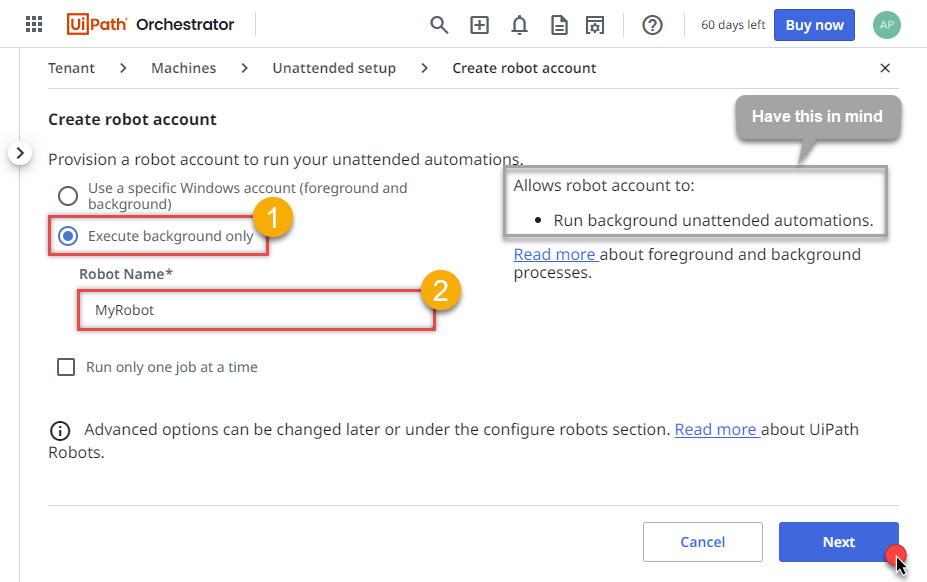
Let's make our robot to work only on background automations:
-
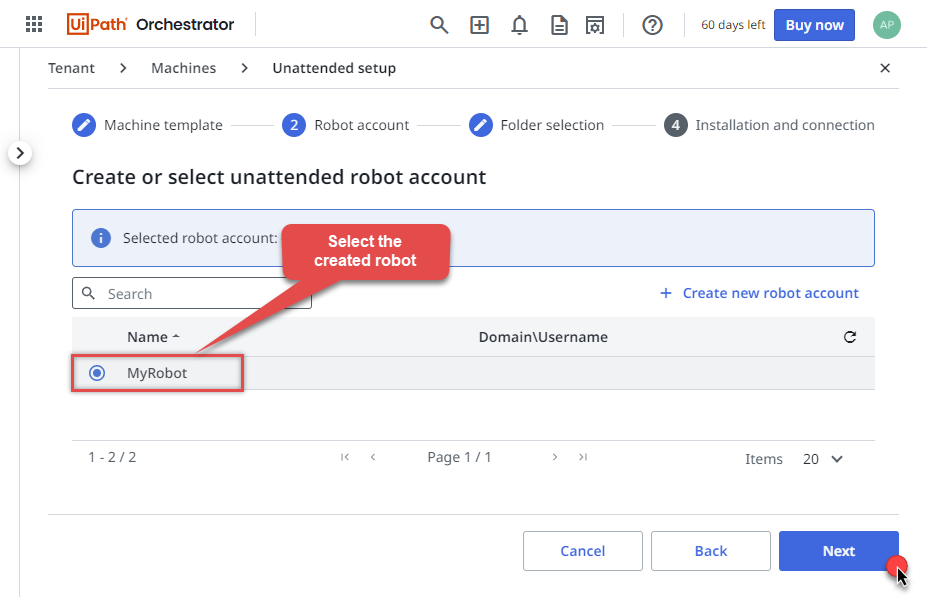
Continue by selecting newly created robot:
-
Select Shared folder, so that everyone in the team can benefit from it:
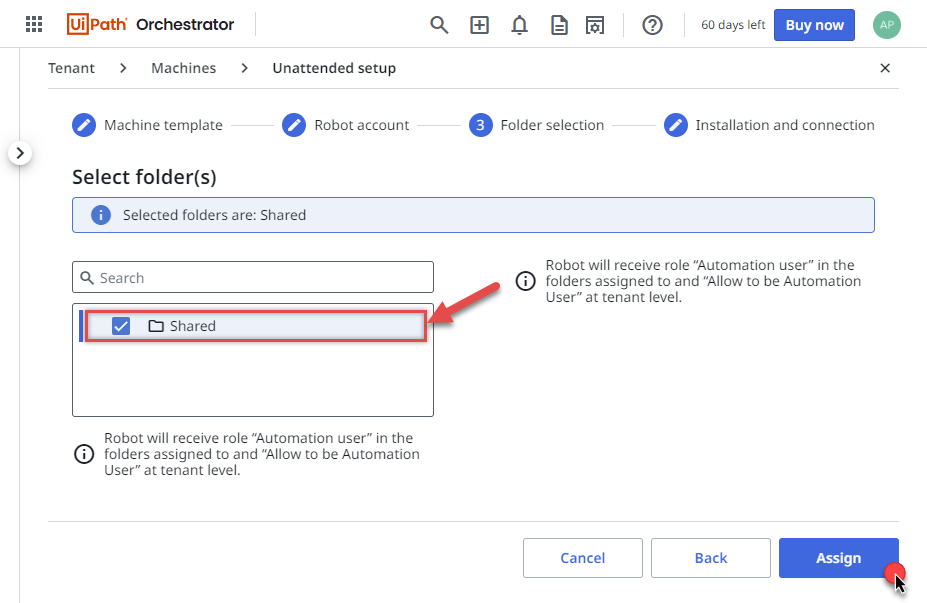 This is the folder where we published our UiPath process package "MyProcess"
 -
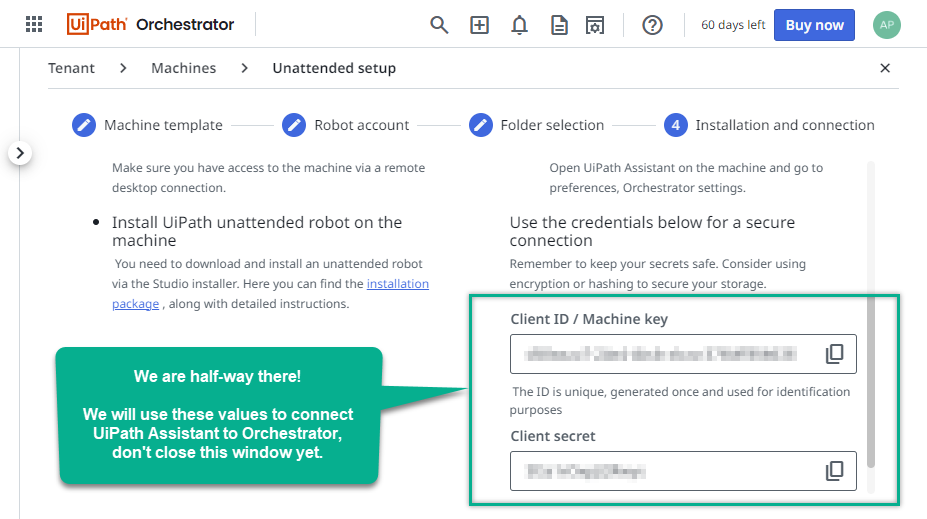
We are almost done!
We are given machine Client ID and Client secret which we will use to connect UiPath Assistant to our created machine in Orchestrator.
Let's leave this open for a while and see how we can do it in the next step.
Connect UiPath Assistant to Orchestrator
We are ready to connect UiPath Assistant to the machine we created in Orchestrator. UiPath Assistant will run our package in a remote machine. Let's connect it and give it some work!
- Connect to a remote machine (where your UiPath process package will be running).
- Install UiPath Studio there.
- Then configure ODBC data source:
If you chose Use user or system data source option in connection configuration, when creating UiPath process package, then create an identical ODBC data source on the same remote machine. Use the same configuration as the one created in your workstation in the first step.
Use Copy Settings and Load Settings buttons to make your life easier. They will help you to transfer settings between different ODBC data sources.If you chose Use connection string option, then you don't have to do anything. However, you still have to install ODBC PowerPack on the remote machine.
-
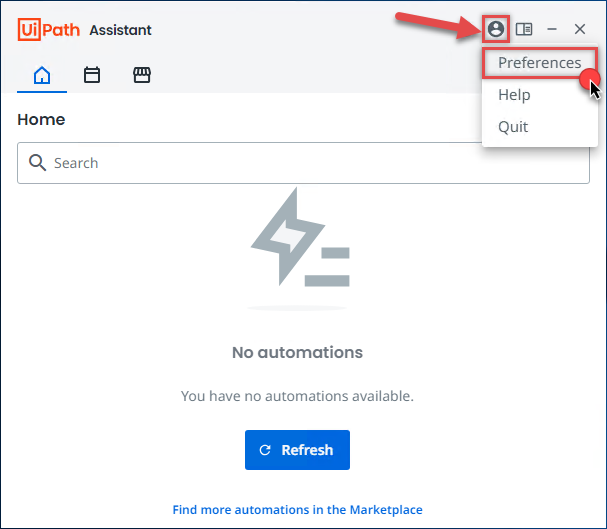
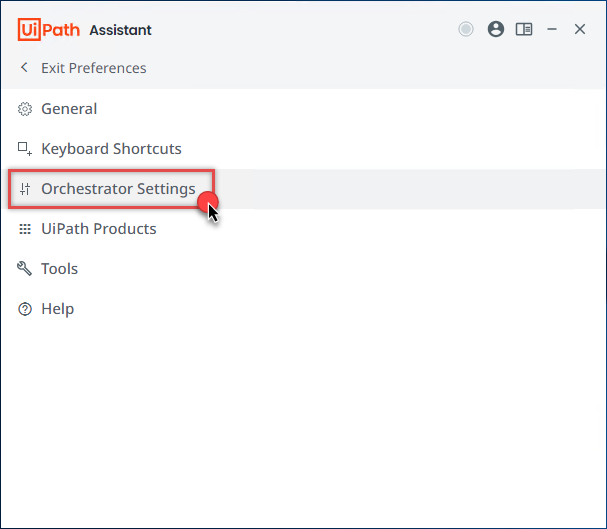
Continue by opening UiPath Assistant and going to Preferences:
-
Find Orchestrator Settings menu item and click it:
-
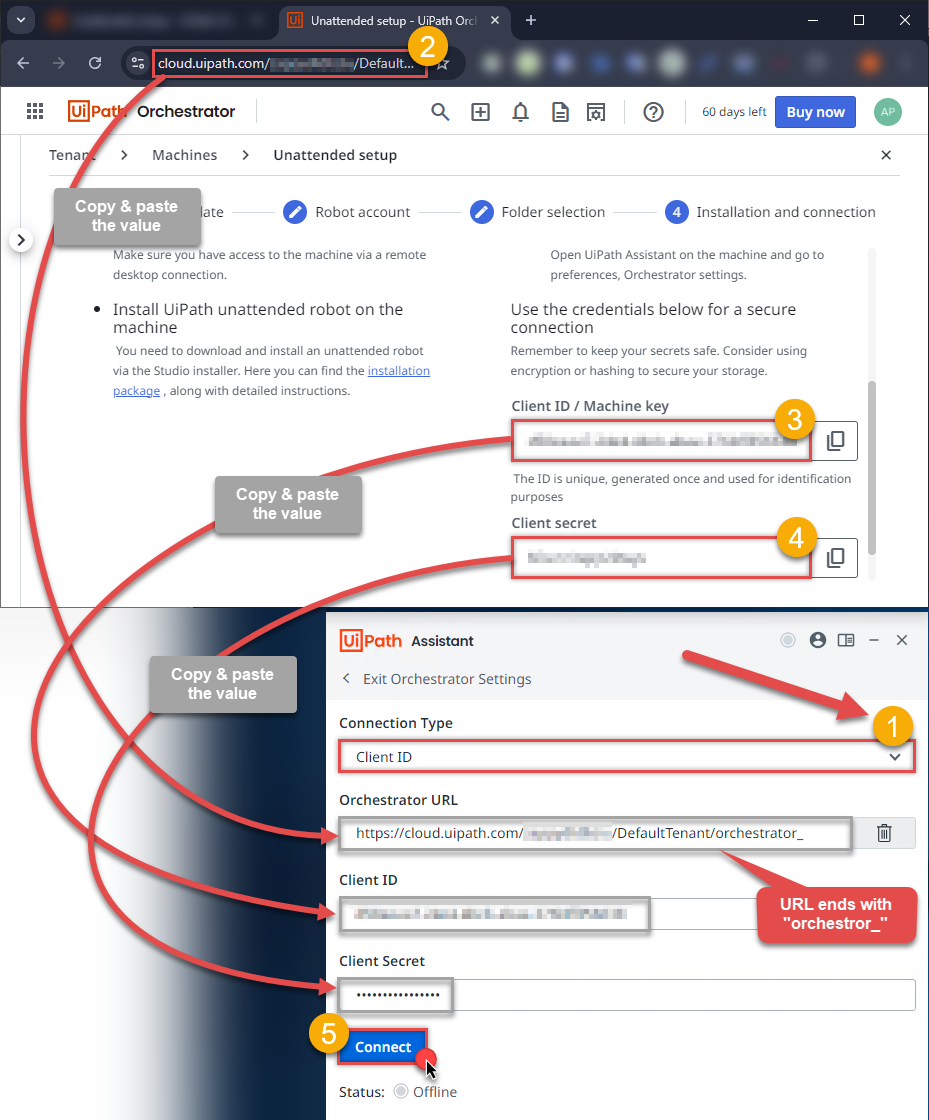
And here even bigger fun begins! But fear not, all you have to do is open your web browser window with Client ID & Client secret we obtained in the previous step and simply copy and paste those values into UiPath Assistant. Also, don't forget to configure Orchestrator URL:
-
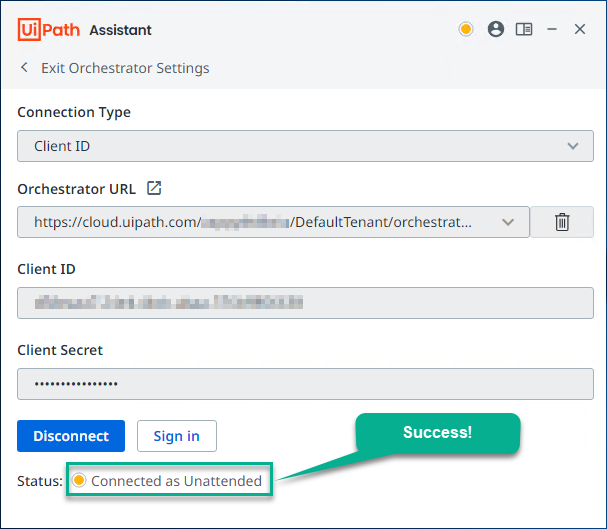
Finally, we get rewarded for the hard work with the Connected as Unattended status:
Create and run UiPath process in Orchestrator
We are at the finish line! Let's create and run UiPath process. This will execute the package on your remote machine using the UiPath Assistant configured earlier.
- First of all, open UiPath Orchestrator from UiPath Automation Cloud console.
-
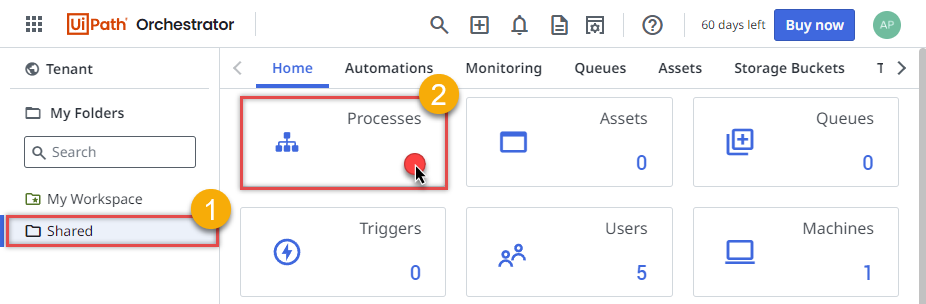
Then proceed by going to Process in Shared folder:
-
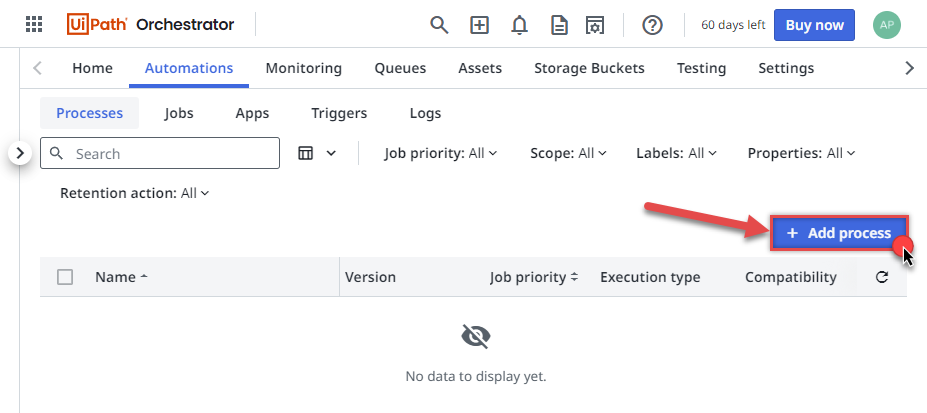
Continue by simply clicking on Add process button:
-
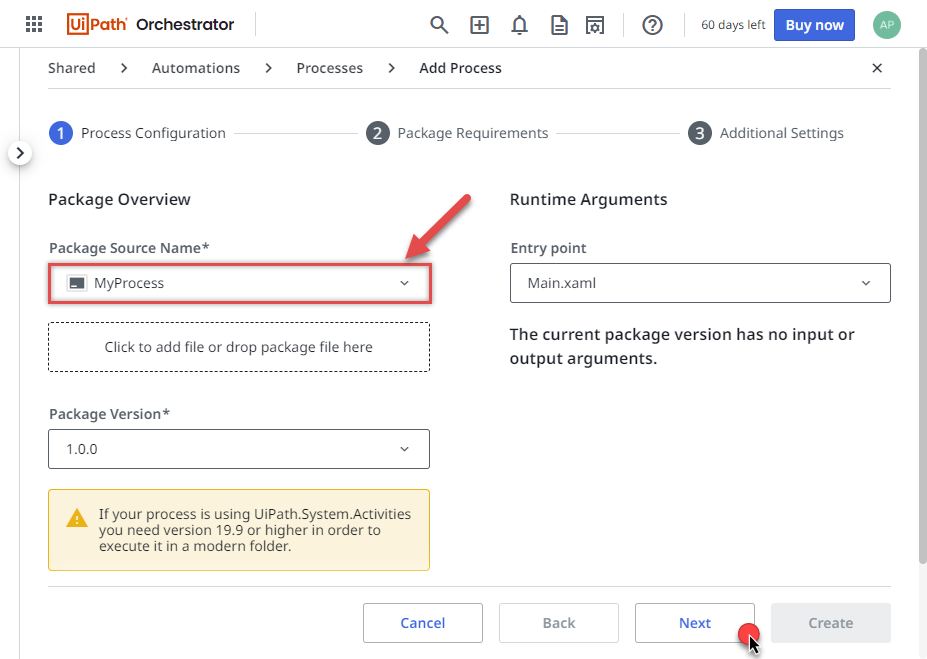
Select the process package we created in UiPath Studio:
-
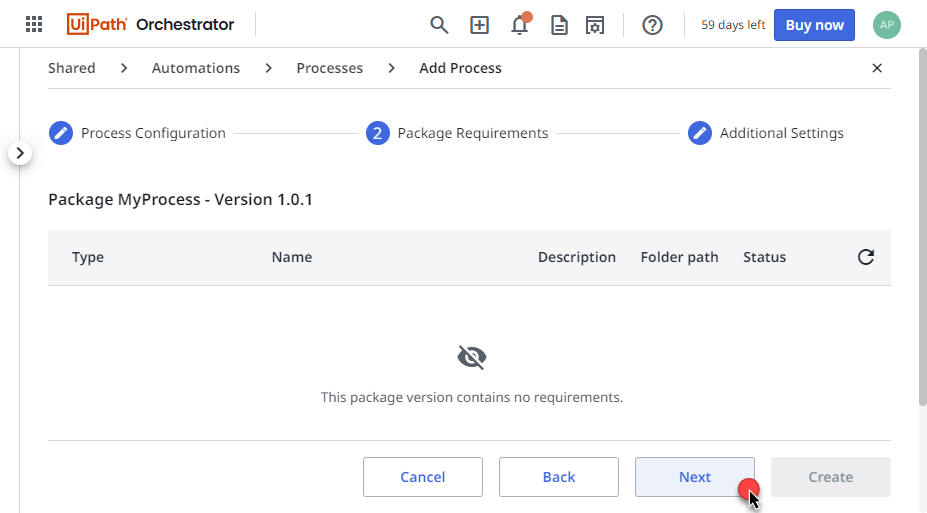
Rest a while, and just hit Next, unless your package has requirements:
-
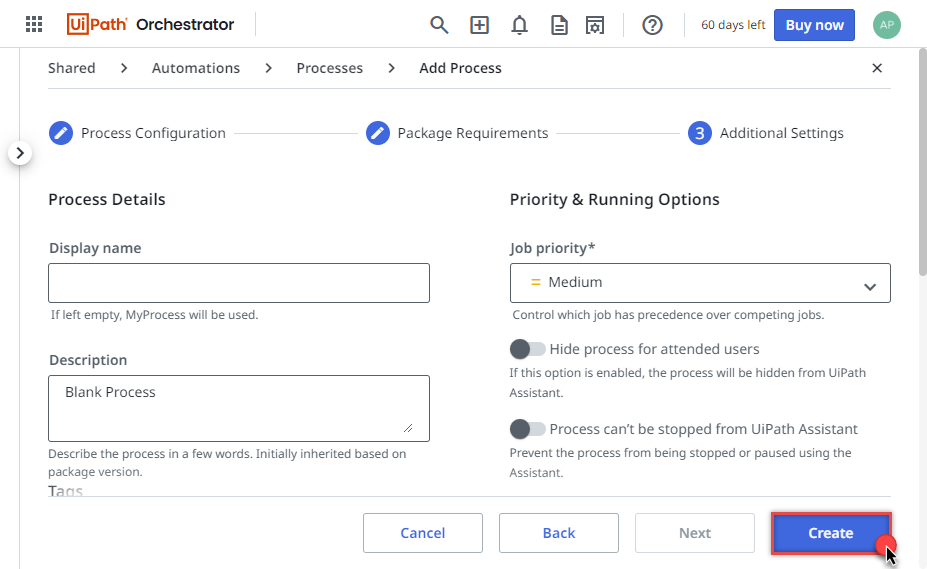
Then simply hit Create button:
-
But let's not stop here and Start the process by creating a job right away:
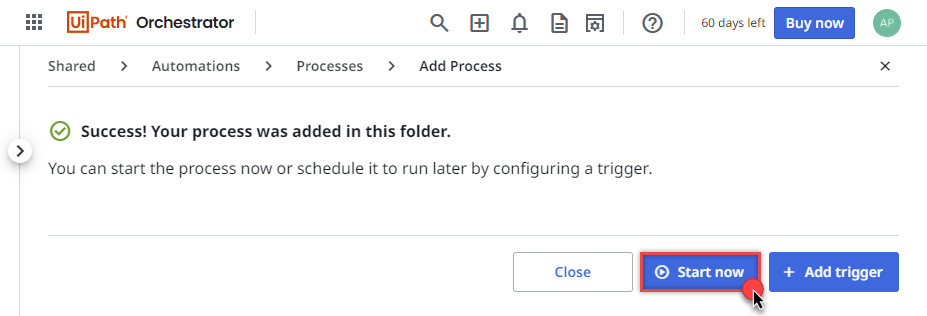
-
Use the same Production runtime we created before and hit Start:
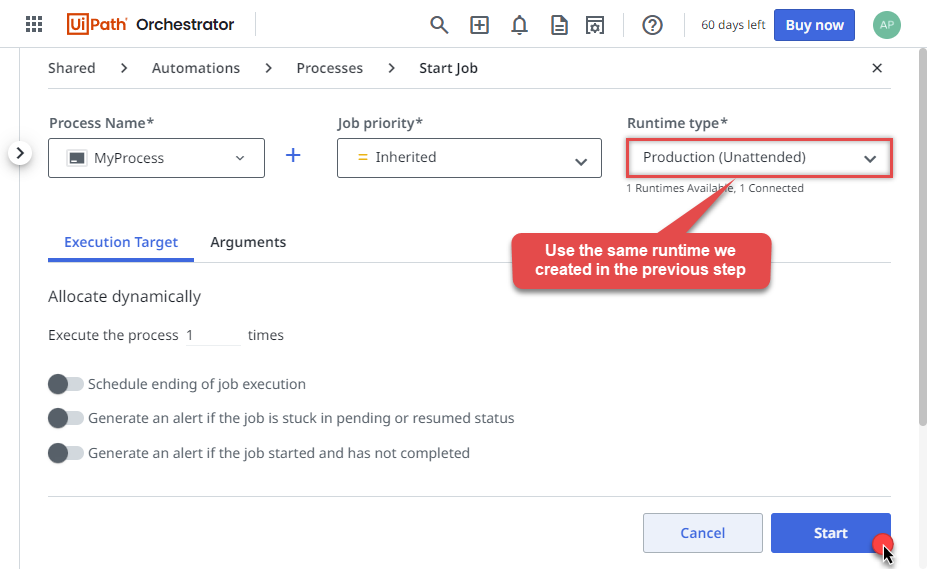
-
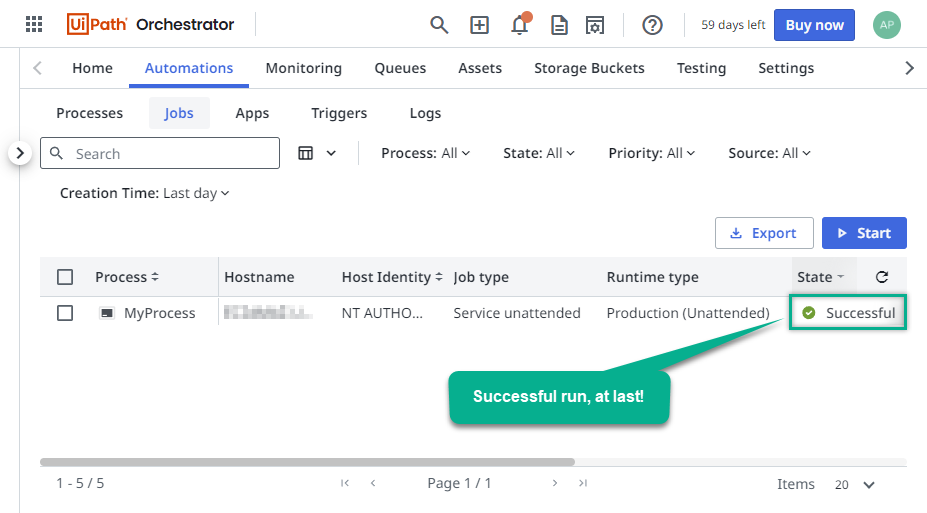
We've reached the final step! In the CSV destination file or destination of your choice you should see JDBC-ODBC Bridge data:
Optional: Centralized data access via ZappySys Data Gateway
In some situations, you may need to provide JDBC-ODBC Bridge data access to multiple users or services. Configuring the data source on a Data Gateway creates a single, centralized connection point for this purpose.
This configuration provides two primary advantages:
-
Centralized data access
The data source is configured once on the gateway, eliminating the need to set it up individually on each user's machine or application. This significantly simplifies the management process.
-
Centralized access control
Since all connections route through the gateway, access can be governed or revoked from a single location for all users.
| Data Gateway |
Local ODBC
data source
|
|
|---|---|---|
| Simple configuration | ||
| Installation | Single machine | Per machine |
| Connectivity | Local and remote | Local only |
| Connections limit | Limited by License | Unlimited |
| Central data access | ||
| Central access control | ||
| More flexible cost |
To achieve this, you must first create a data source in the Data Gateway (server-side) and then create an ODBC data source in UiPath (client-side) to connect to it.
Let's not wait and get going!
Create JDBC-ODBC Bridge data source in the gateway
In this section we will create a data source for JDBC-ODBC Bridge in the Data Gateway. Let's follow these steps to accomplish that:
-
Search for
gatewayin the Windows Start Menu and open ZappySys Data Gateway Configuration: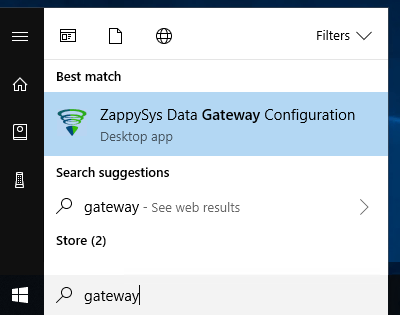
-
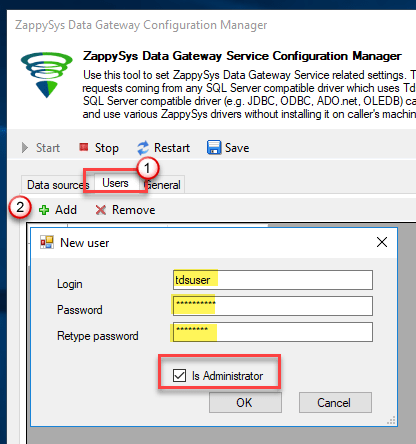
Go to the Users tab and follow these steps to add a Data Gateway user:
- Click the Add button
-
In the Login field enter a username, e.g.,
john - Then enter a Password
- Check the Is Administrator checkbox
- Click OK to save
-
Now we are ready to add a data source:
- Click the Add button
- Give the Data source a name (have it handy for later)
- Then select Native - ZappySys JDBC Bridge Driver
- Finally, click OK
JdbcOdbcBridgeDSNZappySys JDBC Bridge Driver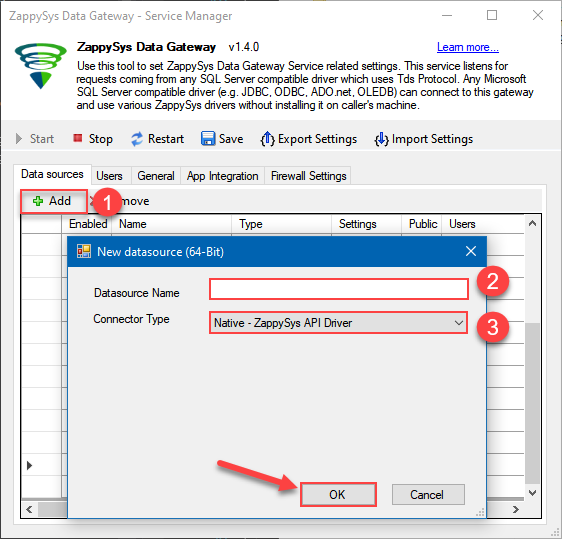
-
When the ZappySys JDBC Bridge Driver configuration window opens, go back to ODBC Data Source Administrator where you already have the JDBC-ODBC Bridge ODBC data source created and configured, and follow these steps on how to Import data source configuration into the Gateway:
-
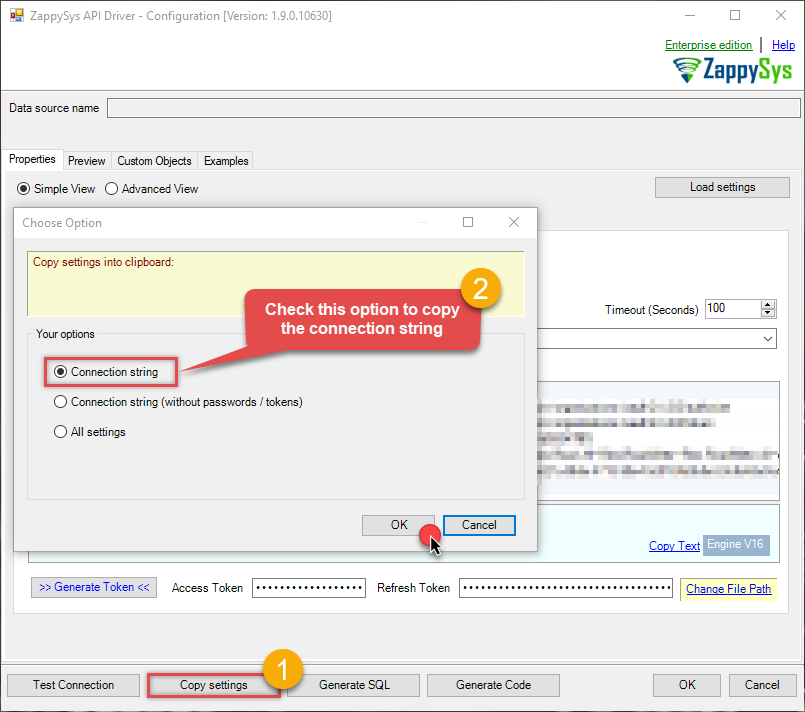
Open ODBC data source configuration and click Copy settings:
ZappySys JDBC Bridge Driver - JDBC-ODBC BridgeRead and write JDBC data effortlessly. Connect ODBC applications to Java-based services using standard JDBC drivers (.jar) for analytics, reporting, and data pipelines — almost no coding required.JdbcOdbcBridgeDSN
-
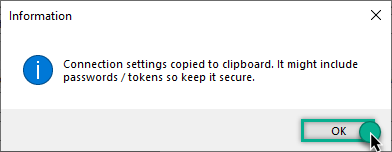
The window opens, telling us the connection string was successfully copied to the clipboard:
-
Then go to Data Gateway configuration and in data source configuration window click Load settings:
JdbcOdbcBridgeDSN
ZappySys JDBC Bridge Driver - Configuration [Version: 2.0.1.10418]ZappySys JDBC Bridge Driver - JDBC-ODBC BridgeRead and write JDBC data effortlessly. Connect ODBC applications to Java-based services using standard JDBC drivers (.jar) for analytics, reporting, and data pipelines — almost no coding required.JdbcOdbcBridgeDSN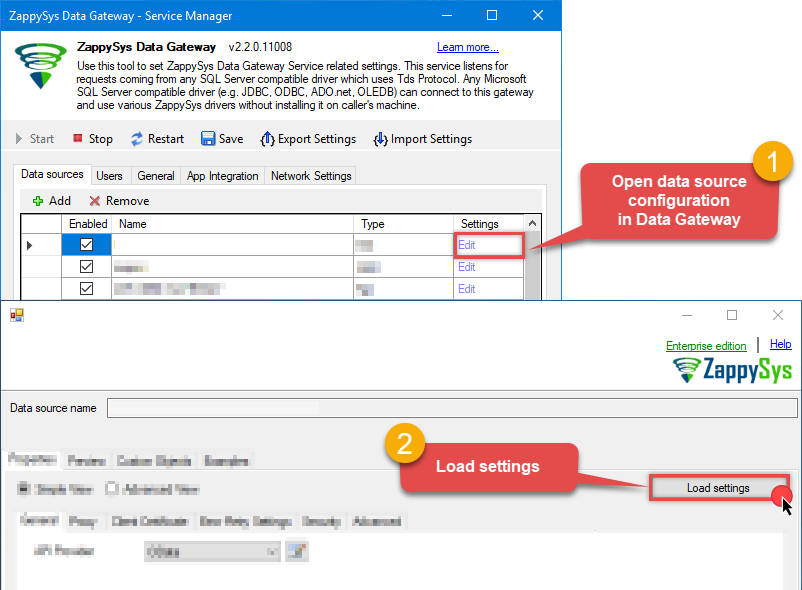
-
Once a window opens, just paste the settings by pressing
CTRL+Vor by clicking right mouse button and then Paste option.
-
Open ODBC data source configuration and click Copy settings:
-
Once done, go to the Network Settings tab and Add a firewall rule for inbound traffic:
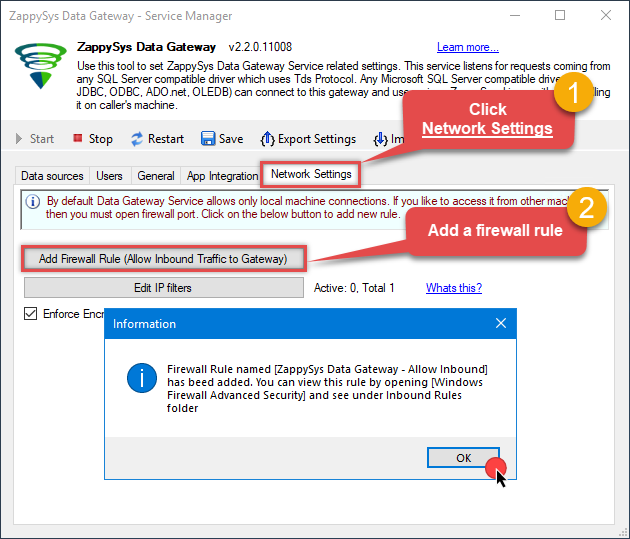
- This will initially allow all inbound traffic.
- Click Edit IP filters to restrict access to specific IP addresses or ranges.
-
Crucial Step: After creating or modifying the data source, you must:
- Click the Save button to persist your changes.
- Hit Yes when prompted to restart the Data Gateway service.
This ensures all changes are properly applied:
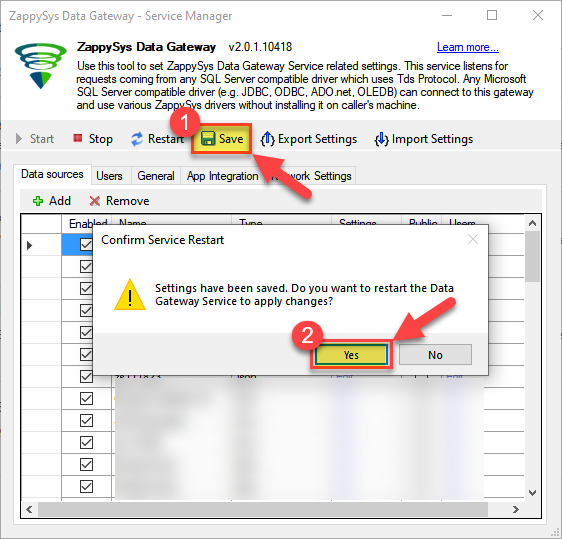 Skipping this step may cause the new settings to fail, preventing you from connecting to the data source.
Create ODBC data source to connect to the gateway
In this part we will create an ODBC data source to connect to the ZappySys Data Gateway from UiPath. To achieve that, let's perform these steps:
-
Search for
odbcand open the ODBC Data Sources (64-bit):
-
Create a User data source (User DSN) based on the ODBC Driver 17 for SQL Server driver:
ODBC Driver 17 for SQL Server
If you don't see the ODBC Driver 17 for SQL Server driver in the list, choose a similar version. -
Then set a Name for the data source (e.g.
Gateway) and the address of the Data Gateway:ZappySysGatewayDSNlocalhost,5000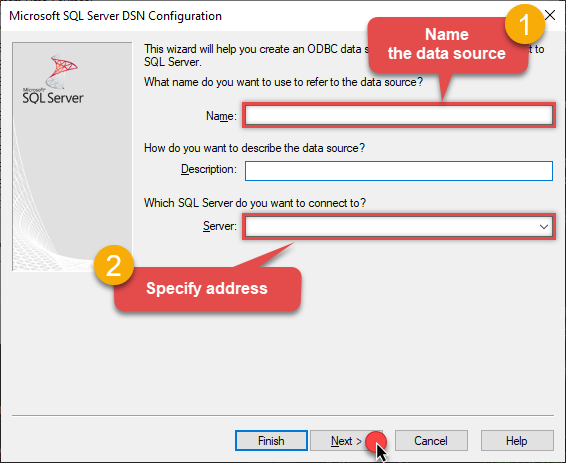 Make sure you separate the hostname and port with a comma, e.g.
localhost,5000. -
Proceed with the authentication part:
- Select SQL Server authentication
-
In the Login ID field enter the user name you created in the Data Gateway, e.g.,
john - Set Password to the one you configured in the Data Gateway
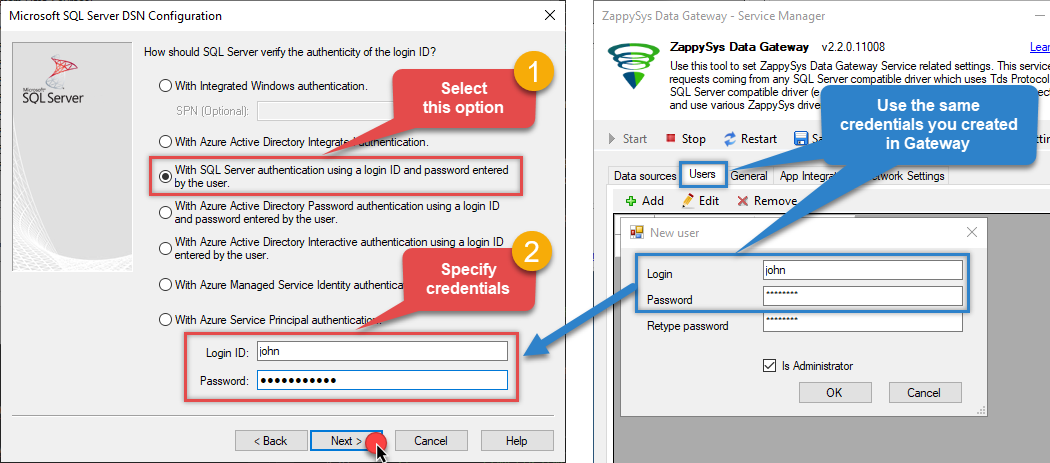
-
Then set the default database property to
JdbcOdbcBridgeDSN(the one we used in the Data Gateway):JdbcOdbcBridgeDSNJdbcOdbcBridgeDSN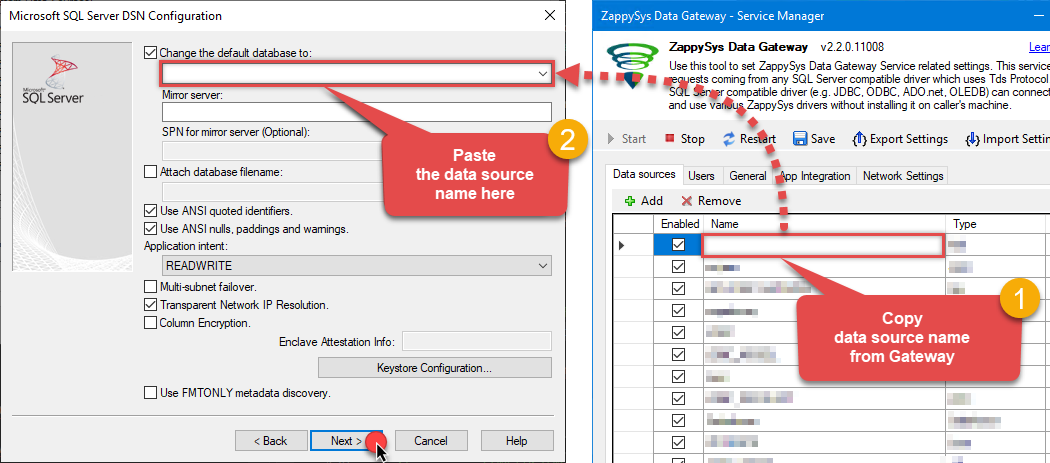 Make sure to type the data source name manually or copy/paste it directly into the field. Using the dropdown might fail because the Trust server certificate option is not enabled yet (next step).
 -
Continue by checking the Trust server certificate option:
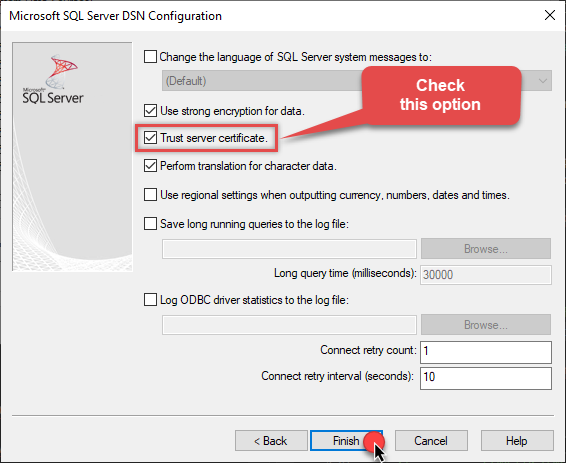
-
Once you do that, test the connection:
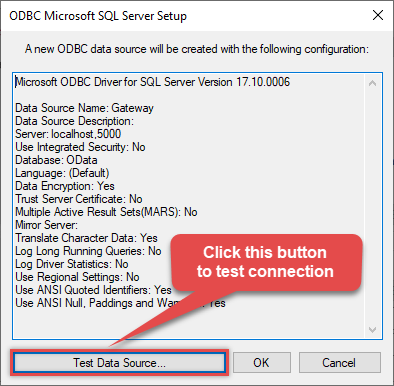
-
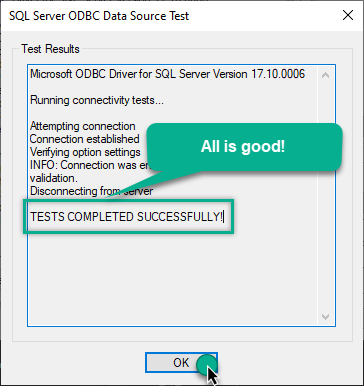
If the connection is successful, everything is good:
-
Done!
We are ready to move to the final step. Let's do it!
Access data in UiPath via the gateway
Finally, we are ready to read data from JDBC-ODBC Bridge in UiPath via the Data Gateway. Follow these final steps:
-
Go back to UiPath.
-
Add Run Query activity in Main Sequence box:
-
Click Configure Connection... button to create an ODBC connection:
-
Continue by clicking Connection Wizard:
-
When the window opens, select ODBC-based driver, provider, and then choose ODBC data source:
ZappySysGatewayDSNZappySysGatewayDSN
You can also select Use connection string option and use whole ODBC connection string instead. Obtain the connection string by pressing Copy Settings button in your data source configuration. -
Read the data the same way we discussed at the beginning of this article.
-
That's it!
Now you can connect to JDBC-ODBC Bridge data in UiPath via the Data Gateway.
john and your password.
Troubleshooters & resources (JDBC Bridge Driver)
Below are some useful community articles to help you troubleshoot and configure the ZappySys JDBC Bridge Driver:
-
How to combine multiple JAR files
Learn how to merge multiple
.jardependencies when your JDBC driver requires more than one file. -
How to fix JBR error: “Data lake is not available / Unable to verify trust for server certificate chain”
Resolve SSL or certificate validation issues encountered during JDBC connections.
-
System Exception: “Java is not installed or not accessible”
Fix Java path or environment issues that prevent the JDBC Bridge from launching Java.
-
JDBC Bridge Driver disconnect from Java host error
Troubleshoot unexpected disconnection problems between SSIS and the Java process.
-
Error: Could not open jvm.cfg while using JDBC Bridge Driver
Resolve JVM configuration path errors during driver initialization.
-
How to enable JDBC Bridge Driver logging
Enable detailed driver logging for better visibility during troubleshooting.
-
How to pass JDBC connection parameters (not by URL)
Learn how to specify connection properties programmatically instead of embedding them in the JDBC URL.
-
How to fix JDBC Bridge error: “No connection could be made because the target machine actively refused it”
Troubleshoot firewall or local port binding issues preventing communication with the Java host.
-
How to use JDBC Bridge options (System Property for Java command line, e.g., classpath, proxy)
Configure custom Java options like classpath and proxy using JDBC Bridge system properties.
Conclusion
In this article we showed you how to connect to JDBC-ODBC Bridge in UiPath and integrate data without writing complex code — all of this was powered by JDBC-ODBC Bridge Driver. ZappySys JDBC Bridge Driver allows you to connect to any Java application that supports JDBC.
Download ODBC PowerPack now or ping us via chat if you have any questions or are looking for a specific feature (you can also reach out to us by submitting a ticket):