ODBC JDBC Bridge Driver
Bridge JDBC data sources into ODBC-compatible tools and applications.
Use any JDBC driver from apps that only speak ODBC, such as Excel, Power BI, C# and Informatica. Add the driver .jar, connect with a JDBC URL, and run SELECT, INSERT, UPDATE and DELETE against the source.
Included in the Enterprise edition and above
- Any ODBC-compliant tool
- Runs in your environment
- SQL Server via Data Gateway
- 32-bit and 64-bit


At a glance
What the JDBC Bridge Driver can do
Bridge JDBC data sources into ODBC-compatible tools and applications.
JDBC to ODBC
Load any JDBC driver (a .jar), connect with a JDBC URL and use the database from ODBC tools.
- Any JDBC-compliant database
- JDBC URL and driver class
- Connection properties
Read and write
SELECT, INSERT, UPDATE and DELETE are passed to the JDBC data source.
- DML statements
- Virtual tables
- Stored procedures where the source supports them
Works with the tools you have
Any ODBC-compliant tool can use the DSN: Power BI, Tableau, Qlik, SSRS, Informatica, Excel and SSIS.
- Create a DSN once, reuse it everywhere
- 32-bit and 64-bit ODBC
- Stored in the standard ODBC Data Source Administrator
Use it from code
Connect from Java, C#, Python, PowerShell and more with an ODBC connection string that names the DSN.
- Standard ODBC connection strings
- Parameterized queries
- Same SQL as in the UI
SQL Server via Data Gateway
Query the driver from SQL Server (linked server / OPENQUERY) without installing it on the SQL Server machine, through the Data Gateway.
- No driver install on the server
- Works with SQL Server 2012 through 2025 (32/64 bit)
- Same DSN, same SQL
See all features
- In few clicks read /write data from any JDBC Driver in non JAVA apps (i.e. Excel, Power BI, C#).
- Support for Query Preview UI
- Support for Data Gateway to integrate JDBC driver in SQL Server Code (T-SQL)
SQL Server 2012–2025
Ways to use it
Pick how you reach your data.
Configure the DSN once, then query it from any ODBC tool or from SQL Server.
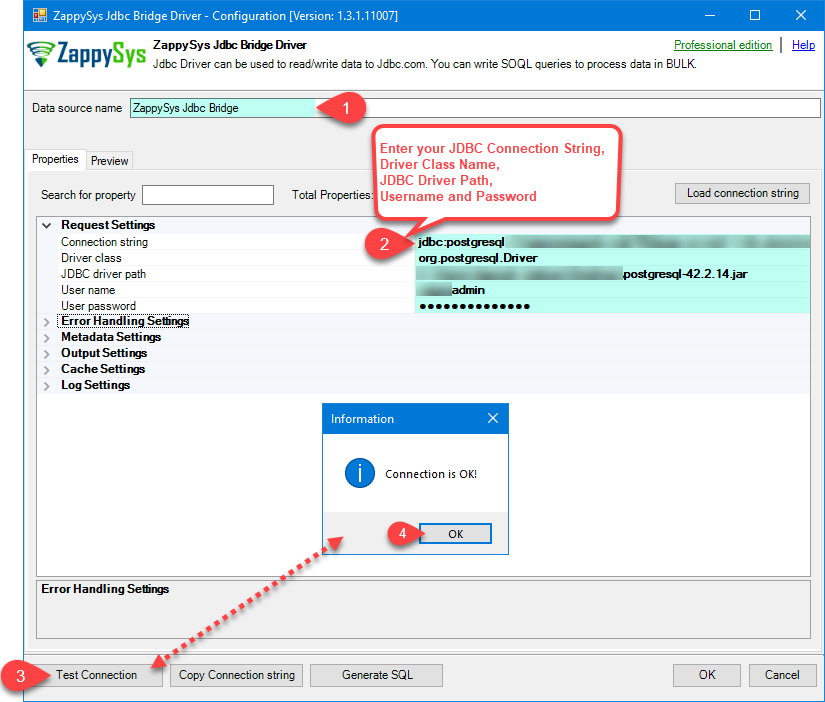
Add a JDBC driver and connect.
Choose the driver jar, enter the JDBC URL and connection properties.
- Any JDBC database
- JDBC URL
- Test connection
Run SQL against the JDBC source.
SELECT and DML are passed to the data source.
- SELECT / INSERT / UPDATE / DELETE
- Preview in the UI
- Use from any ODBC tool
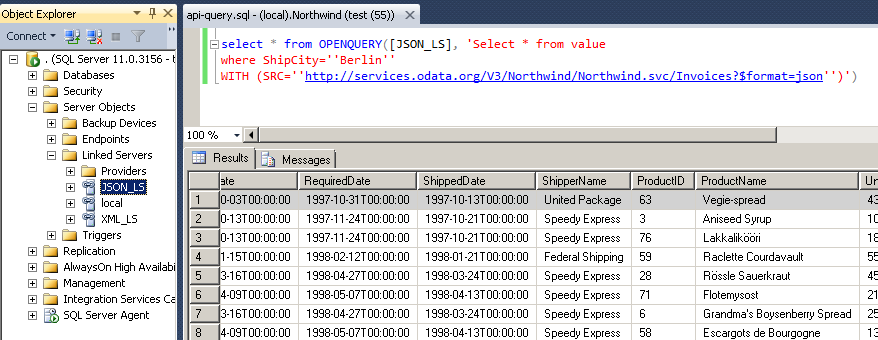
Query it from SQL Server with Data Gateway.
Expose the driver through the ODBC PowerPack Data Gateway and create a linked server in SQL Server. The driver does not have to be installed on the SQL Server machine.
- Linked server or OPENQUERY
- No driver install on the server
- Works with SQL Server 2012 through 2025 (32/64 bit)
Inside the UI
The driver UI, step by step.
Real screens from the ZappySys ODBC driver configuration.
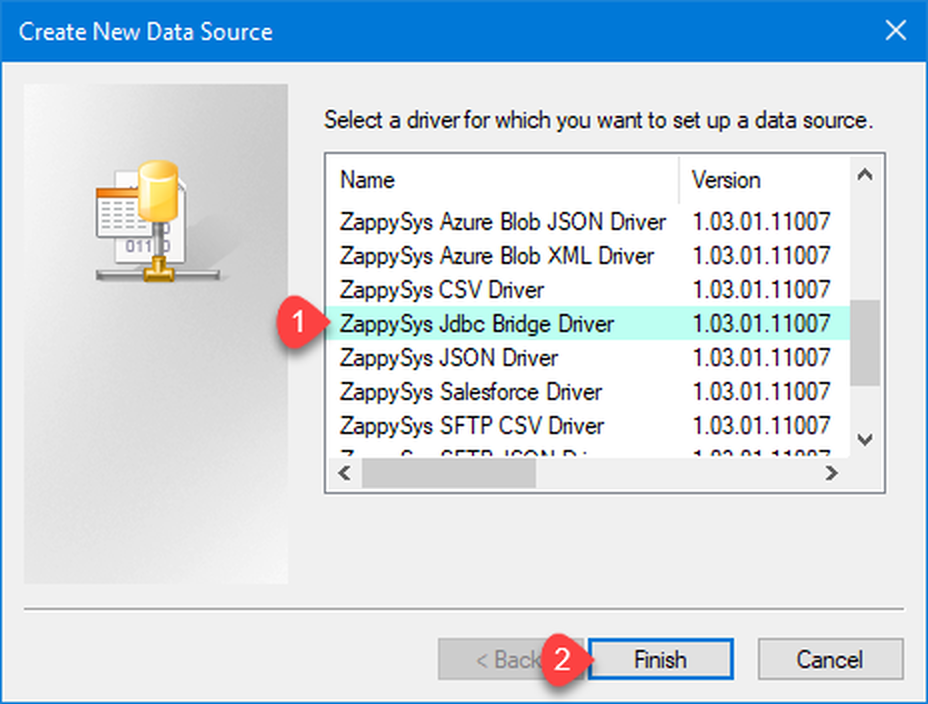
Create the DSN
Add a user or system DSN and pick the JDBC Bridge Driver.
SQL example
Use any JDBC driver from ODBC.
The bridge loads a JDBC driver (a .jar), connects with a JDBC URL and exposes the database to ODBC tools. DML statements are passed through.
-
JDBC connection
A JDBC URL and the driver jar, for example for PostgreSQL.
Driver class : org.postgresql.Driver URL : jdbc:postgresql://my-host-name:5432/my-db-name -
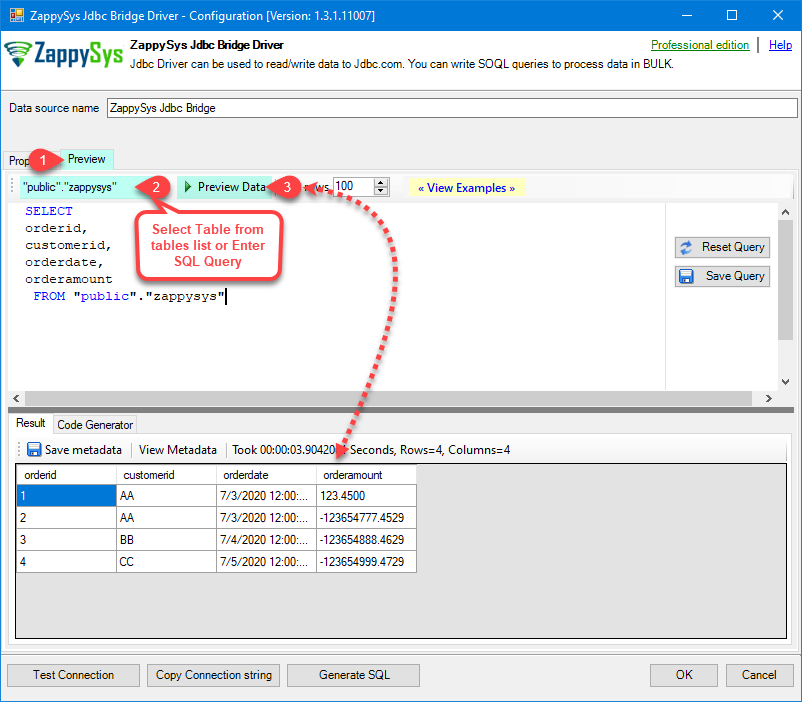
Run the SQL query
SQL Query
SELECT * FROM MyTableSELECT, INSERT, UPDATE and DELETE are passed to the JDBC data source.
Data Gateway lets SQL Server use the driver without installing it on the server.
-
Rows returned to your tool
Result Rows of MyTable, as returned by the JDBC source Any ODBC-compliant tool can read the result.
Statements taken from the driver help.
SQL query examples
Copy a query, change the source, run it.
7 of the 7 examples from the JDBC Bridge Driver help. Open one to see the SQL.
Read files, API responses and objects as rows.
DML – SELECT Example
Output-On Flag
This example shows how to invoke statements which has multiple statements and produces result. If you are calling multiple statements then for some JDBC drivers you have to set this else it will not produce output or might throw error.
#Output-On CREATE TABLE MyTable(Id int); INSERT INTO MyTable(Id) Values(1); SELECT * From MyTable;Output-Off Flag
Using Java settings file (e.g. set HTTP Proxy, use java runtime path, enable log)
This example shows how to create java settings file in ZappySys to use additional options for Java runtime. This file affects all JDBC connection you invoke using ZappySys driver.
This example shows how to create java settings file in ZappySys to use additional options for Java runtime. This file affects all JDBC connection you invoke using ZappySys driver.

For example use this file if you have multiple java runtimes and you like to use specific java version.
--or-- you like to enable log file for additional logging
--or-- you like to pass runtime arguments to java.exe using java.arg options (e.g. enable HTTP Proxy or change memory settings).

Check this link to see all possible options you can pass in java.args setting below
https://docs.oracle.com/en/java/javase/17/docs/specs/man/java.html

To Use ZappySys Java Settings file use below steps.

1. Create a custom file called "JdbcBridge.properties" in the following location (assuming you installed at default location) C:\Program Files (x86)\ZappySys\ZappySys ODBC PowerPack\
2. You can paste following example lines to start with (use # to comment and remove it to uncomment option you need). Basically you can use app.logfile, java.path and java.args

#------------Start of file---------------------

######################################################
##Sample settings file for ZappySys JDBC Bridge
######################################################
####Enable Additional log from java side like below
#app.logfile=c:/temp/JdbcBridge_log.txt

####Set custom Java runtime path rather than using default path like below (uncomment / change as per your need)
#java.path=c:\JAVA\JDK8\bin\
#java.path=c:\Program Files\Amazon Corretto\jdk1.8.0_382\bin

####Enable HTTP/HTTPS Proxy like below (e.g. Use Fiddler Proxy or other Web Proxy)
#java.args= -Djava.net.useSystemProxies=true
#--OR--
#java.args= -Dhttps.proxyHost=127.0.0.1 -Dhttps.proxyPort=8888 -Dhttp.proxyHost=127.0.0.1 -Dhttp.proxyPort=8888
#--OR--
#Tools like Fiddler (web proxy tool) will need some extra settings to trust self-signed certificate
#https://azureossd.github.io/2017/04/26/capture-java-vm-traffic-using-fiddler/
#java.args= -Dhttps.proxyHost=127.0.0.1 -Dhttps.proxyPort=8888 -Dhttp.proxyHost=127.0.0.1 -Dhttp.proxyPort=8888 -Djavax.net.ssl.trustStore="c:\Program Files\Amazon Corretto\jdk1.8.0_382\bin\FiddlerKeystore" -Djavax.net.ssl.trustStorePassword=test123

#------------End of file---------------------INSERT, UPDATE, DELETE, UPSERT and bulk loads.
DML – UPDATE Example
This example shows how to use UPDATE one or more records in JDBC table. You can supply any valid SOQL compatible WHERE clause.
UPDATE account SET name='New Company Name', BillingState='GA' WHERE id IN ('0014N00001hTNEEQA4')DML – INSERT Example
This example shows how to create a new record in JDBC table.
INSERT INTO Account(Name, BillingCity,PK__c)
VALUES ('mycompany name', 'New York','K100')DML – DELETE Example
This example shows how to delete one or more records in JDBC table. You can supply any valid SOQL compatible WHERE clause.
DELETE FROM account WHERE id IN ('0014N00001hTNEEQA4')Run the same query from SQL Server or your own code.
SQL Server (linked server)
Query the driver from SQL Server through the Data Gateway. The driver does not have to be installed on SQL Server.
-- SQL Server: create a linked server to the ZappySys Data Gateway (here [ZAPPY_GATEWAY]),
-- then run the driver query through OPENQUERY.
SELECT *
FROM OPENQUERY([ZAPPY_GATEWAY], 'SELECT * FROM MyTable')
C# (System.Data.Odbc)
using System;
using System.Data.Odbc;

// Use a DSN ("DSN=MyZappyDsn;") or name the driver directly
using (var conn = new OdbcConnection("DRIVER={ZappySys JDBC Bridge Driver};"))
{
    conn.Open();
    var cmd = new OdbcCommand(@"SELECT * FROM MyTable", conn);
    using (var rdr = cmd.ExecuteReader())
    {
        while (rdr.Read())
        {
            for (int i = 0; i < rdr.FieldCount; i++)
                Console.Write("{0}={1}  ", rdr.GetName(i), rdr[i]);
            Console.WriteLine();
        }
    }
}
Python (pyodbc)
import pyodbc

# Use a DSN ("DSN=MyZappyDsn;") or name the driver directly
conn = pyodbc.connect("DRIVER={ZappySys JDBC Bridge Driver};")
cursor = conn.cursor()
cursor.execute(r"""
SELECT * FROM MyTable
""")
for row in cursor.fetchall():
    print(row)
conn.close()
PowerShell
$conn = New-Object System.Data.Odbc.OdbcConnection
$conn.ConnectionString = "DRIVER={ZappySys JDBC Bridge Driver};"   # or "DSN=MyZappyDsn"
$conn.Open()
$cmd = $conn.CreateCommand()
$cmd.CommandText = @'
SELECT * FROM MyTable
'@
$table = New-Object System.Data.DataTable
(New-Object System.Data.Odbc.OdbcDataAdapter($cmd)).Fill($table) | Out-Null
$conn.Close()
$table | Format-Table
Java (JDBC through Data Gateway)
// Java uses the ZappySys Data Gateway and the Microsoft SQL Server JDBC driver.
// On the gateway, add a data source (here "MyZappySource") that uses the ZappySys JDBC Bridge Driver.
import java.sql.*;

String url = "jdbc:sqlserver://localhost:5000;databaseName=MyZappySource;user=MyGatewayUser;password=MyPassword;encrypt=false";
String sql = "SELECT * FROM MyTable";
try (Connection conn = DriverManager.getConnection(url);
     Statement st = conn.createStatement();
     ResultSet rs = st.executeQuery(sql)) {
    while (rs.next()) {
        System.out.println(rs.getString(1));
    }
}
PHP (odbc_connect)
<?php
$conn = odbc_connect("DRIVER={ZappySys JDBC Bridge Driver};", "", "");   // or "DSN=MyZappyDsn"
$sql = <<<'SQL'
SELECT * FROM MyTable
SQL;
$rs = odbc_exec($conn, $sql);
while ($row = odbc_fetch_array($rs)) {
    print_r($row);
}
odbc_close($conn);Articles
Guides and tutorials for the JDBC Bridge Driver
Compatibility and requirements
Built for Windows, and for your own environment.
- Windows 11, 10, 8 and 7, and Windows Server 2022, 2019, 2016, 2012 R2 and 2008
- .NET Framework 4.x. The JDBC Bridge Driver also needs Java 8 or later
- 32-bit and 64-bit ODBC drivers. SQL Server 2012 through 2025 through the Data Gateway
- Self-hosted: drivers run in your Windows process, business data does not pass through ZappySys servers, and credentials stay in your DSN
- Free trial of ODBC PowerPack: test with your own data before you buy
FAQ
Questions about the JDBC Bridge Driver
Which tools and languages can use this driver?
Any ODBC-compliant tool, such as Power BI, Tableau, Qlik, SSRS, Informatica, Excel and SSIS. You can also connect from Java, C#, Python, PowerShell and other languages with an ODBC connection string.
Do I need to install the driver on SQL Server?
No. With the Data Gateway option the driver runs on the gateway machine and SQL Server connects to it through a linked server.
Which edition includes the JDBC Bridge Driver?
The JDBC Bridge Driver is included in the Enterprise edition of ODBC PowerPack. See the edition comparison for the full list.
Which databases can I reach?
Any data source that has a JDBC driver (for example PostgreSQL with a jdbc:postgresql:// URL).
Do I need Java installed?
Yes. Install a Java runtime (JRE or JDK, version 8 or higher). The help recommends JRE 8, and the driver needs the .jar file of your JDBC driver.
How do I troubleshoot a JDBC connection?
Turn on logging for the ODBC layer and for Java in the DSN, then read the log files. The help also explains how to read a Java crash error file.
Which SQL Server and Windows versions are supported?
Support for SQL Server 2025, 2022, 2019, 2017, 2016, 2014 and 2012 (32/64 bit) through the Data Gateway. See the system requirements.
Can I try it before buying?
Yes. Download ODBC PowerPack, create a DSN and test your own data before you buy.
Related drivers
Pair it with the rest of ODBC PowerPack.
 JSON / REST API DriverQuery JSON files and REST APIs with SQL, OAuth, pagination, and streaming for la
 XML / SOAP API DriverRead XML files and SOAP web services with XPath filters and familiar SQL.
 CSV / REST API DriverQuery CSV and flat files from disk or HTTP endpoints using SQL.
 Salesforce DriverQuery and write Salesforce objects with SOQL-friendly SQL over ODBC.
 Amazon S3 Driver for CSV FilesQuery CSV objects stored in Amazon S3 buckets.
 Data GatewayInstall once on any server. All client apps connect to it — no ODBC on every mac
What customers say
Start your free trial today
Install ODBC PowerPack and add a JDBC Bridge Driver DSN.
Preview your data in the driver UI before you connect your tool.
- One DSN, many toolsPower BI, Excel, SSIS, Python and SQL Server can all use it.
- Free trialTest the driver with your own data before you buy.
- Live supportHelp during your trial and after purchase.
Open Help FileBrowse all ODBC PowerPack drivers
New purchases may be eligible for refund review within 30 days. See the refund policy.
Talk to an engineer before or during your trial.