SSIS XML File Destination
Write simple or nested XML files from one or many Data Flow inputs, such as SQL Server, MySQL, flat files or Excel.
XML File Destination writes simple or nested XML files from single or multiple Data Flow inputs (e.g. SQL Server, MySQL, Flat File, Excel). Design the shape in a drag-and-drop layout editor with elements, attributes, document arrays and parent/child relations, then write one document for all records or one per parent record.
The trial includes XML File Destination and every other PowerPack component
- Data Flow Destination in SSIS
- Runs in your environment
- Also runs in Azure Data Factory
- Fully functional 30-day trial


At a glance
What XML File Destination can do
XML File Destination generates simple or complex XML files from single or multiple Data Flow inputs. In a few clicks you can shape XML from one or many tables, including parent/child nested documents.
Nested XML from multiple inputs
Generate simple or complex XML files from single or multiple Data Flow inputs (e.g. SQL Server, MySQL, Flat File, Excel).
- Parent/child nested documents from multiple tables
- Any Data Flow source can be attached (SQL Server, MySQL, Flat File, Excel and more)
Drag & drop layout editor
Design the XML shape in an easy drag-and-drop layout editor.
- Elements, attributes and document arrays
- Add or edit input datasets and parent/child relations
Output modes
Choose one XML document for all records or one per parent record with OutputMode.
- One XML document for all records (batching allowed)
- One XML document for each parent record, or a single dataset array (batching allowed)
ArrayBatchSizesets rows per batch for single dataset array mode
Namespaces & declaration
Control namespaces, the root element and the XML declaration.
Namespaces,RootElementNameandRootElementPrefix(e.g.<ns1:Root>)DoNotOutputXmlDeclarationandXmlStandAlone
NULL & empty-node handling
Leave out NULL attributes or elements and empty nested nodes.
DoNotOutputNullAttribute(otherwise output asxsi:nil="true")DoNotOutputEmptyNestedAttribute
Header, footer & formatting
Add document header and footer text and control indentation and culture-based formats.
DocumentHeader/DocumentFooter, or from an upstream columnIndentOutputfor pretty printDateTimeFormatandCulture
File write & encoding
Overwrite or append to the target file and choose the character encoding.
OverwriteIfExistsandAppendEncodingorCharacterSet(e.g. ISO-8859-1)
SQL Server 2012–2025 & ADF
Runs in your environment on SQL Server 2012–2025 and Azure-SSIS.
- SQL Server 2025, 2022, 2019, 2017, 2016, 2014, 2012 (32/64-bit)
- Azure Data Factory (SSIS IR)
- Design packages in Visual Studio 2017, 2019, 2022, or 2026
- Windows only (64-bit OS): Windows 7–11 or Windows Server 2012–2025
See all features
- Generate complex XML from single or multiple inputs
- Easy drag & drop layout editor for nested XML (arrays, attributes, elements)
- Parent/child nested documents from multiple tables
- Works with any upstream Data Flow source (e.g. SQL Server, MySQL, Flat File, Excel)
- Output modes: one document for all records, one per parent record, single dataset array
- Namespaces, root element name and prefix
- Optional XML declaration and standalone attribute
- Skip NULL attributes/elements and empty nested nodes
- Document header and footer text
- Indent output (pretty print), date/time format and culture settings
- Overwrite or append to the target file
- Encoding and character set options
- Logging modes with optional timestamp prefix
Support for SQL Server 2025, 2022, 2019, 2017, 2016, 2014, 2012 (32/64-bit) and Azure Data Factory
SQL Server 2012–2025
How it works
From the toolbox to your first run.
Connect inputs, pick the file and output mode, then shape the XML in the layout editor.
Connect inputs and pick the target file.
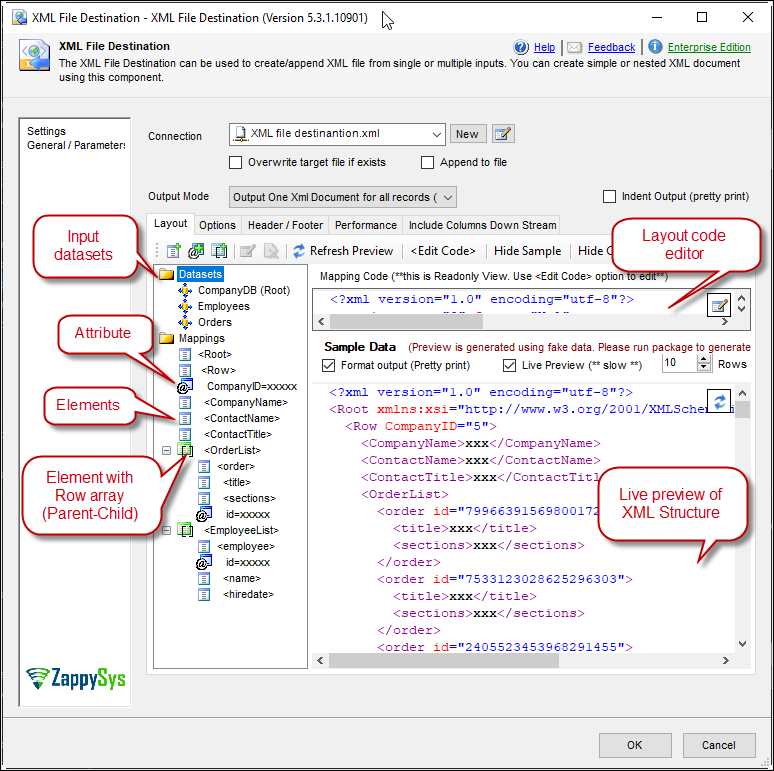
Connect one or more upstream components to XML File Destination, for example customers and orders. In the editor, select the File Connection, check Overwrite target file, set Output Mode (for example one XML document for each parent record) and check Indent Output.
- Single or multiple inputs from any Data Flow source
- One document for all records, per parent record, or single dataset array
OverwriteIfExistsorAppend
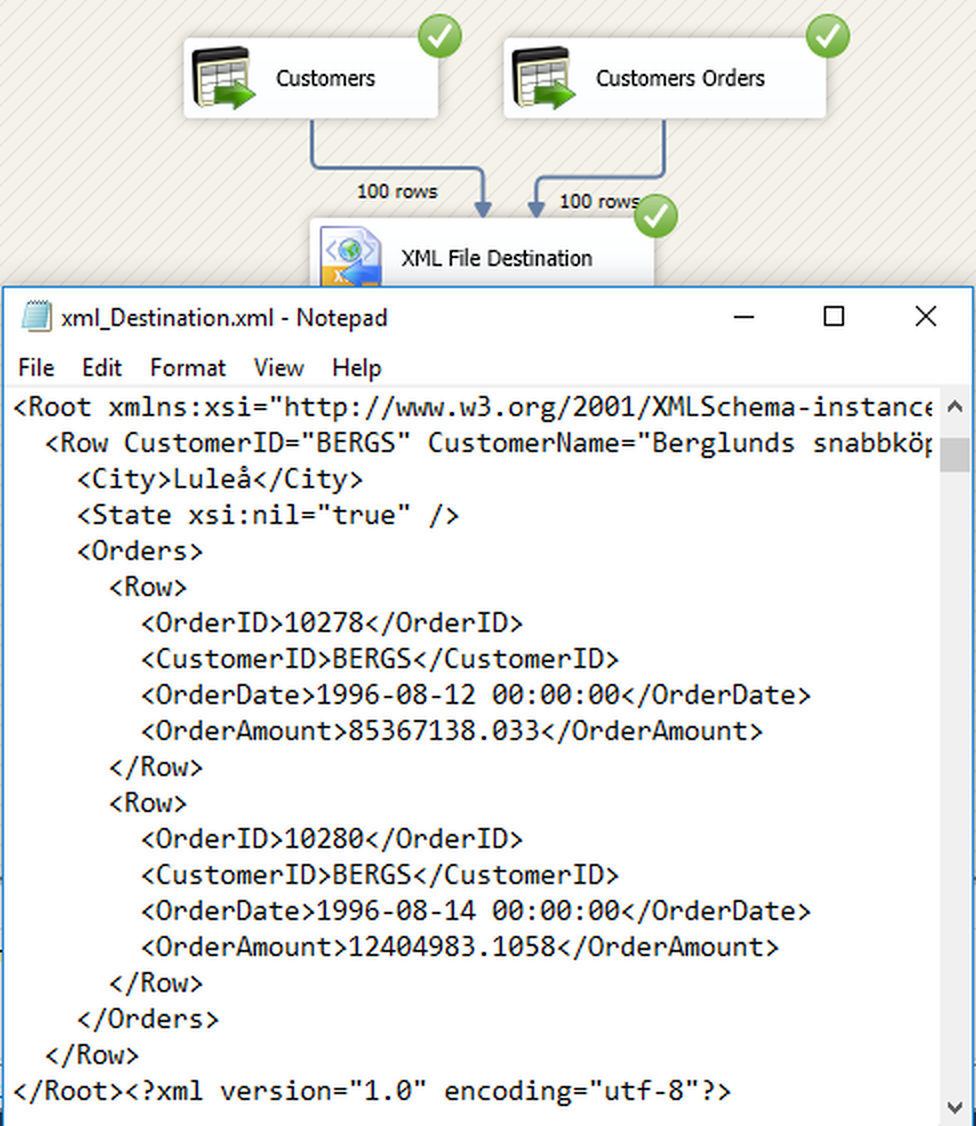
Define nested elements and parent/child relations.
The layout tree under Mappings defines the whole document. Add attributes and elements bound to input columns, add document arrays for child rows, and edit any dataset from the same screen.
- Elements, attributes and document arrays
- Namespaces, root element name and prefix
- Skip NULL attributes/elements and empty nested nodes
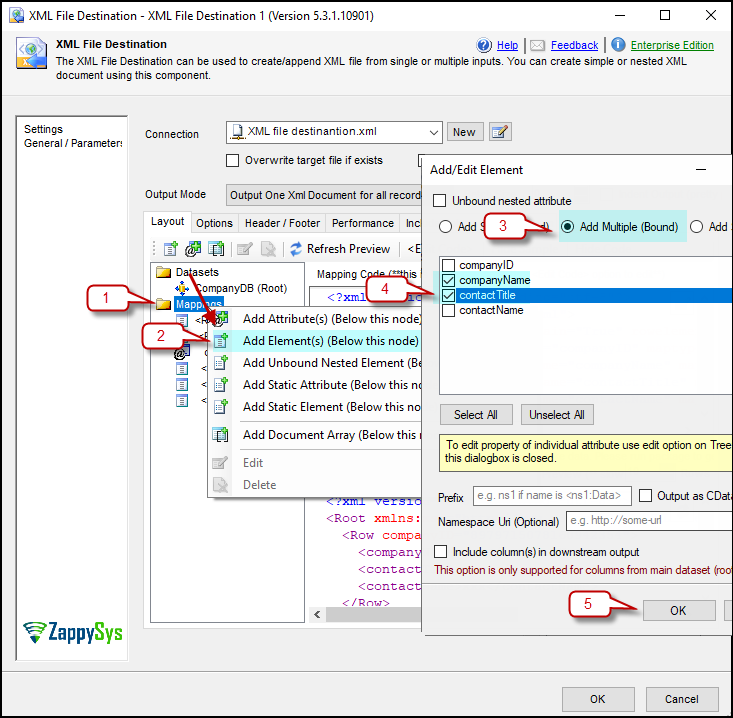
Add attributes and elements from the right-click menu.
Right-click Mappings and choose Add Attribute(s) or Add Element(s), then pick Add Multiple (Bound) and check the columns to output.
- Bind several columns at once
- Attributes or child elements of any node
- Optional XML declaration and standalone attribute
Nest child rows with a document array.
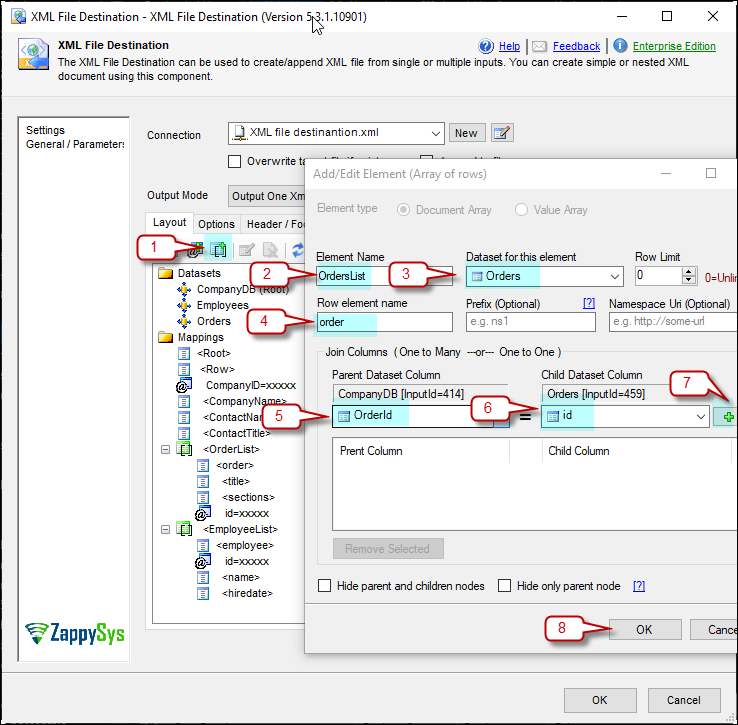
Right-click Mappings and choose Add Document Array to create an array of rows from a second dataset, such as Orders under Customers, then add elements under the new node.
- Parent/child relation between two datasets
- Elements and attributes under each array item
- Empty arrays and nested nodes can be skipped
Inside the UI
Key settings, as they appear in SSDT.
Real screens from the XML File Destination product page. Step through them, or open any shot at full size.
Create XML File from multiple input sources
Connect several upstream inputs to one XML File Destination and join them into nested XML.
Articles
Worked examples that use XML File Destination.
Compatibility and requirements
Designed to stay inside your SSIS runtime.
- SQL Server 2012 through 2025, 32-bit and 64-bit
- Windows only, 64-bit OS required. SQL Server Express and Web editions do not include SSIS
- Azure Data Factory SSIS Integration Runtime
- Self-hosted: credentials and data stay in your environment (external API calls still reach that service)
- Fully functional 30-day trial of SSIS PowerPack
FAQ
Questions teams ask before they drop XML File Destination on the canvas.
What is XML File Destination?
A Data Flow destination in SSIS PowerPack that writes simple or nested XML files from single or multiple inputs (e.g. SQL Server, MySQL, Flat File, Excel). A drag-and-drop layout editor defines elements, attributes, document arrays and parent/child relations, and the output goes to a File Connection.
How is it different from XML Generator Transform?
The layout editor and concepts are almost identical. XML Generator Transform outputs XML in a column for downstream components, while XML File Destination writes the XML to a file through a File Connection.
Which output modes are available?
OutputMode offers Output One XML Document for all records, Output One XML Document for each parent record, and Single Dataset Array, where ArrayBatchSize sets how many rows go in each batch (0 = all in one).
Can I control namespaces, NULLs and encoding?
Yes. Set Namespaces, RootElementName and RootElementPrefix, turn off the XML declaration, and use DoNotOutputNullAttribute to skip NULL values instead of writing xsi:nil="true". Choose an Encoding with or without BOM, or a CharacterSet such as ISO-8859-1.
Which SQL Server versions can I run it on?
SQL Server 2025, 2022, 2019, 2017, 2016, 2014, and 2012 (32- and 64-bit), plus Azure Data Factory with an SSIS Integration Runtime (packages must target SQL Server 2017). See Compatibility and requirements.



What customers say
Start your free trial today
Install SSIS PowerPack and drag XML File Destination onto the Data Flow.
Shape nested XML from any Data Flow source in a visual editor and write it straight to a file.
- Data Flow Destination in SSISXML File Destination appears in the toolbox after you install PowerPack.
- Fully functional 30-day trialSSIS PowerPack, running in your environment.
- Live supportHelp during your trial and after purchase.
Open Help FileBrowse all SSIS PowerPack tasks
New purchases may be eligible for refund review within 30 days. See the refund policy.
Talk to an engineer before or during your trial.