SSIS Salesforce API Task
Call any Salesforce REST (JSON) or SOAP (XML) API from the SSIS control flow and save the response to a variable or file.
Send GET, POST and other requests to any Salesforce REST or SOAP endpoint using a shared Salesforce connection (OAuth 2.0). Extract values with JSONPath or XPath, validate the response (status code, content, headers), insert SSIS variables with format specifiers such as {{User::MyDate,yyyy-MM-dd}}, and poll a job status until it completes.
The trial includes Salesforce API Task and every other PowerPack component
- Control Flow Task in SSIS
- Runs in your environment
- Also runs in Azure Data Factory
- Fully functional 30-day trial


At a glance
What Salesforce API Task can do
Salesforce API Task calls any Salesforce REST (JSON) or SOAP (XML) API through the Salesforce connection manager and saves the response, or a filtered value from it, to an SSIS variable or file.
Call any Salesforce API
Call any Salesforce REST (JSON) or SOAP (XML) API.
- HTTP methods such as GET and POST
RequestContentType: JSON, XML, form, binary and more- Custom
RequestHeadersandRequestData
Save response
Save the response to an SSIS variable or a file.
ResponseAccessMode: Variable or FileSaveAsBinaryfor non-text content- Save the HTTP status code and response headers to variables
JSONPath & XPath filters
Extract a specific value from the response text.
- JSONPath for JSON responses
- XPath for XML responses
Response validation
Validate the response with custom rules.
- Response code must be less than 300
- Response content must contain a given string
- Response header must contain a key/value pair
Dynamic variables
Use SSIS variables with format specifiers anywhere in the URL, headers or request data.
- e.g.
{{User::MyVar}},{{User::MyDate,yyyy-MM-dd}},{{User::MyAmount,C}}
Status check polling
Repeat a request until the response contains a success or failure value.
EnableStatusCheckwithStatusSuccessValue/StatusFailedValueStatusCheckMaxWaitSecondsand wait between iterations
Uploads & compression
Send files and large payloads efficiently.
IsMultiPartUpload: raw or multipart/form-data uploadEnableSplitStreamForUploadfor chunked upload of very large files- gzip request and response compression
SQL Server 2012–2025 & ADF
Runs in your environment on SQL Server 2012–2025 and Azure-SSIS.
- SQL Server 2025, 2022, 2019, 2017, 2016, 2014, 2012 (32/64-bit)
- Azure Data Factory (SSIS IR)
- Design packages in Visual Studio 2017, 2019, 2022, or 2026
- Windows only (64-bit OS): Windows 7–11 or Windows Server 2012–2025
Salesforce connection
Connect through the Salesforce Connection Manager to Production, Sandbox or Developer orgs.
- OAuth 2.0 (interactive, useful with MFA / 2FA) or OAuth Client Credentials
- Error retry and proxy settings
See all features
- Call any Salesforce REST API (RESTful API)
- Call any Salesforce SOAP API (XML API)
- Perform HTTP GET, POST and other requests
- Save response to a variable or a file
- Filter JSON responses using JSONPath
- Filter XML responses using XPath
- Validate response with custom rules (status code, content, header)
- Testing UI (Test Request/Response)
- Dynamic variable replacement with format specifiers in headers or request data
- Status check loop to wait for a success or failure value
- Multipart / raw file upload and chunked upload for large files
- Selectable security protocol (
SecurityProtocol, e.g. TLS 1.2) - OAuth 2.0 authentication on the Salesforce Connection Manager
Support for SQL Server 2025, 2022, 2019, 2017, 2016, 2014, 2012 (32/64-bit) and Azure Data Factory
SQL Server 2012–2025
How it works
From the toolbox to your first run.
Connect, build the request, test it, then choose what to keep from the response.
Create a Salesforce connection.
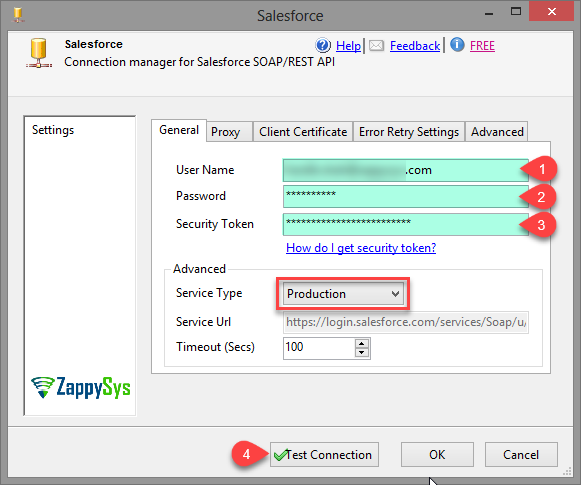
Add a ZS-SALESFORCE connection and choose the authentication type: OAuth 2.0 (interactive, useful when MFA / 2FA is enabled) or OAuth 2.0 Client Credentials (non-interactive). The legacy user name, password and security token method is also available. Pick Production, Sandbox or Developer, then click Test Connection.
- Shared with Salesforce Source, Destination, JSON Source and XML Source
- Retry and proxy settings
Call a Salesforce REST API.
Set the method and URL, for example GET https://na34.salesforce.com/services/data/{{User::varVersion}}/limits, or POST {"Name" : "Ray"} to /services/data/v20.0/sobjects/Account/ with Body Content Type JSON. Click Test Request/Response to see the result before you run the package.
- GET, POST, PUT and other methods
- Variables anywhere in URL, headers or body
- Request content types: JSON, XML, form, binary and more

Call a Salesforce SOAP API.
Post an XML SOAP envelope to a Salesforce SOAP endpoint with an XML content type, then use an XPath expression to pull the value you need from the XML response.
- XML (text/xml) request content types
- XPath filter on the response

Save, filter and validate the response.
On the Response Settings tab check Save Response Content, choose Variable or File, set the content type (JSON or XML) and a filter expression to keep only the value you need. You can also save the HTTP status code and response headers to variables, and add validation rules or a status check loop.
- JSONPath / XPath filter
- Status check until success or failure value
SaveAsBinaryfor files such as zip

Inside the UI
Key settings, as they appear in SSDT.
Real screens from the Salesforce API Task product page. Step through them, or open any shot at full size.
Drag and drop the ZS Salesforce API Task in the design surface
In Visual Studio, drag ZS Salesforce API Task from the SSIS Toolbox onto the Control Flow.
Articles
Worked examples that use Salesforce API Task.
Compatibility and requirements
Designed to stay inside your SSIS runtime.
- SQL Server 2012 through 2025, 32-bit and 64-bit
- Windows only, 64-bit OS required. SQL Server Express and Web editions do not include SSIS
- Azure Data Factory SSIS Integration Runtime
- Self-hosted: credentials and data stay in your environment (external API calls still reach that service)
- Fully functional 30-day trial of SSIS PowerPack
FAQ
Questions teams ask before they drop Salesforce API Task on the canvas.
What is Salesforce API Task?
Salesforce API Task is an SSIS control flow task that calls any Salesforce REST (JSON) or SOAP (XML) API through the Salesforce connection manager and saves the response to a variable or file.
How do I keep only one value from the response?
On Response Settings choose the response content type and enter a filter: JSONPath for JSON responses or XPath for XML responses. The filtered value is saved to your variable or file.
Can it wait for a long-running Salesforce job?
Yes. Enable EnableStatusCheck and set StatusSuccessValue (and optionally StatusFailedValue), the wait between iterations and StatusCheckMaxWaitSeconds. The Bulk API tutorial uses this to wait until a job reaches JobComplete.
Can I make the URL or body dynamic?
Yes. Put SSIS variables anywhere in the URL, headers or request data, with optional format specifiers, for example {{User::MyVar}}, {{User::MyDate,yyyy-MM-dd}} or {{User::MyAmount,C}}.
Which SQL Server versions can I run it on?
SQL Server 2025, 2022, 2019, 2017, 2016, 2014, and 2012 (32- and 64-bit), plus Azure Data Factory with an SSIS Integration Runtime (packages must target SQL Server 2017). See Compatibility and requirements.



What customers say
Start your free trial today
Install SSIS PowerPack and drag Salesforce API Task onto the Control Flow.
Call Salesforce REST or SOAP APIs, check the response and save results to SSIS variables or files.
- Control Flow Task in SSISSalesforce API Task appears in the toolbox after you install PowerPack.
- Fully functional 30-day trialSSIS PowerPack, running in your environment.
- Live supportHelp during your trial and after purchase.
Open Help FileBrowse all SSIS PowerPack tasks
New purchases may be eligible for refund review within 30 days. See the refund policy.
Talk to an engineer before or during your trial.