SSIS Salesforce Source
Extract Salesforce objects and SOQL query results into your SSIS data flow.
Read a Salesforce object in Table mode or write a SOQL query, make it dynamic with SSIS variables, convert UTC and local date/time, and send rows to SQL Server or another SSIS destination, all without any programming.
The trial includes Salesforce Source and every other PowerPack component
- Table or SOQL query mode
- Runs in your environment
- Also runs in Azure Data Factory
- OAuth access token for 2FA / MFA


At a glance
What Salesforce Source can do
Salesforce Source extracts large amounts of data from Salesforce.com without any programming. Use simple Table mode or Query mode with full SOQL support, then load SQL Server like any other SSIS source.
Table or Query mode
Multiple modes to read data from Salesforce CRM.
- Table mode: pick a Salesforce object from the list
- Query mode: full SOQL (Salesforce Object Query Language) support
- Object Browser with fields and table info
SOQL queries
Write SOQL with WHERE, ORDER BY, LIMIT, relationships, and aggregates.
- Parent fields with the dot operator (e.g.
Account.Name) - Child records with a nested SELECT
- GROUP BY with optional HAVING
Dynamic queries
Make a query dynamic with SSIS variables.
- Variable placeholders such as
{{User::MyVar}} - Insert Variable button in the query editor
- Date literals such as
TODAY,YESTERDAY,LAST_N_DAYS:365
UTC & local date/time
Automatic conversion between UTC date/time and local date/time.
- Output dates as local time, UTC, or ISO format
- DateTime variables convert to UTC in queries
Preview, max rows & batch size
Check the data before you map a destination.
- Data preview in the UI
- Maximum rows to fetch (0 = unlimited)
- Rows fetched in each request (batch size)
Salesforce connection
One connection manager shared by Salesforce Source, Destination, API Task, JSON Source, and XML Source.
- User name, password, and security token
- Service type (e.g. Production) and service URL
- OAuth access token (helpful for 2FA / MFA)
Large data & deleted records
Options for large or special reads.
- Bulk API mode for large amounts of data
- Read deleted records (IncludeDeleted)
Error handling
Choose what happens when a row fails.
- Fail the component, ignore the failure, or redirect the row to the error output
- Separate settings for errors and truncation
SQL Server 2012–2025 & ADF
Runs in your environment on SQL Server 2012–2025 and Azure-SSIS.
- SQL Server 2025, 2022, 2019, 2017, 2016, 2014, 2012 (32/64-bit)
- Azure Data Factory (SSIS IR)
- Design packages in Visual Studio 2017, 2019, 2022, or 2026
- Windows only (64-bit OS): Windows 7–11 or Windows Server 2012–2025
See all features
- Multiple modes to read data from Salesforce CRM (i.e. Table or Query)
- Support for SOQL (Salesforce Object Query Language)
- Automatic conversion between UTC date/time and local date/time
- Intuitive user interface with Salesforce Object Browser
- Data preview, max rows, and batch size
- OAuth access token (helpful for 2FA / MFA)
- Dynamic query using an SSIS variable placeholder (e.g.
{{User::MyVar}}) Support for SQL Server 2025, 2022, 2019, 2017, 2016, 2014, 2012 (32/64-bit) and Azure Data Factory
- Read from a Salesforce custom report: use this technique
- Read metadata (tables / fields): use this technique
SQL Server 2012–2025
Two access modes
Read a whole object or exactly the rows your query asks for.
Create a Salesforce connection once, then pick Table or Query mode. Preview rows in the UI before you map columns.
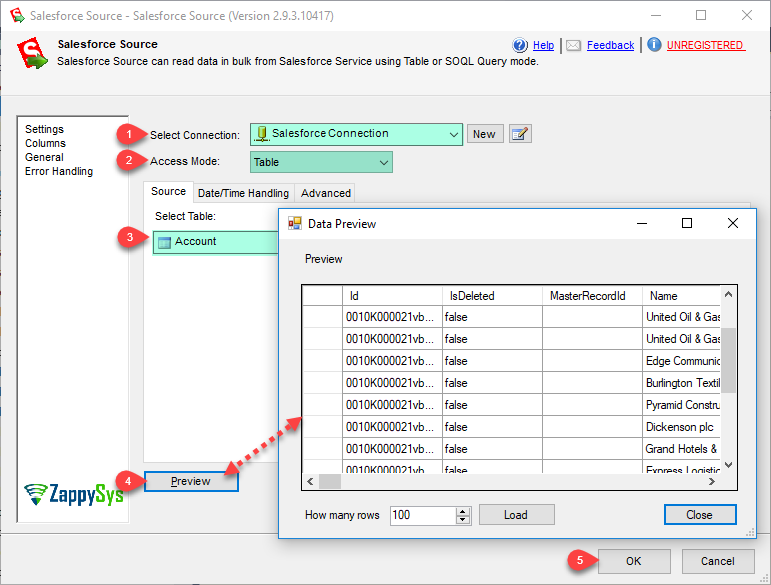
Get data from a Salesforce object.
Select the connection, set Access Mode to Table, and choose an object such as Account from the list. Click Preview to see the rows.
- No query to write
- Max rows and batch size options
- Object Browser shows fields and table info
Query data using the SOQL language.
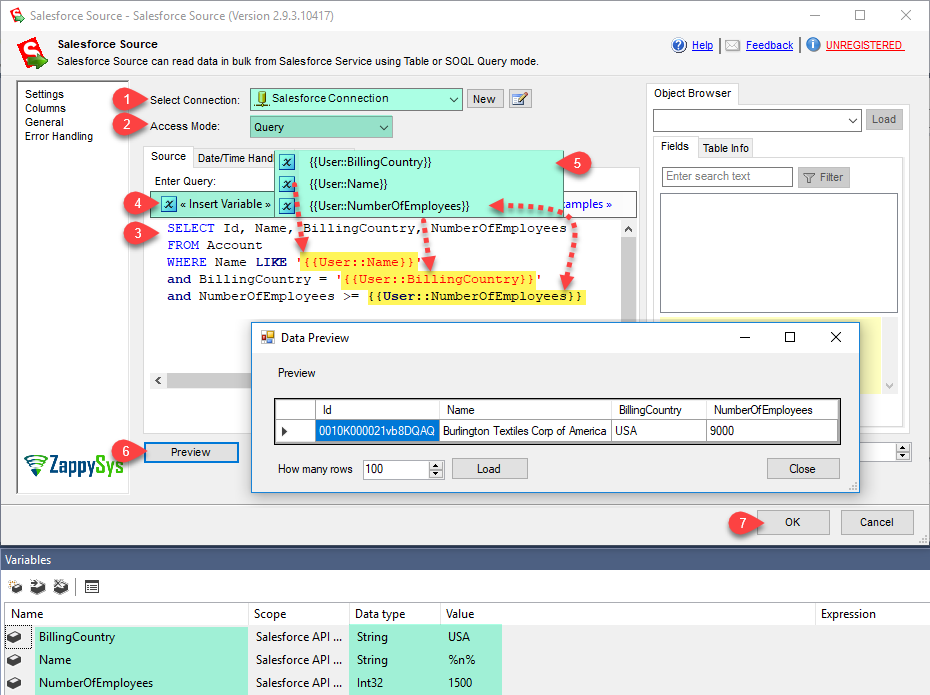
Set Access Mode to Query and enter a SOQL query. Use Insert Variable to add placeholders such as {{User::Name}} for a dynamic query.
- WHERE, ORDER BY, LIMIT, and relationships
- Variable placeholders anywhere in the query
- Date literals such as
YESTERDAY
Connect once, reuse everywhere.
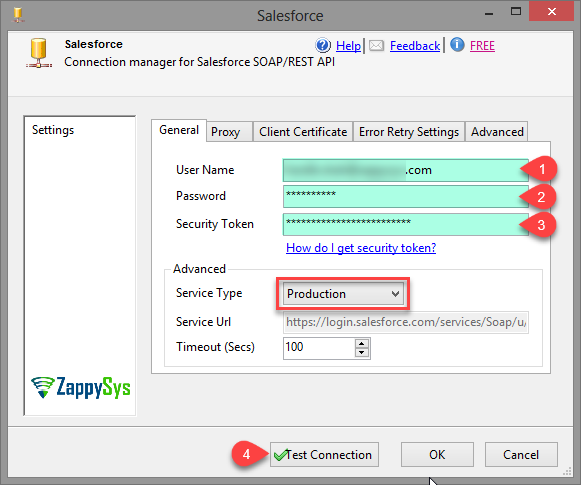
The Salesforce Connection Manager stores the user name, password, and security token, plus the service type (e.g. Production). It is used with Salesforce Source, Salesforce Destination, Salesforce API Task, JSON Source, and XML Source.
- Service type (e.g. Production) and service URL
- Proxy, client certificate, and retry settings
- Test Connection before you save
Inside the UI
Key settings, as they appear in SSDT.
Real screens from the Salesforce Source help file and product page. Step through the connection, both modes, variables, and errors, or open any shot at full size.
Table mode
Pick a Salesforce object such as Account and preview the rows.
SOQL example
A dynamic SOQL query, start to finish.
From the Salesforce Source help file: three SSIS variables feed a SOQL query, and the preview returns the matching account.
-
SOQL query
Variables: Name =
%n%, BillingCountry =USA, NumberOfEmployees =1500.SELECT Id, Name, BillingCountry, NumberOfEmployees FROM Account WHERE Name LIKE '{{User::Name}}' and BillingCountry = '{{User::BillingCountry}}' and NumberOfEmployees >= {{User::NumberOfEmployees}} -
Set the access mode
Access Mode
QuerySelect the Salesforce connection, then use Insert Variable to add the placeholders.
-
Output rows for your data flow
Id Name BillingCountry NumberOfEmployees 0010K000021vb8DQAQ Burlington Textiles Corp of America USA 9000 Connect these rows to SQL Server or another SSIS destination.
More SOQL examples from the help file
| Query | What it shows |
|---|---|
SELECT Id,FirstName, LastName, Account.Name FROM Contact |
Parent fields (child-to-parent) |
SELECT Name, (SELECT FirstName, LastName FROM Contacts ORDER BY CreatedDate LIMIT 5) FROM Account Where Name='ZappySys' |
Child records, top 5 per account |
SELECT LeadSource, COUNT(Name) Cnt FROM Lead GROUP BY LeadSource HAVING COUNT(Name) > 100 |
GROUP BY / aggregate |
... Where LastModifiedDate < {{System::ContainerStartTime,TO_UTC_DATETIME}} AND CreatedDate < YESTERDAY |
Date variable converted to UTC, plus a date literal |
SELECT Id FROM Account WHERE Name = 'Sam\'s Farm' |
Escape a special character |
Query, variables, and preview from the Salesforce Source help file, which lists more SOQL examples.
Articles
Worked examples that use Salesforce Source.
Compatibility and requirements
Designed to stay inside your SSIS runtime.
- SQL Server 2012 through 2025, 32-bit and 64-bit
- Windows only, 64-bit OS required. SQL Server Express and Web editions do not include SSIS
- Azure Data Factory SSIS Integration Runtime
- Self-hosted: credentials and data stay in your environment (external API calls still reach that service)
- Fully functional 30-day trial of SSIS PowerPack
FAQ
Questions teams ask before they drop Salesforce Source on the canvas.
What can Salesforce Source read?
Any Salesforce object in Table mode, or the result of a SOQL query in Query mode. For custom reports or metadata, ZappySys documents separate techniques (see Features).
How do I make a query dynamic?
Use variable placeholders such as {{User::MyVar}} anywhere in the SOQL query; the Insert Variable button adds them for you. DateTime variables are converted to UTC by default.
Does SOQL support JOINs?
No. SOQL is similar to SQL but simpler, and the JOIN clause is not supported. Use parent fields (e.g. Account.Name) or a nested child query instead.
How are dates handled?
Output dates can be converted to local time, UTC, or ISO format, and input date values in Query mode can be converted the same way.
Can it read a large amount of data?
Yes. It is built to extract large amounts of data, and a Bulk API mode is available for large reads. For very large sets see the Bulk API guide.
Which SQL Server versions can I run it on?
SQL Server 2025, 2022, 2019, 2017, 2016, 2014, and 2012 (32- and 64-bit), plus Azure Data Factory with an SSIS Integration Runtime (packages must target SQL Server 2017). See Compatibility and requirements.
Where is the full property reference?
Open the Salesforce Source help file for properties and SOQL examples. System requirements are on the installation page.
See also
Pair it with the rest of the Salesforce toolbox.




What customers say
Start your free trial today
Install SSIS PowerPack and drag Salesforce Source onto a Data Flow.
Preview real Salesforce data before you map a destination, with no programming required.
- Data Flow Source in SSISSalesforce Source appears in the toolbox after you install PowerPack.
- Fully functional 30-day trialSSIS PowerPack, running in your environment.
- Live supportHelp during your trial and after purchase.
Open Help FileBrowse all SSIS PowerPack tasks
New purchases may be eligible for refund review within 30 days. See the refund policy.
Talk to an engineer before or during your trial.