SSIS Reporting Services (SSRS) Task
Export or email SSRS reports inside an SSIS package, with or without a report server.
Reporting Services (SSRS) Task, also called the SSIS Report Generator Task, exports or emails SQL Server Reporting Services reports inside an SSIS package. It also supports data-driven export, which exports several reports to disk and emails them to users based on settings stored in a SQL table.
The trial includes Reporting Services (SSRS) Task and every other PowerPack component
- Control Flow Task in SSIS
- Runs in your environment
- Also runs in Azure Data Factory
- Fully functional 30-day trial


At a glance
What Reporting Services (SSRS) Task can do
Reporting Services (SSRS) Task, also called the SSIS Report Generator Task, exports or emails SQL Server Reporting Services reports inside an SSIS package. It also supports data-driven export, which exports several reports to disk and emails them to users based on settings stored in a SQL table.
Export server reports
Export or email SQL Server Reporting Services reports from a report server inside an SSIS package.
- PDF, XLS, DOC, MHT, HTML, CSV, TIFF or XML
- SSRS 2005 and higher
ReportServiceUrlandReportPath
Local reports, no SSRS server
Export an RDL or RDLC file as PDF, XLS or DOC without any Reporting Services setup.
- Datasets are supplied at runtime by your query
DatasetNames,DatasetQueries,DatasetConnectionStrings- Or bind a recordset with
RecordsetVariable
Data-driven export
Export many reports to different users in different formats, driven by settings in a SQL table.
ConfigTableNamewithConfigFilter(e.g. by group name)- Last start / end date, status and message are tracked per report
Email reports as attachments
Send the exported report as an attachment to a list of users.
EmailSMTPConnection, To / Cc / Bcc lists- Subject and body placeholders like
{{ReportName}},{{ReportDate}} EmailAsHtmlfor HTML or plain text- Server reports can also go out as the HTML email body (see tutorial)
Report parameters
Pass report parameter values from SSIS variables or as direct values.
- Multi-value parameters with comma separated values
{NULL}and{DEFAULT}valuesUseDirectValueForParameter
SharePoint integrated mode
Export reports hosted in SharePoint integrated mode as well as native mode.
- Use the SharePoint
_vti_bin/reportserverURL - Paste a report URL and validate it in the UI
Report server credentials
Connect to the report server with a user name and password or Windows authentication.
UserName/PasswordWindowsAuthenticationuses the package’s current credentials
SQL Server 2012–2025 & ADF
Runs in your environment on SQL Server 2012–2025 and Azure-SSIS.
- SQL Server 2025, 2022, 2019, 2017, 2016, 2014, 2012 (32/64-bit)
- Azure Data Factory (SSIS IR)
- Design packages in Visual Studio 2017, 2019, 2022, or 2026
- Windows only (64-bit OS): Windows 7–11 or Windows Server 2012–2025
File naming & timeouts
Control where and how exported files are saved.
ExportFilePathwith a date/time suffix (e.g._yyyy-MM-dd)GenerateSnapshotafter the report runsTimeoutSecondsfor report generation
See all features
- Automate / Call reporting services report export and email process using SSIS
- Support for SSRS 2005 and higher (e.g. 2008, 2012)
- Support for Local report mode which requires no connectivity to SSRS server, just provide rdl file and runtime connection to export report
- Support for Sharepoint Integrated Mode
- Export report in xls, pdf, doc, xml, mhtml and csv format (server reports also HTML and TIFF)
- Send report as attachment to list of users
- Support for Data Driven export process with reports, recipients and file format stored in a database table
- Report parameters from SSIS variables or direct values, including multi-value, NULL and default
- Bind local report datasets from queries, connection strings or a recordset variable
- Email subject and body placeholders such as
{{ReportName}}and{{ReportDate}} - Windows authentication or user name / password for the report server
- Date/time suffix for exported file names
- Generate snapshot and set report generation timeout
- Send a server report as the HTML email body
Support for SQL Server 2025, 2022, 2019, 2017, 2016, 2014, 2012 (32/64-bit) and Azure Data Factory
SQL Server 2012–2025
How it works
From the toolbox to your first run.
Key steps from the Reporting Services (SSRS) Task page and help file, with the screens you will see in SSDT.
Export a report from your report server.
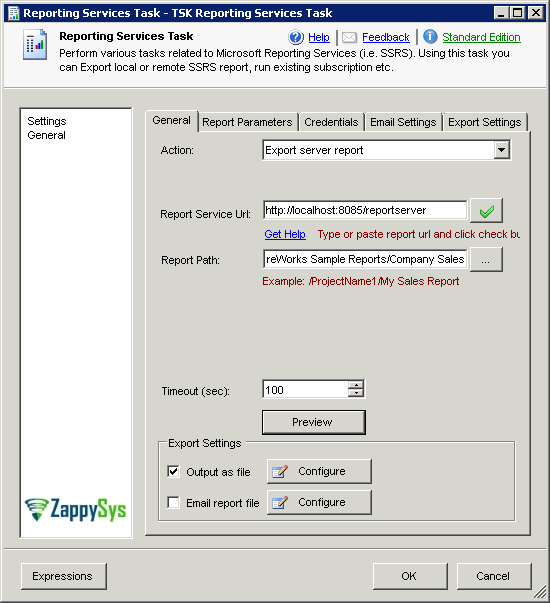
Set Action to Export server report, enter the report service URL (e.g. http://myserver/reportserver) and the report path, then choose file and email output. Paste a report URL from the browser and click the green check to parse it.
- PDF, XLS, DOC, MHT, HTML, CSV, TIFF or XML
- SharePoint integrated mode via
_vti_bin/reportserver - Parameters from SSIS variables or direct values
Drive many exports from a SQL config table.
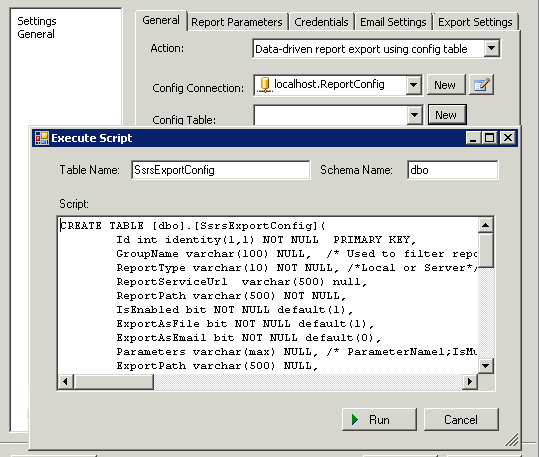
Choose Data-driven report export using config table, pick the config connection and click New to create the SsrsExportConfig table from the built-in script. Each row sets the report type (Server or Local), path, parameters, export path and email options; a Row Filter such as GroupName='Daily' selects which rows run.
- Mix server and local reports in one run
ConfigFilterlimits which reports export
Connect with Windows or explicit credentials.
On the Credentials tab, use Windows authentication (the account the package runs under) or enter a user name and password for the report server.
WindowsAuthenticationUserName/Password

Preview the report from the task.
Click Preview to open the report in a viewer with its parameters before you schedule the export, and check the available export formats.
- Set a timeout for report generation (
TimeoutSeconds)

Inside the UI
Key settings, as they appear in SSDT.
Real screens from the Reporting Services (SSRS) Task product page. Step through them, or open any shot at full size.
Report Generator Task – Export Server Report Mode
Export server report: report server URL, report path, parameters, credentials and file or email output.
Articles
Worked examples that use Reporting Services (SSRS) Task.
Compatibility and requirements
Designed to stay inside your SSIS runtime.
- SQL Server 2012 through 2025, 32-bit and 64-bit
- Windows only, 64-bit OS required. SQL Server Express and Web editions do not include SSIS
- Azure Data Factory SSIS Integration Runtime
- Self-hosted: credentials and data stay in your environment (external API calls still reach that service)
- Fully functional 30-day trial of SSIS PowerPack
FAQ
Questions teams ask before they drop Reporting Services (SSRS) Task on the canvas.
What is Reporting Services (SSRS) Task?
Reporting Services (SSRS) Task, also called the SSIS Report Generator Task, exports or emails SQL Server Reporting Services reports inside an SSIS package. It also supports data-driven export, which exports several reports to disk and emails them to users based on settings stored in a SQL table.
Which export formats are supported?
Server reports export to PDF, XLS, DOC, MHT, HTML, CSV, TIFF or XML; the SSRS tutorial also lists Word (.docx) and Excel (.xlsx). Local RDL/RDLC reports export to PDF, XLS or DOC.
Can I export reports without an SSRS server?
Yes. Export local report renders an .rdl or .rdlc file from disk with no Reporting Services setup. Local mode ignores the report’s own queries, so you supply the data at runtime with dataset names, queries and connection strings, or a recordset variable.
How do I pass report parameters?
Map parameters to SSIS variables, or set UseDirectValueForParameter to type values. Names are case sensitive; use commas for multi-value parameters, {NULL} for null and {DEFAULT} for the report’s default.
Can it email the report?
Yes. Enable email output, pick an SMTP connection and enter recipients (separated by semicolons). Subject and body can use {{ReportName}}, {{ReportPath}}, {{ReportParameters}} and {{ReportDate}}. The tutorial also shows sending a server report as the HTML email body.
Can I export many reports in one run?
Yes. Data-driven export reads a SQL config table where each row holds a report, its parameters, export path and recipients. Use ConfigFilter (e.g. GroupName='WEEKLY') to choose which rows run.
Which SQL Server versions can I run it on?
SQL Server 2025, 2022, 2019, 2017, 2016, 2014, and 2012 (32- and 64-bit), plus Azure Data Factory with an SSIS Integration Runtime (packages must target SQL Server 2017). See Compatibility and requirements.



What customers say
Start your free trial today
Install SSIS PowerPack and drag Reporting Services (SSRS) Task onto the Control Flow.
Export and email SSRS reports from SSIS on demand or after your ETL finishes.
- Control Flow Task in SSISReporting Services (SSRS) Task appears in the toolbox after you install PowerPack.
- Fully functional 30-day trialSSIS PowerPack, running in your environment.
- Live supportHelp during your trial and after purchase.
Open Help FileBrowse all SSIS PowerPack tasks
New purchases may be eligible for refund review within 30 days. See the refund policy.
Talk to an engineer before or during your trial.