SSIS Excel File Source
Read Excel files without installing any Microsoft Office driver.
SSIS Excel File Source (Advanced Excel Source) can be used to read Excel files without installing any Microsoft Office Driver. You can extract using Table mode or query mode (SQL Command).
The trial includes Excel File Source and every other PowerPack component
- Data Flow Source in SSIS
- Runs in your environment
- Also runs in Azure Data Factory
- Fully functional 30-day trial


At a glance
What Excel File Source can do
SSIS Excel File Source (Advanced Excel Source) can be used to read Excel files without installing any Microsoft Office Driver. You can extract using Table mode or query mode (SQL Command).
Read Excel without Office
Read Excel files without installing any Microsoft Office driver.
- Office 2007 Excel files (
*.XLSX), so you can read more than 64000 rows - Runs in 64-bit mode without any additional driver, unlike native SSIS Excel
Table or SQL query mode
Read a sheet in Table mode, or filter data with a SQL query in Query mode.
AccessMode: Table or Query- Use SSIS variables in the query
SQL query support
A built-in query engine converts SQL to fetch data from Excel.
- WHERE with AND, OR, LIKE, IN, BETWEEN, IS NULL and comparison operators
- TOP N, ORDER BY and column aliases
WITHclause options such asRangeStartCellandSkipRows
Flexible sheet selection
Pick sheets by position, by name pattern, by named range or by the data they contain.
[$first_sheet$],[$1$]or[$last_sheet$]- Regular expression across multiple sheets, e.g.
Sheet-(\d+)--regex NamedRange:NAMEandSearchStringForTabSelect
Multiple files & passwords
Read many workbooks with a wildcard path and open password-protected workbooks through the ZappySys Excel Connection Manager.
- e.g.
c:\SSIS\Excel\file*.xlsx - Password-protected workbooks, not supported by the native SSIS Excel connection
Raw or formatted values
Output data in raw mode or as formatted in Excel.
FormatAllColumnsformats every columnFormattedColumnsfor selected columns, e.g.BirthDate|Amount
Ranges & row control
Read only the cells and rows you need.
RangeStartCellandRangeEndCellSkipRows,MaxRowsandHeaderless
SQL Server 2012–2025 & ADF
Runs in your environment on SQL Server 2012–2025 and Azure-SSIS.
- SQL Server 2025, 2022, 2019, 2017, 2016, 2014, 2012 (32/64-bit)
- Azure Data Factory (SSIS IR)
- Design packages in Visual Studio 2017, 2019, 2022, or 2026
- Windows only (64-bit OS): Windows 7–11 or Windows Server 2012–2025
Accurate metadata detection
Flexible metadata detection modes give you accurate data types.
MetaDataScanMode: Auto, Strict, Guess2x to Guess10x, all-string or MAX-length optionsMetaDataTreatStringAsAsciifor DT_STR instead of DT_WSTR
See all features
- Read an Excel workbook using Table mode or SQL Query mode
- Support for Office 2007 Excel files (
*.XLSX), so you can read more than 64000 rows - Support for 64-bit mode without any additional driver, unlike native SSIS Excel
- No Microsoft Office driver installation needed
- Output data in raw or formatted mode
- Flexible metadata detection mode for accurate data types
- Support for password-protected workbooks
- Read multiple Excel files with a wildcard path
- SQL queries with WHERE, LIKE, IN, BETWEEN, TOP and ORDER BY
- Read the first, last or Nth sheet, or many sheets by regular expression
- Query named ranges just like a table
- Select sheets by searching for data inside them
- Read a specific cell range, skip rows and read headerless data
Support for SQL Server 2025, 2022, 2019, 2017, 2016, 2014, 2012 (32/64-bit) and Azure Data Factory
SQL Server 2012–2025
How it works
From the toolbox to your first run.
Key steps from the Excel File Source page and help file, with the screens you will see in SSDT.
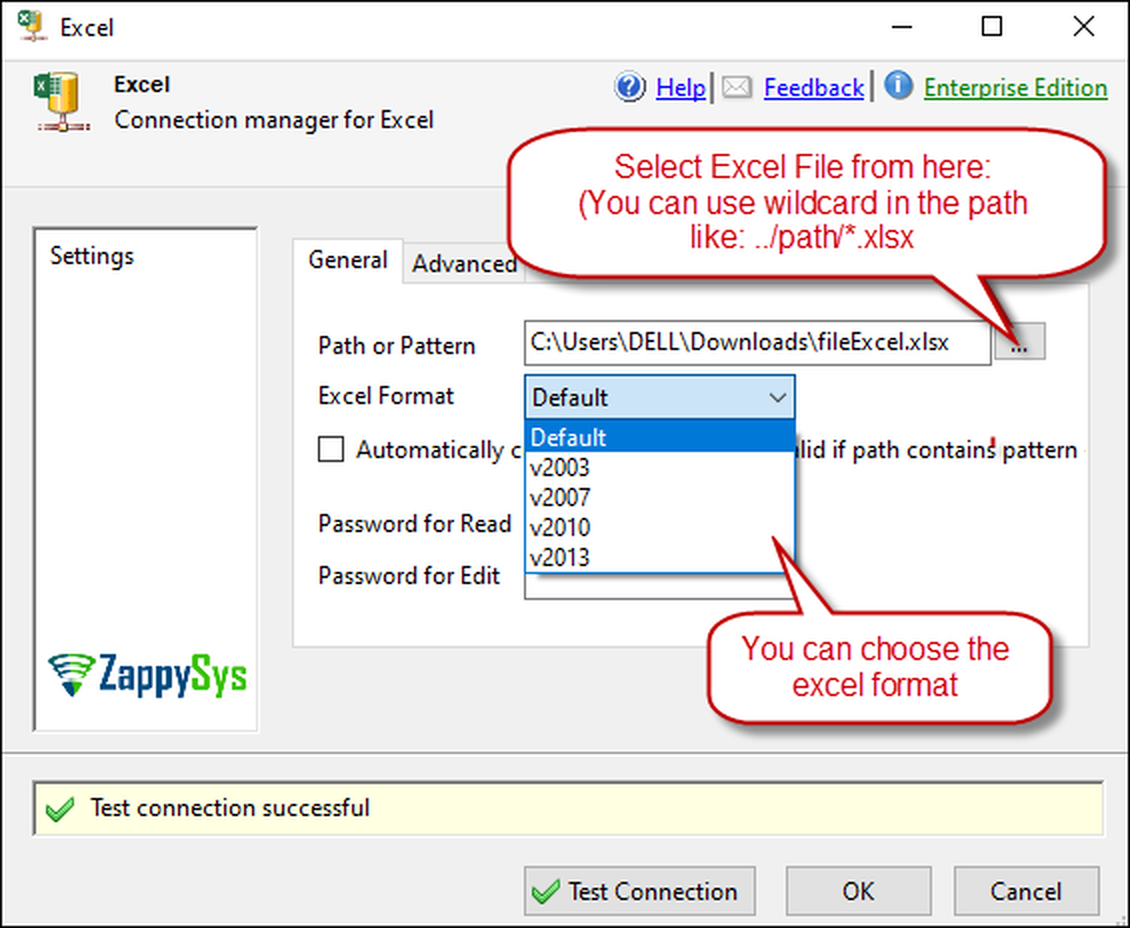
Point the Excel connection at one file or many.
In the ZS-EXCEL connection manager, enter a file path or a wildcard pattern such as c:\SSIS\Excel\file*.xlsx to read many workbooks, pick the Excel format and enter passwords for protected workbooks.
- Wildcard patterns work with Excel Source only
OpenPasswordfor protected workbooks
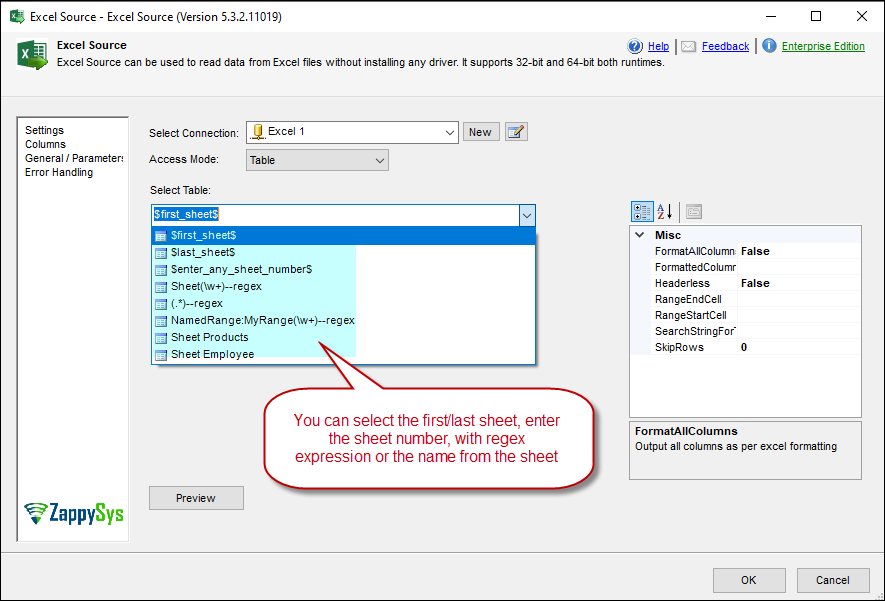
Pick the sheet by name, position, pattern or range.
With Access Mode Table, choose $first_sheet$, $last_sheet$, a sheet number, a regular expression such as Sheet(\w+)--regex to read several sheets, a named range, or a sheet name.
RangeStartCell/RangeEndCellto read part of a sheetHeaderless,SkipRowsandMaxRowsFormatAllColumnsfor Excel-formatted output
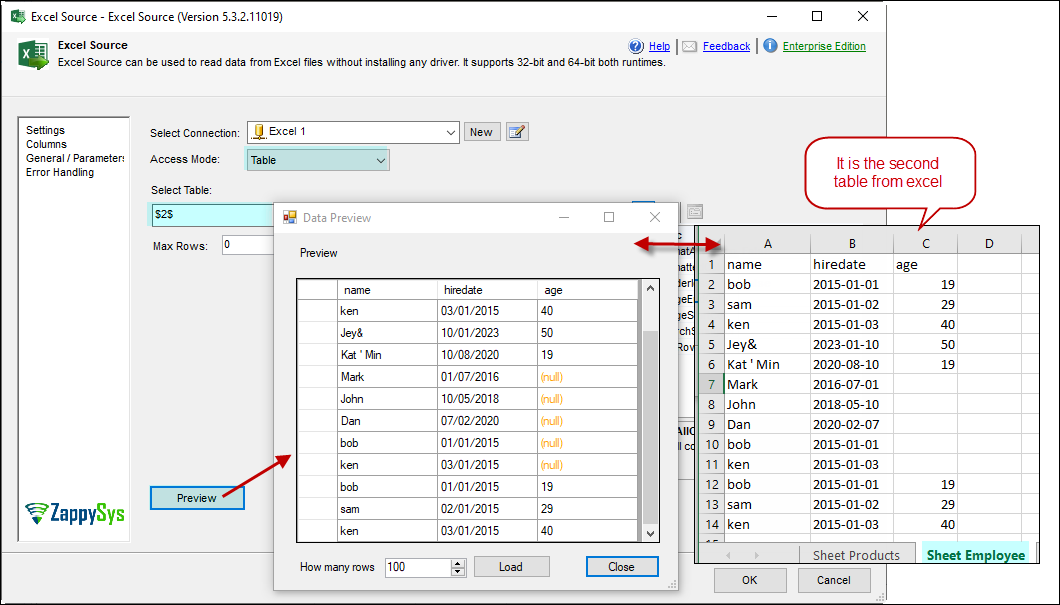
Read a sheet by its number.
Here $2$ reads the second sheet of the workbook. Click Preview to compare the rows with the sheet before you run the package.
- Read any sheet by number instead of a hard-coded name
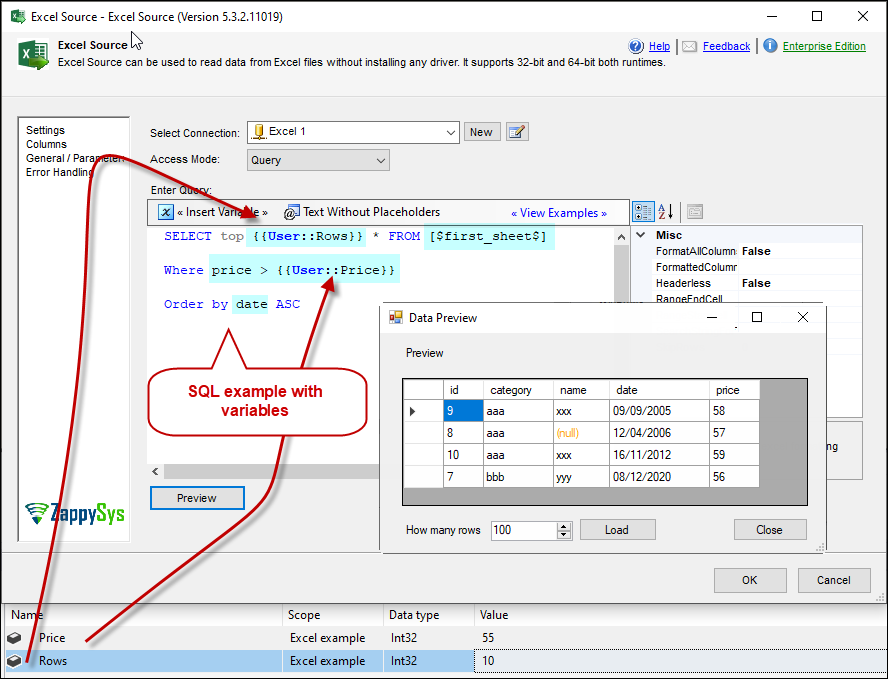
Filter and sort with a SQL query and SSIS variables.
Set Access Mode to Query and write SQL such as SELECT TOP {{User::Rows}} * FROM [$first_sheet$] WHERE price > {{User::Price}} ORDER BY date ASC. Variables are inserted with Insert Variable.
- TOP, WHERE and ORDER BY on sheet data
- Dynamic values from SSIS variables
Inside the UI
Key settings, as they appear in SSDT.
Real screens from the Excel File Source product page. Step through them, or open any shot at full size.
Excel connection
Set a single file path or a wildcard pattern, the Excel format and optional passwords.
Articles
Worked examples that use Excel File Source.
Compatibility and requirements
Designed to stay inside your SSIS runtime.
- SQL Server 2012 through 2025, 32-bit and 64-bit
- Windows only, 64-bit OS required. SQL Server Express and Web editions do not include SSIS
- Azure Data Factory SSIS Integration Runtime
- Self-hosted: credentials and data stay in your environment (external API calls still reach that service)
- Fully functional 30-day trial of SSIS PowerPack
FAQ
Questions teams ask before they drop Excel File Source on the canvas.
What is Excel File Source?
A Data Flow Source in SSIS PowerPack (Advanced Excel Source) that reads Excel files without installing any Microsoft Office driver. It reads sheets in Table mode or SQL query mode, runs in 32-bit and 64-bit, and supports password-protected workbooks.
Can I read several files or sheets at once?
Yes. Use a wildcard pattern in the Excel Connection Manager, e.g. c:\SSIS\Excel\file*.xlsx, and a regular expression table name such as Sheet-(\d+)--regex to read matching sheets.
How do I read a sheet when its name changes?
Use $first_sheet$, $last_sheet$ or a sheet number such as $3$, a named range (NamedRange:NAME), or a --regex table name combined with SearchStringForTabSelect to pick the sheet that contains given text.
Can I filter rows with SQL?
Yes. In Query mode write SQL such as SELECT TOP 5 * FROM [Sheet1] WHERE [OrderID] < {{User::varOrderID}} ORDER BY OrderID DESC, using SSIS variables for dynamic values.
Which SQL Server versions can I run it on?
SQL Server 2025, 2022, 2019, 2017, 2016, 2014, and 2012 (32- and 64-bit), plus Azure Data Factory with an SSIS Integration Runtime (packages must target SQL Server 2017). See Compatibility and requirements.
See also
More from SSIS PowerPack.




What customers say
Start your free trial today
Install SSIS PowerPack and drag Excel File Source onto the Data Flow.
Read Excel sheets in Table or SQL query mode, from one workbook or many, without installing Microsoft Office drivers.
- Data Flow Source in SSISExcel File Source appears in the toolbox after you install PowerPack.
- Fully functional 30-day trialSSIS PowerPack, running in your environment.
- Live supportHelp during your trial and after purchase.
Open Help FileBrowse all SSIS PowerPack tasks
New purchases may be eligible for refund review within 30 days. See the refund policy.
Talk to an engineer before or during your trial.