SSIS Dynamics CRM / Dataverse / PowerApps Source
Read Dynamics 365 Online, Dataverse, PowerApps or on-premises Dynamics CRM data in Table mode or with FetchXML queries.
Pick a table, or write a FetchXML query with filters, joins, TOP, DISTINCT and GROUP BY, starting from built-in examples or a query exported from CRM Advanced Find. Make it dynamic with SSIS variable placeholders such as {{User::MyVar}}, convert dates between UTC and local time, and connect with OAuth (Azure AD app) for MFA-protected tenants.
The trial includes Dynamics CRM / Dataverse / PowerApps Source and every other PowerPack component
- Data Flow Source in SSIS
- Runs in your environment
- Also runs in Azure Data Factory
- Fully functional 30-day trial


At a glance
What Dynamics CRM / Dataverse / PowerApps Source can do
Dynamics CRM / Dataverse Source reads data from Dynamics 365 Online, Dataverse / PowerApps and on-premises CRM into the SSIS data flow, using simple Table mode or a custom FetchXML query.
Table or FetchXML mode
Read Dynamics CRM / Dataverse data in simple Table mode or with a custom FetchXML query.
AccessMode: Entity or Fetch XML- Dynamics 365 Online, Dataverse, PowerApps or On-Premises CRM
FetchXML query examples
Start from built-in FetchXML examples for common SQL-style queries.
- Columns and aliases, WHERE with AND / OR, DISTINCT, TOP
- GROUP BY with COUNT, SUM, MIN, MAX, AVG
- Build a query in CRM Advanced Find and paste the downloaded FetchXML
Dynamic queries
Use SSIS variables inside the query with placeholders.
- e.g.
{{User::MyVar}} - Insert Variable button in the query editor
UTC / local date conversion
Automatically convert between UTC and local date/time.
OutputDateTimeConversionModefor values coming from CRMInputDateTimeConversionModefor query values
Object Browser & preview
Intuitive user interface with the Dynamics CRM Object Browser and data preview.
- Table Info shows
PrimaryIdAttributeandPrimaryNameAttribute
Advanced data types
Read advanced data types such as Lookup, PartyList and Multi-Select PickList.
- PartyList fields are output as JSON
Max rows, batch & deleted
Control how much data is fetched.
MaxRows(0 = unlimited) andBatchSizeIncludeDeletedto read deleted records
SQL Server 2012–2025 & ADF
Runs in your environment on SQL Server 2012–2025 and Azure-SSIS.
- SQL Server 2025, 2022, 2019, 2017, 2016, 2014, 2012 (32/64-bit)
- Azure Data Factory (SSIS IR)
- Design packages in Visual Studio 2017, 2019, 2022, or 2026
- Windows only (64-bit OS): Windows 7–11 or Windows Server 2012–2025
Modern CRM authentication
Connect to Dynamics 365 Online, Dataverse, PowerApps, IFD or On-Premises CRM.
AuthType: OAuth Client Credentials, OAuth Delegated (MFA / 2FA), IFD or Active Directory- Custom
TokenUrl(e.g. US GCC) - Retry on throttling (e.g. 429) and proxy settings
See all features
- Table (Entity) or Query (FetchXML) mode to read from Dynamics CRM Online / Dataverse / Dynamics 365 / PowerApps or On-Premises CRM
- FetchXML query language support with built-in examples
- Automatic conversion between UTC and local date/time
- Intuitive user interface with Dynamics CRM Object Browser
- Advanced data types such as Lookup, PartyList and Multi-Select PickList
- Data preview, max rows and batch size
- Dynamic query with SSIS variable placeholders (e.g.
{{User::MyVar}}) - Option to read deleted records (
IncludeDeleted) - Azure AD App (OAuth) Client Id / Secret for modern security with MFA / 2FA
- Retry and proxy settings on the Dynamics CRM Connection Manager
Support for SQL Server 2025, 2022, 2019, 2017, 2016, 2014, 2012 (32/64-bit) and Azure Data Factory
SQL Server 2012–2025
How it works
From the toolbox to your first run.
Connect, pick a table or write FetchXML, preview, then run the data flow.
Connect to Dynamics 365, Dataverse or on-premises CRM.
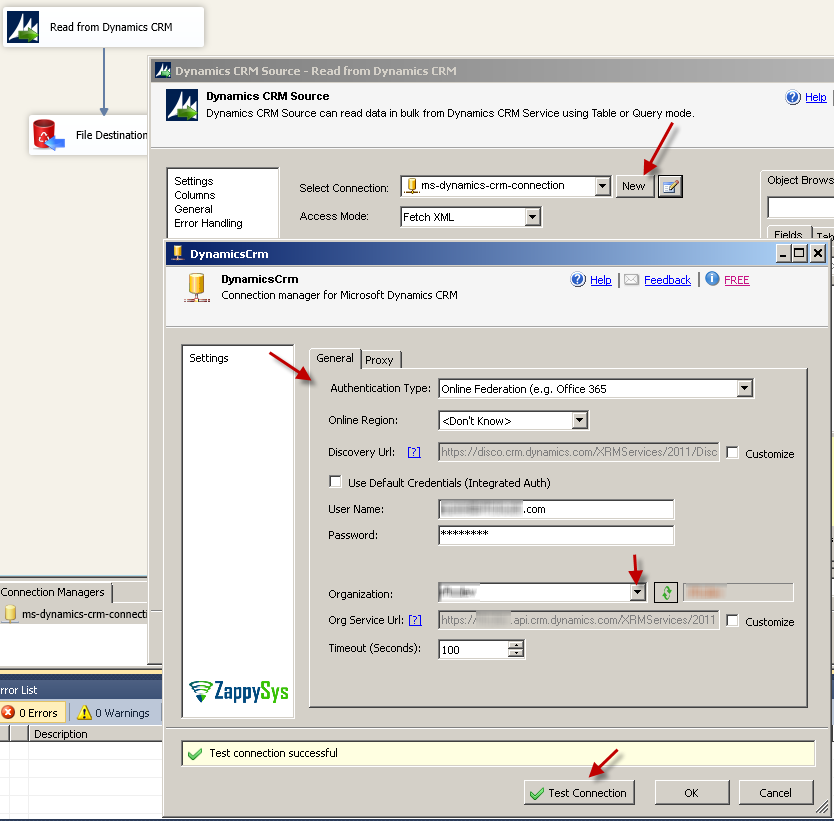
Create a ZS-DYNAMICS-CRM connection from the source. For Dynamics 365 Online and Dataverse use OAuth 2.0 Client Credentials or OAuth Delegated (interactive sign-in for MFA / 2FA) with an Azure AD app Client Id and Secret; for on-premises CRM use IFD or Active Directory. Select the organization and click Test Connection.
- Same connection works for CRM Destination
- Custom TokenUrl (e.g. US GCC)
- Retry on throttling and proxy settings
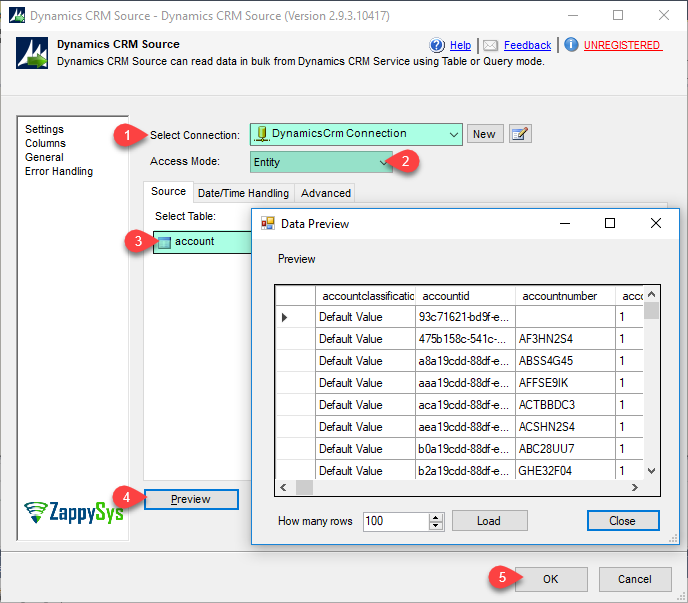
Read a whole table in Table mode.
Choose the table (entity) from the dropdown and click Preview. Use MaxRows to limit the rows and BatchSize to control how many rows each request fetches.
- Object Browser shows table details such as PrimaryIdAttribute
- Lookup, PartyList and Multi-Select PickList columns
Filter, join and aggregate with FetchXML.
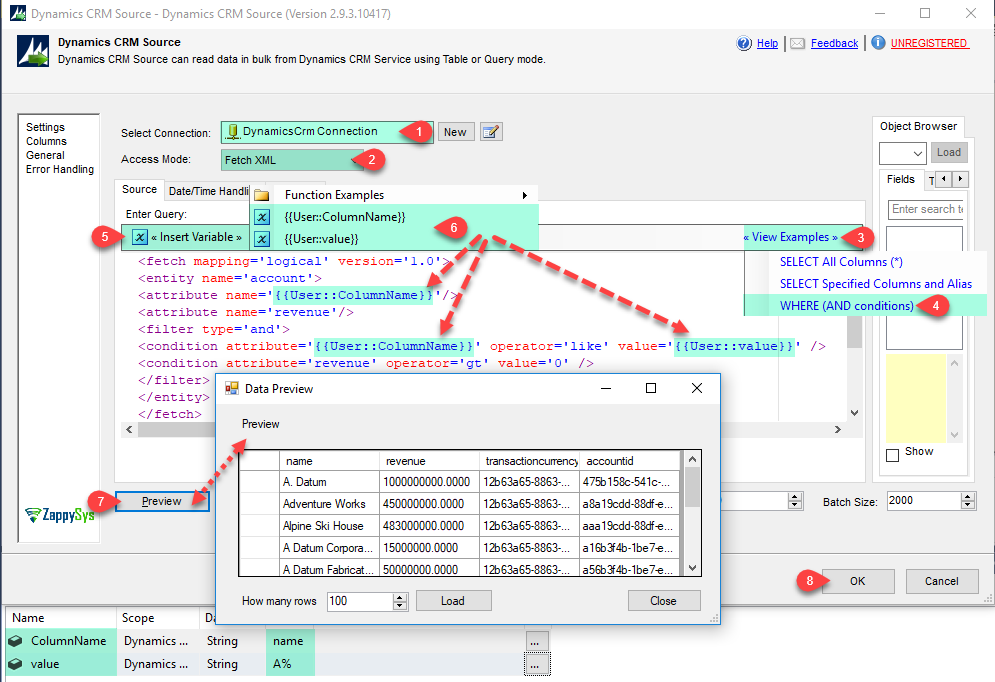
Switch to Query mode and write FetchXML, or pick one of the built-in examples: selected columns and aliases, WHERE with AND / OR, DISTINCT, TOP, GROUP BY aggregates, inner and outer joins, ORDER BY and date operators. You can also build a query visually with Advanced Find in CRM and paste the downloaded FetchXML.
{{User::MyVar}}placeholders for dynamic queries- UTC / local date conversion
Inside the UI
Key settings, as they appear in SSDT.
Real screens from the Dynamics CRM / Dataverse / PowerApps Source product page. Step through them, or open any shot at full size.
Dynamics CRM Source – Create new connection to Microsoft Dynamics 365
Click New next to the connection dropdown and configure a Dynamics 365 (CRM Online) connection.
Articles
Worked examples that use Dynamics CRM / Dataverse / PowerApps Source.
Compatibility and requirements
Designed to stay inside your SSIS runtime.
- SQL Server 2012 through 2025, 32-bit and 64-bit
- Windows only, 64-bit OS required. SQL Server Express and Web editions do not include SSIS
- Azure Data Factory SSIS Integration Runtime
- Self-hosted: credentials and data stay in your environment (external API calls still reach that service)
- Fully functional 30-day trial of SSIS PowerPack
FAQ
Questions teams ask before they drop Dynamics CRM / Dataverse / PowerApps Source on the canvas.
What is Dynamics CRM / Dataverse / PowerApps Source?
It is an SSIS data flow source that reads data from Microsoft Dynamics CRM, including Dynamics 365 Online, Dataverse / PowerApps and on-premises or IFD installations, in simple Table mode or with a custom FetchXML query.
Do I have to write FetchXML by hand?
No. Start from the built-in examples in the query editor, or build the query visually with Advanced Find in the CRM portal and paste the downloaded FetchXML. See the read tutorial for WHERE, TOP, DISTINCT, GROUP BY and JOIN examples.
Can I pass SSIS variables into the query?
Yes. Use placeholders such as {{User::MyVar}} inside the FetchXML, or click Insert Variable in the query editor.
Does it work with MFA-protected Dynamics 365 tenants?
Yes. Use OAuth with an Azure AD app Client Id and Secret: OAuth 2.0 Client Credentials (application permissions) or OAuth Delegated (interactive user sign-in). The older Online Federation mode is deprecated.
Which SQL Server versions can I run it on?
SQL Server 2025, 2022, 2019, 2017, 2016, 2014, and 2012 (32- and 64-bit), plus Azure Data Factory with an SSIS Integration Runtime (packages must target SQL Server 2017). See Compatibility and requirements.






What customers say
Start your free trial today
Install SSIS PowerPack and drag Dynamics CRM / Dataverse / PowerApps Source onto the Data Flow.
Read Dynamics 365, Dataverse and on-premises CRM data with Table mode or FetchXML, and load it into SQL Server or any SSIS destination.
- Data Flow Source in SSISDynamics CRM / Dataverse / PowerApps Source appears in the toolbox after you install PowerPack.
- Fully functional 30-day trialSSIS PowerPack, running in your environment.
- Live supportHelp during your trial and after purchase.
Open Help FileBrowse all SSIS PowerPack tasks
New purchases may be eligible for refund review within 30 days. See the refund policy.
Talk to an engineer before or during your trial.