SSIS Amazon Redshift Destination
Bulk insert a large number of records into Amazon Redshift from any data source using SSIS.
SSIS Amazon Redshift Destination bulk inserts a large number of records into Amazon Redshift from any data source, right inside the SSIS Data Flow with no S3 staging. Amazon Redshift is a cloud-based data warehouse service from Amazon AWS.
The trial includes Amazon Redshift Destination and every other PowerPack component
- Data Flow Destination in SSIS
- Runs in your environment
- Also runs in Azure Data Factory
- Fully functional 30-day trial


At a glance
What Amazon Redshift Destination can do
SSIS Amazon Redshift Destination can be used to bulk insert a large amount of records to Amazon Redshift storage from any data source using SSIS. Amazon Redshift is a cloud based Data Warehouse service from Amazon AWS.
Bulk write to Redshift
Bulk insert a large number of records into an Amazon Redshift table from any data source.
- Writes inside the SSIS Data Flow, with no S3 staging needed
- Feed it from any SSIS source (for example OLE DB Source or Dummy Data Source)
Batch size control
Set how many rows are processed in each request.
BatchSizeproperty on the component
Table picker & auto-mapping
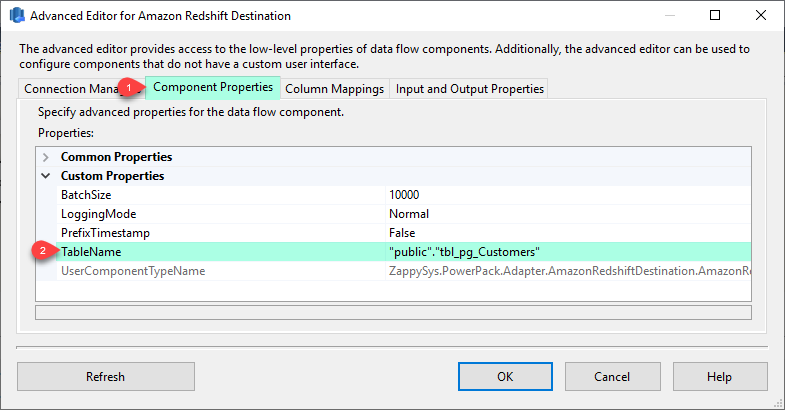
Pick the destination table from the Tables dropdown on the Component Properties tab.
- New, empty table: all input columns are mapped automatically
- Existing table: drag columns from the source list to the target list
Truncation warnings
Warns during validation when data length differs between source and destination.
Secure Redshift connection
Connect with host, port, database, user name and password through the Amazon Redshift Connection Manager.
- Enable SSL
- X509 client certificate from the LocalMachine or CurrentUser store, or a PFX or PEM file
Connection performance
Tune how the connection behaves while the package runs.
- Connection pooling for better performance
RetainSameConnectionkeeps one connection open for the whole package- Separate command and connect timeouts
Logging & locale
Control what is logged during package execution.
LoggingMode: Normal, Medium, Detailed or DebuggingPrefixTimestampadds a timestamp to log messagesLocaleIDfor locale-sensitive data such as date and time
SQL Server 2012–2025 & ADF
Runs in your environment on SQL Server 2012–2025 and Azure-SSIS.
- SQL Server 2025, 2022, 2019, 2017, 2016, 2014, 2012 (32/64-bit)
- Azure Data Factory (SSIS IR)
- Design packages in Visual Studio 2017, 2019, 2022, or 2026
- Windows only (64-bit OS): Windows 7–11 or Windows Server 2012–2025
Upsert & delete
To update/insert (upsert) or delete rows in a Redshift table, use Upsert Destination, which supports Amazon Redshift bulk operations.
See all features
- Bulk insert a large number of records into Amazon Redshift from any data source
- Write to Amazon Redshift inside the SSIS Data Flow without S3 staging
- Supports batch size (
BatchSize: how many rows to process in each request) - Pick the destination table from a dropdown; input columns are mapped automatically for a new, empty table
- Truncation warning during validation if the data length differs between source and destination
- SSL and X509 client certificate support on the Amazon Redshift Connection Manager
- Connection pooling and
RetainSameConnectionto share one open connection across tasks - Logging modes (Normal, Medium, Detailed, Debugging) with optional timestamp prefix
- Upsert or delete Redshift rows with Upsert Destination
Support for SQL Server 2025, 2022, 2019, 2017, 2016, 2014, 2012 (32/64-bit) and Azure Data Factory
SQL Server 2012–2025
How it works
From the toolbox to your first run.
Key steps from the Amazon Redshift Destination page and help file, with the screens you will see in SSDT.
Amazon Redshift Destination – Connection Manager
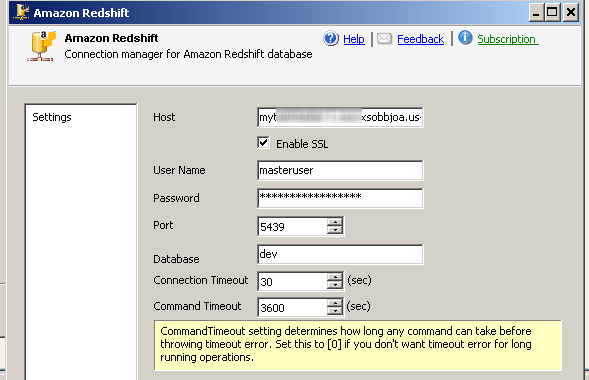
Right-click the Connection Managers panel, choose New Connection and pick ZS-REDSHIFT.
Enter the host, database, user name and password (tick Enable SSL if needed), then click Test Connection to verify the credentials.
Amazon Redshift Destination – Configuration
Double-click Amazon Redshift Destination, select the Redshift connection on the Connection Manager tab, then open Component Properties and pick the destination table from the Tables dropdown.
Use BatchSize to set how many rows are processed in each request.
Amazon Redshift Destination – Mapping
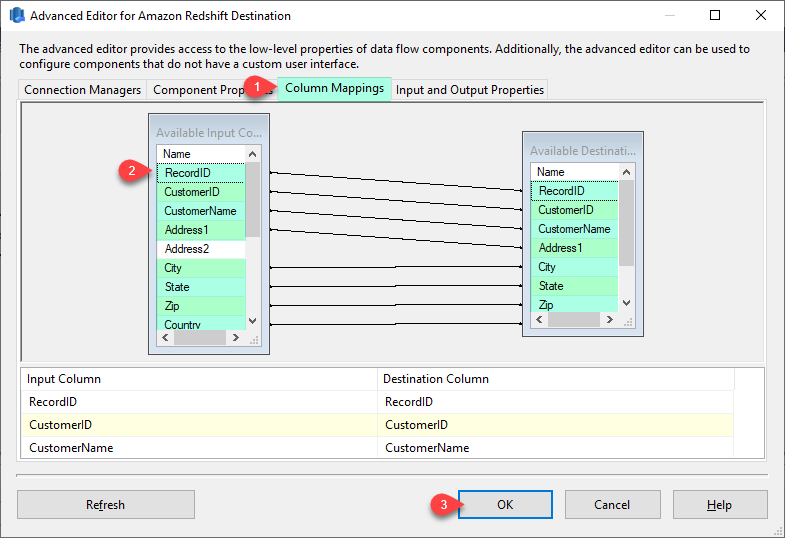
On the Mappings tab, verify the mapping. If the target table is new and empty, all input columns are mapped automatically.
For an existing table, drag columns from the source list to the target list, then run the package and verify the data is saved.
Inside the UI
Key settings, as they appear in SSDT.
Real screens from the Amazon Redshift Destination product page. Step through them, or open any shot at full size.
Amazon Redshift Destination – Connection Manager
New Amazon Redshift connection: enter host, database, user name and password, enable SSL and click Test Connection.
Articles
Worked examples that use Amazon Redshift Destination.
Compatibility and requirements
Designed to stay inside your SSIS runtime.
- SQL Server 2012 through 2025, 32-bit and 64-bit
- Windows only, 64-bit OS required. SQL Server Express and Web editions do not include SSIS
- Azure Data Factory SSIS Integration Runtime
- Self-hosted: credentials and data stay in your environment (external API calls still reach that service)
- Fully functional 30-day trial of SSIS PowerPack
FAQ
Questions teams ask before they drop Amazon Redshift Destination on the canvas.
What is Amazon Redshift Destination?
SSIS Amazon Redshift Destination bulk inserts a large number of records into Amazon Redshift from any data source, right inside the SSIS Data Flow with no S3 staging. Amazon Redshift is a cloud-based data warehouse service from Amazon AWS.
What can Amazon Redshift Destination do?
It bulk inserts rows from any SSIS source into a Redshift table you pick from a dropdown, with a configurable BatchSize. New, empty tables get all input columns mapped automatically, and validation warns about possible truncation when source and target data lengths differ.
Do I need to stage data in Amazon S3?
No. The destination writes straight from the SSIS Data Flow, without S3 staging. If you prefer the S3 staging / COPY command approach, use the Amazon Redshift Data Transfer Task.
How do I update or delete existing Redshift rows?
Use Upsert Destination, which supports bulk upsert (update or insert) and bulk delete for Amazon Redshift. See Merge / Upsert data in Amazon Redshift using SSIS.
Which SQL Server versions can I run it on?
SQL Server 2025, 2022, 2019, 2017, 2016, 2014, and 2012 (32- and 64-bit), plus Azure Data Factory with an SSIS Integration Runtime (packages must target SQL Server 2017). See Compatibility and requirements.





What customers say
Start your free trial today
Install SSIS PowerPack and drag Amazon Redshift Destination onto the Data Flow.
Bulk insert a large number of records into Amazon Redshift from any data source using SSIS.
- Data Flow Destination in SSISAmazon Redshift Destination appears in the toolbox after you install PowerPack.
- Fully functional 30-day trialSSIS PowerPack, running in your environment.
- Live supportHelp during your trial and after purchase.
Open Help FileBrowse all SSIS PowerPack tasks
New purchases may be eligible for refund review within 30 days. See the refund policy.
Talk to an engineer before or during your trial.