

Endpoint Create / Update CSV File (Generic)
Name
create_csv_file
Description
Related Tables
Parameters
| Parameter | Required | Options | ||||||||||||||||
|---|---|---|---|---|---|---|---|---|---|---|---|---|---|---|---|---|---|---|
|
Name:
Label: Drive Id Specify a drive |
YES | |||||||||||||||||
|
Name:
Label: File Id or Path (e.g. root:/somefolder/myfile.xyz: ) - Max 1000 Listed Specify a File Id or Path. Syntax: [{file-id}] -OR- [root:/{file-path}:] (Example: root:/folder/subfolder/myfile.xyz: ) |
YES | |||||||||||||||||
|
Name:
Label: Site Id (Re-Select Drive Id after you change this) Specify a site |
||||||||||||||||||
|
Name:
Label: Search Type - For UI Only (i.e. Recursive -OR- Non-Recursive) - Default=Recursive) NOTE: Not Supported with Application Credentials which uses Sites.Selected Scope. If you do not wish to see files from child folders then use Non-Recursive option. Recursive option has certain limitations (e.g. Only indexed files will appear so it takes time to show up in the list). If you do not see some files listed in the output then use Non-Recursive option (must specify Parent Folder Path in SearchPath property). |
|
|||||||||||||||||
|
Name:
Label: Search Folder (For UI Only - Helps to narrow down File Selection DropDown) - Max 200 Listed This parameter is only for UI. Select this to narrow down File List Dropdown. Select Search Folder first and then select File List dropdown to see new File list (found under this selected folder). |
Output Columns
| Label | Data Type (SSIS) | Data Type (SQL) | Length | Description |
|---|---|---|---|---|
| id |
DT_WSTR
|
nvarchar(500)
|
500 | |
| name |
DT_WSTR
|
nvarchar(150)
|
150 | |
| size |
DT_I8
|
bigint
|
||
| createdDateTime |
DT_DBTIMESTAMP
|
datetime
|
||
| lastModifiedDateTime |
DT_DBTIMESTAMP
|
datetime
|
||
| webUrl |
DT_WSTR
|
nvarchar(1500)
|
1500 | |
| webUrlPath |
DT_WSTR
|
nvarchar(1500)
|
1500 | |
| createdBy_user_id |
DT_WSTR
|
nvarchar(200)
|
200 | |
| createdBy_user_email |
DT_WSTR
|
nvarchar(150)
|
150 | |
| createdBy_user_displayName |
DT_WSTR
|
nvarchar(100)
|
100 | |
| createdBy_application_id |
DT_WSTR
|
nvarchar(200)
|
200 | |
| createdBy_application_displayName |
DT_WSTR
|
nvarchar(100)
|
100 | |
| lastModifiedBy_user_id |
DT_WSTR
|
nvarchar(200)
|
200 | |
| lastModifiedBy_user_email |
DT_WSTR
|
nvarchar(150)
|
150 | |
| lastModifiedBy_user_displayName |
DT_WSTR
|
nvarchar(150)
|
150 | |
| lastModifiedBy_application_id |
DT_WSTR
|
nvarchar(200)
|
200 | |
| lastModifiedBy_application_displayName |
DT_WSTR
|
nvarchar(150)
|
150 | |
| parentReference_id |
DT_WSTR
|
nvarchar(200)
|
200 | |
| parentReference_driveId |
DT_WSTR
|
nvarchar(400)
|
400 | |
| parentReference_driveType |
DT_WSTR
|
nvarchar(100)
|
100 | |
| parentReference_name |
DT_WSTR
|
nvarchar(200)
|
200 | This is only returned when calling lookup or /children call (e.g. /items/root:/[folder-name] OR /items/[item-id] ) |
| parentReference_siteId |
DT_WSTR
|
nvarchar(200)
|
200 | |
| parentReference_path |
DT_WSTR
|
nvarchar(1000)
|
1000 | This is only returned when calling lookup or /children call (e.g. /items/root:/[folder-name] OR /items/[item-id] ) |
| fileSystemInfo_createdDateTime |
DT_DBTIMESTAMP
|
datetime
|
||
| fileSystemInfo_lastModifiedDateTime |
DT_DBTIMESTAMP
|
datetime
|
||
| folder_childCount |
DT_I8
|
bigint
|
||
| file_mimeType |
DT_WSTR
|
nvarchar(300)
|
300 | |
| file_quickXorHash |
DT_WSTR
|
nvarchar(200)
|
200 | |
| file_sha1Hash |
DT_WSTR
|
nvarchar(200)
|
200 | |
| file_sha256Hash |
DT_WSTR
|
nvarchar(200)
|
200 | |
| shared_scope |
DT_WSTR
|
nvarchar(100)
|
100 | |
| remoteItem_parentReference_id |
DT_WSTR
|
nvarchar(200)
|
200 | |
| remoteItem_parentReference_driveId |
DT_WSTR
|
nvarchar(400)
|
400 | |
| remoteItem_parentReference_driveType |
DT_WSTR
|
nvarchar(100)
|
100 | |
| remoteItem_parentReference_name |
DT_WSTR
|
nvarchar(200)
|
200 | |
| remoteItem_parentReference_siteId |
DT_WSTR
|
nvarchar(200)
|
200 | |
| remoteItem_parentReference_path |
DT_WSTR
|
nvarchar(1000)
|
1000 | |
| remoteItem_shared_scope |
DT_WSTR
|
nvarchar(100)
|
100 | |
| remoteItem_shared_sharedDateTime |
DT_DBTIMESTAMP
|
datetime
|
||
| remoteItem_sharedBy_user_id |
DT_WSTR
|
nvarchar(200)
|
200 | |
| remoteItem_sharedBy_user_email |
DT_WSTR
|
nvarchar(150)
|
150 | |
| remoteItem_sharedBy_user_displayName |
DT_WSTR
|
nvarchar(150)
|
150 | |
| remoteItem_sharepointIds_listId |
DT_WSTR
|
nvarchar(200)
|
200 | |
| remoteItem_sharepointIds_listItemId |
DT_WSTR
|
nvarchar(200)
|
200 | |
| remoteItem_sharepointIds_listItemUniqueId |
DT_WSTR
|
nvarchar(200)
|
200 | |
| remoteItem_sharepointIds_siteId |
DT_WSTR
|
nvarchar(200)
|
200 | |
| remoteItem_sharepointIds_siteUrl |
DT_WSTR
|
nvarchar(200)
|
200 | |
| remoteItem_sharepointIds_tenantId |
DT_WSTR
|
nvarchar(200)
|
200 | |
| remoteItem_sharepointIds_webId |
DT_WSTR
|
nvarchar(200)
|
200 | |
| id_path |
DT_WSTR
|
nvarchar(500)
|
500 | |
| folder_path |
DT_WSTR
|
nvarchar(500)
|
500 |
Input Columns
| Label | Data Type (SSIS) | Data Type (SQL) | Length | Description | |||||||||||||||||||||||||||||||||||||||||||||||||||||||||||||||||||||||||||||||||||||||||||||||
|---|---|---|---|---|---|---|---|---|---|---|---|---|---|---|---|---|---|---|---|---|---|---|---|---|---|---|---|---|---|---|---|---|---|---|---|---|---|---|---|---|---|---|---|---|---|---|---|---|---|---|---|---|---|---|---|---|---|---|---|---|---|---|---|---|---|---|---|---|---|---|---|---|---|---|---|---|---|---|---|---|---|---|---|---|---|---|---|---|---|---|---|---|---|---|---|---|---|---|---|
| There are no Static columns defined for this endpoint. This endpoint detects columns dynamically at runtime. | |||||||||||||||||||||||||||||||||||||||||||||||||||||||||||||||||||||||||||||||||||||||||||||||||||
Examples
SSIS
Use SharePoint Online Connector in API Source or in API Destination SSIS Data Flow components to read or write data.
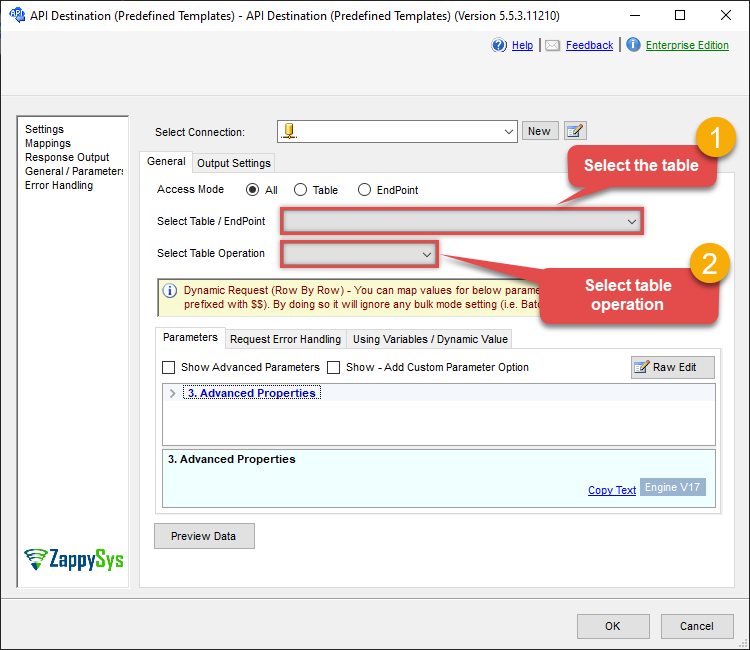
API Destination
This Endpoint belongs to the CSV File Read/Write table, therefore it is better to use it, instead of accessing the endpoint directly. Use this table and table-operation pair to create / update csv file:

| Required Parameters | |
|---|---|
| Drive Id | Fill-in the parameter... |
| File Id or Path (e.g. root:/somefolder/myfile.xyz: ) - Max 1000 Listed | Fill-in the parameter... |
| ColumnDelimiter | Fill-in the parameter... |
| RowDelimiter | Fill-in the parameter... |
| HasColumnHeaderRow | Fill-in the parameter... |
| QuotesAroundValue | Fill-in the parameter... |
| Optional Parameters | |
| Site Id (Re-Select Drive Id after you change this) | |
| Search Type - For UI Only (i.e. Recursive -OR- Non-Recursive) - Default=Recursive) | |
| Search Folder (For UI Only - Helps to narrow down File Selection DropDown) - Max 200 Listed | |
| DataFormat | Notset |
| Continue On 404 Error (When item not found) | True |
| AlwaysQuoteRegardlessDataType | False |
| Encoding | |
| CharacterSet | |
| WriterDateTimeFormat | |
ODBC application
Use these SQL queries in your ODBC application data source:
Create or update a CSV file
<p>Creates or updates a CSV file directly in a SharePoint document library using a streaming approach. Reads records from an external source (e.g. MSSQL) and writes to CSV.</p>
INSERT INTO FileReaderWriterCsv
SOURCE( 'MSSQL'--OR 'ODBC'
, 'Data Source=localhost;Initial Catalog=Northwind;Integrated Security=true'
, 'select OrderId,CustomerId,OrderDate FROM Northwind.dbo.Orders'
)
WITH(
	    DriveId='b!0zqXLXXJh0uUMzl-JXAd9Ztngc-5utVDqRyD2lKpD2535-11HLQTR5z4hOzmA7Q0'
	  , FileId='root:/test_out.csv:'
	--, FileId='root:/subfolder/test_out.csv:'
	--, FileId='01N3NxxxxxxxWZYSDJ'  --exising File ID
	--, ColumnDelimiter=',' --{LF}, {TAB}, | , \x0009 ...
	--, RowDelimiter='{NEWLINE}' --{LF}, {TAB}, | , \x0009 ...
	--, HasColumnHeaderRow=0 --set for header less file
  --, WriterDateTimeFormat='yyyy-MM-ddTHH:mm:ss.fff'
  --See Query Builder for more options
)
create_csv_file endpoint belongs to
FileReaderWriterCsv
table(s), and can therefore be used via those table(s).
SQL Server
Use these SQL queries in SQL Server after you create a data source in Data Gateway:
Create or update a CSV file
<p>Creates or updates a CSV file directly in a SharePoint document library using a streaming approach. Reads records from an external source (e.g. MSSQL) and writes to CSV.</p>
DECLARE @MyQuery NVARCHAR(MAX) = 'INSERT INTO FileReaderWriterCsv
SOURCE( ''MSSQL''--OR ''ODBC''
, ''Data Source=localhost;Initial Catalog=Northwind;Integrated Security=true''
, ''select OrderId,CustomerId,OrderDate FROM Northwind.dbo.Orders''
)
WITH(
	    DriveId=''b!0zqXLXXJh0uUMzl-JXAd9Ztngc-5utVDqRyD2lKpD2535-11HLQTR5z4hOzmA7Q0''
	  , FileId=''root:/test_out.csv:''
	--, FileId=''root:/subfolder/test_out.csv:''
	--, FileId=''01N3NxxxxxxxWZYSDJ''  --exising File ID
	--, ColumnDelimiter='','' --{LF}, {TAB}, | , \x0009 ...
	--, RowDelimiter=''{NEWLINE}'' --{LF}, {TAB}, | , \x0009 ...
	--, HasColumnHeaderRow=0 --set for header less file
  --, WriterDateTimeFormat=''yyyy-MM-ddTHH:mm:ss.fff''
  --See Query Builder for more options
)';

EXEC (@MyQuery) AT [LS_TO_SHAREPOINT_ONLINE_IN_GATEWAY];
create_csv_file endpoint belongs to
FileReaderWriterCsv
table(s), and can therefore be used via those table(s).