SSIS XML Parser Task
Extract one or more values from an XML document in the Control Flow with XPath.
SSIS XML Parser Task is a free task that extracts one or more values from an XML document in the Control Flow. Read the XML from direct text, an SSIS variable or a file connection, enter an XPath expression for each value, and save the results to SSIS variables or the SSIS output.
XML Parser Task is free in every edition. The same download also includes a trial of the paid PowerPack components
- Control Flow Task in SSIS
- Runs in your environment
- Also runs in Azure Data Factory
- Free component (FREE edition)
















At a glance
What XML Parser Task can do
SSIS XML Parser Task is a free task that extracts one or more values from an XML document in the Control Flow. Read the XML from direct text, an SSIS variable or a file connection, enter an XPath expression for each value, and save the results to SSIS variables or the SSIS output.
Extract values with XPath
Extract single or multiple values from an XML document in the Control Flow by property name or XPath expression.
- Extract values into multiple SSIS variables in one task
Direct, file or variable input
Read the XML document from a direct string, an XML file or an SSIS variable.
SourceAccessMode: Direct, Variable or ConnectionSourceDirectValue,SourceVariable,SourceConnection(file path)
Variable placeholders
Use a variable placeholder inside the direct input string so the XML can change at runtime.
- Example:
{{User::varHtml}}
Multiple XPath expressions
Enter as many XPath expressions as you need in one task, each with its own target and description.
- By position:
/catalog/book[1]/title - Attributes:
/catalog/book[1]/@id - Predicates:
/catalog/book[@id="bk102"]/title
Map values to targets
Send each extracted value to an SSIS variable or to the SSIS output.
TargetSettingsper extracted valueLOG-TO-OUTPUTtarget shows the value in the Output panel
Test parse settings
Test your XML parse settings in the task UI before running the package.
- Test shows the output of every expression in one window
Logging & expressions
Control logging, and set options dynamically with SSIS expressions using their numeric values.
LoggingMode: Normal, Medium, Detailed or DebuggingPrefixTimestampadds a timestamp to log messages- Pair with the free ZS Logging Task to show extracted values
SQL Server 2012–2025 & ADF
Runs in your environment on SQL Server 2012–2025 and Azure-SSIS.
- SQL Server 2025, 2022, 2019, 2017, 2016, 2014, 2012 (32/64-bit)
- Azure Data Factory (SSIS IR)
- Design packages in Visual Studio 2017, 2019, 2022, or 2026
- Windows only (64-bit OS): Windows 7–11 or Windows Server 2012–2025
See all features
- Read XML Document and extract single or multiple properties by name or XPath expression
- Read XML Document from direct string, XML file or SSIS Variable
- Extract values into multiple SSIS variables
- Element, attribute and predicate XPath expressions, each with an optional description
- Support for Test XML Parse settings
- Use variable placeholders (e.g.
{{User::varHtml}}) in the direct input string - Send extracted values to variables or
LOG-TO-OUTPUT - Options can be set by SSIS expression using their numeric values
LoggingMode(Normal, Medium, Detailed, Debugging) andPrefixTimestamp- Works with the free ZS Logging Task to display extracted values
Support for SQL Server 2025, 2022, 2019, 2017, 2016, 2014, 2012 (32/64-bit) and Azure Data Factory
SQL Server 2012–2025
How it works
From the toolbox to your first run.
Key steps from the XML Parser Task page and help file, with the screens you will see in SSDT.
Enter an XPath expression for each value you need.
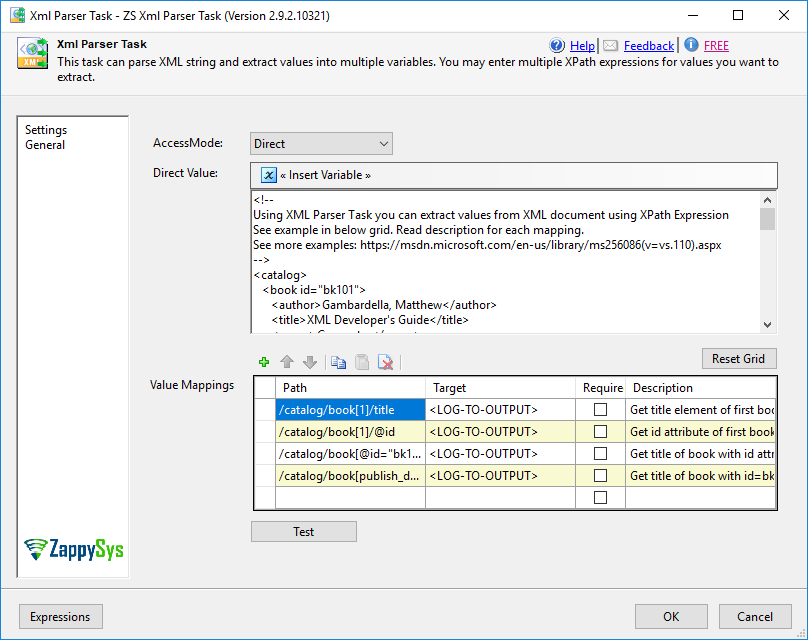
Set AccessMode to Direct, Variable or Connection and point it at your XML. Add a row per value in Value Mappings with an XPath expression, a Target and an optional description, then click Test to see the output of every expression.
- Element by position:
/catalog/book[1]/title - Attribute:
/catalog/book[1]/@id - Predicate:
/catalog/book[@id="bk102"]/title
Send each value to a variable or the log.
Pick a Target for every mapping: an SSIS variable, to use the value later in the package, or <LOG-TO-OUTPUT> to write it to the Output window.
- Insert Variable adds a placeholder to the direct input
- Add, delete and reorder mapping rows
Run the package and read the parsed values.
Run the package and open View > Output. Each expression mapped to LOG-TO-OUTPUT is logged as “Value Parsed for [path]” with its value. Connect the free ZS Logging Task to show values stored in variables.
LoggingModeup to DebuggingPrefixTimestampfor log lines

Inside the UI
Key settings, as they appear in SSDT.
Real screens from the XML Parser Task help file. Step through them, or open any shot at full size.
Drag the task from the SSIS Toolbox
In your SSIS project, drag ZS XML Parser Task from the SSIS Toolbox onto the Control Flow.
Compatibility and requirements
Designed to stay inside your SSIS runtime.
- SQL Server 2012 through 2025, 32-bit and 64-bit
- Windows only, 64-bit OS required. SQL Server Express and Web editions do not include SSIS
- Azure Data Factory SSIS Integration Runtime
- Self-hosted: credentials and data stay in your environment (external API calls still reach that service)
- Fully functional 30-day trial of SSIS PowerPack
FAQ
Questions teams ask before they drop XML Parser Task on the canvas.
What is XML Parser Task?
SSIS XML Parser Task is a free task that extracts one or more values from an XML document in the Control Flow. Read the XML from direct text, an SSIS variable or a file connection, enter an XPath expression for each value, and save the results to SSIS variables or the SSIS output.
Is XML Parser Task free?
Yes. It is included in the FREE edition of SSIS PowerPack, as well as in the Standard, Professional and Enterprise editions. See compare editions.
Which XPath expressions can I use?
Standard XPath. The help example selects an element by position (/catalog/book[1]/title), an attribute (/catalog/book[1]/@id) and a node by attribute or child value (/catalog/book[@id="bk102"]/title, /catalog/book[publish_date="2001-03-10"]/title).
Where can the XML come from?
Set SourceAccessMode to Direct (text typed in the task), Variable (an SSIS variable) or Connection (a file connection that holds the XML file path). In direct text you can also use a variable placeholder such as {{User::varHtml}}.
How do I see the extracted values?
Map a value to <LOG-TO-OUTPUT> to write it to the SSIS Output window, or map it to a variable and display it with the free ZS Logging Task. The Test button shows each expression’s output before you run the package.
Which SQL Server versions can I run it on?
SQL Server 2025, 2022, 2019, 2017, 2016, 2014, and 2012 (32- and 64-bit), plus Azure Data Factory with an SSIS Integration Runtime (packages must target SQL Server 2017). See Compatibility and requirements.


What customers say
Free in every edition
Install SSIS PowerPack and drag XML Parser Task onto the Control Flow.
Extract values from XML text, files or variables into SSIS variables with XPath.
- Control Flow Task in SSISXML Parser Task appears in the toolbox after you install PowerPack.
- Free to useXML Parser Task is included in the FREE edition of SSIS PowerPack.
- Live supportQuestions? Talk to a ZappySys engineer.
Talk to an engineer before or during your trial.