

Table Files
Description
No description available
Supported Operations
Below section contains supported CRUD operations. Each operation is executed by some EndPoint behind the scene.| Method | Supported | Reference EndPoint |
|---|---|---|
| SELECT | list_files | |
| INSERT | ||
| UPDATE | ||
| UPSERT | ||
| DELETE | delete_item | |
| LOOKUP | get_item |
Examples
SSIS
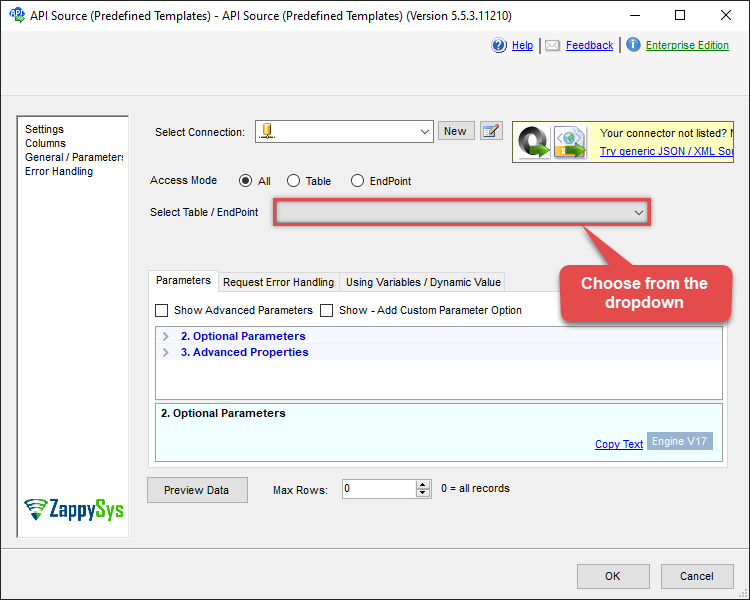
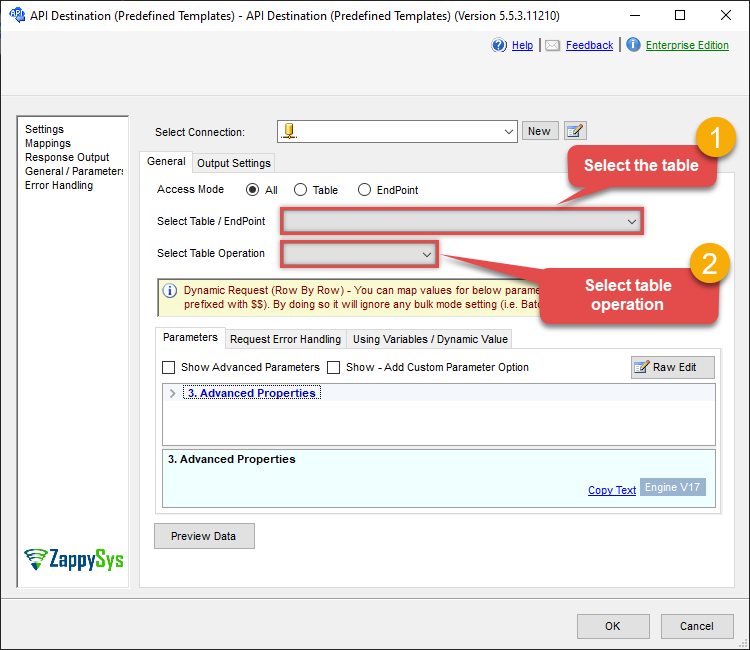
Use OneDrive Connector in API Source component to read data or in API Destination component to read/write data:
Read from Files table using API Source

| Required Parameters | |
|---|---|
| Record Filter (Client Side) | Fill-in the parameter... |
| Drive Id / Shared Folder | Fill-in the parameter... |
| Optional Parameters | |
| Default Group or User Id (additional Scopes needed to list - If fails enter manually) | |
| Search Type (Default=Recursive) | search(q='') |
| Search Path (Default=Root Folder) - Max 200 listed | /root |
| Order By Field(s) - Only for Recursive SearchType | |
Read/write to Files table using API Destination
| Required Parameters | |
|---|---|
| Record Filter (Client Side) | Fill-in the parameter... |
| Drive Id / Shared Folder | Fill-in the parameter... |
| Optional Parameters | |
| Default Group or User Id (additional Scopes needed to list - If fails enter manually) | |
| Search Type (Default=Recursive) | search(q='') |
| Search Path (Default=Root Folder) - Max 200 listed | /root |
| Order By Field(s) - Only for Recursive SearchType | |
ODBC application
Use these SQL queries in your ODBC application data source:
Read all files (recursive)
<p>Gets all files recursively from the default drive. Use this when you need a flat list of every file under a drive. For a single folder (non-recursive) or to filter by path, use the <code>list_root</code> or <code>list_files</code> table with <code>DriveId</code> and <code>SearchPath</code>.</p>
SELECT * FROM FilesDelete a file or folder
<p>Deletes a file or folder. Identify the item by ID or path in the <code>WITH</code> clause. This action cannot be undone.</p>
DELETE FROM Files
WITH (
     DriveId='me'
   --OR--
   --DriveId='b!GtLN726LE0eY5F2BBNi14'

   --Enter file path or ID

   --,ItemId='root:/dump.pdf:'	--Path must end with colon
   --,ItemId='root:/myfolder/dump.pdf:'
   --,ItemId='01SUOJPKHXMPKD2UXXXXXXXXXXXXXXXXXX'
	)

--Using Table Name instead of endpoint (with Id / Path in WHERE clause for simple Syntax)

--************
--Delete File by ID	or Path
--************
--DELETE From Files Where Id='01N3NI7YU6DYBSLCEDKBB23CR4FSWZYSDJ'
--DELETE From Files Where Id='root:/test_out.csv:'
--DELETE From Files Where Id='root:/somefolder/test_out.csv:'

--************
--Delete Folder by ID or Path
--************
--DELETE From Folders Where Id='01N3NI7YU6DYBSLCEDKBB23CR4FSWZYSDJ'
--DELETE From Folders Where Id='root:/somefolder:'
--DELETE From Folders Where Id='root:/somefolder/childfolder:'

--DriveId can be retrieved by selecting from 'list_drives' endpoint.
--FileId can be retrieved by selecting from 'list_folder' or 'list_root' endpoints.
SQL Server
Use these SQL queries in SQL Server after you create a data source in Data Gateway:
Read all files (recursive)
<p>Gets all files recursively from the default drive. Use this when you need a flat list of every file under a drive. For a single folder (non-recursive) or to filter by path, use the <code>list_root</code> or <code>list_files</code> table with <code>DriveId</code> and <code>SearchPath</code>.</p>
DECLARE @MyQuery NVARCHAR(MAX) = 'SELECT * FROM Files';

EXEC (@MyQuery) AT [LS_TO_ONEDRIVE_IN_GATEWAY];
Delete a file or folder
<p>Deletes a file or folder. Identify the item by ID or path in the <code>WITH</code> clause. This action cannot be undone.</p>
DECLARE @MyQuery NVARCHAR(MAX) = 'DELETE FROM Files
WITH (
     DriveId=''me''
   --OR--
   --DriveId=''b!GtLN726LE0eY5F2BBNi14''

   --Enter file path or ID

   --,ItemId=''root:/dump.pdf:''	--Path must end with colon
   --,ItemId=''root:/myfolder/dump.pdf:''
   --,ItemId=''01SUOJPKHXMPKD2UXXXXXXXXXXXXXXXXXX''
	)

--Using Table Name instead of endpoint (with Id / Path in WHERE clause for simple Syntax)

--************
--Delete File by ID	or Path
--************
--DELETE From Files Where Id=''01N3NI7YU6DYBSLCEDKBB23CR4FSWZYSDJ''
--DELETE From Files Where Id=''root:/test_out.csv:''
--DELETE From Files Where Id=''root:/somefolder/test_out.csv:''

--************
--Delete Folder by ID or Path
--************
--DELETE From Folders Where Id=''01N3NI7YU6DYBSLCEDKBB23CR4FSWZYSDJ''
--DELETE From Folders Where Id=''root:/somefolder:''
--DELETE From Folders Where Id=''root:/somefolder/childfolder:''

--DriveId can be retrieved by selecting from ''list_drives'' endpoint.
--FileId can be retrieved by selecting from ''list_folder'' or ''list_root'' endpoints.';

EXEC (@MyQuery) AT [LS_TO_ONEDRIVE_IN_GATEWAY];