

Endpoint Read JSON File (Generic)
Name
get_json_file
Description
Related Tables
Parameters
| Parameter | Required | Options | ||||||||||||||
|---|---|---|---|---|---|---|---|---|---|---|---|---|---|---|---|---|
|
Name:
Label: Drive Id / Shared Folder Specify a drive |
YES | |||||||||||||||
|
Name:
Label: File Id or Path (e.g. root:/somefolder/myfile.xyz: ) - Max 1000 Listed Specify a File Id or Path. Syntax: [{file-id}] -OR- [root:/{file-path}:] (Example: root:/folder/subfolder/myfile.xyz: ) |
YES | |||||||||||||||
|
Name:
Label: Default Group or User Id (additional Scopes needed to list - If fails enter manually) To list all users and groups from your organizations you need additional scopes. See connection UI - Choose User.Read.All and Group.Read.All Scopes and regenerate token. You can manually type value too if you know Group or User Id. Format is /users/{id} OR /groups/{id} |
|
|||||||||||||||
|
Name:
Label: Search Type (For UI Only - Default=Recursive - i.e. Blank) If you do not wish to see files from child folders then use Non-Recursive option. Recursive option has certain limitations (e.g. Only indexed files will appear so it takes time to show up in the list). If you do not see some files listed in the output then use Non-Recursive option (must specify Parent Folder Path in SearchPath property). |
|
|||||||||||||||
|
Name:
Label: Search Folder (For UI Only - Helps to narrow down File Selection DropDown) - Max 200 Listed This parameter is only for UI. Select this to narrow down File List Dropdown. Select Search Folder first and then select File List dropdown to see new File list (found under this selected folder). |
Output Columns
| Label | Data Type (SSIS) | Data Type (SQL) | Length | Description | |||||||||||||||||||||||||||||||||||||||||||||||||||||||||||||||||||||||||||||||||||||||||||||||
|---|---|---|---|---|---|---|---|---|---|---|---|---|---|---|---|---|---|---|---|---|---|---|---|---|---|---|---|---|---|---|---|---|---|---|---|---|---|---|---|---|---|---|---|---|---|---|---|---|---|---|---|---|---|---|---|---|---|---|---|---|---|---|---|---|---|---|---|---|---|---|---|---|---|---|---|---|---|---|---|---|---|---|---|---|---|---|---|---|---|---|---|---|---|---|---|---|---|---|---|
| There are no Static columns defined for this endpoint. This endpoint detects columns dynamically at runtime. | |||||||||||||||||||||||||||||||||||||||||||||||||||||||||||||||||||||||||||||||||||||||||||||||||||
Input Columns
| Label | Data Type (SSIS) | Data Type (SQL) | Length | Description | |||||||||||||||||||||||||||||||||||||||||||||||||||||||||||||||||||||||||||||||||||||||||||||||
|---|---|---|---|---|---|---|---|---|---|---|---|---|---|---|---|---|---|---|---|---|---|---|---|---|---|---|---|---|---|---|---|---|---|---|---|---|---|---|---|---|---|---|---|---|---|---|---|---|---|---|---|---|---|---|---|---|---|---|---|---|---|---|---|---|---|---|---|---|---|---|---|---|---|---|---|---|---|---|---|---|---|---|---|---|---|---|---|---|---|---|---|---|---|---|---|---|---|---|---|
| There are no Static columns defined for this endpoint. This endpoint detects columns dynamically at runtime. | |||||||||||||||||||||||||||||||||||||||||||||||||||||||||||||||||||||||||||||||||||||||||||||||||||
Examples
SSIS
Use OneDrive Connector in API Source or in API Destination SSIS Data Flow components to read or write data.
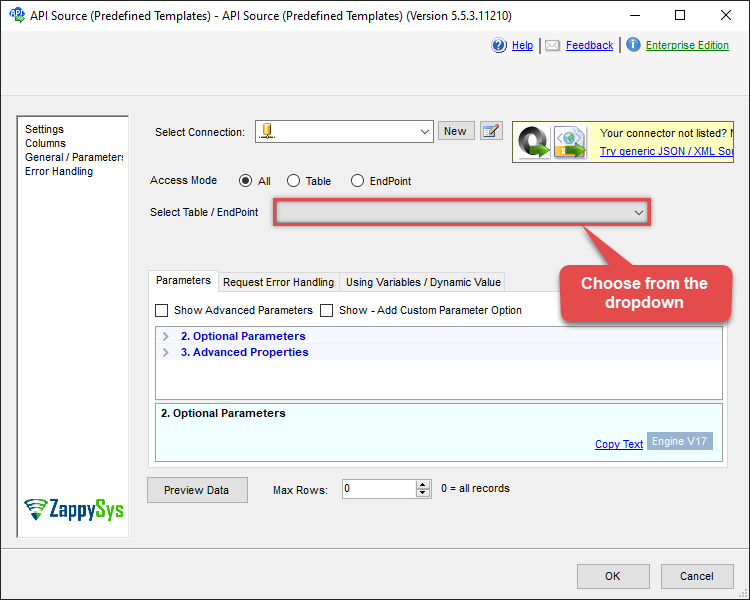
API Source
This Endpoint belongs to the JSON File Read/Create/Update table, therefore it is better to use it, instead of accessing the endpoint directly:

| Required Parameters | |
|---|---|
| Drive Id / Shared Folder | Fill-in the parameter... |
| File Id or Path (e.g. root:/somefolder/myfile.xyz: ) - Max 1000 Listed | Fill-in the parameter... |
| FileCompressionType | Fill-in the parameter... |
| Optional Parameters | |
| Default Group or User Id (additional Scopes needed to list - If fails enter manually) | |
| Search Type (For UI Only - Default=Recursive - i.e. Blank) | |
| Search Folder (For UI Only - Helps to narrow down File Selection DropDown) - Max 200 Listed | |
| DataFormat | Notset |
| Continue On 404 Error (When item not found) | True |
| Filter | |
| ExcludedProperties | |
| Encoding | |
| CharacterSet | |
| EnableCustomReplace | |
| SearchFor | |
| ReplaceWith | |
| EnableArrayFlattening | |
| MaxArrayItemsToFlatten | |
| ArrayTransformType | |
| ArrayTransColumnNameFilter | |
| ArrayTransRowValueFilter | |
| ArrayTransEnableCustomColumns | |
| ArrayTransCustomColumns | |
| EnablePivot | |
| DateFormatString | |
API Destination
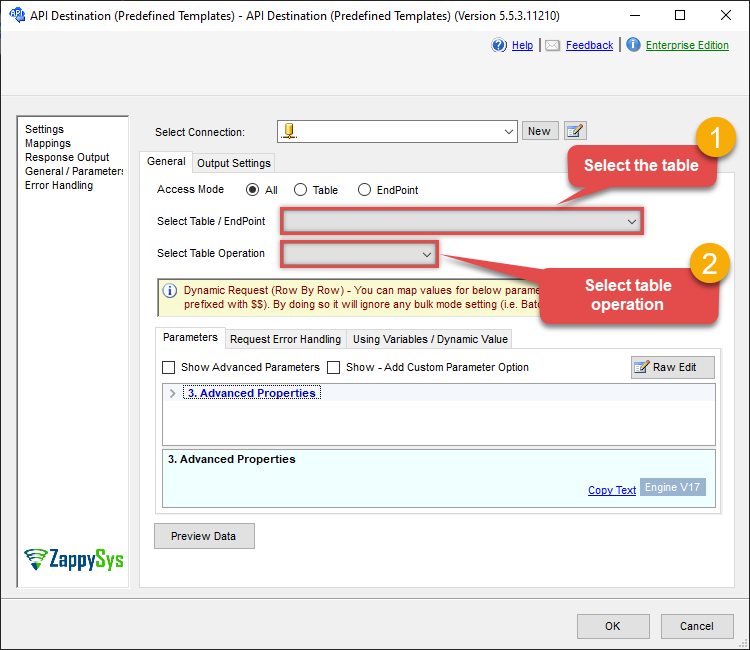
This Endpoint belongs to the JSON File Read/Create/Update table, therefore it is better to use it, instead of accessing the endpoint directly. Use this table and table-operation pair to read json file:
| Required Parameters | |
|---|---|
| Drive Id / Shared Folder | Fill-in the parameter... |
| File Id or Path (e.g. root:/somefolder/myfile.xyz: ) - Max 1000 Listed | Fill-in the parameter... |
| FileCompressionType | Fill-in the parameter... |
| Optional Parameters | |
| Default Group or User Id (additional Scopes needed to list - If fails enter manually) | |
| Search Type (For UI Only - Default=Recursive - i.e. Blank) | |
| Search Folder (For UI Only - Helps to narrow down File Selection DropDown) - Max 200 Listed | |
| DataFormat | Notset |
| Continue On 404 Error (When item not found) | True |
| Filter | |
| ExcludedProperties | |
| Encoding | |
| CharacterSet | |
| EnableCustomReplace | |
| SearchFor | |
| ReplaceWith | |
| EnableArrayFlattening | |
| MaxArrayItemsToFlatten | |
| ArrayTransformType | |
| ArrayTransColumnNameFilter | |
| ArrayTransRowValueFilter | |
| ArrayTransEnableCustomColumns | |
| ArrayTransCustomColumns | |
| EnablePivot | |
| DateFormatString | |
ODBC application
Use these SQL queries in your ODBC application data source:
Read JSON file (streaming, no download)
<p>Gets JSON file content without downloading to disk (streaming). Supply <code>DriveId</code> and <code>FileId</code> (path must end with colon). For compressed files set <code>FileCompressionType</code> to <code>GZip</code> or <code>Zip</code>.</p>
SELECT * from get_json_file
WITH(
	  DriveId='b!0zqXLXXJh0uUMzl-JXAd9Ztngc-5utVDqRyD2lKpD2535-11HLQTR5z4hOzmA7Q0'

	, FileId='root:/myfolder/dump.json:' --Path must end with colon
  --, FileId='01N3NI7YRUO2UHV2TUMBGJ4H4QQMWCG6DA'

  --to read compressed file use below way
  --, FileId='root:/myfolder/dump.json.gz:' --Path must end with colon
  --, FileCompressionType='GZip' --None, GZip, Zip

    , Filter='$.store.books[*]' --or just blank (see help file for more filter examples)

)

--SELECT * FROM get_json_file WITH(FileId='01N3NI7YQJMKXUWUAQGJEJJJNSGVT7QSJ3')
--SELECT * FROM get_json_file WITH(FileId='root:/dump.json:') --Path must end with colon
--SELECT * FROM get_json_file WITH(FileId='root:/Documents/dump.json:') --Path must end with colon
--SELECT * FROM get_json_file WITH(FileId='root:/Documents/SubFolder/dump.json:') --Path must end with colon
Read compressed JSON file (Zip/Gzip, streaming)
<p>Gets a compressed JSON file (Zip or Gzip) without downloading to disk. Set <code>FileCompressionType</code> and supply <code>FileId</code> (path to the .zip or .gz file).</p>
SELECT * from get_json_file
WITH(
	DriveId='b!0zqXLXXJh0uUMzl-JXAd9Ztngc-5utVDqRyD2lKpD2535-11HLQTR5z4hOzmA7Q0'
  , FileId='root:/myfolder/dump.json.zip:' --Path must end with colon
--, FileId='01N3NI7YRUO2UHV2TUMBGJ4H4QQMWCG6DA'
  , Filter='$.store.books[*]' --or just blank (see help file for more filter examples)
  , FileCompressionType='Zip' --None, GZip, Zip
)
get_json_file endpoint belongs to
FileReaderWriterJson
table(s), and can therefore be used via those table(s).
SQL Server
Use these SQL queries in SQL Server after you create a data source in Data Gateway:
Read JSON file (streaming, no download)
<p>Gets JSON file content without downloading to disk (streaming). Supply <code>DriveId</code> and <code>FileId</code> (path must end with colon). For compressed files set <code>FileCompressionType</code> to <code>GZip</code> or <code>Zip</code>.</p>
DECLARE @MyQuery NVARCHAR(MAX) = 'SELECT * from get_json_file
WITH(
	  DriveId=''b!0zqXLXXJh0uUMzl-JXAd9Ztngc-5utVDqRyD2lKpD2535-11HLQTR5z4hOzmA7Q0''

	, FileId=''root:/myfolder/dump.json:'' --Path must end with colon
  --, FileId=''01N3NI7YRUO2UHV2TUMBGJ4H4QQMWCG6DA''

  --to read compressed file use below way
  --, FileId=''root:/myfolder/dump.json.gz:'' --Path must end with colon
  --, FileCompressionType=''GZip'' --None, GZip, Zip

    , Filter=''$.store.books[*]'' --or just blank (see help file for more filter examples)

)

--SELECT * FROM get_json_file WITH(FileId=''01N3NI7YQJMKXUWUAQGJEJJJNSGVT7QSJ3'')
--SELECT * FROM get_json_file WITH(FileId=''root:/dump.json:'') --Path must end with colon
--SELECT * FROM get_json_file WITH(FileId=''root:/Documents/dump.json:'') --Path must end with colon
--SELECT * FROM get_json_file WITH(FileId=''root:/Documents/SubFolder/dump.json:'') --Path must end with colon';

EXEC (@MyQuery) AT [LS_TO_ONEDRIVE_IN_GATEWAY];
Read compressed JSON file (Zip/Gzip, streaming)
<p>Gets a compressed JSON file (Zip or Gzip) without downloading to disk. Set <code>FileCompressionType</code> and supply <code>FileId</code> (path to the .zip or .gz file).</p>
DECLARE @MyQuery NVARCHAR(MAX) = 'SELECT * from get_json_file
WITH(
	DriveId=''b!0zqXLXXJh0uUMzl-JXAd9Ztngc-5utVDqRyD2lKpD2535-11HLQTR5z4hOzmA7Q0''
  , FileId=''root:/myfolder/dump.json.zip:'' --Path must end with colon
--, FileId=''01N3NI7YRUO2UHV2TUMBGJ4H4QQMWCG6DA''
  , Filter=''$.store.books[*]'' --or just blank (see help file for more filter examples)
  , FileCompressionType=''Zip'' --None, GZip, Zip
)';

EXEC (@MyQuery) AT [LS_TO_ONEDRIVE_IN_GATEWAY];
get_json_file endpoint belongs to
FileReaderWriterJson
table(s), and can therefore be used via those table(s).