SSIS JSON Parser Task
Extract one or more values from a JSON document in the Control Flow and save them to SSIS variables.
SSIS JSON Parser Task is a free task that extracts one or more values from a JSON document in the Control Flow. Read the JSON from direct text, an SSIS variable or a file, type a property name or JSONPath expression for each value, and send it to an SSIS variable or the SSIS output.
JSON Parser Task is free in every edition. The same download also includes a trial of the paid PowerPack components
- Control Flow Task in SSIS
- Runs in your environment
- Also runs in Azure Data Factory
- Free component (FREE edition)


At a glance
What JSON Parser Task can do
SSIS JSON Parser Task is a free task that extracts one or more values from a JSON document in the Control Flow. Read the JSON from direct text, an SSIS variable or a file, type a property name or JSONPath expression for each value, and send it to an SSIS variable or the SSIS output.
Extract values with JSONPath
Extract single or multiple values from a JSON document in the Control Flow by property name or JSONPath expression.
JSON Path (Filter)property holds the filter- Filter by array index, e.g. pick just the 3rd book (index starts at 0)
- Nested paths like
LocationInfo.Cityand array items likeOrderIDList[0]
Direct, file or variable input
Read the JSON document from direct text, a JSON file or an SSIS variable.
SourceDirectValue,SourceConnection(file path) orSourceVariable- Insert Variable option adds a variable to the input text
Automatic field parsing
Automatically parse the possible fields from the JSON document, so you can pick the values to extract.
- Parse Field button lists the values to map
Map values to variables
Send each extracted value to an SSIS variable or to the SSIS output.
TargetSettingsper extracted valueLOG-TO-OUTPUTtarget shows the value in the Output panel- Use the variables in later tasks, e.g. insert them into SQL Server
Test parse settings
Test your JSONPath settings in the task UI before running the package.
- Test shows the parsed values in a popup
- Reset Grid clears the mappings
Free Logging Task included
The free ZS Logging Task installs with it and can display the extracted variable values.
- Show values in the SSIS output (execution log), a MessageBox, a file or a variable
Logging control
Control how much information is logged during package execution.
LoggingMode: set to Debugging for maximum log
SQL Server 2012–2025 & ADF
Runs in your environment on SQL Server 2012–2025 and Azure-SSIS.
- SQL Server 2025, 2022, 2019, 2017, 2016, 2014, 2012 (32/64-bit)
- Azure Data Factory (SSIS IR)
- Design packages in Visual Studio 2017, 2019, 2022, or 2026
- Windows only (64-bit OS): Windows 7–11 or Windows Server 2012–2025
See all features
- Read JSON Document and extract single or multiple properties by name or JSONPath expression
- Read JSON Document from direct string, JSON file or SSIS Variable
- Automatically Parse possible fields from JSON document
- Support for Test JSON Parse settings
- Filter JSON with a JSONPath expression (e.g. select one array item by index)
- Map nested properties (e.g.
LocationInfo.City) and array items (e.g.OrderIDList[0]) - Map each extracted value to an SSIS variable or
LOG-TO-OUTPUT - Insert Variable option to use an SSIS variable inside the input text
- Extracted variables can be used by later tasks, e.g. inserted into SQL Server with Execute SQL Task
- Free ZS Logging Task shows variable values in the SSIS output, a MessageBox, a file or a variable
LoggingModecontrols how much information is logged- Parses a single JSON document per task (use JSON Source for multiple documents)
Support for SQL Server 2025, 2022, 2019, 2017, 2016, 2014, 2012 (32/64-bit) and Azure Data Factory
SQL Server 2012–2025
How it works
From the toolbox to your first run.
Key steps from the JSON Parser Task page and help file, with the screens you will see in SSDT.
Point it at your JSON and map each value.
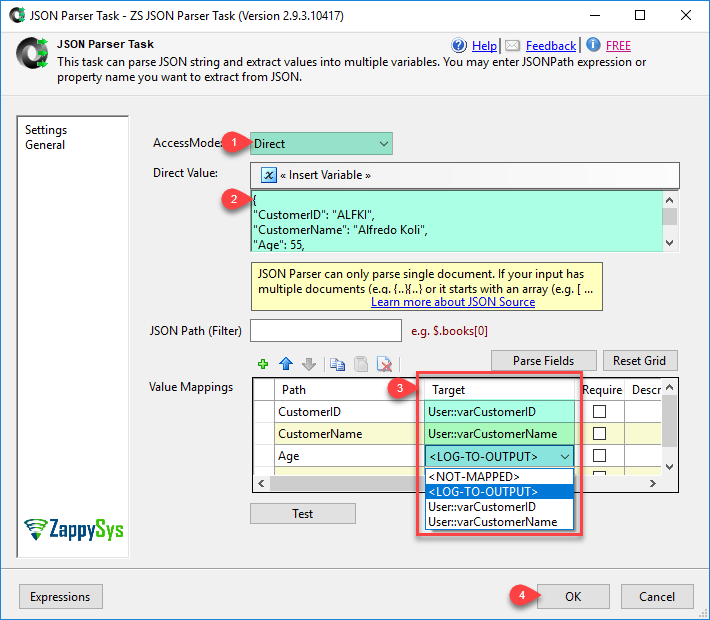
Double-click the task and set AccessMode to Direct, Variable or Connection (file). Paste or select the JSON, click Parse Fields to list the paths, then pick a Target for each one: an SSIS variable or <LOG-TO-OUTPUT>.
- Insert Variable adds an SSIS variable to the input text
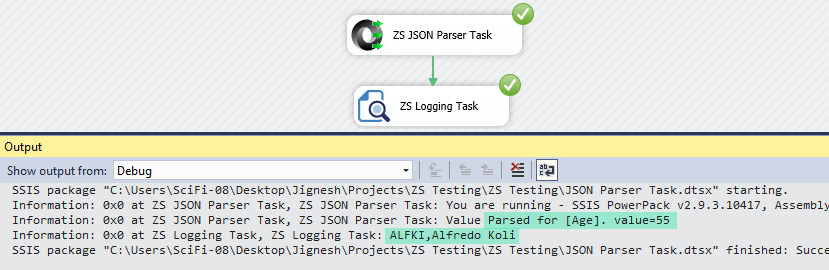
- Example: CustomerID and CustomerName go to String variables, Age to the log
- Input must be a single JSON document (for many documents use JSON Source)
Filter with JSONPath and test before you run.
Enter a JSON Path (Filter) such as docs[0] or $.books[0] to work on one node, then map nested paths like LocationInfo.City or array items like OrderIDList[0]. Test shows the parsed values in a message box.
- Array index starts at 0
- Reset Grid clears the mappings
- Test before you run the package
Run the package and check the values.
Join the free ZS Logging Task after the parser to show the variable values in the SSIS output (Execution Log), a MessageBox, a file or a variable. Values mapped to LOG-TO-OUTPUT appear in the Output window too (View > Output).
- The Logging Task installs with the JSON Parser Task
- Use the variables in later tasks, e.g. an Execute SQL Task
Inside the UI
Key settings, as they appear in SSDT.
Real screens from the JSON Parser Task product page. Step through them, or open any shot at full size.
Drag and drop ZS JSON Parser Task to the design panel
Drag ZS JSON Parser Task onto the Control Flow. The installer also adds the free ZS Logging Task; join the two with the green arrow.
Articles
Worked examples that use JSON Parser Task.
Compatibility and requirements
Designed to stay inside your SSIS runtime.
- SQL Server 2012 through 2025, 32-bit and 64-bit
- Windows only, 64-bit OS required. SQL Server Express and Web editions do not include SSIS
- Azure Data Factory SSIS Integration Runtime
- Self-hosted: credentials and data stay in your environment (external API calls still reach that service)
- Fully functional 30-day trial of SSIS PowerPack
FAQ
Questions teams ask before they drop JSON Parser Task on the canvas.
What is JSON Parser Task?
SSIS JSON Parser Task is a free task that extracts one or more values from a JSON document in the Control Flow. Read the JSON from direct text, an SSIS variable or a file, type a property name or JSONPath expression for each value, and send it to an SSIS variable or the SSIS output.
Is JSON Parser Task free?
Yes. It is included in the FREE edition of SSIS PowerPack, as well as in the Standard, Professional and Enterprise editions. See compare editions.
Can it read nested objects and arrays?
Yes. Map nested properties with dot paths such as LocationInfo.City and array items with an index such as OrderIDList[0] (index starts at 0). Use the JSON Path (Filter) box, e.g. $.books[0], to narrow the document first.
Can it parse a file that holds several JSON documents?
No. The task parses a single JSON document. The task UI notes that input with multiple documents, or input that starts with an array, should be read with JSON Source instead.
How do I see the extracted values?
Set a value’s Target to <LOG-TO-OUTPUT> to write it to the SSIS Output window, or map it to a variable and show it with the free ZS Logging Task (Execution Log, MessageBox, file or variable).
Can it drive REST API pagination?
Yes. In the Zuora API tutorial the JSON Parser Task reads the saved response file and stores the done flag and queryLocator in variables that control the next page request.
Which SQL Server versions can I run it on?
SQL Server 2025, 2022, 2019, 2017, 2016, 2014, and 2012 (32- and 64-bit), plus Azure Data Factory with an SSIS Integration Runtime (packages must target SQL Server 2017). See Compatibility and requirements.






What customers say
Free in every edition
Install SSIS PowerPack and drag JSON Parser Task onto the Control Flow.
Extract values from JSON text, files or variables into SSIS variables, free.
- Control Flow Task in SSISJSON Parser Task appears in the toolbox after you install PowerPack.
- Free to useJSON Parser Task is included in the FREE edition of SSIS PowerPack.
- Live supportQuestions? Talk to a ZappySys engineer.
Talk to an engineer before or during your trial.