Outlook Mail (Office 365) Connector for Azure Data Factory (Pipeline) : Get messages via SQL

Integrate Azure Data Factory (Pipeline) and Outlook Mail (Office 365)

Learn how to get messages using the Outlook Mail (Office 365) Connector for Azure Data Factory (Pipeline). This connector enables you to read and write Microsoft Outlook Mail (Office 365) data effortlessly. Send, manage, and sync messages, attachments, and folders — almost no coding required. We'll walk you through the exact setup.

Let's dive in!

Create data source using Outlook Mail (Office 365) ODBC Driver

  1. Download and install ODBC PowerPack (if you haven't already).

  2. Search for odbc and open the ODBC Data Sources (64-bit):

    Open ODBC Data Source
  3. Create a User data source (User DSN) based on the ZappySys API Driver driver:

    ZappySys API Driver
    Create new User DSN for ZappySys API Driver
    • Create and use a User DSN if the client application runs under a User Account. This is the ideal option at design time (e.g., when developing in Visual Studio). Use it for both types of applications (64-bit and 32-bit).
    • Create and use a System DSN if the client application runs under a System Account (e.g., as a Windows Service). This is usually the required option in a production environment. If your Windows Service is a 32-bit application, you must use the 32-bit ODBC Data Source Administrator to configure this
  4. When the Configuration window appears give your data source a name if you haven't done that already, then select "Outlook Mail (Office 365)" from the list of Popular Connectors. If "Outlook Mail (Office 365)" is not present in the list, then click "Search Online" and download it. Then set the path to the location where you downloaded it. Finally, click Continue >> to proceed with configuring the DSN:

    OutlookMailOffice365DSN
    Outlook Mail (Office 365)
    ODBC DSN Template Selection
  5. Now it's time to configure the Connection Manager. Select Authentication Type, e.g. Token Authentication. Then select API Base URL (in most cases, the default one is the right one). More info is available in the Authentication section.

    Outlook Mail (Office 365) authentication

    Use delegated access (User Credentials) whenever you want to let a signed-in user work with their own resources or resources they can access. Whether it's an admin setting up policies for their entire organization or a user deleting an email in their inbox, all scenarios involving user actions should use delegated access. [API reference]

    Follow these simple steps below to create Microsoft Entra ID application with delegated access:

    WARNING: If you are planning to automate processes, we recommend that you use a Application Credentials authentication method. In case, you still need to use User Credentials, then make sure you use a system/generic account (e.g. automation@my-company.com). When you use a personal account which is tied to a specific employee profile and that employee leaves the company, the token may become invalid and any automated processes using that token will start to fail.
    1. Navigate to the Azure Portal and log in using your credentials.
    2. Access Microsoft Entra ID.
    3. Register a new application by going to App registrations and clicking on New registration button: Start new app registration in Microsoft Entra ID
      INFO: Find more information on how to register an application in Graph API reference.
    4. When configuration window opens, configure these fields:
      • Supported account type
        • Use Accounts in this organizational directory only, if you need access to data in your organization only.
      • Redirect URI:
        • Set the type to Public client/native (mobile & desktop).
        • Use https://zappysys.com/oauth as the URL.
      Register app in Microsoft Entra ID
    5. After registering the app, copy the Application (client) ID for later: Copy client ID of Microsoft Entra ID app
    6. Then copy OAuth authorization endpoint (v2) & OAuth token endpoint (v2) URLs to use later in the configuration: Copy Auth and Token URLs in Microsoft Entra ID app
    7. Now go to SSIS package or ODBC data source and use the copied values in User Credentials authentication configuration:
      • In the Authorization URL field paste the OAuth authorization endpoint (v2) URL value you copied in the previous step.
      • In the Token URL field paste the OAuth token endpoint (v2) URL value you copied in the previous step.
      • In the Client ID field paste the Application (client) ID value you copied in the previous step.
      • In the Scope field use the default value or select individual scopes, e.g.:
        • email
        • offline_access
        • openid
        • profile
        • Mail.Read
        • Mail.Read.Shared
        • Mail.ReadBasic
        • Mail.ReadBasic.Shared
        • Mail.ReadWrite
        • Mail.ReadWrite.Shared
        • Mail.Send
        • Mail.Send.Shared
        • User.Read
        • User.ReadBasic.All
        • Group.Read.All
    8. Press Generate Token button to generate Access and Refresh Tokens.
    9. Optional step. Choose Default User Id from the drop down menu (if someone shared a mailbox with you).
    10. Click Test Connection to confirm the connection is working.
    11. Done! Now you are ready to use the API Connector!
    API Connection Manager configuration

    Just perform these simple steps to finish authentication configuration:

    1. Set Authentication Type to User Credentials [OAuth]
    2. Optional step. Modify API Base URL if needed (in most cases default will work).
    3. Fill in all the required parameters and set optional parameters if needed.
    4. Press Generate Token button to generate the tokens.
    5. Finally, hit OK button:
    OutlookMailOffice365DSN
    Outlook Mail (Office 365)
    User Credentials [OAuth]
    https://graph.microsoft.com/v1.0
    Required Parameters
    Authorization URL Fill-in the parameter...
    Token URL Fill-in the parameter...
    Client ID Fill-in the parameter...
    Scope Fill-in the parameter...
    Return URL Fill-in the parameter...
    Optional Parameters
    Client Secret
    Refresh Token File Path
    Login Prompt Option
    Default User Id (Select after clicking **Generate Token**) me
    RetryMode RetryWhenStatusCodeMatch
    RetryStatusCodeList 429|503
    RetryCountMax 5
    RetryMultiplyWaitTime True
    ODBC DSN OAuth Connection Configuration
    Outlook Mail (Office 365) authentication

    Application-only access is broader and more powerful than delegated access (User Credentials), so you should only use app-only access where needed. Use it when: 1. The application needs to run in an automated way, without user input (for example, a daily script that checks emails from certain contacts and sends automated responses). 2. The application needs to access resources belonging to multiple different users (for example, a backup or data loss prevention app might need to retrieve messages from many different chat channels, each with different participants). 3. You find yourself tempted to store credentials locally and allow the app to sign in 'as' the user or admin. [API reference]

    Follow these simple steps below to create Microsoft Entra ID application with application access permissions.

    1. Navigate to the Azure Portal and log in using your credentials.
    2. Access Microsoft Entra ID.
    3. Register a new application by going to App registrations and clicking on New registration button: Start new app registration in Microsoft Entra ID
      INFO: Find more information on how to register an application in Graph API reference.
    4. When configuration window opens, configure these fields:
      • Supported account type
        • e.g. select Accounts in this organizational directory only if you need access to data in your organization only.
      • Redirect URI:
        • Set the type to Public client/native (mobile & desktop).
        • Leave the URL field empty.
      Register app in Microsoft Entra ID
    5. After registering the app, copy the Application (client) ID for later: Copy client ID of Microsoft Entra ID app
    6. Then copy OAuth authorization endpoint (v2) & OAuth token endpoint (v2) URLs: Copy Auth and Token URLs in Microsoft Entra ID app
    7. Continue and create Client secret: Add Client secret for Microsoft Entra ID app
    8. Then copy the Client secret for later steps: Copy Client secret
    9. Continue by adding permissions for the app by going to the API permissions section, and clicking on Add a permission: Start adding permissions to Microsoft Entra ID app
    10. Select Microsoft Graph: Select Graph API permissions for Microsoft Entra ID app
    11. Then choose Application permissions option: Select app permissions for Microsoft Entra ID app
    12. Continue by adding these Mail (Outlook) permissions: Select Outlook Mail application scopes
    13. Finish by clicking Add permissions button: Add permissions to Microsoft Entra ID app
    14. Now it's time to Grant admin consent for your application: Grant admin consent for Microsoft Entra ID app
    15. Confirm all the permissions are granted: Admin consent granted successfully in Entra ID
    16. Now go to SSIS package or ODBC data source and use the copied values in Application Credentials authentication configuration:
      • In the Token URL field paste the OAuth token endpoint (v2) URL value you copied in the previous step.
      • In the Client ID field paste the Application (client) ID value you copied in the previous step.
      • In the Client Secret field paste the Client secret value you copied in the previous step.
      • Choose Default User Id from the drop down menu.
    17. Click Test Connection to confirm the connection is working.
    18. That's it! Now you can use the connector.
    API Connection Manager configuration

    Just perform these simple steps to finish authentication configuration:

    1. Set Authentication Type to Application Credentials [OAuth]
    2. Optional step. Modify API Base URL if needed (in most cases default will work).
    3. Fill in all the required parameters and set optional parameters if needed.
    4. Finally, hit OK button:
    OutlookMailOffice365DSN
    Outlook Mail (Office 365)
    Application Credentials [OAuth]
    https://graph.microsoft.com/v1.0
    Required Parameters
    Token URL Fill-in the parameter...
    Client ID Fill-in the parameter...
    Client Secret Fill-in the parameter...
    Scope Fill-in the parameter...
    Default User Id Fill-in the parameter...
    Optional Parameters
    RetryMode RetryWhenStatusCodeMatch
    RetryStatusCodeList 429|503
    RetryCountMax 5
    RetryMultiplyWaitTime True
    ODBC DSN OAuth Connection Configuration

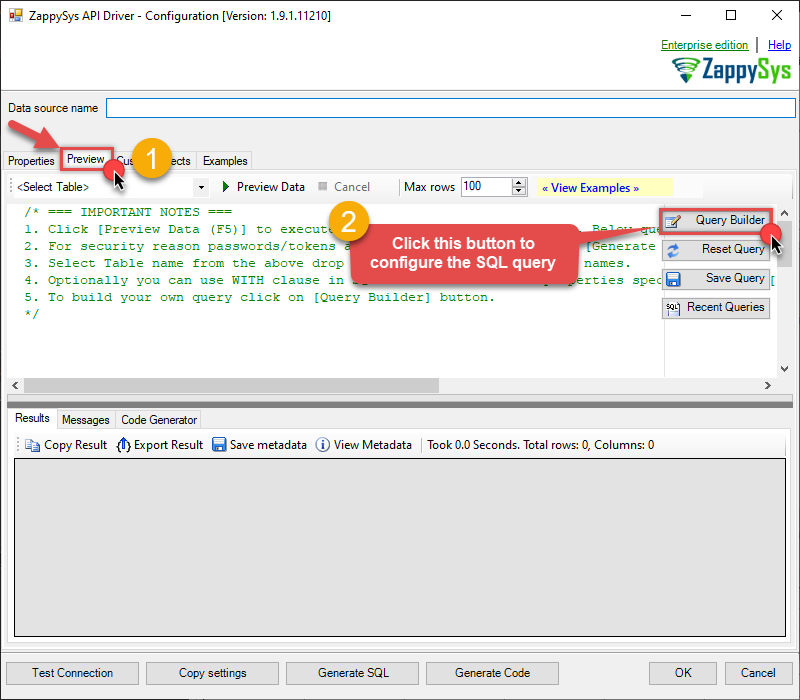
  6. Then go to Preview tab to start building a SQL query.

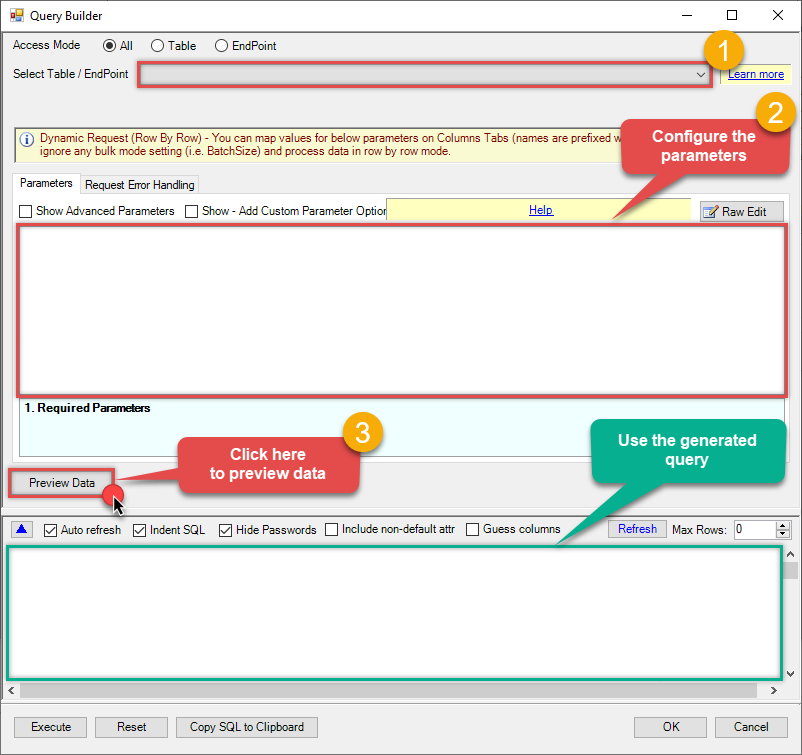
  7. Once you do that, proceed by opening Query Builder:

    ZappySys API Driver - Outlook Mail (Office 365)
    Read and write Microsoft Outlook Mail (Office 365) data effortlessly. Send, manage, and sync messages, attachments, and folders — almost no coding required.
    OutlookMailOffice365DSN
    Open Query Builder in API ODBC Driver to read and write data to REST API
  8. Then simply select the Get Messages endpoint (action).

  9. Continue by configuring the Required parameters. You can also set optional parameters too.

  10. Move on by hitting Preview Data button to preview the results.

  11. If you see the results you need, simply copy the generated query:
    Get Messages
    Required Parameters
    User ID or Email Select the value from the dropdown
    Optional Parameters
    Search Criteria
    Email Body Format html
    MailFolderId
    Order By
    Page Size 100
    Selected Columns
    Advanced Properties
    EnableArrayFlattening True
    MaxArrayItemsToFlatten 5
    DataFormat OData
    SELECT * FROM get_messages
    WITH (UserID='firstname.lastname@domainname.com')
    Query Builder
  12. Click OK to use built SQL query and close the Query Builder.

  13. Now hit Preview Data button to preview the data using the generated SQL query. If you are satisfied with the result, use this query in Azure Data Factory (Pipeline):

    ZappySys API Driver - Outlook Mail (Office 365)
    Read and write Microsoft Outlook Mail (Office 365) data effortlessly. Send, manage, and sync messages, attachments, and folders — almost no coding required.
    OutlookMailOffice365DSN
    SELECT * FROM get_messages
    WITH (UserID='firstname.lastname@domainname.com')
    API ODBC Driver-based data source data preview
    You can also access data quickly from the tables dropdown by selecting <Select table>.
    A WHERE clause, LIMIT keyword will be performed on the client side, meaning that the whole result set will be retrieved from the Outlook Mail (Office 365) API first, and only then the filtering will be applied to the data. If possible, it is recommended to use parameters in Query Builder to filter the data on the server side (in Outlook Mail (Office 365) servers).

Let's not stop here and explore SQL query examples, including how to use them in Stored Procedures and Views (virtual tables) in the next steps.

Outlook Mail (Office 365) SQL query examples

Use these SQL queries in your Azure Data Factory (Pipeline) data source:

Read messages for a specified user

Gets messages for a given user. Supply UserID in the WITH clause (user email or GUID).

SELECT * FROM get_messages
WITH (UserID='firstname.lastname@domainname.com')

Read first N messages for a specified user

Gets the first N messages for a user. Supply UserID and PageSize in the WITH clause.

SELECT * FROM get_messages
WITH (UserID='firstname.lastname@domainname.com', PageSize='5')

Read messages in a mail folder

Gets messages in a mail folder. Supply MailFolderID in the WITH clause (e.g. INBOX or a folder ID).

SELECT * FROM get_messages
WITH (
MailFolderID='INBOX' --or use mai folder id
)

Read messages with subject starting with text

Gets messages whose subject starts with given text. Use SearchCriteria in the WITH clause (e.g. startsWith(Subject,'Announcements for')). See Microsoft Graph filter docs for more conditions.

SELECT * FROM get_messages
WITH (UserID='firstname.lastname@domainname.com', SearchCriteria='startsWith(Subject,''Announcements for'')')

--Check this link to learn more about search conditions: https://learn.microsoft.com/en-us/graph/filter-query-parameter?tabs=http

Read messages that have attachments

Gets only messages that have attachments. Use SearchCriteria='hasAttachments eq true' in the WITH clause.

SELECT * FROM get_messages
WITH (UserID='firstname.lastname@domainname.com', SearchCriteria='hasAttachments eq true')

--Check this link to learn more about search conditions: https://learn.microsoft.com/en-us/graph/filter-query-parameter?tabs=http

Read unread messages

Gets only unread messages. Use SearchCriteria='IsRead eq false' in the WITH clause.

SELECT * FROM get_messages
WITH (UserID='firstname.lastname@domainname.com', SearchCriteria='IsRead eq false')

--Check this link to learn more about search conditions: https://learn.microsoft.com/en-us/graph/filter-query-parameter?tabs=http

Create SQL view in ODBC data source

ZappySys API Drivers support flexible Query language so you can override Default Properties you configured on Data Source such as URL, Body. This way you don't have to create multiple Data Sources if you like to read data from multiple EndPoints. However not every application support supplying custom SQL to driver so you can only select Table from list returned from driver.

If you're dealing with Microsoft Access and need to import data from an SQL query, it's important to note that Access doesn't allow direct import of SQL queries. Instead, you can create custom objects (Virtual Tables) to handle the import process.

Many applications like MS Access, Informatica Designer wont give you option to specify custom SQL when you import Objects. In such case Virtual Table is very useful. You can create many Virtual Tables on the same Data Source (e.g. If you have 50 URLs with slight variations you can create virtual tables with just URL as Parameter setting.

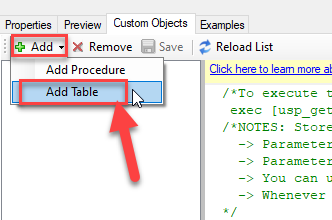
  1. Go to Custom Objects Tab and Click on Add button and Select Add Table:
    ZappySys Driver - Add Table

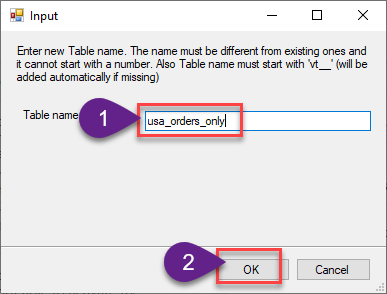
  2. Enter the desired Table name and click on OK:
    ZappySys Driver - Add Table Name

  3. And it will open the New Query Window Click on Cancel to close that window and go to Custom Objects Tab.

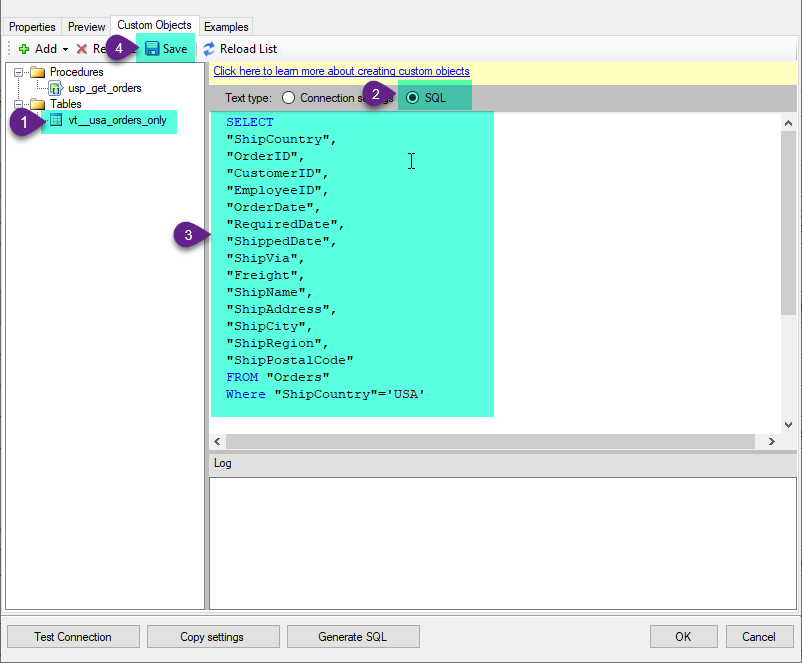
  4. Select the created table, Select Text Type AS SQL and write the your desired SQL Query and Save it and it will create the custom table in the ZappySys Driver:
    Here is an example SQL query for ZappySys Driver. You can insert Placeholders also. Read more about placeholders here

    SELECT
      "ShipCountry",
      "OrderID",
      "CustomerID",
      "EmployeeID",
      "OrderDate",
      "RequiredDate",
      "ShippedDate",
      "ShipVia",
      "Freight",
      "ShipName",
      "ShipAddress",
      "ShipCity",
      "ShipRegion",
      "ShipPostalCode"
    FROM "Orders"
    Where "ShipCountry"='USA'

    ZappySys Driver - Create Custom Table
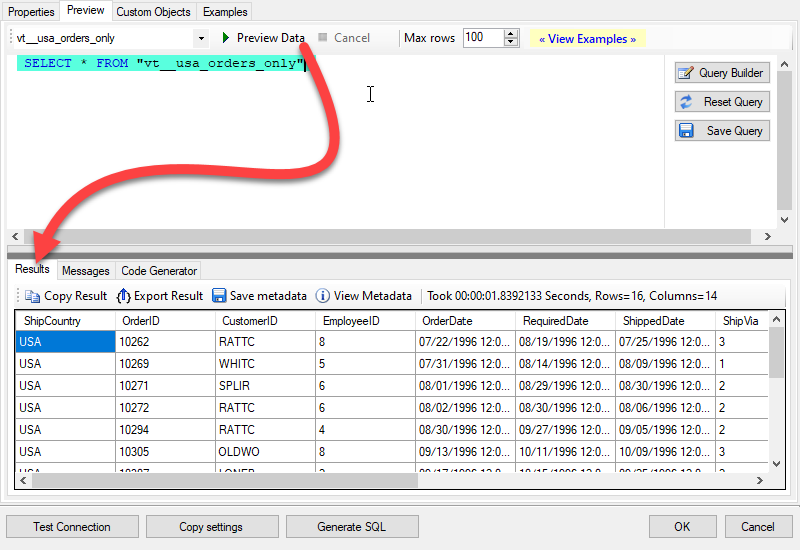
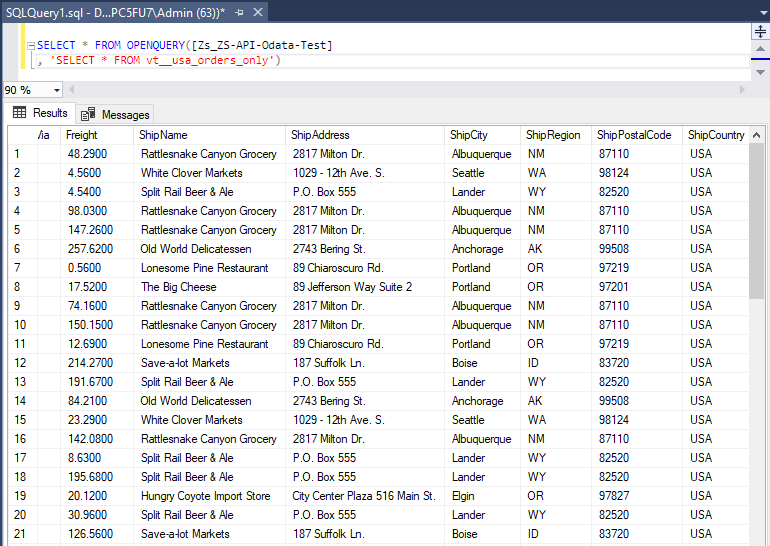
  5. That's it now go to Preview Tab and Execute your custom virtual table query. In this example it will extract the orders for the USA Shipping Country only:

    SELECT * FROM "vt__usa_orders_only"
    ZappySys Driver - Execute Custom Virtual Table Query

Get messages in Azure Data Factory (Pipeline) via SQL view

  1. Sign in to Azure Portal

    • Open your browser and go to: https://portal.azure.com

    • Enter your Azure credentials and complete MFA if required.

    • After login, go to Data factories.

    Azure Portal
  2. Under Azure Data Factory Resource - Create or select the Data Factory you want to work with.

    Select the Data Factory
  3. Inside the Data Factory resource page, click Launch studio.

    Launch Azure Data Factory Studio
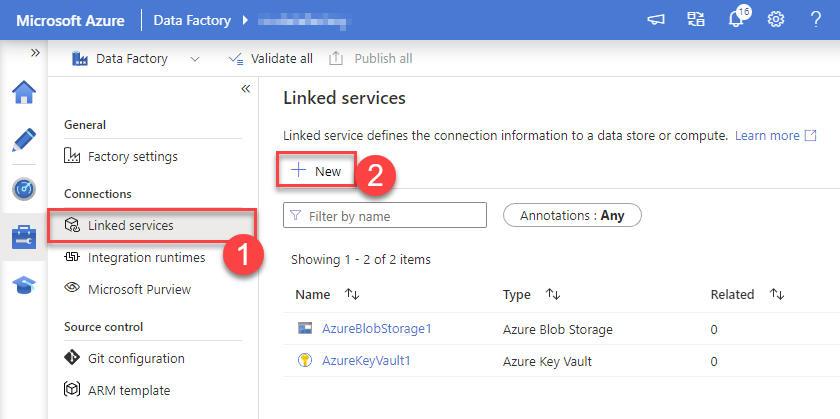
  4. Create a New Linked service:

    • In the Manage section (left menu).

    • Under Connections, select Linked services.

    • Click + New to create a new Linked service based on ODBC.

    Add new Linked service
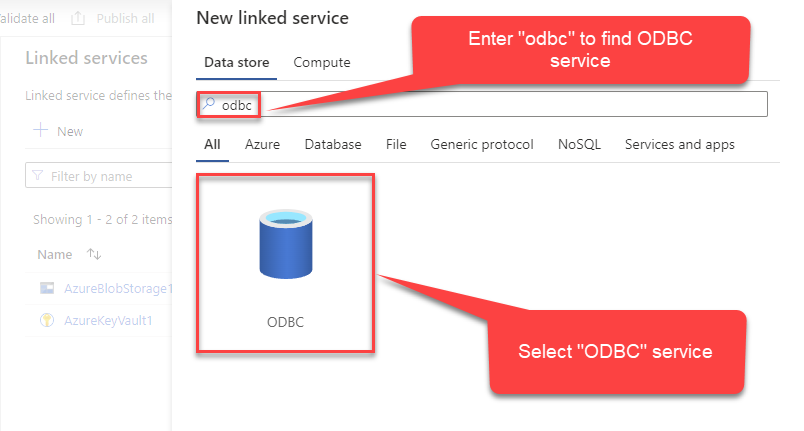
  5. Select ODBC service:

    Add new ODBC service
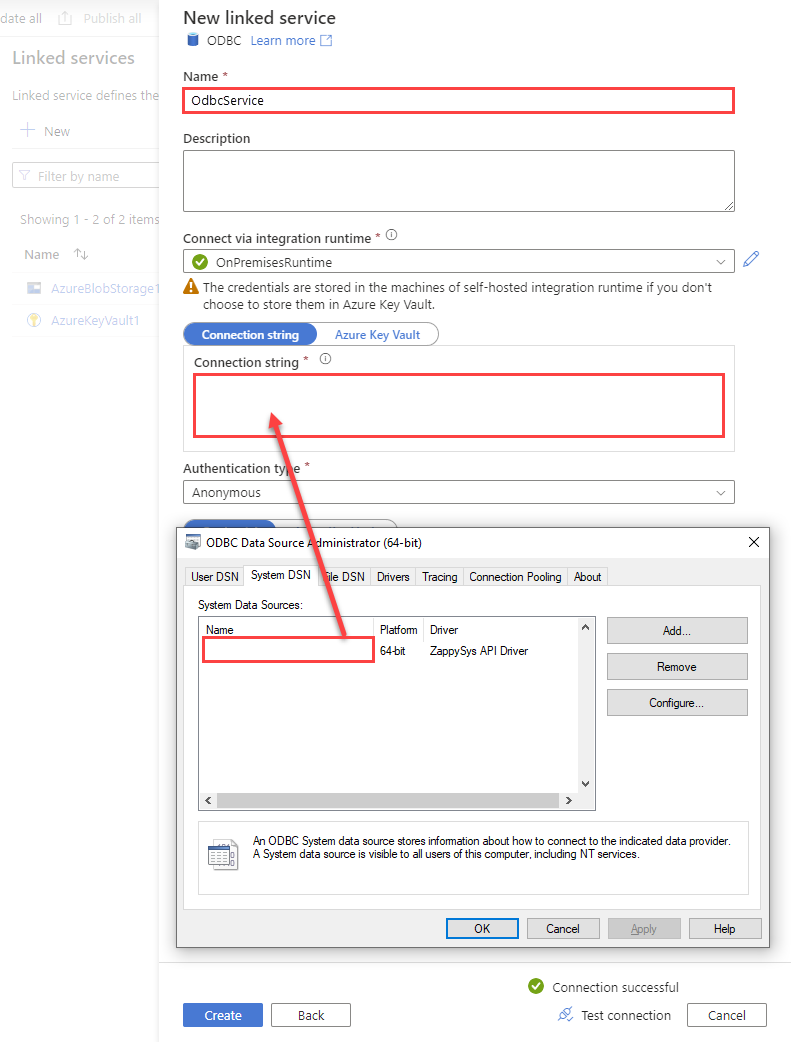
  6. Configure new ODBC service. Use the same DSN name we used in the previous step and copy it to Connection string box:

    OutlookMailOffice365DSN
    DSN=OutlookMailOffice365DSN
    Configure new ODBC service
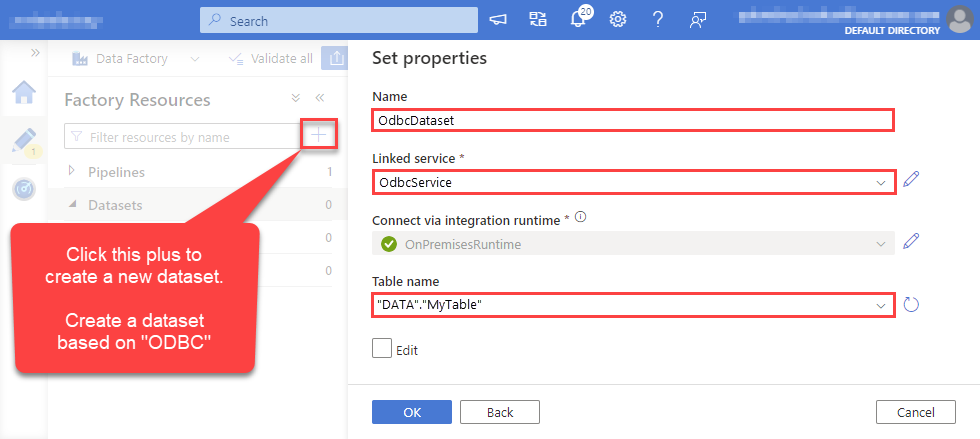
  7. For created ODBC service create ODBC-based dataset:

    Add new ODBC dataset
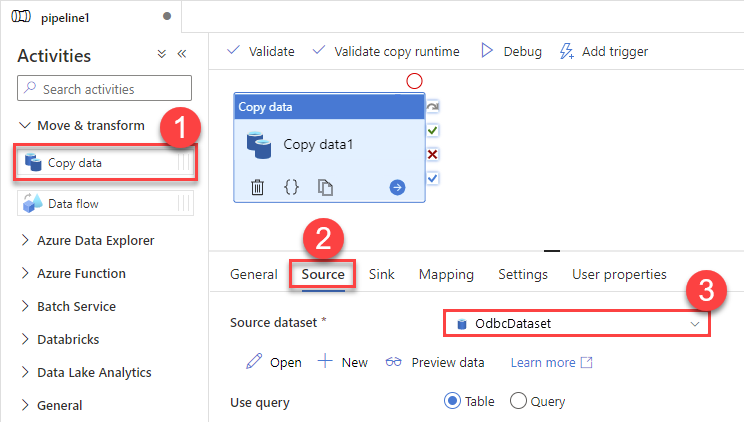
  8. Go to your pipeline and add Copy data connector into the flow. In Source section use OdbcDataset we created as a source dataset:

    Set source in Copy data
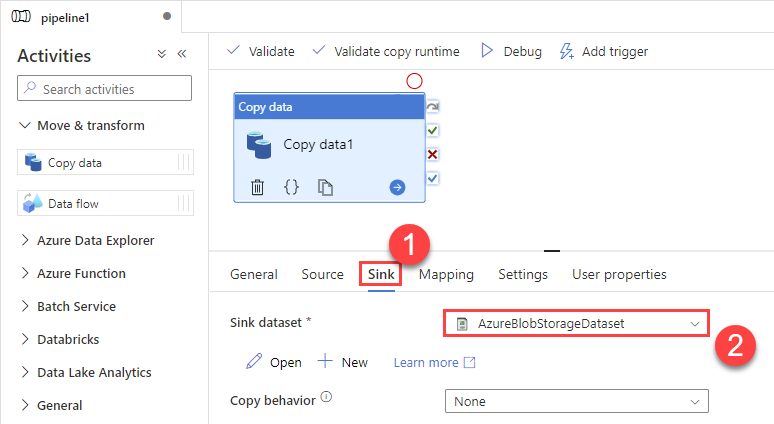
  9. Then go to Sink section and select a destination/sink dataset. In this example we use precreated AzureBlobStorageDataset which saves data into an Azure Blob:

    Set sink in Copy data
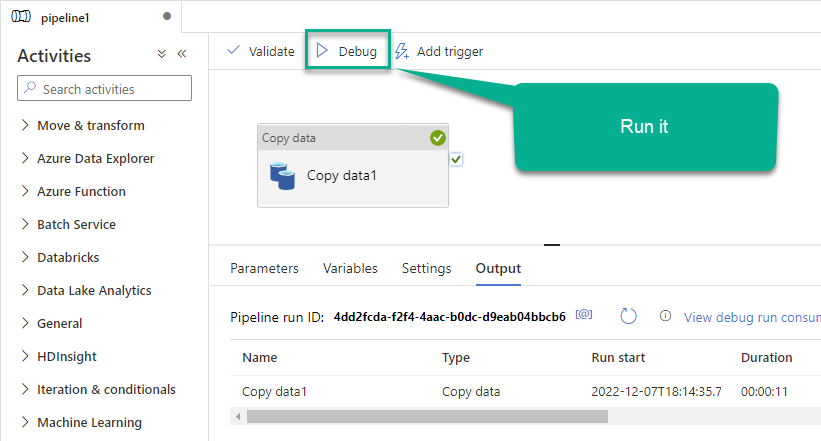
  10. Finally, run the pipeline and see data being transferred from OdbcDataset to your destination dataset:

    Run the flow

Advanced topics

Creating SQL stored procedures

You can create procedures to encapsulate custom logic and then only pass handful parameters rather than long SQL to execute your API call.

Steps to create Custom Stored Procedure in ZappySys Driver. You can insert Placeholders anywhere inside Procedure Body. Read more about placeholders here

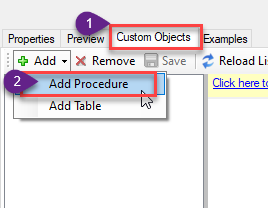
  1. Go to Custom Objects Tab and Click on Add button and Select Add Procedure:
    ZappySys Driver - Add Stored Procedure

  2. Enter the desired Procedure name and click on OK:
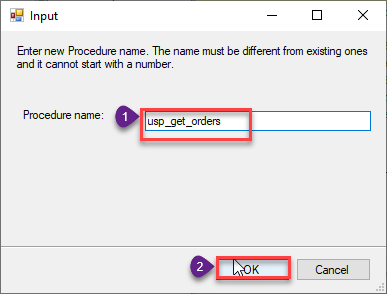
    ZappySys Driver - Add Stored Procedure Name

  3. Select the created Stored Procedure and write the your desired stored procedure and Save it and it will create the custom stored procedure in the ZappySys Driver. Here is an example stored procedure for ZappySys Driver. You can insert Placeholders anywhere inside Procedure Body. Read more about placeholders here

    CREATE PROCEDURE [usp_get_orders]
        @fromdate = '<<yyyy-MM-dd,FUN_TODAY>>'
     AS
        SELECT * FROM Orders where OrderDate >= '<@fromdate>';
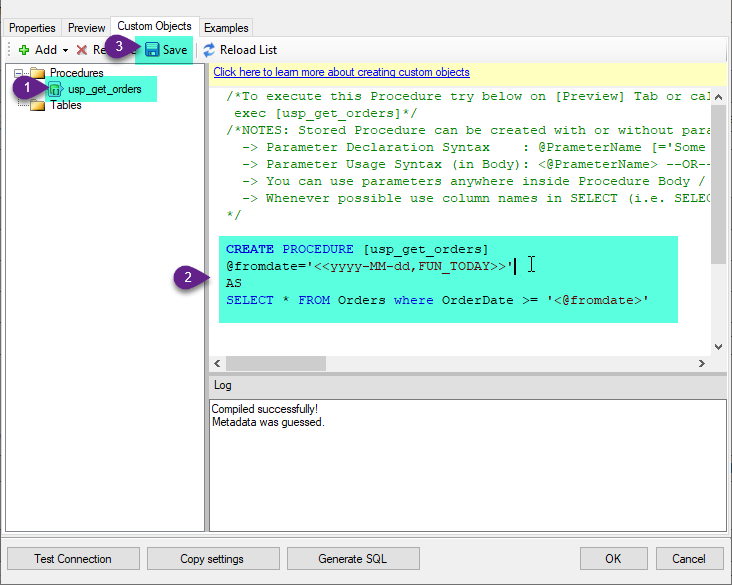
    
    ZappySys Driver - Create Custom Stored Procedure
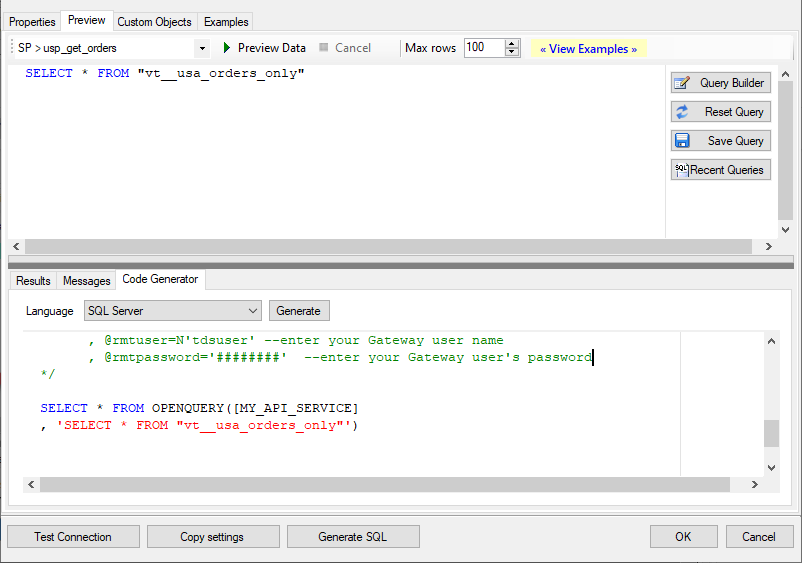
  4. That's it now go to Preview Tab and Execute your Stored Procedure using Exec Command. In this example it will extract the orders from the date 1996-01-01:

    Exec usp_get_orders '1996-01-01';
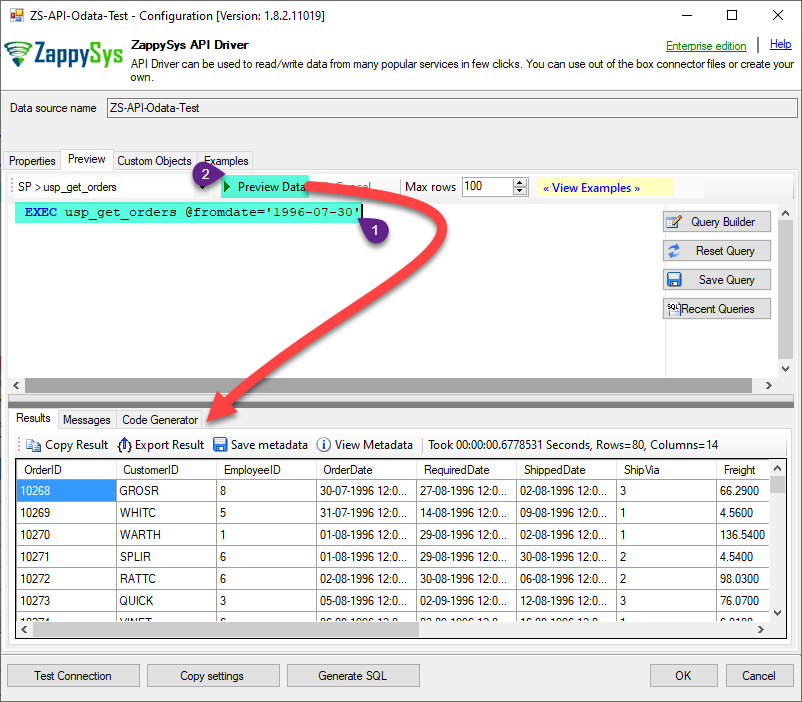
    ZappySys Driver - Execute Custom Stored Procedure

Conclusion

And there you have it — a complete guide on how to get messages in Azure Data Factory (Pipeline) without writing complex code. All of this was powered by Outlook Mail (Office 365) ODBC Driver, which handled the REST API pagination and authentication for us automatically.

Download the trial now or ping us via chat if you have any questions or are looking for a specific feature (you can also reach out to us by submitting a ticket):

More actions supported by Outlook Mail (Office 365) Connector

Got another use case in mind? We've documented the exact setups for a variety of essential Outlook Mail (Office 365) operations directly in Azure Data Factory (Pipeline), so you can skip the trial and error. Find your next step-by-step guide below:

More Outlook Mail (Office 365) integrations

All
Data Integration
Database
BI & Reporting
Productivity
Programming Languages
Automation & Scripting
ODBC applications