

Table Projects
Description
No description available
Supported Operations
Below section contains supported CRUD operations. Each operation is executed by some EndPoint behind the scene.| Method | Supported | Reference EndPoint |
|---|---|---|
| SELECT | get_projects | |
| INSERT | create_project | |
| UPDATE | upsert_project | |
| UPSERT | upsert_project | |
| DELETE | delete_project | |
| LOOKUP |
Examples
SSIS
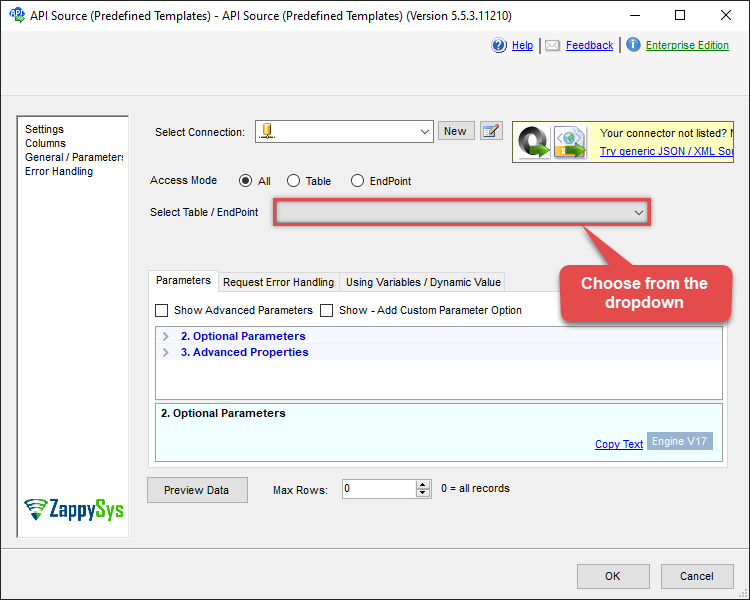
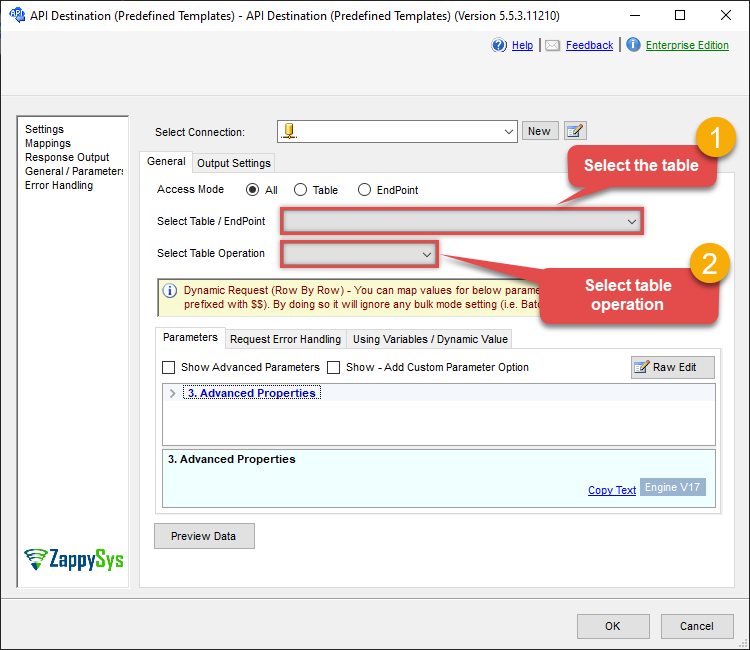
Use Jira Connector in API Source component to read data or in API Destination component to read/write data:
Read from Projects table using API Source

| Optional Parameters | |
|---|---|
| NextUrlAttributeOrExpr | $.nextPage |
| MaxResults | |
Read/write to Projects table using API Destination
| Optional Parameters | |
|---|---|
| NextUrlAttributeOrExpr | $.nextPage |
| MaxResults | |
ODBC application
Use these SQL queries in your ODBC application data source:
Read issues using JQL query
<p>Gets issues that match a JQL (Jira Query Language) expression. Supply the JQL string in the <code>Jql</code> parameter; you can filter by status, project, date, assignee, text, and more.</p><p>See the commented examples in the code for common patterns (IDs, keys, dates, text search, etc.). JQL reference links are included in the snippet.</p>
SELECT * FROM Issues WITH (Jql='status IN (Done, Closed) AND created > -5d' )
/*
Useful links:
  https://support.atlassian.com/jira-work-management/docs/jql-fields/
  https://www.atlassian.com/software/jira/guides/jql/tutorials#advanced-search
  https://www.atlassian.com/blog/jira/jql-the-most-flexible-way-to-search-jira-14

Other Possible JQL expressions:

Ids (IN):       key IN(10001, 10002, 10003);
Keys (IN):       key IN(CS-1, CS-2, CS-3);
Projects (IN):       project IN(PROJ1, PROJ2, PROJ3);
Status (EQUAL):       status='Done';
Date (Expression 1):       created >=-5d;
Date (Expression 2):       created >=startOfMonth() AND created <=now();
Date (Expression 3):       created >=startOfYear() AND created <=startOfDay();
Date (Static):       created >= '2008/12/31';
Date (Static with time):       created >= '2008/12/31 23:59';
Project and Status (AND + IN):       project=CS AND status NOT IN ('Done', 'Open', 'Closed');
Assignee and Created Date:    assignee is NOT EMPTY and created < -1d;
Text (Contains - Fuzzy):       Summary ~ 'some words' OR description ~ 'some words';
Text (Contains - Fuzzy Wildcard):       Summary ~ 'some*' OR description ~ 'some*';
Text (Contains - Exact):       Summary ~ '\"exact words\"' OR description ~ '\"exact words\"';
Text (Does Not Contain - Fuzzy):       Summary !~ 'some words' OR description !~ 'some words';
Empty OR Null:   fixVersion is empty OR fixVersion is null;
Is Not Empty OR Is Not Null:    fixVersion is not empty OR fixVersion is not null;
WAS Operator (previous value):       status WAS "Resolved" BY (jsmith,srogen) BEFORE "2019/02/02";
WAS IN Operator:   status WAS IN ("Resolved", "In Progress");
WAS NOT IN Operator:    status WAS NOT IN ("Resolved", "In Progress");
WAS + BY + DURING (date range):       status WAS "Resolved" BY (jsmith,srogen) DURING("2019/02/02", "2020/02/02");
CHANGED operator:    assignee CHANGED;
CHANGED operator (multiple):       status CHANGED FROM "In Progress" TO "Open"

*/
Read projects
<p>Gets all projects. Use this to list project keys and metadata before querying issues or creating new issues in a project.</p>
SELECT * FROM ProjectsCreate a project
<p>Creates a single project. Supply <code>ProjectKey</code>, <code>Name</code>, <code>ProjectTypeKey</code>, <code>LeadAccountId</code>, and <code>AssigneeType</code>. Use <code>WITH (Output=1)</code> to return the created project.</p>
INSERT INTO Projects(ProjectKey, Name, ProjectTypeKey, LeadAccountId, AssigneeType)
VALUES ('TEST', 'Test Project', 'software', '70122:XXXXXXXX-XXXX-XXXX-XXXX-c5da8c98b9e2', 'PROJECT_LEAD')
WITH (Output=1)
Update a project
<p>Updates an existing project. Set the columns to change (e.g. <code>Name</code>, <code>ProjectCategoryId</code>) and identify the project with <code>ProjectIdOrKey</code> in <code>WITH</code>.</p>
UPDATE Projects
SET Name = 'My Test Kanban Project'
   ,ProjectCategoryId = 1
WITH (ProjectIdOrKey = 'MYPRJCT', Output=1, ContinueOn404Error=0)
Delete a project
<p>Deletes a single project. Identify the project with <code>ProjectIdOrKey</code> in the <code>WITH</code> clause. Use with care; deletion may be restricted by Jira configuration.</p>
DELETE FROM Projects
WITH (ProjectIdOrKey = '10020', Output=1, ContinueOn404Error=0)
SQL Server
Use these SQL queries in SQL Server after you create a data source in Data Gateway:
Read issues using JQL query
<p>Gets issues that match a JQL (Jira Query Language) expression. Supply the JQL string in the <code>Jql</code> parameter; you can filter by status, project, date, assignee, text, and more.</p><p>See the commented examples in the code for common patterns (IDs, keys, dates, text search, etc.). JQL reference links are included in the snippet.</p>
DECLARE @MyQuery NVARCHAR(MAX) = 'SELECT * FROM Issues WITH (Jql=''status IN (Done, Closed) AND created > -5d'' )
/*
Useful links:
  https://support.atlassian.com/jira-work-management/docs/jql-fields/
  https://www.atlassian.com/software/jira/guides/jql/tutorials#advanced-search
  https://www.atlassian.com/blog/jira/jql-the-most-flexible-way-to-search-jira-14

Other Possible JQL expressions:

Ids (IN):       key IN(10001, 10002, 10003);
Keys (IN):       key IN(CS-1, CS-2, CS-3);
Projects (IN):       project IN(PROJ1, PROJ2, PROJ3);
Status (EQUAL):       status=''Done'';
Date (Expression 1):       created >=-5d;
Date (Expression 2):       created >=startOfMonth() AND created <=now();
Date (Expression 3):       created >=startOfYear() AND created <=startOfDay();
Date (Static):       created >= ''2008/12/31'';
Date (Static with time):       created >= ''2008/12/31 23:59'';
Project and Status (AND + IN):       project=CS AND status NOT IN (''Done'', ''Open'', ''Closed'');
Assignee and Created Date:    assignee is NOT EMPTY and created < -1d;
Text (Contains - Fuzzy):       Summary ~ ''some words'' OR description ~ ''some words'';
Text (Contains - Fuzzy Wildcard):       Summary ~ ''some*'' OR description ~ ''some*'';
Text (Contains - Exact):       Summary ~ ''\"exact words\"'' OR description ~ ''\"exact words\"'';
Text (Does Not Contain - Fuzzy):       Summary !~ ''some words'' OR description !~ ''some words'';
Empty OR Null:   fixVersion is empty OR fixVersion is null;
Is Not Empty OR Is Not Null:    fixVersion is not empty OR fixVersion is not null;
WAS Operator (previous value):       status WAS "Resolved" BY (jsmith,srogen) BEFORE "2019/02/02";
WAS IN Operator:   status WAS IN ("Resolved", "In Progress");
WAS NOT IN Operator:    status WAS NOT IN ("Resolved", "In Progress");
WAS + BY + DURING (date range):       status WAS "Resolved" BY (jsmith,srogen) DURING("2019/02/02", "2020/02/02");
CHANGED operator:    assignee CHANGED;
CHANGED operator (multiple):       status CHANGED FROM "In Progress" TO "Open"

*/';

EXEC (@MyQuery) AT [LS_TO_JIRA_IN_GATEWAY];
Read projects
<p>Gets all projects. Use this to list project keys and metadata before querying issues or creating new issues in a project.</p>
DECLARE @MyQuery NVARCHAR(MAX) = 'SELECT * FROM Projects';

EXEC (@MyQuery) AT [LS_TO_JIRA_IN_GATEWAY];
Create a project
<p>Creates a single project. Supply <code>ProjectKey</code>, <code>Name</code>, <code>ProjectTypeKey</code>, <code>LeadAccountId</code>, and <code>AssigneeType</code>. Use <code>WITH (Output=1)</code> to return the created project.</p>
DECLARE @MyQuery NVARCHAR(MAX) = 'INSERT INTO Projects(ProjectKey, Name, ProjectTypeKey, LeadAccountId, AssigneeType)
VALUES (''TEST'', ''Test Project'', ''software'', ''70122:XXXXXXXX-XXXX-XXXX-XXXX-c5da8c98b9e2'', ''PROJECT_LEAD'')
WITH (Output=1)';

EXEC (@MyQuery) AT [LS_TO_JIRA_IN_GATEWAY];
Update a project
<p>Updates an existing project. Set the columns to change (e.g. <code>Name</code>, <code>ProjectCategoryId</code>) and identify the project with <code>ProjectIdOrKey</code> in <code>WITH</code>.</p>
DECLARE @MyQuery NVARCHAR(MAX) = 'UPDATE Projects
SET Name = ''My Test Kanban Project''
   ,ProjectCategoryId = 1
WITH (ProjectIdOrKey = ''MYPRJCT'', Output=1, ContinueOn404Error=0)';

EXEC (@MyQuery) AT [LS_TO_JIRA_IN_GATEWAY];
Delete a project
<p>Deletes a single project. Identify the project with <code>ProjectIdOrKey</code> in the <code>WITH</code> clause. Use with care; deletion may be restricted by Jira configuration.</p>
DECLARE @MyQuery NVARCHAR(MAX) = 'DELETE FROM Projects
WITH (ProjectIdOrKey = ''10020'', Output=1, ContinueOn404Error=0)';

EXEC (@MyQuery) AT [LS_TO_JIRA_IN_GATEWAY];