

Table Issues
Description
No description available
Supported Operations
Below section contains supported CRUD operations. Each operation is executed by some EndPoint behind the scene.| Method | Supported | Reference EndPoint |
|---|---|---|
| SELECT | get_issues | |
| INSERT | create_issues | |
| UPDATE | update_issue | |
| UPSERT | ||
| DELETE | delete_issue | |
| LOOKUP | get_issue |
Examples
SSIS
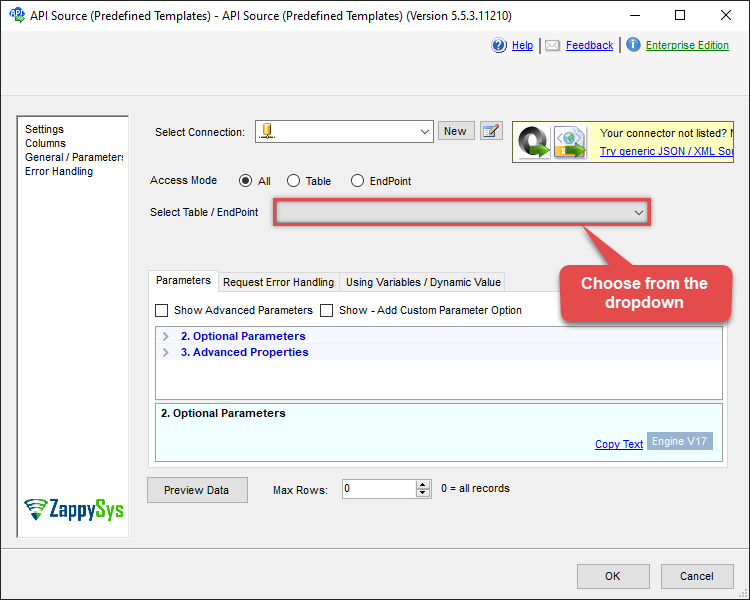
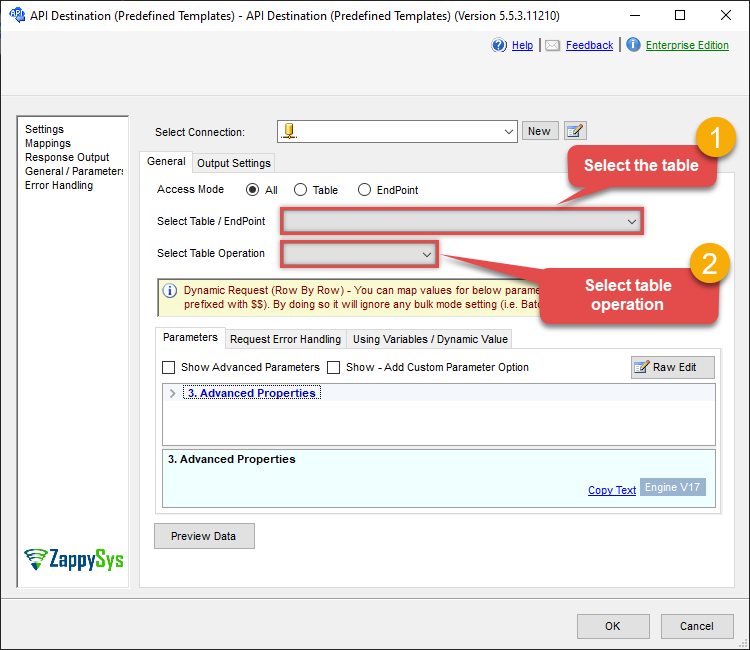
Use Jira Connector in API Source component to read data or in API Destination component to read/write data:
Read from Issues table using API Source

| There are no parameters to configure. |
Read/write to Issues table using API Destination
| There are no parameters to configure. |
ODBC application
Use these SQL queries in your ODBC application data source:
Read issues
<p>Gets all issues. By default the query returns every issue; you can narrow results by adding a <code>WITH</code> clause to search by Key, Project, or JQL expression (see the commented options in the code).</p><p>Use <code>SearchBy='Key'</code> with a single key or ID for one issue, or comma-separated keys/IDs for multiple. Use <code>SearchBy='Project'</code> to limit to one or more project codes. Use <code>SearchBy='Jql'</code> with a JQL expression for advanced filtering.</p>
SELECT * FROM Issues

--//Query single issue by numeric Issue Id
--SELECT * FROM Issues Where Id=101234

--//Query issue by numeric Issue Ids (multiple)
--SELECT * FROM Issues WITH(SearchBy='Key', Key='101234,101235,101236')

--//Query issue by Issue Key(s) (alpha-numeric)
--SELECT * FROM Issues WITH(SearchBy='Key', Key='PROJ-11')
--SELECT * FROM Issues WITH(SearchBy='Key', Key='PROJ-11,PROJ-12,PROJ-13')

--//Query issue by project(s)
--SELECT * FROM Issues WITH(SearchBy='Project', Project='PROJ')
--SELECT * FROM Issues WITH(SearchBy='Project', Project='PROJ,KAN,CS')

--//Query issue by JQL expression
--SELECT * FROM Issues WITH(SearchBy='Jql', Jql='status IN (Done, Closed) AND created > -5d' )
Read an issue by ID
<p>Gets a single issue by its key (e.g. CS-123) or numeric ID (e.g. 10001). Supply the key or ID in the <code>Key</code> parameter; the connector returns that issue’s fields.</p>
SELECT * FROM Issues WITH(SearchBy='Key', Key='10001')Read an issue by ID — continue on specific error
<p>By default, if the issue is not found or the search condition is invalid, the query returns an error. You can tell the connector to continue instead by setting <code>ContineOnErrorForMessage=1</code> and supplying the error message (or a substring) to ignore in <code>ErrorSubstringToMatch</code>.</p>
SELECT * FROM Issues WITH(SearchBy='Key', Key='10001', ContineOnErrorForMessage=1, ErrorSubstringToMatch='Issue does not exist')Read an issue by Key
<p>Gets a single issue by its project key and number (e.g. CS-1). Same as reading by ID; use whichever identifier you have.</p>
SELECT * FROM Issues WITH(SearchBy='Key', Key='CS-1')Read multiple issues by ID or Key
<p>Gets multiple issues in one request. Supply comma-separated keys and/or numeric IDs in the <code>Key</code> parameter; the connector returns all matching issues.</p>
SELECT * FROM Issues WITH(SearchBy='Key', Key='CS-1,CS-2,10003,10004')Read issues for a project
<p>Gets all issues belonging to a given project (or projects). Supply one or more project codes in <code>Project</code>; use a comma-separated list for multiple projects.</p>
SELECT * FROM Issues WITH(SearchBy='Project', Project='CS')Read issues (specific fields only)
<p>Gets all issues but returns only the columns you specify in <code>Fields</code>, which can speed up the query when you need just a few fields. Use a comma-separated list of field names; <code>*all</code> returns every field.</p>
SELECT * FROM Issues WITH(Fields='id,key,summary,status')Read issues using JQL query
<p>Gets issues that match a JQL (Jira Query Language) expression. Supply the JQL string in the <code>Jql</code> parameter; you can filter by status, project, date, assignee, text, and more.</p><p>See the commented examples in the code for common patterns (IDs, keys, dates, text search, etc.). JQL reference links are included in the snippet.</p>
SELECT * FROM Issues WITH (Jql='status IN (Done, Closed) AND created > -5d' )
/*
Useful links:
  https://support.atlassian.com/jira-work-management/docs/jql-fields/
  https://www.atlassian.com/software/jira/guides/jql/tutorials#advanced-search
  https://www.atlassian.com/blog/jira/jql-the-most-flexible-way-to-search-jira-14

Other Possible JQL expressions:

Ids (IN):       key IN(10001, 10002, 10003);
Keys (IN):       key IN(CS-1, CS-2, CS-3);
Projects (IN):       project IN(PROJ1, PROJ2, PROJ3);
Status (EQUAL):       status='Done';
Date (Expression 1):       created >=-5d;
Date (Expression 2):       created >=startOfMonth() AND created <=now();
Date (Expression 3):       created >=startOfYear() AND created <=startOfDay();
Date (Static):       created >= '2008/12/31';
Date (Static with time):       created >= '2008/12/31 23:59';
Project and Status (AND + IN):       project=CS AND status NOT IN ('Done', 'Open', 'Closed');
Assignee and Created Date:    assignee is NOT EMPTY and created < -1d;
Text (Contains - Fuzzy):       Summary ~ 'some words' OR description ~ 'some words';
Text (Contains - Fuzzy Wildcard):       Summary ~ 'some*' OR description ~ 'some*';
Text (Contains - Exact):       Summary ~ '\"exact words\"' OR description ~ '\"exact words\"';
Text (Does Not Contain - Fuzzy):       Summary !~ 'some words' OR description !~ 'some words';
Empty OR Null:   fixVersion is empty OR fixVersion is null;
Is Not Empty OR Is Not Null:    fixVersion is not empty OR fixVersion is not null;
WAS Operator (previous value):       status WAS "Resolved" BY (jsmith,srogen) BEFORE "2019/02/02";
WAS IN Operator:   status WAS IN ("Resolved", "In Progress");
WAS NOT IN Operator:    status WAS NOT IN ("Resolved", "In Progress");
WAS + BY + DURING (date range):       status WAS "Resolved" BY (jsmith,srogen) DURING("2019/02/02", "2020/02/02");
CHANGED operator:    assignee CHANGED;
CHANGED operator (multiple):       status CHANGED FROM "In Progress" TO "Open"

*/
Create an issue
<p>Creates a single issue in a project. Supply at least <code>ProjectKey</code>, <code>IssueTypeName</code>, <code>Summary</code>, and optionally <code>Description</code> and other columns. Use <code>WITH (Output=1)</code> to return the created issue.</p>
INSERT INTO Issues(ProjectKey, IssueTypeName, Summary, Description)
VALUES('SMP', 'Task', 'My ticket inserted through the API', 'A description about an issue')
WITH (Output=1)
Create multiple issues (bulk from external source)
<p>Creates multiple issues by loading rows from an external source such as Microsoft SQL Server or another ODBC database. Use <code>SOURCE('MSSQL', connectionString, query)</code> (or <code>ODBC</code> / driver connection) so that column aliases in the query match the issue input columns (e.g. <code>ProjectKey</code>, <code>IssueTypeName</code>, <code>Summary</code>, <code>Description</code>).</p>
INSERT INTO Issues(ProjectKey, IssueTypeName, Summary, Description)
SOURCE('MSSQL' --OR ODBC
, 'Data Source=localhost;Initial Catalog=Northwind;Integrated Security=true'
--For ODBC
--, 'Dsn=MyOdbcDsn'
--, 'Driver={My ODBC Driver Type}...'
--Alias must match Supported Input Columns - Use Query Builder to find Input Column Names
,'select top 10 C_ProjKey as ProjectKey, C_Type as IssueTypeName, C_Summary as Summary, C_Desc as Description FROM Orders'

--Static value example
--,'select top 10 ''CS'' as ProjectKey, ''New Feature'' as IssueTypeName, ''Task created - <<FUN_SEQUENCE>>'' Summary, ''A description <<FUN_NOW>>'' Description FROM Orders'
)
Update an issue
<p>Updates an existing issue. Set the columns you want to change (<code>Summary</code>, <code>Description</code>, <code>Labels</code>, <code>DueDate</code>, etc.) and identify the issue with <code>IssueIdOrKey</code> in <code>WITH</code> or in a <code>WHERE</code> clause. Optional <code>WITH</code> parameters control notifications and security overrides.</p>
UPDATE Issues
SET Summary = 'This is my summary'
   ,Description = 'Lot''s of stuff to describe'
   ,Labels = '[ "bugfix" ]'
   ,DueDate = '2029-10-10'
--WHERE Id=1234
--WHERE Id='ISSKEY'
WITH (
	IssueIdOrKey='ISSKEY', --or use Id in where clause
	Output=1,
	NotifyUsers=0,
	OverrideScreenSecurity=0,
	OverrideEditableFlag=0,
	ContinueOn404Error=0
)'
Update or create an issue with custom fields
<p>Updates or creates an issue including custom fields of various types: dropdown, radio, checkboxes, date, labels, number, paragraph, URL, user, team, and single-line text. Use the custom field ID (e.g. <code>customfield_10050</code>) and the appropriate suffix or raw JSON format as shown in the example. For insert, use the same column list in <code>INSERT INTO Issues(...)</code>.</p>
UPDATE Issues
SET customfield_10050='[{"value":"AAA"},{"value":"BBB"}]'	--CUSTOM Checkboxes field update (Must use Raw JSON)
,customfield_10051='2020-12-31'	--CUSTOM Date field update
,customfield_10052='2020-12-31T23:59:59'	--CUSTOM DateTime field update

--Custom Dropdown / Radio fields
,customfield_10048_value='BBB'	--CUSTOM Dropdown field update (Using value - i.e. item label)
--OR--
--,customfield_10048_id='10022'	--CUSTOM Dropdown field update (Using id - i.e. item id)
--OR--
--,customfield_10048='{"value":"BBB"}'	--CUSTOM Dropdown (Using Raw value)

,customfield_10053='["bugfix","test"]'	--CUSTOM Labels field update (Must use Raw JSON)
,customfield_10057='[{"value":"AAA"},{"value":"BBB"}]'	--CUSTOM Listbox Multiselect field update (Must use Raw JSON)
,customfield_10049=123455555.123	--CUSTOM Number field update
,customfield_10054_text='Long string...line-1
	Long string... line-2
	Long string... line-3'	--CUSTOM Paragraph field update

,customfield_10055_value='BBB'	--CUSTOM Radio field update by value
--OR--
--,customfield_10055_id='10023'	--CUSTOM Radio field update

,customfield_10058='https://zappysys.com'	--CUSTOM Url field update
,customfield_10059_accountId="5dd64082af96bc0efbe55103" --CUSTOM User field update (update by accountId)
--OR--
--,customfield_10059='{"accountId":"5dd64082af96bc0efbe55103","displayName":"System"}'	--CUSTOM User field update --accountId=5dd64082af96bc0efbe55103
,customfield_10060='Custom text single line'	--CUSTOM text single line field
,customfield_10001='577069e1-1bcd-4b1e-9070-0b2475830d1c'	--CUSTOM Team field update (update by Team Id)
--WHERE Id=10000
WITH (
	IssueIdOrKey='ISSKEY', --or use Id in where clause
	Output=1,
	NotifyUsers=0,
	OverrideScreenSecurity=0,
	OverrideEditableFlag=0,
	ContinueOn404Error=0
)

--For INSERT use same values with same fields like below. For Insert you do not have to specify Id or Key
--INSERT INTO Issues(ProjectKey, IssueTypeName, Summary, Description, customfield_10050,....., customfield_10060)
--VALUES ('SMP', 'Task', 'My ticket inserted through the API', 'A description about an issue', '[{"value":"AAA"},{"value":"BBB"}]' ,... 'Custom text single line')

'
Update multiple issues by JQL
<p>Updates every issue that matches a JQL expression. Add a <code>WHERE</code> condition (e.g. <code>Where 1=1</code>) so the connector uses the lookup path, then supply the JQL in <code>WITH (jql='...')</code>. All matching issues receive the same column updates.</p>
UPDATE Issues
SET Summary = 'This is done on <<fun_now>>'
Where 1=1
WITH (jql='status=done' , ContinueOn404Error=0)
--WITH (jql='key in(10001, 10002, 10003)' , ContinueOn404Error=0)
--WITH (jql='key in(CS-1, CS-2, CS-3)', ContinueOn404Error=0)
Delete an issue
<p>Deletes a single issue. Identify the issue with <code>IssueIdOrKey</code> in the <code>WITH</code> clause. Set <code>ContinueOn404Error=0</code> to treat a missing issue as an error, or <code>1</code> to ignore it.</p>
DELETE FROM Issues
WITH (IssueIdOrKey='10020', OUTPUT=1, ContinueOn404Error=0)
Delete multiple issues by JQL
<p>Deletes every issue that matches a JQL expression. Add a <code>WHERE</code> condition (e.g. <code>Where 1=1</code>) so the connector uses the lookup path, then supply the JQL in <code>WITH (jql='...')</code>. Use with care; all matching issues are removed.</p>
DELETE FROM Issues
Where 1=1
WITH (jql='status=done' , ContinueOn404Error=0)
--WITH (jql='key in(10001, 10002, 10003)' , ContinueOn404Error=0)
--WITH (jql='key in(CS-1, CS-2, CS-3)', ContinueOn404Error=0)
Update custom option field (dropdown or radio)
<p>Shows how to update a custom field that uses a single option (dropdown or radio). You can set the value by option label (<code>customfield_xxxx_value</code>), by option ID (<code>customfield_xxxx_id</code>), or with raw JSON. To clear the field, set it to <code>null</code>. Replace the custom field ID with your own from <code>Fields</code>.</p>
--(By value)
UPDATE Issues
SET customfield_10048_value ='BBB' --supply value (label) of dropdown/radio
WITH (IssueIdOrKey='10020')

--OR-- (By item ID)

UPDATE Issues
SET customfield_10048_id =10023 --supply id of dropdown/radio item
WITH (IssueIdOrKey='10020')

--OR-- (Raw id)

UPDATE Issues
SET customfield_10048='{"id":"10023"}' --supply raw json
WITH (IssueIdOrKey='10020')

--OR--  (Raw value)
UPDATE Issues
SET customfield_10048='{"value":"BBB"}' --supply raw json
WITH (IssueIdOrKey='10020')

--OR--  (set null)

UPDATE Issues
SET customfield_10048 =null
WITH (IssueIdOrKey='10020')
Update custom multi-select, user, or team fields (raw JSON)
<p>Shows how to update custom fields that hold multiple values or complex types (e.g. multi-select, user, team) using raw JSON. Supply a JSON array or object as required by the field type; to clear, set the column to <code>null</code>. Use <code>SELECT * FROM Fields</code> to find your custom field IDs.</p>
UPDATE Issues
SET customfield_10048='[{"value":"AAA"}, {"value":"CCC"}]' --supply raw json
WITH (IssueIdOrKey='10020')

--OR--

UPDATE Issues
SET customfield_10048 =null --set to null
WITH (IssueIdOrKey='10020')
Read issues with all columns (including SLA / nested custom fields)
<p>Gets issues with all columns exposed, including SLA and nested custom fields, without defining a <code>META</code> parameter. Set the connector’s Metadata Mode to <code>MergeStaticDynamic</code> so the driver scans sample data and merges static and dynamic columns. This approach is simpler but slower because of the extra requests used to infer column types from data.</p>
-- No META needed. Set MetaDetectionOrder to MergeStaticDynamic so nested/SLA columns are discovered automatically.
-- Slower: driver makes extra requests to scan data and merge with static metadata.

SELECT *
FROM Issues
WITH(
	  JQL='project IN(SUP)'
	  ,MetaDetectionOrder='MergeStaticDynamic'
)
Read custom fields with nested structures (SLA fields)
<p>Shows how to query custom fields that contain nested document structures (not arrays), such as SLA fields. Use <code>META='@OverrideMode:1'</code> to merge static and dynamic metadata so you can select both standard columns and nested custom field properties. Replace the example custom field IDs (e.g. <code>customfield_10084</code>) with your own; run <code>SELECT * FROM Fields</code> or check Jira project settings to find field IDs.</p>
-- NOTE: Replace customfield_10084, customfield_10085, customfield_10086 with your own custom field IDs.
-- You can run [SELECT * FROM Fields] in preview tab to get the field IDs.
-- OR you can find field IDs in Jira: Project Settings > Issue types > Edit field > field ID in URL or API.

SELECT
-- static fields

  id
, key
, summary
, statusname

-- dynamic fields

-- SLA: Time to Resolution (replace customfield_10084 with your SLA field ID)

,[fields.customfield_10084.id] as c10084_id
,[fields.customfield_10084.name] as c10084_name
,[fields.customfield_10084.ongoingCycle.startTime.friendly] as c10084_startTime_friendly
,[fields.customfield_10084.ongoingCycle.startTime.jira] as c10084_startTime_jira
,[fields.customfield_10084.ongoingCycle.breachTime.friendly] as c10084_breachTime_friendly
,[fields.customfield_10084.ongoingCycle.breachTime.jira] as c10084_breachTime_jira
,[fields.customfield_10084.ongoingCycle.elapsedTime.friendly] as c10084_elapsedTime_friendly
,[fields.customfield_10084.ongoingCycle.remainingTime.friendly] as c10084_remainingTime_friendly
,[fields.customfield_10084.ongoingCycle.goalDuration.friendly] as c10084_goalDuration_friendly
,[fields.customfield_10084.ongoingCycle.breached] as c10084_breached
,[fields.customfield_10084.ongoingCycle.paused] as c10084_paused

-- SLA: Time to First Response (replace customfield_10085 with your SLA field ID)

,[fields.customfield_10085.id] as c10085_id
,[fields.customfield_10085.name] as c10085_name
,[fields.customfield_10085.ongoingCycle.startTime.friendly] as c10085_startTime_friendly
,[fields.customfield_10085.ongoingCycle.startTime.jira] as c10085_startTime_jira
,[fields.customfield_10085.ongoingCycle.breachTime.friendly] as c10085_breachTime_friendly
,[fields.customfield_10085.ongoingCycle.breachTime.jira] as c10085_breachTime_jira
,[fields.customfield_10085.ongoingCycle.elapsedTime.friendly] as c10085_elapsedTime_friendly
,[fields.customfield_10085.ongoingCycle.remainingTime.friendly] as c10085_remainingTime_friendly
,[fields.customfield_10085.ongoingCycle.goalDuration.friendly] as c10085_goalDuration_friendly
,[fields.customfield_10085.ongoingCycle.breached] as c10085_breached
,[fields.customfield_10085.ongoingCycle.paused] as c10085_paused

-- SLA: Time to Close After Resolution (replace customfield_10086 with your SLA field ID)

,[fields.customfield_10086.id] as c10086_id
,[fields.customfield_10086.name] as c10086_name

-- Other nested custom fields (replace IDs as needed)
,[fields.customfield_10024.id] as c10024_id
,[fields.customfield_10024.name] as c10024_name
,[fields.customfield_10075.languageCode] as c10075_languageCode
,[fields.customfield_10075.displayName] as c10075_displayName

FROM Issues
WITH(
	  JQL='project IN(SUP)'
	  -- @OverrideMode:1 merges metadata so you can use static + dynamic fields together
	  ,META='@OverrideMode:1
	  ;fields.customfield_10084.id : string(10)
	  ;fields.customfield_10084.name : string(180)
	  ;fields.customfield_10084.ongoingCycle.startTime.friendly : string(130)
	  ;fields.customfield_10084.ongoingCycle.startTime.jira : DateTime
	  ;fields.customfield_10084.ongoingCycle.breachTime.friendly : string(130)
	  ;fields.customfield_10084.ongoingCycle.breachTime.jira : DateTime
	  ;fields.customfield_10084.ongoingCycle.elapsedTime.friendly : string(30)
	  ;fields.customfield_10084.ongoingCycle.remainingTime.friendly : string(70)
	  ;fields.customfield_10084.ongoingCycle.goalDuration.friendly : string(30)
	  ;fields.customfield_10084.ongoingCycle.breached : Boolean
	  ;fields.customfield_10084.ongoingCycle.paused : Boolean
	  ;fields.customfield_10085.id : string(10)
	  ;fields.customfield_10085.name : string(220)
	  ;fields.customfield_10085.ongoingCycle.startTime.friendly : string(130)
	  ;fields.customfield_10085.ongoingCycle.startTime.jira : DateTime
	  ;fields.customfield_10085.ongoingCycle.breachTime.friendly : string(130)
	  ;fields.customfield_10085.ongoingCycle.breachTime.jira : DateTime
	  ;fields.customfield_10085.ongoingCycle.elapsedTime.friendly : string(30)
	  ;fields.customfield_10085.ongoingCycle.remainingTime.friendly : string(70)
	  ;fields.customfield_10085.ongoingCycle.goalDuration.friendly : string(30)
	  ;fields.customfield_10085.ongoingCycle.breached : Boolean
	  ;fields.customfield_10085.ongoingCycle.paused : Boolean
	  ;fields.customfield_10086.id : string(10)
	  ;fields.customfield_10086.name : string(300)
	  ;fields.customfield_10024.id : string(40)
	  ;fields.customfield_10024.name : string(80)
	  ;fields.customfield_10075.languageCode : string(20)
	  ;fields.customfield_10075.displayName : string(70)
	  ;--add more nested custom field properties here as needed--
	  '
)
SQL Server
Use these SQL queries in SQL Server after you create a data source in Data Gateway:
Read issues
<p>Gets all issues. By default the query returns every issue; you can narrow results by adding a <code>WITH</code> clause to search by Key, Project, or JQL expression (see the commented options in the code).</p><p>Use <code>SearchBy='Key'</code> with a single key or ID for one issue, or comma-separated keys/IDs for multiple. Use <code>SearchBy='Project'</code> to limit to one or more project codes. Use <code>SearchBy='Jql'</code> with a JQL expression for advanced filtering.</p>
DECLARE @MyQuery NVARCHAR(MAX) = 'SELECT * FROM Issues

--//Query single issue by numeric Issue Id
--SELECT * FROM Issues Where Id=101234

--//Query issue by numeric Issue Ids (multiple)
--SELECT * FROM Issues WITH(SearchBy=''Key'', Key=''101234,101235,101236'')

--//Query issue by Issue Key(s) (alpha-numeric)
--SELECT * FROM Issues WITH(SearchBy=''Key'', Key=''PROJ-11'')
--SELECT * FROM Issues WITH(SearchBy=''Key'', Key=''PROJ-11,PROJ-12,PROJ-13'')

--//Query issue by project(s)
--SELECT * FROM Issues WITH(SearchBy=''Project'', Project=''PROJ'')
--SELECT * FROM Issues WITH(SearchBy=''Project'', Project=''PROJ,KAN,CS'')

--//Query issue by JQL expression
--SELECT * FROM Issues WITH(SearchBy=''Jql'', Jql=''status IN (Done, Closed) AND created > -5d'' )';

EXEC (@MyQuery) AT [LS_TO_JIRA_IN_GATEWAY];
Read an issue by ID
<p>Gets a single issue by its key (e.g. CS-123) or numeric ID (e.g. 10001). Supply the key or ID in the <code>Key</code> parameter; the connector returns that issue’s fields.</p>
DECLARE @MyQuery NVARCHAR(MAX) = 'SELECT * FROM Issues WITH(SearchBy=''Key'', Key=''10001'')';

EXEC (@MyQuery) AT [LS_TO_JIRA_IN_GATEWAY];
Read an issue by ID — continue on specific error
<p>By default, if the issue is not found or the search condition is invalid, the query returns an error. You can tell the connector to continue instead by setting <code>ContineOnErrorForMessage=1</code> and supplying the error message (or a substring) to ignore in <code>ErrorSubstringToMatch</code>.</p>
DECLARE @MyQuery NVARCHAR(MAX) = 'SELECT * FROM Issues WITH(SearchBy=''Key'', Key=''10001'', ContineOnErrorForMessage=1, ErrorSubstringToMatch=''Issue does not exist'')';

EXEC (@MyQuery) AT [LS_TO_JIRA_IN_GATEWAY];
Read an issue by Key
<p>Gets a single issue by its project key and number (e.g. CS-1). Same as reading by ID; use whichever identifier you have.</p>
DECLARE @MyQuery NVARCHAR(MAX) = 'SELECT * FROM Issues WITH(SearchBy=''Key'', Key=''CS-1'')';

EXEC (@MyQuery) AT [LS_TO_JIRA_IN_GATEWAY];
Read multiple issues by ID or Key
<p>Gets multiple issues in one request. Supply comma-separated keys and/or numeric IDs in the <code>Key</code> parameter; the connector returns all matching issues.</p>
DECLARE @MyQuery NVARCHAR(MAX) = 'SELECT * FROM Issues WITH(SearchBy=''Key'', Key=''CS-1,CS-2,10003,10004'')';

EXEC (@MyQuery) AT [LS_TO_JIRA_IN_GATEWAY];
Read issues for a project
<p>Gets all issues belonging to a given project (or projects). Supply one or more project codes in <code>Project</code>; use a comma-separated list for multiple projects.</p>
DECLARE @MyQuery NVARCHAR(MAX) = 'SELECT * FROM Issues WITH(SearchBy=''Project'', Project=''CS'')';

EXEC (@MyQuery) AT [LS_TO_JIRA_IN_GATEWAY];
Read issues (specific fields only)
<p>Gets all issues but returns only the columns you specify in <code>Fields</code>, which can speed up the query when you need just a few fields. Use a comma-separated list of field names; <code>*all</code> returns every field.</p>
DECLARE @MyQuery NVARCHAR(MAX) = 'SELECT * FROM Issues WITH(Fields=''id,key,summary,status'')';

EXEC (@MyQuery) AT [LS_TO_JIRA_IN_GATEWAY];
Read issues using JQL query
<p>Gets issues that match a JQL (Jira Query Language) expression. Supply the JQL string in the <code>Jql</code> parameter; you can filter by status, project, date, assignee, text, and more.</p><p>See the commented examples in the code for common patterns (IDs, keys, dates, text search, etc.). JQL reference links are included in the snippet.</p>
DECLARE @MyQuery NVARCHAR(MAX) = 'SELECT * FROM Issues WITH (Jql=''status IN (Done, Closed) AND created > -5d'' )
/*
Useful links:
  https://support.atlassian.com/jira-work-management/docs/jql-fields/
  https://www.atlassian.com/software/jira/guides/jql/tutorials#advanced-search
  https://www.atlassian.com/blog/jira/jql-the-most-flexible-way-to-search-jira-14

Other Possible JQL expressions:

Ids (IN):       key IN(10001, 10002, 10003);
Keys (IN):       key IN(CS-1, CS-2, CS-3);
Projects (IN):       project IN(PROJ1, PROJ2, PROJ3);
Status (EQUAL):       status=''Done'';
Date (Expression 1):       created >=-5d;
Date (Expression 2):       created >=startOfMonth() AND created <=now();
Date (Expression 3):       created >=startOfYear() AND created <=startOfDay();
Date (Static):       created >= ''2008/12/31'';
Date (Static with time):       created >= ''2008/12/31 23:59'';
Project and Status (AND + IN):       project=CS AND status NOT IN (''Done'', ''Open'', ''Closed'');
Assignee and Created Date:    assignee is NOT EMPTY and created < -1d;
Text (Contains - Fuzzy):       Summary ~ ''some words'' OR description ~ ''some words'';
Text (Contains - Fuzzy Wildcard):       Summary ~ ''some*'' OR description ~ ''some*'';
Text (Contains - Exact):       Summary ~ ''\"exact words\"'' OR description ~ ''\"exact words\"'';
Text (Does Not Contain - Fuzzy):       Summary !~ ''some words'' OR description !~ ''some words'';
Empty OR Null:   fixVersion is empty OR fixVersion is null;
Is Not Empty OR Is Not Null:    fixVersion is not empty OR fixVersion is not null;
WAS Operator (previous value):       status WAS "Resolved" BY (jsmith,srogen) BEFORE "2019/02/02";
WAS IN Operator:   status WAS IN ("Resolved", "In Progress");
WAS NOT IN Operator:    status WAS NOT IN ("Resolved", "In Progress");
WAS + BY + DURING (date range):       status WAS "Resolved" BY (jsmith,srogen) DURING("2019/02/02", "2020/02/02");
CHANGED operator:    assignee CHANGED;
CHANGED operator (multiple):       status CHANGED FROM "In Progress" TO "Open"

*/';

EXEC (@MyQuery) AT [LS_TO_JIRA_IN_GATEWAY];
Create an issue
<p>Creates a single issue in a project. Supply at least <code>ProjectKey</code>, <code>IssueTypeName</code>, <code>Summary</code>, and optionally <code>Description</code> and other columns. Use <code>WITH (Output=1)</code> to return the created issue.</p>
DECLARE @MyQuery NVARCHAR(MAX) = 'INSERT INTO Issues(ProjectKey, IssueTypeName, Summary, Description)
VALUES(''SMP'', ''Task'', ''My ticket inserted through the API'', ''A description about an issue'')
WITH (Output=1)';

EXEC (@MyQuery) AT [LS_TO_JIRA_IN_GATEWAY];
Create multiple issues (bulk from external source)
<p>Creates multiple issues by loading rows from an external source such as Microsoft SQL Server or another ODBC database. Use <code>SOURCE('MSSQL', connectionString, query)</code> (or <code>ODBC</code> / driver connection) so that column aliases in the query match the issue input columns (e.g. <code>ProjectKey</code>, <code>IssueTypeName</code>, <code>Summary</code>, <code>Description</code>).</p>
DECLARE @MyQuery NVARCHAR(MAX) = 'INSERT INTO Issues(ProjectKey, IssueTypeName, Summary, Description)
SOURCE(''MSSQL'' --OR ODBC
, ''Data Source=localhost;Initial Catalog=Northwind;Integrated Security=true''
--For ODBC
--, ''Dsn=MyOdbcDsn''
--, ''Driver={My ODBC Driver Type}...''
--Alias must match Supported Input Columns - Use Query Builder to find Input Column Names
,''select top 10 C_ProjKey as ProjectKey, C_Type as IssueTypeName, C_Summary as Summary, C_Desc as Description FROM Orders''

--Static value example
--,''select top 10 ''''CS'''' as ProjectKey, ''''New Feature'''' as IssueTypeName, ''''Task created - <<FUN_SEQUENCE>>'''' Summary, ''''A description <<FUN_NOW>>'''' Description FROM Orders''
)';

EXEC (@MyQuery) AT [LS_TO_JIRA_IN_GATEWAY];
Update an issue
<p>Updates an existing issue. Set the columns you want to change (<code>Summary</code>, <code>Description</code>, <code>Labels</code>, <code>DueDate</code>, etc.) and identify the issue with <code>IssueIdOrKey</code> in <code>WITH</code> or in a <code>WHERE</code> clause. Optional <code>WITH</code> parameters control notifications and security overrides.</p>
DECLARE @MyQuery NVARCHAR(MAX) = 'UPDATE Issues
SET Summary = ''This is my summary''
   ,Description = ''Lot''''s of stuff to describe''
   ,Labels = ''[ "bugfix" ]''
   ,DueDate = ''2029-10-10''
--WHERE Id=1234
--WHERE Id=''ISSKEY''
WITH (
	IssueIdOrKey=''ISSKEY'', --or use Id in where clause
	Output=1,
	NotifyUsers=0,
	OverrideScreenSecurity=0,
	OverrideEditableFlag=0,
	ContinueOn404Error=0
)''';

EXEC (@MyQuery) AT [LS_TO_JIRA_IN_GATEWAY];
Update or create an issue with custom fields
<p>Updates or creates an issue including custom fields of various types: dropdown, radio, checkboxes, date, labels, number, paragraph, URL, user, team, and single-line text. Use the custom field ID (e.g. <code>customfield_10050</code>) and the appropriate suffix or raw JSON format as shown in the example. For insert, use the same column list in <code>INSERT INTO Issues(...)</code>.</p>
DECLARE @MyQuery NVARCHAR(MAX) = 'UPDATE Issues
SET customfield_10050=''[{"value":"AAA"},{"value":"BBB"}]''	--CUSTOM Checkboxes field update (Must use Raw JSON)
,customfield_10051=''2020-12-31''	--CUSTOM Date field update
,customfield_10052=''2020-12-31T23:59:59''	--CUSTOM DateTime field update

--Custom Dropdown / Radio fields
,customfield_10048_value=''BBB''	--CUSTOM Dropdown field update (Using value - i.e. item label)
--OR--
--,customfield_10048_id=''10022''	--CUSTOM Dropdown field update (Using id - i.e. item id)
--OR--
--,customfield_10048=''{"value":"BBB"}''	--CUSTOM Dropdown (Using Raw value)

,customfield_10053=''["bugfix","test"]''	--CUSTOM Labels field update (Must use Raw JSON)
,customfield_10057=''[{"value":"AAA"},{"value":"BBB"}]''	--CUSTOM Listbox Multiselect field update (Must use Raw JSON)
,customfield_10049=123455555.123	--CUSTOM Number field update
,customfield_10054_text=''Long string...line-1
	Long string... line-2
	Long string... line-3''	--CUSTOM Paragraph field update

,customfield_10055_value=''BBB''	--CUSTOM Radio field update by value
--OR--
--,customfield_10055_id=''10023''	--CUSTOM Radio field update

,customfield_10058=''https://zappysys.com''	--CUSTOM Url field update
,customfield_10059_accountId="5dd64082af96bc0efbe55103" --CUSTOM User field update (update by accountId)
--OR--
--,customfield_10059=''{"accountId":"5dd64082af96bc0efbe55103","displayName":"System"}''	--CUSTOM User field update --accountId=5dd64082af96bc0efbe55103
,customfield_10060=''Custom text single line''	--CUSTOM text single line field
,customfield_10001=''577069e1-1bcd-4b1e-9070-0b2475830d1c''	--CUSTOM Team field update (update by Team Id)
--WHERE Id=10000
WITH (
	IssueIdOrKey=''ISSKEY'', --or use Id in where clause
	Output=1,
	NotifyUsers=0,
	OverrideScreenSecurity=0,
	OverrideEditableFlag=0,
	ContinueOn404Error=0
)

--For INSERT use same values with same fields like below. For Insert you do not have to specify Id or Key
--INSERT INTO Issues(ProjectKey, IssueTypeName, Summary, Description, customfield_10050,....., customfield_10060)
--VALUES (''SMP'', ''Task'', ''My ticket inserted through the API'', ''A description about an issue'', ''[{"value":"AAA"},{"value":"BBB"}]'' ,... ''Custom text single line'')

''';

EXEC (@MyQuery) AT [LS_TO_JIRA_IN_GATEWAY];
Update multiple issues by JQL
<p>Updates every issue that matches a JQL expression. Add a <code>WHERE</code> condition (e.g. <code>Where 1=1</code>) so the connector uses the lookup path, then supply the JQL in <code>WITH (jql='...')</code>. All matching issues receive the same column updates.</p>
DECLARE @MyQuery NVARCHAR(MAX) = 'UPDATE Issues
SET Summary = ''This is done on <<fun_now>>''
Where 1=1
WITH (jql=''status=done'' , ContinueOn404Error=0)
--WITH (jql=''key in(10001, 10002, 10003)'' , ContinueOn404Error=0)
--WITH (jql=''key in(CS-1, CS-2, CS-3)'', ContinueOn404Error=0)';

EXEC (@MyQuery) AT [LS_TO_JIRA_IN_GATEWAY];
Delete an issue
<p>Deletes a single issue. Identify the issue with <code>IssueIdOrKey</code> in the <code>WITH</code> clause. Set <code>ContinueOn404Error=0</code> to treat a missing issue as an error, or <code>1</code> to ignore it.</p>
DECLARE @MyQuery NVARCHAR(MAX) = 'DELETE FROM Issues
WITH (IssueIdOrKey=''10020'', OUTPUT=1, ContinueOn404Error=0)';

EXEC (@MyQuery) AT [LS_TO_JIRA_IN_GATEWAY];
Delete multiple issues by JQL
<p>Deletes every issue that matches a JQL expression. Add a <code>WHERE</code> condition (e.g. <code>Where 1=1</code>) so the connector uses the lookup path, then supply the JQL in <code>WITH (jql='...')</code>. Use with care; all matching issues are removed.</p>
DECLARE @MyQuery NVARCHAR(MAX) = 'DELETE FROM Issues
Where 1=1
WITH (jql=''status=done'' , ContinueOn404Error=0)
--WITH (jql=''key in(10001, 10002, 10003)'' , ContinueOn404Error=0)
--WITH (jql=''key in(CS-1, CS-2, CS-3)'', ContinueOn404Error=0)';

EXEC (@MyQuery) AT [LS_TO_JIRA_IN_GATEWAY];
Update custom option field (dropdown or radio)
<p>Shows how to update a custom field that uses a single option (dropdown or radio). You can set the value by option label (<code>customfield_xxxx_value</code>), by option ID (<code>customfield_xxxx_id</code>), or with raw JSON. To clear the field, set it to <code>null</code>. Replace the custom field ID with your own from <code>Fields</code>.</p>
DECLARE @MyQuery NVARCHAR(MAX) = '--(By value)
UPDATE Issues
SET customfield_10048_value =''BBB'' --supply value (label) of dropdown/radio
WITH (IssueIdOrKey=''10020'')

--OR-- (By item ID)

UPDATE Issues
SET customfield_10048_id =10023 --supply id of dropdown/radio item
WITH (IssueIdOrKey=''10020'')

--OR-- (Raw id)

UPDATE Issues
SET customfield_10048=''{"id":"10023"}'' --supply raw json
WITH (IssueIdOrKey=''10020'')

--OR--  (Raw value)
UPDATE Issues
SET customfield_10048=''{"value":"BBB"}'' --supply raw json
WITH (IssueIdOrKey=''10020'')

--OR--  (set null)

UPDATE Issues
SET customfield_10048 =null
WITH (IssueIdOrKey=''10020'')';

EXEC (@MyQuery) AT [LS_TO_JIRA_IN_GATEWAY];
Update custom multi-select, user, or team fields (raw JSON)
<p>Shows how to update custom fields that hold multiple values or complex types (e.g. multi-select, user, team) using raw JSON. Supply a JSON array or object as required by the field type; to clear, set the column to <code>null</code>. Use <code>SELECT * FROM Fields</code> to find your custom field IDs.</p>
DECLARE @MyQuery NVARCHAR(MAX) = 'UPDATE Issues
SET customfield_10048=''[{"value":"AAA"}, {"value":"CCC"}]'' --supply raw json
WITH (IssueIdOrKey=''10020'')

--OR--

UPDATE Issues
SET customfield_10048 =null --set to null
WITH (IssueIdOrKey=''10020'')';

EXEC (@MyQuery) AT [LS_TO_JIRA_IN_GATEWAY];
Read issues with all columns (including SLA / nested custom fields)
<p>Gets issues with all columns exposed, including SLA and nested custom fields, without defining a <code>META</code> parameter. Set the connector’s Metadata Mode to <code>MergeStaticDynamic</code> so the driver scans sample data and merges static and dynamic columns. This approach is simpler but slower because of the extra requests used to infer column types from data.</p>
DECLARE @MyQuery NVARCHAR(MAX) = '-- No META needed. Set MetaDetectionOrder to MergeStaticDynamic so nested/SLA columns are discovered automatically.
-- Slower: driver makes extra requests to scan data and merge with static metadata.

SELECT *
FROM Issues
WITH(
	  JQL=''project IN(SUP)''
	  ,MetaDetectionOrder=''MergeStaticDynamic''
)';

EXEC (@MyQuery) AT [LS_TO_JIRA_IN_GATEWAY];
Read custom fields with nested structures (SLA fields)
<p>Shows how to query custom fields that contain nested document structures (not arrays), such as SLA fields. Use <code>META='@OverrideMode:1'</code> to merge static and dynamic metadata so you can select both standard columns and nested custom field properties. Replace the example custom field IDs (e.g. <code>customfield_10084</code>) with your own; run <code>SELECT * FROM Fields</code> or check Jira project settings to find field IDs.</p>
DECLARE @MyQuery NVARCHAR(MAX) = '-- NOTE: Replace customfield_10084, customfield_10085, customfield_10086 with your own custom field IDs.
-- You can run [SELECT * FROM Fields] in preview tab to get the field IDs.
-- OR you can find field IDs in Jira: Project Settings > Issue types > Edit field > field ID in URL or API.

SELECT
-- static fields

  id
, key
, summary
, statusname

-- dynamic fields

-- SLA: Time to Resolution (replace customfield_10084 with your SLA field ID)

,[fields.customfield_10084.id] as c10084_id
,[fields.customfield_10084.name] as c10084_name
,[fields.customfield_10084.ongoingCycle.startTime.friendly] as c10084_startTime_friendly
,[fields.customfield_10084.ongoingCycle.startTime.jira] as c10084_startTime_jira
,[fields.customfield_10084.ongoingCycle.breachTime.friendly] as c10084_breachTime_friendly
,[fields.customfield_10084.ongoingCycle.breachTime.jira] as c10084_breachTime_jira
,[fields.customfield_10084.ongoingCycle.elapsedTime.friendly] as c10084_elapsedTime_friendly
,[fields.customfield_10084.ongoingCycle.remainingTime.friendly] as c10084_remainingTime_friendly
,[fields.customfield_10084.ongoingCycle.goalDuration.friendly] as c10084_goalDuration_friendly
,[fields.customfield_10084.ongoingCycle.breached] as c10084_breached
,[fields.customfield_10084.ongoingCycle.paused] as c10084_paused

-- SLA: Time to First Response (replace customfield_10085 with your SLA field ID)

,[fields.customfield_10085.id] as c10085_id
,[fields.customfield_10085.name] as c10085_name
,[fields.customfield_10085.ongoingCycle.startTime.friendly] as c10085_startTime_friendly
,[fields.customfield_10085.ongoingCycle.startTime.jira] as c10085_startTime_jira
,[fields.customfield_10085.ongoingCycle.breachTime.friendly] as c10085_breachTime_friendly
,[fields.customfield_10085.ongoingCycle.breachTime.jira] as c10085_breachTime_jira
,[fields.customfield_10085.ongoingCycle.elapsedTime.friendly] as c10085_elapsedTime_friendly
,[fields.customfield_10085.ongoingCycle.remainingTime.friendly] as c10085_remainingTime_friendly
,[fields.customfield_10085.ongoingCycle.goalDuration.friendly] as c10085_goalDuration_friendly
,[fields.customfield_10085.ongoingCycle.breached] as c10085_breached
,[fields.customfield_10085.ongoingCycle.paused] as c10085_paused

-- SLA: Time to Close After Resolution (replace customfield_10086 with your SLA field ID)

,[fields.customfield_10086.id] as c10086_id
,[fields.customfield_10086.name] as c10086_name

-- Other nested custom fields (replace IDs as needed)
,[fields.customfield_10024.id] as c10024_id
,[fields.customfield_10024.name] as c10024_name
,[fields.customfield_10075.languageCode] as c10075_languageCode
,[fields.customfield_10075.displayName] as c10075_displayName

FROM Issues
WITH(
	  JQL=''project IN(SUP)''
	  -- @OverrideMode:1 merges metadata so you can use static + dynamic fields together
	  ,META=''@OverrideMode:1
	  ;fields.customfield_10084.id : string(10)
	  ;fields.customfield_10084.name : string(180)
	  ;fields.customfield_10084.ongoingCycle.startTime.friendly : string(130)
	  ;fields.customfield_10084.ongoingCycle.startTime.jira : DateTime
	  ;fields.customfield_10084.ongoingCycle.breachTime.friendly : string(130)
	  ;fields.customfield_10084.ongoingCycle.breachTime.jira : DateTime
	  ;fields.customfield_10084.ongoingCycle.elapsedTime.friendly : string(30)
	  ;fields.customfield_10084.ongoingCycle.remainingTime.friendly : string(70)
	  ;fields.customfield_10084.ongoingCycle.goalDuration.friendly : string(30)
	  ;fields.customfield_10084.ongoingCycle.breached : Boolean
	  ;fields.customfield_10084.ongoingCycle.paused : Boolean
	  ;fields.customfield_10085.id : string(10)
	  ;fields.customfield_10085.name : string(220)
	  ;fields.customfield_10085.ongoingCycle.startTime.friendly : string(130)
	  ;fields.customfield_10085.ongoingCycle.startTime.jira : DateTime
	  ;fields.customfield_10085.ongoingCycle.breachTime.friendly : string(130)
	  ;fields.customfield_10085.ongoingCycle.breachTime.jira : DateTime
	  ;fields.customfield_10085.ongoingCycle.elapsedTime.friendly : string(30)
	  ;fields.customfield_10085.ongoingCycle.remainingTime.friendly : string(70)
	  ;fields.customfield_10085.ongoingCycle.goalDuration.friendly : string(30)
	  ;fields.customfield_10085.ongoingCycle.breached : Boolean
	  ;fields.customfield_10085.ongoingCycle.paused : Boolean
	  ;fields.customfield_10086.id : string(10)
	  ;fields.customfield_10086.name : string(300)
	  ;fields.customfield_10024.id : string(40)
	  ;fields.customfield_10024.name : string(80)
	  ;fields.customfield_10075.languageCode : string(20)
	  ;fields.customfield_10075.displayName : string(70)
	  ;--add more nested custom field properties here as needed--
	  ''
)';

EXEC (@MyQuery) AT [LS_TO_JIRA_IN_GATEWAY];