

Endpoint Get Table Rows
Name
get_table_rows
Description
Get table rows [API reference]
Related Tables
Parameters
| Parameter | Required | Options | ||||||||||||||||||||||||||||||||||||||||||||||||||||
|---|---|---|---|---|---|---|---|---|---|---|---|---|---|---|---|---|---|---|---|---|---|---|---|---|---|---|---|---|---|---|---|---|---|---|---|---|---|---|---|---|---|---|---|---|---|---|---|---|---|---|---|---|---|---|
|
Name:
Label: Page Size (Default=2000, Max=10000) Max can be 10000 but it may decrease performance if you fetching less than 10K rows in some requests. |
YES | |||||||||||||||||||||||||||||||||||||||||||||||||||||
|
Name:
Label: TableName Table name |
YES | |||||||||||||||||||||||||||||||||||||||||||||||||||||
|
Name:
Label: PagingOffset |
||||||||||||||||||||||||||||||||||||||||||||||||||||||
|
Name:
Label: SysId Row 'sys_id' |
||||||||||||||||||||||||||||||||||||||||||||||||||||||
|
Name:
Label: Fields to include in response (Keep blank to get all fields -OR- Enter comma separated list) Comma-separated field names you want to return in the response. E.g. sys_id,name,label,sys_name,sys_updated_on. Using this setting reduces the response size and speed up the processing. |
||||||||||||||||||||||||||||||||||||||||||||||||||||||
|
Name:
Label: Query / Order By (Server Side Filter) Server-side encoded query for filtering and ordering records. Supports string, numeric, date, NULL checks, AND/OR logic, and ORDER BY clauses. |
|
Output Columns
| Label | Data Type (SSIS) | Data Type (SQL) | Length | Description |
|---|---|---|---|---|
| sys_id |
DT_WSTR
|
nvarchar(32)
|
32 | |
| [$parent.Pivot_Name$] |
DT_WSTR
|
nvarchar(2000)
|
2000 |
Input Columns
| Label | Data Type (SSIS) | Data Type (SQL) | Length | Description | |||||||||||||||||||||||||||||||||||||||||||||||||||||||||||||||||||||||||||||||||||||||||||||||
|---|---|---|---|---|---|---|---|---|---|---|---|---|---|---|---|---|---|---|---|---|---|---|---|---|---|---|---|---|---|---|---|---|---|---|---|---|---|---|---|---|---|---|---|---|---|---|---|---|---|---|---|---|---|---|---|---|---|---|---|---|---|---|---|---|---|---|---|---|---|---|---|---|---|---|---|---|---|---|---|---|---|---|---|---|---|---|---|---|---|---|---|---|---|---|---|---|---|---|---|
| There are no Static columns defined for this endpoint. This endpoint detects columns dynamically at runtime. | |||||||||||||||||||||||||||||||||||||||||||||||||||||||||||||||||||||||||||||||||||||||||||||||||||
Examples
SSIS
Use ServiceNow Connector in API Source or in API Destination SSIS Data Flow components to read or write data.
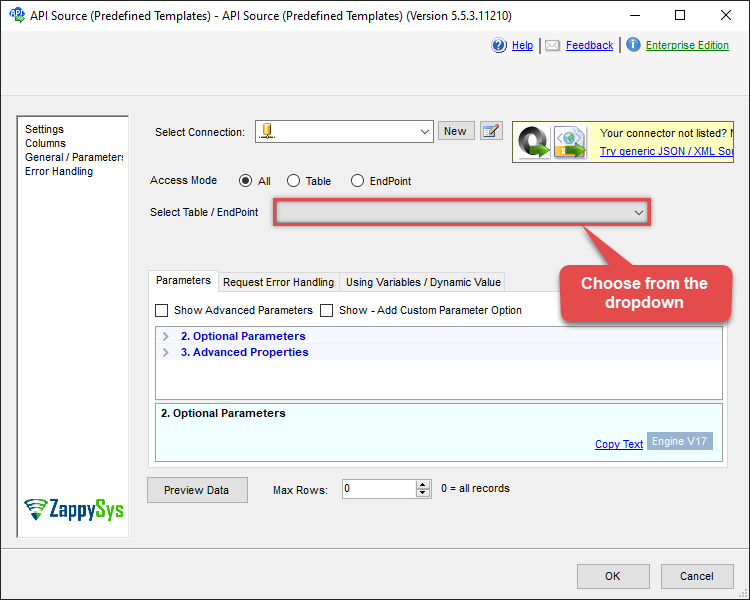
API Source
This Endpoint belongs to the [Dynamic Table] table, therefore it is better to use it, instead of accessing the endpoint directly:

| There are no parameters to configure. |
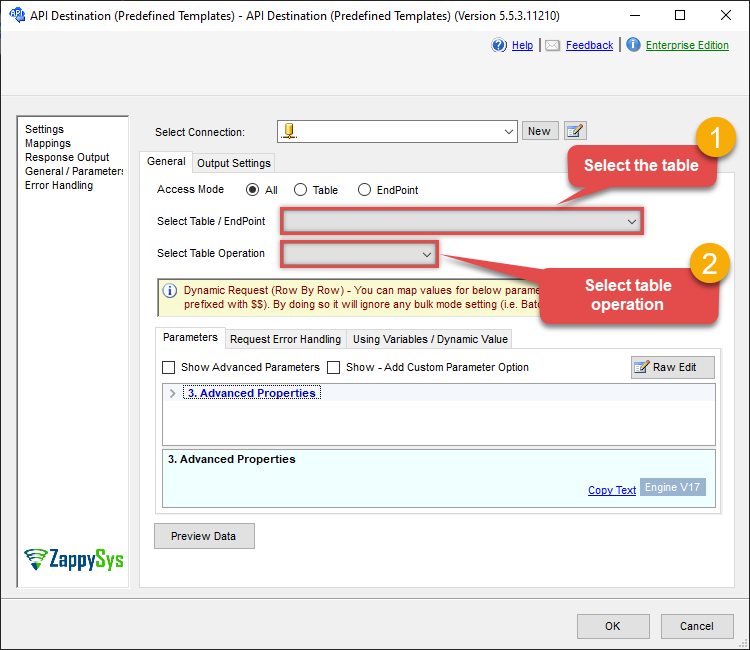
API Destination
This Endpoint belongs to the [Dynamic Table] table, therefore it is better to use it, instead of accessing the endpoint directly. Use this table and table-operation pair to get table rows:
| There are no parameters to configure. |
ODBC application
Use these SQL queries in your ODBC application data source:
Read incidents
<p>Gets a list of incidents from the <code>incident</code> table. You can use this pattern to read from any other table by changing the table name.</p>
SELECT * FROM incident

--Using Primary Key
--SELECT * FROM any_table_here WHERE sys_id='109562a3c611227500a7b7ff98cc0dc7' --Primary Key in WHERE clause

--OR--

--Use below to query system / hidden tables (faster response - No Table name lookup needed in below)
SELECT * FROM get_table_rows WITH(TableName='incident', Query='number=INC0000001')

--=================================
--Examples: Using Filter Expression
--=================================
-- Incremental Load Pattern: Load only incidents updated in the last 24 hours (see FUN_TO_DATETIME function help for more information, you can use +/- d, m, y, min,h,s along with now, today, yesterday, weekstart, weekend, monthstart, monthend, yearstart, yearend functions)
--SELECT * FROM incident WITH(Query='sys_updated_on>=<<today-1d,FUN_TO_DATETIME>>')

--SELECT * FROM incident WITH(Query='number=INC0000001') --Equal condition
--SELECT * FROM incident WITH(Query='number!=INC0000001') --Not equal condition
--SELECT * FROM incident WITH(Query='numberININC0000001,INC0000002,INC0000003') --IN condition
--SELECT * FROM incident WITH(Query='number=INC0000001^state=7') --AND condition
--SELECT * FROM incident WITH(Query='number=INC0000001^ORnumber=INC0000002') --OR condition
--SELECT * FROM incident WITH(Query='numberLIKE0001') --LIKE condition
--SELECT * FROM incident WITH(Query='numberSTARTSWITHINC00') --StartWith condition
--SELECT * FROM incident WITH(Query='numberENDSWITH0001') --StartWith condition
--SELECT * FROM incident WITH(Query='number=INC0000001^state=7^NQORnumber=INC0000002') --AND / OR MIXED using NQ (NewQuery Operator)  -- (number=INC0000001 and state=7) OR (number=INC0000002)

--more information about filter here https://docs.servicenow.com/bundle/utah-platform-user-interface/page/use/common-ui-elements/reference/r_OpAvailableFiltersQueries.html


-- To read all available tables execute this query:
-- SELECT * FROM Tables

-- Other common tables:
-----------------------
-- SELECT * FROM sys_db_object
-- SELECT * FROM sys_dictionary
-- SELECT * FROM sys_user
-- SELECT * FROM sys_user_has_role
-- SELECT * FROM sys_user_grmember
-- SELECT * FROM task
-- SELECT * FROM task_sla
-- SELECT * FROM incident
-- SELECT * FROM incident_sla
-- SELECT * FROM change_request
-- SELECT * FROM cmdb_ci_computer
-- SELECT * FROM cmdb_ci_outage
-- SELECT * FROM cmdb_ci
-- SELECT * FROM sn_customerservice_case
-- SELECT * FROM kb_knowledge
-- SELECT * FROM kb_use
-- SELECT * FROM sc_req_item
-- SELECT * FROM sc_request
-- SELECT * FROM sc_task
Read incidents incrementally (by updated date)
<p>Fetch incidents updated after a specific date. This pattern is recommended for incremental loads and scheduled sync jobs.</p> <p>Use this approach to avoid full table scans, reduce API calls, and improve overall performance.</p> <p>The date filter can be specified using either a static date value or a dynamic date expression. Dynamic date expressions allow relative date calculations and are useful for automated jobs.</p> <p>Examples of dynamic date expressions:</p> <ul> <li><code>yesterday</code> – incidents updated yesterday</li> <li><code>today</code> – incidents updated today</li> <li><code>today-1d</code> – incidents updated in the last 24 hours</li> <li><code>monthstart</code> – incidents updated since the beginning of the month</li> <li><code>monthend-1d</code> – incidents updated up to the last day of the previous month</li> </ul>
-- Incrementally fetch incidents updated after a given date
SELECT *
FROM get_table_rows
WITH(
TableName='incident',

-- Load only incidents updated in the last 24 hours
Query='sys_updated_on>=<<today-1d,FUN_TO_DATETIME>>'

--OR Updated after static date time
--Query='sys_updated_on>=2025-01-01T23:23:59'
--Query='sys_updated_on>=2025-01-01'

--Other examples of placeholder function usage
--Query='sys_updated_on>=<<monthstart-7d,FUN_TO_DATETIME>>'
--Query='sys_updated_on>=<<monthstart-5d+1y,FUN_TO_DATETIME>>'

)
Read data from system tables
<p>Gets data from system tables (e.g. <code>sys_choice</code>, <code>sys_journal_field</code>). Many tables are not listed in the <code>get_tables</code> endpoint and are hidden from UI selection. Use the <code>get_table_rows</code> endpoint to query them directly.</p>
SELECT * FROM get_table_rows WITH(TableName='sys_choice', Query='name=incident^element=close_code')
--SELECT * FROM get_table_rows WITH(TableName='sys_journal_field', Query='name=incident^element=close_code')
Read an incident by number
<p>Fetch a specific incident using its human-readable <code>number</code> (for example <code>INC0012345</code>). This is the most common lookup used in integrations and support workflows.</p> <p>The query filters the <code>incident</code> table using <code>sysparm_query</code> semantics.</p>
-- Query a single incident by incident number
SELECT *
FROM get_table_rows
WITH(
  TableName='incident',
  Query='number=INC0012345'
)
Read incident work notes
<p>Retrieve <strong>Work Notes</strong> added to incidents. Work notes are stored as journal entries in the <code>sys_journal_field</code> table, not directly on the incident record.</p> <p>This example returns all internal notes entered by agents.</p>
-- Get work notes for all incidents
SELECT *
FROM get_table_rows
WITH(
	TableName='sys_journal_field',
	Query='name=incident^element=work_notes'
)
Read incident additional comments
<p>Fetch <strong>Additional Comments</strong> (customer-visible notes) for incidents. These comments are typically shared with end users and customers.</p> <p>Data is sourced from the ServiceNow journal table.</p>
-- Get customer-facing comments for incidents
SELECT *
FROM get_table_rows
WITH(
TableName='sys_journal_field',
Query='name=incident^element=comments'
)
Read incident tasks
<p>Retrieve all tasks associated with a specific incident. Incident tasks are stored in the <code>incident_task</code> table and linked using the parent incident reference.</p> <p>You can use static date or function as above. This function expression can be in the form of [function_name][+/-][interval][interval][+/-][interval]... For example to get Last date of previous month you can do "monthend-1d". To get yesterday's date you can just type "yesterday". Valid date function names for this expression are [ now | today | yesterday | weekstart | weekend | monthstart | monthend | yearstart | yearend ]. Valid interval names are [ms (for milliseconds) | s OR sec | min | h OR hour | y OR year | d OR day |m OR month | y OR year] </p>
-- Get all tasks for a specific incident
SELECT *
FROM get_table_rows
WITH(
    TableName='incident_task',
    Query='incident.number=INC0012345'
)
Read attachments for an incident
<p>Retrieve all file attachments linked to a specific incident. Attachments are stored in the <code>sys_attachment</code> table.</p> <p>This example is commonly used before downloading or deleting attachments.</p>
-- List attachments linked to an incident
SELECT *
FROM get_table_rows
WITH(
	TableName='sys_attachment',
	Query='table_name=incident^table_sys_id=<<INCIDENT_SYS_ID>>'
)
Read dropdown labels and values
<p>Resolve and list <strong>dropdown (choice) field labels and values</strong> for any ServiceNow table or form screen.</p> <p>ServiceNow stores dropdown fields as internal values (for example <code>4</code>) while displaying user-friendly labels (such as <code>4 - Low</code>) in the UI. These mappings are defined in the <code>sys_choice</code> system table.</p> <p>Use this example to discover and resolve dropdown options for fields like <strong>Priority</strong>, <strong>State</strong>, <strong>Category</strong>, <strong>Close Code</strong>, and any custom choice field across all ServiceNow tables.</p>
-- Resolve and list dropdown (choice) labels and values for any table and field
-- Replace <TABLE_NAME> and <FIELD_NAME> with your target form field (e.g. name=incident^element=priority)

SELECT *
FROM get_table_rows
WITH(
  TableName='sys_choice',
  Query='name=<TABLE_NAME>^element=<FIELD_NAME>'
)
Read incidents using reference fields
<p>Demonstrates how to query the <code>incident</code> table using <strong>reference (foreign key) fields</strong> in ServiceNow.</p> <p>ServiceNow allows filtering on fields from related tables using <strong>dot-walking</strong> syntax (<code>reference_field.some_field</code>), without requiring explicit joins.</p> <p>Use these patterns to filter incidents by <strong>Caller</strong>, <strong>Assigned User</strong>, <strong>Assignment Group</strong>, <strong>Configuration Item</strong>, or other referenced records.</p>
-- 1. Query incidents by caller's username (caller_id → sys_user)
SELECT *
FROM get_table_rows
WITH(
	TableName='incident',
	Query='caller_id.user_name=john.doe'
)

-- 2. Query incidents by assigned user's display name (assigned_to → sys_user)
SELECT *
FROM get_table_rows
WITH(
	TableName='incident',
	Query='assigned_to.name=Jane Smith'
)

-- 3. Query incidents by assignment group name (assignment_group → sys_user_group)
SELECT *
FROM get_table_rows
WITH(
	TableName='incident',
	Query='assignment_group.name=Network'
)

-- 4. Query incidents by configuration item name (cmdb_ci → CMDB record)
SELECT *
FROM get_table_rows
WITH(
	TableName='incident',
	Query='cmdb_ci.name=SRV-APP-01'
)

-- 5. Combine reference field and local field filters
--    (Network group + High priority incidents)
SELECT *
FROM get_table_rows
WITH(
	TableName='incident',
	Query='assignment_group.name=Network^priority=1'
)
Read selected columns (performance optimization)
<p>By default, all column values are returned in the result set. You can instruct the ServiceNow API to send only specific columns by setting the <code>Fields</code> parameter in the <code>WITH</code> clause. This significantly speeds up the response.</p>
SELECT number,name FROM incident WITH (Fields='number,name') --Setting Fields parameter will speed up the queryRead table using server-side filter
<h3>Server-side filtering using ServiceNow native query language</h3> <p> This example demonstrates how to filter ServiceNow table data using the native <strong>server-side filter expression</strong> (sysparm_query) via the <code>WITH(Query='...')</code> clause. </p> <p> <strong>Why this matters:</strong><br/> Server-side filtering is executed <em>inside ServiceNow</em> before data is returned. This dramatically improves performance, reduces network traffic, and avoids unnecessary client-side processing. </p> <p> Using a SQL <code>WHERE</code> clause without <code>WITH(Query=...)</code> forces the driver to retrieve more data first and then filter locally, which is slower. Always prefer <strong>server-side filters first</strong>. Use client-side filtering only when a condition cannot be expressed using ServiceNow query syntax. </p> <hr/> <h4>ServiceNow query operators (mapped to SQL)</h4> <table border="1" cellpadding="5" cellspacing="0"> <tr><th>Operator</th><th>Meaning</th><th>SQL Equivalent</th></tr> <tr><td><code>=</code></td><td>Equals</td><td>=</td></tr> <tr><td><code>!=</code></td><td>Not equals</td><td><></td></tr> <tr><td><code>IN</code></td><td>In list</td><td>IN (...)</td></tr> <tr><td><code>LIKE</code></td><td>Contains</td><td>LIKE '%x%'</td></tr> <tr><td><code>STARTSWITH</code></td><td>Starts with</td><td>LIKE 'x%'</td></tr> <tr><td><code>ENDSWITH</code></td><td>Ends with</td><td>LIKE '%x'</td></tr> <tr><td><code>^</code></td><td>AND</td><td>AND</td></tr> <tr><td><code>^OR</code></td><td>OR (same group)</td><td>OR</td></tr> <tr><td><code>NQ</code></td><td>New Query (OR group)</td><td>OR (grouped)</td></tr> </table> <p> <strong>Important:</strong><br/> <ul> <li><code>^</code> always means <strong>AND</strong></li> <li><code>^OR</code> applies OR within the same query group</li> <li><code>NQ</code> starts a <strong>new OR group</strong> (similar to adding parentheses in SQL)</li> </ul> </p> <p> Example: <pre> priority=1^state=2^NQpriority=2^state=3 </pre> Is equivalent to SQL: <pre> (priority = 1 AND state = 2) OR (priority = 2 AND state = 3) </pre> </p> <hr/> <h4>Date and time filtering using ZappySys Placeholder Engine</h4> <p> You can dynamically generate date values using placeholders. These are evaluated at runtime before the query is sent to ServiceNow. </p> <ul> <li><code><<today,FUN_TO_DATE>></code> – today</li> <li><code><<yesterday,FUN_TO_DATE>></code> – yesterday</li> <li><code><<today-1d,FUN_TO_DATE>></code> – today minus 1 day</li> <li><code><<today-1m,FUN_TO_DATE>></code> – today minus 1 month</li> <li><code><<monthstart,FUN_TO_DATE>></code> – current month start</li> <li><code><<monthend,FUN_TO_DATE>></code> – current month end</li> <li><code><<yearstart,FUN_TO_DATE>></code> – year start</li> <li><code><<yearend,FUN_TO_DATE>></code> – year end</li> </ul> <p> See full placeholder documentation here:<br/> <a href="https://zappysys.com/onlinehelp/odbc-powerpack/scr/odbc-format-static-placeholders.htm#fun_FUN_TO_DATETIME" target="_blank"> ZappySys Placeholder Engine – FUN_TO_DATETIME </a> </p> <hr/> <h4>Reference documentation</h4> <ul> <li><a href="https://www.servicenow.com/docs/r/api-reference/rest-apis/c_TableAPI.html" target="_blank">ServiceNow Table API</a></li> <li><a href="https://docs.servicenow.com/bundle/utah-platform-user-interface/page/use/common-ui-elements/reference/r_OpAvailableFiltersQueries.html" target="_blank">ServiceNow Filter Operators</a></li> <li><a href="https://developer.servicenow.com/dev.do#!/learn/learning-plans/xanadu/servicenow_application_developer/app_store_learnv2_rest_xanadu_request_parameters" target="_blank">Advanced Query Parameters</a></li> </ul>
-- Basic server-side filter
SELECT * FROM incident WITH(Query='state=2')

-- Primary key lookup (fastest)
SELECT * FROM incident WHERE sys_id='109562a3c611227500a7b7ff98cc0dc7'

-- Not equal
SELECT * FROM incident WITH(Query='state!=6')

-- IN condition
SELECT * FROM incident WITH(Query='priorityIN1,2,3')

-- AND condition
SELECT * FROM incident WITH(Query='priority=1^state=2')
-- SQL: WHERE priority = 1 AND state = 2

-- OR condition (same group)
SELECT * FROM incident WITH(Query='priority=1^ORstate=2')
-- SQL: WHERE priority = 1 OR state = 2

-- AND / OR mixed using NQ
SELECT * FROM incident WITH(Query='priority=1^state=2^NQpriority=2^state=3')
-- SQL: (priority = 1 AND state = 2) OR (priority = 2 AND state = 3)

-- LIKE / StartsWith / EndsWith
SELECT * FROM incident WITH(Query='short_descriptionLIKEemail')
SELECT * FROM incident WITH(Query='numberSTARTSWITHINC')
SELECT * FROM incident WITH(Query='numberENDSWITH001')

-- Date filter using placeholders (last 1 month)
SELECT * FROM incident WITH(Query='opened_at>=<<today-1m,FUN_TO_DATE>>')

-- From month start
SELECT * FROM incident WITH(Query='opened_at>=<<monthstart,FUN_TO_DATE>>')

-- Between dates
SELECT * FROM incident WITH(Query='opened_at>=<<monthstart,FUN_TO_DATE>>^opened_at<=<<monthend,FUN_TO_DATE>>')
Read an incident by ID
<p>Gets a single incident by its <code>sys_id</code> (primary key).</p>
SELECT * FROM incident
WHERE sys_id = 'SYS_ID_GOES_HERE'
Read table using server-side filter
<h3>Server-side filtering using ServiceNow native query language</h3> <p> This example demonstrates how to filter ServiceNow table data using the native <strong>server-side filter expression</strong> (sysparm_query) via the <code>WITH(Query='...')</code> clause. </p> <p> <strong>Why this matters:</strong><br/> Server-side filtering is executed <em>inside ServiceNow</em> before data is returned. This dramatically improves performance, reduces network traffic, and avoids unnecessary client-side processing. </p> <p> Using a SQL <code>WHERE</code> clause without <code>WITH(Query=...)</code> forces the driver to retrieve more data first and then filter locally, which is slower. Always prefer <strong>server-side filters first</strong>. Use client-side filtering only when a condition cannot be expressed using ServiceNow query syntax. </p> <hr/> <h4>ServiceNow query operators (mapped to SQL)</h4> <table border="1" cellpadding="5" cellspacing="0"> <tr><th>Operator</th><th>Meaning</th><th>SQL Equivalent</th></tr> <tr><td><code>=</code></td><td>Equals</td><td>=</td></tr> <tr><td><code>!=</code></td><td>Not equals</td><td><></td></tr> <tr><td><code>IN</code></td><td>In list</td><td>IN (...)</td></tr> <tr><td><code>LIKE</code></td><td>Contains</td><td>LIKE '%x%'</td></tr> <tr><td><code>STARTSWITH</code></td><td>Starts with</td><td>LIKE 'x%'</td></tr> <tr><td><code>ENDSWITH</code></td><td>Ends with</td><td>LIKE '%x'</td></tr> <tr><td><code>^</code></td><td>AND</td><td>AND</td></tr> <tr><td><code>^OR</code></td><td>OR (same group)</td><td>OR</td></tr> <tr><td><code>NQ</code></td><td>New Query (OR group)</td><td>OR (grouped)</td></tr> </table> <p> <strong>Important:</strong><br/> <ul> <li><code>^</code> always means <strong>AND</strong></li> <li><code>^OR</code> applies OR within the same query group</li> <li><code>NQ</code> starts a <strong>new OR group</strong> (similar to adding parentheses in SQL)</li> </ul> </p> <p> Example: <pre> priority=1^state=2^NQpriority=2^state=3 </pre> Is equivalent to SQL: <pre> (priority = 1 AND state = 2) OR (priority = 2 AND state = 3) </pre> </p> <hr/> <h4>Date and time filtering using ZappySys Placeholder Engine</h4> <p> You can dynamically generate date values using placeholders. These are evaluated at runtime before the query is sent to ServiceNow. </p> <ul> <li><code><<today,FUN_TO_DATE>></code> – today</li> <li><code><<yesterday,FUN_TO_DATE>></code> – yesterday</li> <li><code><<today-1d,FUN_TO_DATE>></code> – today minus 1 day</li> <li><code><<today-1m,FUN_TO_DATE>></code> – today minus 1 month</li> <li><code><<monthstart,FUN_TO_DATE>></code> – current month start</li> <li><code><<monthend,FUN_TO_DATE>></code> – current month end</li> <li><code><<yearstart,FUN_TO_DATE>></code> – year start</li> <li><code><<yearend,FUN_TO_DATE>></code> – year end</li> </ul> <p> See full placeholder documentation here:<br/> <a href="https://zappysys.com/onlinehelp/odbc-powerpack/scr/odbc-format-static-placeholders.htm#fun_FUN_TO_DATETIME" target="_blank"> ZappySys Placeholder Engine – FUN_TO_DATETIME </a> </p> <hr/> <h4>Reference documentation</h4> <ul> <li><a href="https://www.servicenow.com/docs/r/api-reference/rest-apis/c_TableAPI.html" target="_blank">ServiceNow Table API</a></li> <li><a href="https://docs.servicenow.com/bundle/utah-platform-user-interface/page/use/common-ui-elements/reference/r_OpAvailableFiltersQueries.html" target="_blank">ServiceNow Filter Operators</a></li> <li><a href="https://developer.servicenow.com/dev.do#!/learn/learning-plans/xanadu/servicenow_application_developer/app_store_learnv2_rest_xanadu_request_parameters" target="_blank">Advanced Query Parameters</a></li> </ul>
-- Basic server-side filter
SELECT * FROM incident WITH(Query='state=2')

-- Primary key lookup (fastest)
SELECT * FROM incident WHERE sys_id='109562a3c611227500a7b7ff98cc0dc7'

-- Not equal
SELECT * FROM incident WITH(Query='state!=6')

-- IN condition
SELECT * FROM incident WITH(Query='priorityIN1,2,3')

-- AND condition
SELECT * FROM incident WITH(Query='priority=1^state=2')
-- SQL: WHERE priority = 1 AND state = 2

-- OR condition (same group)
SELECT * FROM incident WITH(Query='priority=1^ORstate=2')
-- SQL: WHERE priority = 1 OR state = 2

-- AND / OR mixed using NQ
SELECT * FROM incident WITH(Query='priority=1^state=2^NQpriority=2^state=3')
-- SQL: (priority = 1 AND state = 2) OR (priority = 2 AND state = 3)

-- LIKE / StartsWith / EndsWith
SELECT * FROM incident WITH(Query='short_descriptionLIKEemail')
SELECT * FROM incident WITH(Query='numberSTARTSWITHINC')
SELECT * FROM incident WITH(Query='numberENDSWITH001')

-- Date filter using placeholders (last 1 month)
SELECT * FROM incident WITH(Query='opened_at>=<<today-1m,FUN_TO_DATE>>')

-- From month start
SELECT * FROM incident WITH(Query='opened_at>=<<monthstart,FUN_TO_DATE>>')

-- Between dates
SELECT * FROM incident WITH(Query='opened_at>=<<monthstart,FUN_TO_DATE>>^opened_at<=<<monthend,FUN_TO_DATE>>')
get_table_rows endpoint belongs to
[Dynamic Table]
table(s), and can therefore be used via those table(s).
SQL Server
Use these SQL queries in SQL Server after you create a data source in Data Gateway:
Read incidents
<p>Gets a list of incidents from the <code>incident</code> table. You can use this pattern to read from any other table by changing the table name.</p>
DECLARE @MyQuery NVARCHAR(MAX) = 'SELECT * FROM incident

--Using Primary Key
--SELECT * FROM any_table_here WHERE sys_id=''109562a3c611227500a7b7ff98cc0dc7'' --Primary Key in WHERE clause

--OR--

--Use below to query system / hidden tables (faster response - No Table name lookup needed in below)
SELECT * FROM get_table_rows WITH(TableName=''incident'', Query=''number=INC0000001'')

--=================================
--Examples: Using Filter Expression
--=================================
-- Incremental Load Pattern: Load only incidents updated in the last 24 hours (see FUN_TO_DATETIME function help for more information, you can use +/- d, m, y, min,h,s along with now, today, yesterday, weekstart, weekend, monthstart, monthend, yearstart, yearend functions)
--SELECT * FROM incident WITH(Query=''sys_updated_on>=<<today-1d,FUN_TO_DATETIME>>'')

--SELECT * FROM incident WITH(Query=''number=INC0000001'') --Equal condition
--SELECT * FROM incident WITH(Query=''number!=INC0000001'') --Not equal condition
--SELECT * FROM incident WITH(Query=''numberININC0000001,INC0000002,INC0000003'') --IN condition
--SELECT * FROM incident WITH(Query=''number=INC0000001^state=7'') --AND condition
--SELECT * FROM incident WITH(Query=''number=INC0000001^ORnumber=INC0000002'') --OR condition
--SELECT * FROM incident WITH(Query=''numberLIKE0001'') --LIKE condition
--SELECT * FROM incident WITH(Query=''numberSTARTSWITHINC00'') --StartWith condition
--SELECT * FROM incident WITH(Query=''numberENDSWITH0001'') --StartWith condition
--SELECT * FROM incident WITH(Query=''number=INC0000001^state=7^NQORnumber=INC0000002'') --AND / OR MIXED using NQ (NewQuery Operator)  -- (number=INC0000001 and state=7) OR (number=INC0000002)

--more information about filter here https://docs.servicenow.com/bundle/utah-platform-user-interface/page/use/common-ui-elements/reference/r_OpAvailableFiltersQueries.html


-- To read all available tables execute this query:
-- SELECT * FROM Tables

-- Other common tables:
-----------------------
-- SELECT * FROM sys_db_object
-- SELECT * FROM sys_dictionary
-- SELECT * FROM sys_user
-- SELECT * FROM sys_user_has_role
-- SELECT * FROM sys_user_grmember
-- SELECT * FROM task
-- SELECT * FROM task_sla
-- SELECT * FROM incident
-- SELECT * FROM incident_sla
-- SELECT * FROM change_request
-- SELECT * FROM cmdb_ci_computer
-- SELECT * FROM cmdb_ci_outage
-- SELECT * FROM cmdb_ci
-- SELECT * FROM sn_customerservice_case
-- SELECT * FROM kb_knowledge
-- SELECT * FROM kb_use
-- SELECT * FROM sc_req_item
-- SELECT * FROM sc_request
-- SELECT * FROM sc_task';

EXEC (@MyQuery) AT [LS_TO_SERVICENOW_IN_GATEWAY];
Read incidents incrementally (by updated date)
<p>Fetch incidents updated after a specific date. This pattern is recommended for incremental loads and scheduled sync jobs.</p> <p>Use this approach to avoid full table scans, reduce API calls, and improve overall performance.</p> <p>The date filter can be specified using either a static date value or a dynamic date expression. Dynamic date expressions allow relative date calculations and are useful for automated jobs.</p> <p>Examples of dynamic date expressions:</p> <ul> <li><code>yesterday</code> – incidents updated yesterday</li> <li><code>today</code> – incidents updated today</li> <li><code>today-1d</code> – incidents updated in the last 24 hours</li> <li><code>monthstart</code> – incidents updated since the beginning of the month</li> <li><code>monthend-1d</code> – incidents updated up to the last day of the previous month</li> </ul>
DECLARE @MyQuery NVARCHAR(MAX) = '-- Incrementally fetch incidents updated after a given date
SELECT *
FROM get_table_rows
WITH(
TableName=''incident'',

-- Load only incidents updated in the last 24 hours
Query=''sys_updated_on>=<<today-1d,FUN_TO_DATETIME>>''

--OR Updated after static date time
--Query=''sys_updated_on>=2025-01-01T23:23:59''
--Query=''sys_updated_on>=2025-01-01''

--Other examples of placeholder function usage
--Query=''sys_updated_on>=<<monthstart-7d,FUN_TO_DATETIME>>''
--Query=''sys_updated_on>=<<monthstart-5d+1y,FUN_TO_DATETIME>>''

)';

EXEC (@MyQuery) AT [LS_TO_SERVICENOW_IN_GATEWAY];
Read data from system tables
<p>Gets data from system tables (e.g. <code>sys_choice</code>, <code>sys_journal_field</code>). Many tables are not listed in the <code>get_tables</code> endpoint and are hidden from UI selection. Use the <code>get_table_rows</code> endpoint to query them directly.</p>
DECLARE @MyQuery NVARCHAR(MAX) = 'SELECT * FROM get_table_rows WITH(TableName=''sys_choice'', Query=''name=incident^element=close_code'')
--SELECT * FROM get_table_rows WITH(TableName=''sys_journal_field'', Query=''name=incident^element=close_code'')';

EXEC (@MyQuery) AT [LS_TO_SERVICENOW_IN_GATEWAY];
Read an incident by number
<p>Fetch a specific incident using its human-readable <code>number</code> (for example <code>INC0012345</code>). This is the most common lookup used in integrations and support workflows.</p> <p>The query filters the <code>incident</code> table using <code>sysparm_query</code> semantics.</p>
DECLARE @MyQuery NVARCHAR(MAX) = '-- Query a single incident by incident number
SELECT *
FROM get_table_rows
WITH(
  TableName=''incident'',
  Query=''number=INC0012345''
)';

EXEC (@MyQuery) AT [LS_TO_SERVICENOW_IN_GATEWAY];
Read incident work notes
<p>Retrieve <strong>Work Notes</strong> added to incidents. Work notes are stored as journal entries in the <code>sys_journal_field</code> table, not directly on the incident record.</p> <p>This example returns all internal notes entered by agents.</p>
DECLARE @MyQuery NVARCHAR(MAX) = '-- Get work notes for all incidents
SELECT *
FROM get_table_rows
WITH(
	TableName=''sys_journal_field'',
	Query=''name=incident^element=work_notes''
)';

EXEC (@MyQuery) AT [LS_TO_SERVICENOW_IN_GATEWAY];
Read incident additional comments
<p>Fetch <strong>Additional Comments</strong> (customer-visible notes) for incidents. These comments are typically shared with end users and customers.</p> <p>Data is sourced from the ServiceNow journal table.</p>
DECLARE @MyQuery NVARCHAR(MAX) = '-- Get customer-facing comments for incidents
SELECT *
FROM get_table_rows
WITH(
TableName=''sys_journal_field'',
Query=''name=incident^element=comments''
)';

EXEC (@MyQuery) AT [LS_TO_SERVICENOW_IN_GATEWAY];
Read incident tasks
<p>Retrieve all tasks associated with a specific incident. Incident tasks are stored in the <code>incident_task</code> table and linked using the parent incident reference.</p> <p>You can use static date or function as above. This function expression can be in the form of [function_name][+/-][interval][interval][+/-][interval]... For example to get Last date of previous month you can do "monthend-1d". To get yesterday's date you can just type "yesterday". Valid date function names for this expression are [ now | today | yesterday | weekstart | weekend | monthstart | monthend | yearstart | yearend ]. Valid interval names are [ms (for milliseconds) | s OR sec | min | h OR hour | y OR year | d OR day |m OR month | y OR year] </p>
DECLARE @MyQuery NVARCHAR(MAX) = '-- Get all tasks for a specific incident
SELECT *
FROM get_table_rows
WITH(
    TableName=''incident_task'',
    Query=''incident.number=INC0012345''
)';

EXEC (@MyQuery) AT [LS_TO_SERVICENOW_IN_GATEWAY];
Read attachments for an incident
<p>Retrieve all file attachments linked to a specific incident. Attachments are stored in the <code>sys_attachment</code> table.</p> <p>This example is commonly used before downloading or deleting attachments.</p>
DECLARE @MyQuery NVARCHAR(MAX) = '-- List attachments linked to an incident
SELECT *
FROM get_table_rows
WITH(
	TableName=''sys_attachment'',
	Query=''table_name=incident^table_sys_id=<<INCIDENT_SYS_ID>>''
)';

EXEC (@MyQuery) AT [LS_TO_SERVICENOW_IN_GATEWAY];
Read dropdown labels and values
<p>Resolve and list <strong>dropdown (choice) field labels and values</strong> for any ServiceNow table or form screen.</p> <p>ServiceNow stores dropdown fields as internal values (for example <code>4</code>) while displaying user-friendly labels (such as <code>4 - Low</code>) in the UI. These mappings are defined in the <code>sys_choice</code> system table.</p> <p>Use this example to discover and resolve dropdown options for fields like <strong>Priority</strong>, <strong>State</strong>, <strong>Category</strong>, <strong>Close Code</strong>, and any custom choice field across all ServiceNow tables.</p>
DECLARE @MyQuery NVARCHAR(MAX) = '-- Resolve and list dropdown (choice) labels and values for any table and field
-- Replace <TABLE_NAME> and <FIELD_NAME> with your target form field (e.g. name=incident^element=priority)

SELECT *
FROM get_table_rows
WITH(
  TableName=''sys_choice'',
  Query=''name=<TABLE_NAME>^element=<FIELD_NAME>''
)';

EXEC (@MyQuery) AT [LS_TO_SERVICENOW_IN_GATEWAY];
Read incidents using reference fields
<p>Demonstrates how to query the <code>incident</code> table using <strong>reference (foreign key) fields</strong> in ServiceNow.</p> <p>ServiceNow allows filtering on fields from related tables using <strong>dot-walking</strong> syntax (<code>reference_field.some_field</code>), without requiring explicit joins.</p> <p>Use these patterns to filter incidents by <strong>Caller</strong>, <strong>Assigned User</strong>, <strong>Assignment Group</strong>, <strong>Configuration Item</strong>, or other referenced records.</p>
DECLARE @MyQuery NVARCHAR(MAX) = '-- 1. Query incidents by caller''s username (caller_id → sys_user)
SELECT *
FROM get_table_rows
WITH(
	TableName=''incident'',
	Query=''caller_id.user_name=john.doe''
)

-- 2. Query incidents by assigned user''s display name (assigned_to → sys_user)
SELECT *
FROM get_table_rows
WITH(
	TableName=''incident'',
	Query=''assigned_to.name=Jane Smith''
)

-- 3. Query incidents by assignment group name (assignment_group → sys_user_group)
SELECT *
FROM get_table_rows
WITH(
	TableName=''incident'',
	Query=''assignment_group.name=Network''
)

-- 4. Query incidents by configuration item name (cmdb_ci → CMDB record)
SELECT *
FROM get_table_rows
WITH(
	TableName=''incident'',
	Query=''cmdb_ci.name=SRV-APP-01''
)

-- 5. Combine reference field and local field filters
--    (Network group + High priority incidents)
SELECT *
FROM get_table_rows
WITH(
	TableName=''incident'',
	Query=''assignment_group.name=Network^priority=1''
)';

EXEC (@MyQuery) AT [LS_TO_SERVICENOW_IN_GATEWAY];
Read selected columns (performance optimization)
<p>By default, all column values are returned in the result set. You can instruct the ServiceNow API to send only specific columns by setting the <code>Fields</code> parameter in the <code>WITH</code> clause. This significantly speeds up the response.</p>
DECLARE @MyQuery NVARCHAR(MAX) = 'SELECT number,name FROM incident WITH (Fields=''number,name'') --Setting Fields parameter will speed up the query';

EXEC (@MyQuery) AT [LS_TO_SERVICENOW_IN_GATEWAY];
Read table using server-side filter
<h3>Server-side filtering using ServiceNow native query language</h3> <p> This example demonstrates how to filter ServiceNow table data using the native <strong>server-side filter expression</strong> (sysparm_query) via the <code>WITH(Query='...')</code> clause. </p> <p> <strong>Why this matters:</strong><br/> Server-side filtering is executed <em>inside ServiceNow</em> before data is returned. This dramatically improves performance, reduces network traffic, and avoids unnecessary client-side processing. </p> <p> Using a SQL <code>WHERE</code> clause without <code>WITH(Query=...)</code> forces the driver to retrieve more data first and then filter locally, which is slower. Always prefer <strong>server-side filters first</strong>. Use client-side filtering only when a condition cannot be expressed using ServiceNow query syntax. </p> <hr/> <h4>ServiceNow query operators (mapped to SQL)</h4> <table border="1" cellpadding="5" cellspacing="0"> <tr><th>Operator</th><th>Meaning</th><th>SQL Equivalent</th></tr> <tr><td><code>=</code></td><td>Equals</td><td>=</td></tr> <tr><td><code>!=</code></td><td>Not equals</td><td><></td></tr> <tr><td><code>IN</code></td><td>In list</td><td>IN (...)</td></tr> <tr><td><code>LIKE</code></td><td>Contains</td><td>LIKE '%x%'</td></tr> <tr><td><code>STARTSWITH</code></td><td>Starts with</td><td>LIKE 'x%'</td></tr> <tr><td><code>ENDSWITH</code></td><td>Ends with</td><td>LIKE '%x'</td></tr> <tr><td><code>^</code></td><td>AND</td><td>AND</td></tr> <tr><td><code>^OR</code></td><td>OR (same group)</td><td>OR</td></tr> <tr><td><code>NQ</code></td><td>New Query (OR group)</td><td>OR (grouped)</td></tr> </table> <p> <strong>Important:</strong><br/> <ul> <li><code>^</code> always means <strong>AND</strong></li> <li><code>^OR</code> applies OR within the same query group</li> <li><code>NQ</code> starts a <strong>new OR group</strong> (similar to adding parentheses in SQL)</li> </ul> </p> <p> Example: <pre> priority=1^state=2^NQpriority=2^state=3 </pre> Is equivalent to SQL: <pre> (priority = 1 AND state = 2) OR (priority = 2 AND state = 3) </pre> </p> <hr/> <h4>Date and time filtering using ZappySys Placeholder Engine</h4> <p> You can dynamically generate date values using placeholders. These are evaluated at runtime before the query is sent to ServiceNow. </p> <ul> <li><code><<today,FUN_TO_DATE>></code> – today</li> <li><code><<yesterday,FUN_TO_DATE>></code> – yesterday</li> <li><code><<today-1d,FUN_TO_DATE>></code> – today minus 1 day</li> <li><code><<today-1m,FUN_TO_DATE>></code> – today minus 1 month</li> <li><code><<monthstart,FUN_TO_DATE>></code> – current month start</li> <li><code><<monthend,FUN_TO_DATE>></code> – current month end</li> <li><code><<yearstart,FUN_TO_DATE>></code> – year start</li> <li><code><<yearend,FUN_TO_DATE>></code> – year end</li> </ul> <p> See full placeholder documentation here:<br/> <a href="https://zappysys.com/onlinehelp/odbc-powerpack/scr/odbc-format-static-placeholders.htm#fun_FUN_TO_DATETIME" target="_blank"> ZappySys Placeholder Engine – FUN_TO_DATETIME </a> </p> <hr/> <h4>Reference documentation</h4> <ul> <li><a href="https://www.servicenow.com/docs/r/api-reference/rest-apis/c_TableAPI.html" target="_blank">ServiceNow Table API</a></li> <li><a href="https://docs.servicenow.com/bundle/utah-platform-user-interface/page/use/common-ui-elements/reference/r_OpAvailableFiltersQueries.html" target="_blank">ServiceNow Filter Operators</a></li> <li><a href="https://developer.servicenow.com/dev.do#!/learn/learning-plans/xanadu/servicenow_application_developer/app_store_learnv2_rest_xanadu_request_parameters" target="_blank">Advanced Query Parameters</a></li> </ul>
DECLARE @MyQuery NVARCHAR(MAX) = '-- Basic server-side filter
SELECT * FROM incident WITH(Query=''state=2'')

-- Primary key lookup (fastest)
SELECT * FROM incident WHERE sys_id=''109562a3c611227500a7b7ff98cc0dc7''

-- Not equal
SELECT * FROM incident WITH(Query=''state!=6'')

-- IN condition
SELECT * FROM incident WITH(Query=''priorityIN1,2,3'')

-- AND condition
SELECT * FROM incident WITH(Query=''priority=1^state=2'')
-- SQL: WHERE priority = 1 AND state = 2

-- OR condition (same group)
SELECT * FROM incident WITH(Query=''priority=1^ORstate=2'')
-- SQL: WHERE priority = 1 OR state = 2

-- AND / OR mixed using NQ
SELECT * FROM incident WITH(Query=''priority=1^state=2^NQpriority=2^state=3'')
-- SQL: (priority = 1 AND state = 2) OR (priority = 2 AND state = 3)

-- LIKE / StartsWith / EndsWith
SELECT * FROM incident WITH(Query=''short_descriptionLIKEemail'')
SELECT * FROM incident WITH(Query=''numberSTARTSWITHINC'')
SELECT * FROM incident WITH(Query=''numberENDSWITH001'')

-- Date filter using placeholders (last 1 month)
SELECT * FROM incident WITH(Query=''opened_at>=<<today-1m,FUN_TO_DATE>>'')

-- From month start
SELECT * FROM incident WITH(Query=''opened_at>=<<monthstart,FUN_TO_DATE>>'')

-- Between dates
SELECT * FROM incident WITH(Query=''opened_at>=<<monthstart,FUN_TO_DATE>>^opened_at<=<<monthend,FUN_TO_DATE>>'')';

EXEC (@MyQuery) AT [LS_TO_SERVICENOW_IN_GATEWAY];
Read an incident by ID
<p>Gets a single incident by its <code>sys_id</code> (primary key).</p>
DECLARE @MyQuery NVARCHAR(MAX) = 'SELECT * FROM incident
WHERE sys_id = ''SYS_ID_GOES_HERE''';

EXEC (@MyQuery) AT [LS_TO_SERVICENOW_IN_GATEWAY];
Read table using server-side filter
<h3>Server-side filtering using ServiceNow native query language</h3> <p> This example demonstrates how to filter ServiceNow table data using the native <strong>server-side filter expression</strong> (sysparm_query) via the <code>WITH(Query='...')</code> clause. </p> <p> <strong>Why this matters:</strong><br/> Server-side filtering is executed <em>inside ServiceNow</em> before data is returned. This dramatically improves performance, reduces network traffic, and avoids unnecessary client-side processing. </p> <p> Using a SQL <code>WHERE</code> clause without <code>WITH(Query=...)</code> forces the driver to retrieve more data first and then filter locally, which is slower. Always prefer <strong>server-side filters first</strong>. Use client-side filtering only when a condition cannot be expressed using ServiceNow query syntax. </p> <hr/> <h4>ServiceNow query operators (mapped to SQL)</h4> <table border="1" cellpadding="5" cellspacing="0"> <tr><th>Operator</th><th>Meaning</th><th>SQL Equivalent</th></tr> <tr><td><code>=</code></td><td>Equals</td><td>=</td></tr> <tr><td><code>!=</code></td><td>Not equals</td><td><></td></tr> <tr><td><code>IN</code></td><td>In list</td><td>IN (...)</td></tr> <tr><td><code>LIKE</code></td><td>Contains</td><td>LIKE '%x%'</td></tr> <tr><td><code>STARTSWITH</code></td><td>Starts with</td><td>LIKE 'x%'</td></tr> <tr><td><code>ENDSWITH</code></td><td>Ends with</td><td>LIKE '%x'</td></tr> <tr><td><code>^</code></td><td>AND</td><td>AND</td></tr> <tr><td><code>^OR</code></td><td>OR (same group)</td><td>OR</td></tr> <tr><td><code>NQ</code></td><td>New Query (OR group)</td><td>OR (grouped)</td></tr> </table> <p> <strong>Important:</strong><br/> <ul> <li><code>^</code> always means <strong>AND</strong></li> <li><code>^OR</code> applies OR within the same query group</li> <li><code>NQ</code> starts a <strong>new OR group</strong> (similar to adding parentheses in SQL)</li> </ul> </p> <p> Example: <pre> priority=1^state=2^NQpriority=2^state=3 </pre> Is equivalent to SQL: <pre> (priority = 1 AND state = 2) OR (priority = 2 AND state = 3) </pre> </p> <hr/> <h4>Date and time filtering using ZappySys Placeholder Engine</h4> <p> You can dynamically generate date values using placeholders. These are evaluated at runtime before the query is sent to ServiceNow. </p> <ul> <li><code><<today,FUN_TO_DATE>></code> – today</li> <li><code><<yesterday,FUN_TO_DATE>></code> – yesterday</li> <li><code><<today-1d,FUN_TO_DATE>></code> – today minus 1 day</li> <li><code><<today-1m,FUN_TO_DATE>></code> – today minus 1 month</li> <li><code><<monthstart,FUN_TO_DATE>></code> – current month start</li> <li><code><<monthend,FUN_TO_DATE>></code> – current month end</li> <li><code><<yearstart,FUN_TO_DATE>></code> – year start</li> <li><code><<yearend,FUN_TO_DATE>></code> – year end</li> </ul> <p> See full placeholder documentation here:<br/> <a href="https://zappysys.com/onlinehelp/odbc-powerpack/scr/odbc-format-static-placeholders.htm#fun_FUN_TO_DATETIME" target="_blank"> ZappySys Placeholder Engine – FUN_TO_DATETIME </a> </p> <hr/> <h4>Reference documentation</h4> <ul> <li><a href="https://www.servicenow.com/docs/r/api-reference/rest-apis/c_TableAPI.html" target="_blank">ServiceNow Table API</a></li> <li><a href="https://docs.servicenow.com/bundle/utah-platform-user-interface/page/use/common-ui-elements/reference/r_OpAvailableFiltersQueries.html" target="_blank">ServiceNow Filter Operators</a></li> <li><a href="https://developer.servicenow.com/dev.do#!/learn/learning-plans/xanadu/servicenow_application_developer/app_store_learnv2_rest_xanadu_request_parameters" target="_blank">Advanced Query Parameters</a></li> </ul>
DECLARE @MyQuery NVARCHAR(MAX) = '-- Basic server-side filter
SELECT * FROM incident WITH(Query=''state=2'')

-- Primary key lookup (fastest)
SELECT * FROM incident WHERE sys_id=''109562a3c611227500a7b7ff98cc0dc7''

-- Not equal
SELECT * FROM incident WITH(Query=''state!=6'')

-- IN condition
SELECT * FROM incident WITH(Query=''priorityIN1,2,3'')

-- AND condition
SELECT * FROM incident WITH(Query=''priority=1^state=2'')
-- SQL: WHERE priority = 1 AND state = 2

-- OR condition (same group)
SELECT * FROM incident WITH(Query=''priority=1^ORstate=2'')
-- SQL: WHERE priority = 1 OR state = 2

-- AND / OR mixed using NQ
SELECT * FROM incident WITH(Query=''priority=1^state=2^NQpriority=2^state=3'')
-- SQL: (priority = 1 AND state = 2) OR (priority = 2 AND state = 3)

-- LIKE / StartsWith / EndsWith
SELECT * FROM incident WITH(Query=''short_descriptionLIKEemail'')
SELECT * FROM incident WITH(Query=''numberSTARTSWITHINC'')
SELECT * FROM incident WITH(Query=''numberENDSWITH001'')

-- Date filter using placeholders (last 1 month)
SELECT * FROM incident WITH(Query=''opened_at>=<<today-1m,FUN_TO_DATE>>'')

-- From month start
SELECT * FROM incident WITH(Query=''opened_at>=<<monthstart,FUN_TO_DATE>>'')

-- Between dates
SELECT * FROM incident WITH(Query=''opened_at>=<<monthstart,FUN_TO_DATE>>^opened_at<=<<monthend,FUN_TO_DATE>>'')';

EXEC (@MyQuery) AT [LS_TO_SERVICENOW_IN_GATEWAY];
get_table_rows endpoint belongs to
[Dynamic Table]
table(s), and can therefore be used via those table(s).