

Table Orders
Description
No description available
Supported Operations
Below section contains supported CRUD operations. Each operation is executed by some EndPoint behind the scene.| Method | Supported | Reference EndPoint |
|---|---|---|
| SELECT | get_orders | |
| INSERT | ||
| UPDATE | ||
| UPSERT | ||
| DELETE | ||
| LOOKUP | get_order |
Examples
SSIS
Use FastSpring Connector in API Source component to read data or in API Destination component to read/write data:
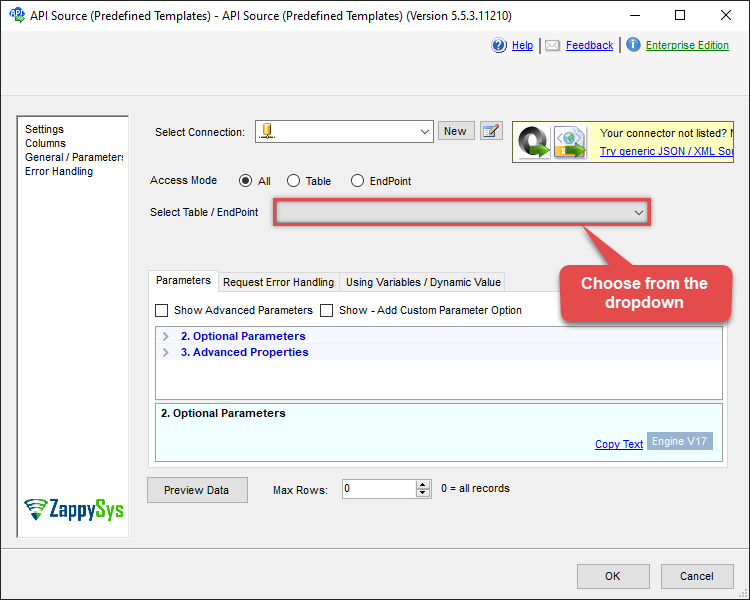
Read from Orders table using API Source

| There are no parameters to configure. |
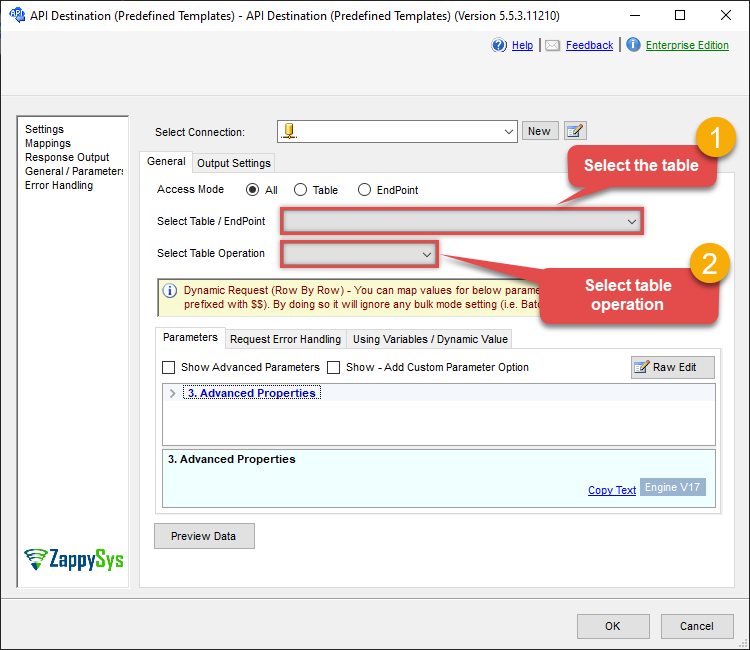
Read/write to Orders table using API Destination
| There are no parameters to configure. |
ODBC application
Use these SQL queries in your ODBC application data source:
Read orders
<p>Gets all orders. Use the <code>Orders</code> table to list transactions; optionally filter by date range or status in the <code>WITH</code> clause.</p>
SELECT * FROM OrdersRead an order by ID
<p>Gets one order by its ID. Use <code>WHERE Id='...'</code> with the order ID from your store.</p>
SELECT * FROM Orders WHERE Id='zzzzzzzzzz'Read orders with date range
<p>Gets orders within a date range. Supply <code>StartDate</code> and <code>EndDate</code> in the <code>WITH</code> clause; use literal dates (e.g. 2020-01-01) or relative date functions (see the next example).</p>
SELECT * FROM Orders WITH (StartDate='2020-01-01', EndDate='2021-12-31')Read orders placed in last 30 days
<p>Gets orders from the last 30 days using relative date functions. Set <code>StartDate='today-30day'</code> and <code>EndDate='today'</code> in the <code>WITH</code> clause. You can also use <code>yesterday</code>, <code>yearstart</code>, <code>yearend</code>, <code>monthstart</code>, <code>monthend</code>, and intervals like <code>yearstart-1y</code>.</p>
SELECT * FROM Orders
--WHERE Currency='USD' AND TotalInPayoutCurrency>=1599
WITH (StartDate='today-30day', EndDate='today') -- try today, yesterday, yearstart, yearend, monthstart, monthend, yearstart-1y
Read orders for a subscription
<p>Gets all orders for a given subscription. Use the <code>SubscriptionOrders</code> table and pass <code>SubscriptionId='...'</code> in the <code>WITH</code> clause.</p>
SELECT * FROM Orders
WHERE SubscriptionId_1='iBPfMFS6TZSxrLzSOrq8PQ'
	OR SubscriptionId_2='iBPfMFS6TZSxrLzSOrq8PQ'
	OR SubscriptionId_3='iBPfMFS6TZSxrLzSOrq8PQ'
ORDER BY OrderDate
Read accounts
<p>Gets all accounts for your store. Use the <code>Accounts</code> table. Optionally filter by <code>Email</code>, <code>CustomKey</code>, <code>OrderID</code>, <code>OrderReference</code>, <code>SubscriptionId</code>, <code>Products</code>, <code>Refunds</code>, <code>SubscriptionStatus</code> in the <code>WITH</code> clause.</p>
SELECT *
FROM Accounts

SELECT "Id"
	, "ContactFirst"
	, "ContactLast"
	, "ContactEmail"
	, "ContactCompany"
	, "ContactPhone"
	, "ContactSubscribed"
	, "AddressLine1"
	, "AddressLine2"
	, "City"
	, "Region"
	, "RegionCustom"
	, "PostalCode"
	, "AddressCompany"
	, "Language"
	, "Country"
	, "LookupGlobal"
	, "Url"
	, "PaymentMethods"
	, "PaymentActive"
	, "Orders"
	, "Subscriptions"
	, "Charges"
	, "Subscribed"
	, "TaxExemptionData"
FROM Accounts

--Use WITH clause --OR-- Key column(s) in WHERE clause
--WHERE [Id] = 'abcd'

--search by one or more parameters below
/*
WITH (
	  Email='X'
	, CustomKey='X'
	, GlobalKey='X'
	, OrderID='X'
	, OrderReference='X'
	, SubscriptionId='X'
	, Products='PROD-1,PROD-2,PROD-3'
	, Refunds='true'
	, SubscriptionStatus='active'
)
*/
SQL Server
Use these SQL queries in SQL Server after you create a data source in Data Gateway:
Read orders
<p>Gets all orders. Use the <code>Orders</code> table to list transactions; optionally filter by date range or status in the <code>WITH</code> clause.</p>
DECLARE @MyQuery NVARCHAR(MAX) = 'SELECT * FROM Orders';

EXEC (@MyQuery) AT [LS_TO_FASTSPRING_IN_GATEWAY];
Read an order by ID
<p>Gets one order by its ID. Use <code>WHERE Id='...'</code> with the order ID from your store.</p>
DECLARE @MyQuery NVARCHAR(MAX) = 'SELECT * FROM Orders WHERE Id=''zzzzzzzzzz''';

EXEC (@MyQuery) AT [LS_TO_FASTSPRING_IN_GATEWAY];
Read orders with date range
<p>Gets orders within a date range. Supply <code>StartDate</code> and <code>EndDate</code> in the <code>WITH</code> clause; use literal dates (e.g. 2020-01-01) or relative date functions (see the next example).</p>
DECLARE @MyQuery NVARCHAR(MAX) = 'SELECT * FROM Orders WITH (StartDate=''2020-01-01'', EndDate=''2021-12-31'')';

EXEC (@MyQuery) AT [LS_TO_FASTSPRING_IN_GATEWAY];
Read orders placed in last 30 days
<p>Gets orders from the last 30 days using relative date functions. Set <code>StartDate='today-30day'</code> and <code>EndDate='today'</code> in the <code>WITH</code> clause. You can also use <code>yesterday</code>, <code>yearstart</code>, <code>yearend</code>, <code>monthstart</code>, <code>monthend</code>, and intervals like <code>yearstart-1y</code>.</p>
DECLARE @MyQuery NVARCHAR(MAX) = 'SELECT * FROM Orders
--WHERE Currency=''USD'' AND TotalInPayoutCurrency>=1599
WITH (StartDate=''today-30day'', EndDate=''today'') -- try today, yesterday, yearstart, yearend, monthstart, monthend, yearstart-1y';

EXEC (@MyQuery) AT [LS_TO_FASTSPRING_IN_GATEWAY];
Read orders for a subscription
<p>Gets all orders for a given subscription. Use the <code>SubscriptionOrders</code> table and pass <code>SubscriptionId='...'</code> in the <code>WITH</code> clause.</p>
DECLARE @MyQuery NVARCHAR(MAX) = 'SELECT * FROM Orders
WHERE SubscriptionId_1=''iBPfMFS6TZSxrLzSOrq8PQ''
	OR SubscriptionId_2=''iBPfMFS6TZSxrLzSOrq8PQ''
	OR SubscriptionId_3=''iBPfMFS6TZSxrLzSOrq8PQ''
ORDER BY OrderDate';

EXEC (@MyQuery) AT [LS_TO_FASTSPRING_IN_GATEWAY];
Read accounts
<p>Gets all accounts for your store. Use the <code>Accounts</code> table. Optionally filter by <code>Email</code>, <code>CustomKey</code>, <code>OrderID</code>, <code>OrderReference</code>, <code>SubscriptionId</code>, <code>Products</code>, <code>Refunds</code>, <code>SubscriptionStatus</code> in the <code>WITH</code> clause.</p>
DECLARE @MyQuery NVARCHAR(MAX) = 'SELECT *
FROM Accounts

SELECT "Id"
	, "ContactFirst"
	, "ContactLast"
	, "ContactEmail"
	, "ContactCompany"
	, "ContactPhone"
	, "ContactSubscribed"
	, "AddressLine1"
	, "AddressLine2"
	, "City"
	, "Region"
	, "RegionCustom"
	, "PostalCode"
	, "AddressCompany"
	, "Language"
	, "Country"
	, "LookupGlobal"
	, "Url"
	, "PaymentMethods"
	, "PaymentActive"
	, "Orders"
	, "Subscriptions"
	, "Charges"
	, "Subscribed"
	, "TaxExemptionData"
FROM Accounts

--Use WITH clause --OR-- Key column(s) in WHERE clause
--WHERE [Id] = ''abcd''

--search by one or more parameters below
/*
WITH (
	  Email=''X''
	, CustomKey=''X''
	, GlobalKey=''X''
	, OrderID=''X''
	, OrderReference=''X''
	, SubscriptionId=''X''
	, Products=''PROD-1,PROD-2,PROD-3''
	, Refunds=''true''
	, SubscriptionStatus=''active''
)
*/';

EXEC (@MyQuery) AT [LS_TO_FASTSPRING_IN_GATEWAY];