
Table Events
Description
Insert, update, delete and list datasets
Supported Operations
Below section contains supported CRUD operations. Each operation is executed by some EndPoint behind the scene.| Method | Supported | Reference EndPoint |
|---|---|---|
| SELECT | list_events | |
| INSERT | create_event | |
| UPDATE | update_event | |
| UPSERT | ||
| DELETE | delete_event | |
| LOOKUP | get_event |
Examples
SSIS
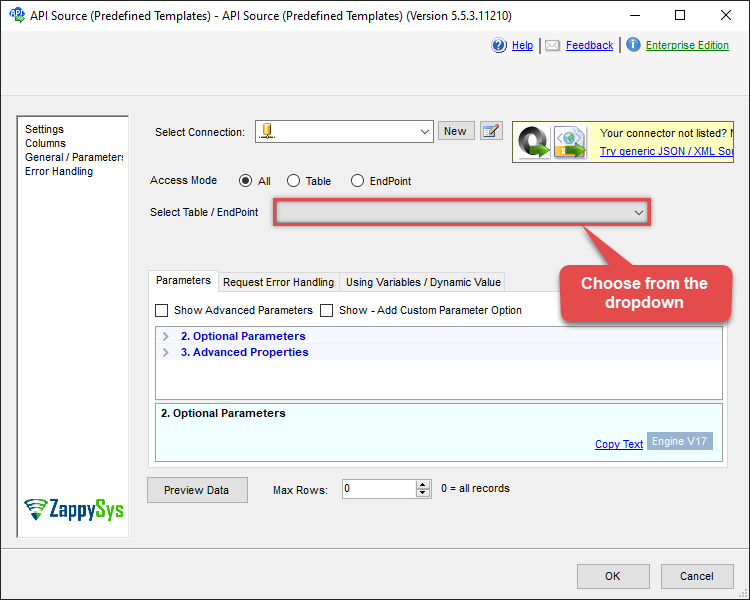
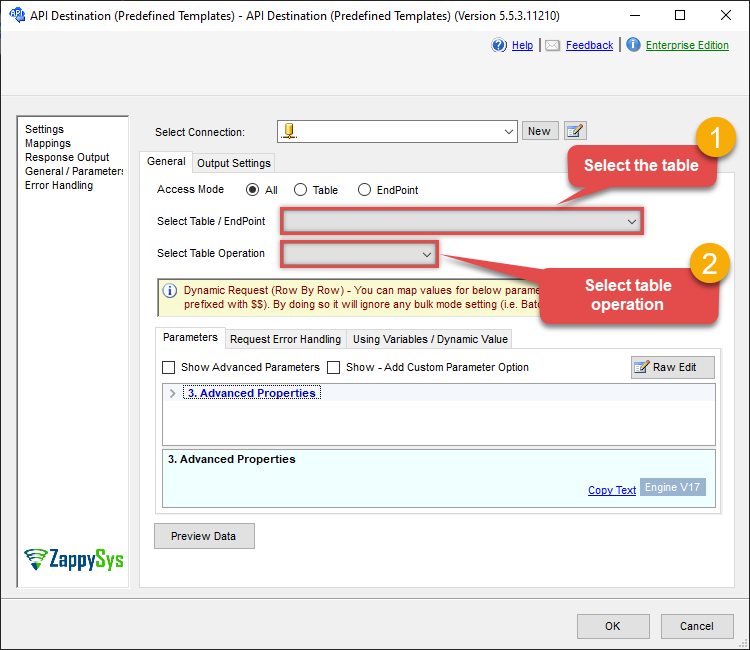
Use Google Calendar Connector in API Source component to read data or in API Destination component to read/write data:
Read from Events table using API Source

| Required Parameters | |
|---|---|
| Calendar ID (e.g. 'primary' or calendar ID) | Fill-in the parameter... |
Read/write to Events table using API Destination
| Required Parameters | |
|---|---|
| Calendar ID (e.g. 'primary' or calendar ID) | Fill-in the parameter... |
ODBC application
Use these SQL queries in your ODBC application data source:
List events
<p>This example lists events from a specified calendar. Supply the calendar ID to target a calendar; for a single event you can filter by event ID in the WHERE clause or use the EventId parameter.</p> <p><strong>Tip:</strong> Combine with time range parameters (<code>StartTime</code>, <code>EndTime</code>) for filtered results.</p>
SELECT * FROM Events
WITH (CalendarId='MyCalendarId')  -- Specify the calendar ID to list events from

--Get single event by Id
--SELECT * FROM Events WHERE Id='MyEventId'  -- Filter by event ID in WHERE clause
--SELECT * FROM Events WITH(EventId='MyEventId')  -- Use EventId parameter for direct lookup
List events with time range
<p>This example demonstrates how to list events within a specific date range using static timestamps. The <code>StartTime</code> and <code>EndTime</code> parameters filter events to only include those starting after the minimum time and ending before the maximum time. This is useful for querying events in a particular month or week.</p> <p><strong>Note:</strong> Timestamps must be in RFC3339 format (e.g., <code>2026-01-01T00:00:00Z</code>).</p>
SELECT *
FROM Events
WITH (CalendarId='primary',
      StartTime='2026-01-01T00:00:00Z',
      EndTime='2026-01-31T23:59:59Z')

--OR-- From all accessible calendars (EventsAll table)

--SELECT *
--FROM EventsAll
--WITH (StartTime='2026-01-01T00:00:00-05:00',
--      EndTime='2026-01-31T23:59:59-05:00')
List events ordered by start time
<p>Use this query to retrieve events ordered by their start time. The <code>OrderBy</code> parameter sorts the results chronologically based on the event's start date and time. This is ideal for displaying upcoming events in sequence.</p> <p><strong>Tip:</strong> Combine with <code>StartTime</code> to focus on future events.</p>
SELECT *
FROM Events
WITH (CalendarId='primary',
      OrderBy='startTime')
List events including deleted ones
<p>This example shows how to include deleted events in the results by setting <code>ShowDeleted='true'</code>. Deleted events are typically hidden, but this parameter allows you to view them for auditing or recovery purposes.</p> <p><strong>Warning:</strong> Deleted events may have limited data available.</p>
SELECT *
FROM Events
WITH (CalendarId='primary',
      ShowDeleted='true')
List events with max results and single events
<p>Limit the number of events returned with <code>MaxResults</code> and expand recurring events into individual instances using <code>SingleEvents='true'</code>. This prevents pagination issues and ensures each occurrence of a recurring event is listed separately.</p> <p><strong>Example use case:</strong> Fetch the next 10 upcoming event instances.</p>
SELECT * FROM Events

WITH (CalendarId='primary',
      MaxResults=10,
      SingleEvents='true')
List events for next week using dynamic dates
<p>This query uses dynamic date functions to list events for the next week. <code><<today,FUN_TO_DATETIME>></code> represents today's date in datetime format, and <code><<today+7d,FUN_TO_DATETIME>></code> adds 7 days. This allows for automated queries that always fetch the upcoming week's events without hardcoding dates.</p> <p><strong>Dynamic Placeholders:</strong> Supported functions include <code>FUN_TO_DATE</code> for dates and <code>FUN_TO_DATETIME</code> for timestamps.</p>
SELECT * FROM Events
--FROM EventsAll --(Get from All Calendars)
WITH (CalendarId='primary',
--//e.g. append -05:00 for EST (New York Time Zone) to convert local time to UTC -OR- just appends "Z" for UTC time (2026-01-01T05:00:00Z which is same as 2026-01-01T00:00:00-05:00 ).
      StartTime='<<today,FUN_TO_DATETIME>>-05:00',
      EndTime='<<today+7d,FUN_TO_DATETIME>>-05:00')
List events ordered by updated time
<p>Retrieve events sorted by their last updated time using <code>OrderBy='updated'</code>. This is useful for tracking recent changes or modifications to events in the calendar.</p> <p><strong>Combine with Filters:</strong> Add <code>StartTime</code> to focus on recently updated events.</p>
SELECT * FROM Events
--FROM EventsAll --(Get from All Calendars)
WITH (CalendarId='primary',
      OrderBy='updated')
List events for today and tomorrow with dynamic placeholders
<p>Use dynamic placeholders to query events starting from today and ending tomorrow. <code><<today,FUN_TO_DATETIME>></code> is today's start, and <code><<today+1d,FUN_TO_DATETIME>></code> is tomorrow's start. This example combines static time ranges with dynamic dates for precise filtering.</p> <p><strong>Advanced Tip:</strong> Adjust the offsets (e.g., +1d for tomorrow) to customize the range.</p>
SELECT *
FROM Events
--FROM EventsAll --(Get from All Calendars)
WITH (CalendarId='primary',
      StartTime='<<today,FUN_TO_DATETIME>>-05:00',
      EndTime='<<today+1d,FUN_TO_DATETIME>>-05:00')
Create event
<p>This example creates a new event in the specified calendar. Provide start and end times, time zones, summary, and optional details such as location and attendees. Supply the target calendar ID (e.g. <code>primary</code> or a custom calendar ID) in the WITH clause.</p> <p><strong>Note:</strong> Time zones are required for timed events. Attendees can be supplied as a JSON array.</p>
INSERT INTO Events(StartsAt, StartsInTimeZone, EndsAt, EndsInTimeZone, Summary,
  Attendees, Description, Location, Status, Transparency, Visibility)
VALUES ('2021-11-26T16:30:50', 'Europe/Vilnius', '2021-11-27T16:30:50','Europe/Vilnius', 'This is an event',
        null, 'My Description', 'Vilnius', 'confirmed', 'opaque', 'default')
--WITH (CalendarId='primary')		   -- Use 'primary' for the main calendar
--WITH (CalendarId='YourCalendarId')  -- Or specify a custom calendar ID
Update event
<p>This example updates an existing event by ID. You can change summary, description, times, location, attendees, reminders, and other fields. Use dynamic placeholders for relative times (e.g. <code><<today+1d+10h,FUN_TO_DATETIME>></code>).</p> <p><strong>Note:</strong> Always provide time zones for timed events. You can choose whether to notify attendees of the update.</p>
UPDATE Events
SET	 Summary = 'Project Kickoff Meeting'            -- Event title
    ,Description = 'Your meeting description in <strong>bold HTML</strong>'

    --For all day event - Example '2026-01-28'
    --,StartsOn = '2026-02-01'                        -- All-day event start date (YYYY-MM-DD)
    --,EndsOn = '2026-02-01'                          -- All-day event end date (YYYY-MM-DD)

    --,StartsOn = '<<monthend+1d,FUN_TO_DATE>>'      -- Dynamic date example
    --,EndsOn   = '<<monthend+1d,FUN_TO_DATE>>'

    --OR--

    --For events which has start/end time : Example '2026-01-28T15:59:00'
    ,StartsAt = '<<today+1d+10h,FUN_TO_DATETIME>>' -- Set time from today + 1 day + 10 hours (10AM)
    ,EndsAt = '<<today+1d+11h,FUN_TO_DATETIME>>'   -- Set time from today + 1 day + 11 hours (11AM)
    ,StartsInTimeZone = 'America/New_York'
    ,EndsInTimeZone = 'America/New_York'

    ,Location = 'Conference Room 2B'                -- Event location
    ,Attendees = '[{"email":"user1@example.com"},{"email":"user2@example.com"}]' -- JSON array of attendees
	,RemindersUseDefault = false                    -- Use custom reminders
	,RemindersOverrides = '[{"method": "popup","minutes": 12},{"method": "popup","minutes": 11}]'  -- JSON array of reminder overrides
    ,Recurrence = '["RRULE:FREQ=WEEKLY;WKST=SU;UNTIL=20260131T045959Z;BYDAY=MO,WE"]'      -- Recurrence rule
    ,Status = 'confirmed'                           -- confirmed | tentative | cancelled
    ,Transparency = 'opaque'                        -- opaque | transparent
    ,Visibility = 'default'                         -- default | public | private | confidential
    ,ColorId = '5'                                  -- Color identifier
    ,GuestsCanInviteOthers = true                   -- Allow guests to invite others
    ,GuestsCanModify = false                        -- Allow guests to modify event
    ,GuestsCanSeeOtherGuests = true                 -- Allow guests to see other guests
    ,AnyoneCanAddSelf = false                       -- Anyone can add themselves as attendee
    ,PrivateCopy = false                            -- Private event copy
    ,ShowMeAs = 'busy'                              -- busy | free | tentative | workingElsewhere
    ,SourceTitle = 'Project Plan'                   -- Source title
    ,SourceUrl = 'https://example.com/project-plan' -- Source URL
WHERE Id = '5hr02mkhg09atao1clih4jco6e'  -- Event ID to update
WITH (
   CalendarId = 'primary' --or 'some-calendar-id'
 , SendUpdates='none' --'all' or 'externalOnly' to notify attendees
)
Delete event
<p>This example deletes an event by ID from the specified calendar. Supply the calendar ID and the event ID.</p> <p><strong>Warning:</strong> This action is irreversible.</p>
DELETE FROM Events  -- Deletes the specified event
WITH (CalendarId='MyCalendarId',  -- Calendar containing the event
      Id='MyEventId')              -- ID of the event to delete
SQL Server
Use these SQL queries in SQL Server after you create a data source in Data Gateway:
List events
<p>This example lists events from a specified calendar. Supply the calendar ID to target a calendar; for a single event you can filter by event ID in the WHERE clause or use the EventId parameter.</p> <p><strong>Tip:</strong> Combine with time range parameters (<code>StartTime</code>, <code>EndTime</code>) for filtered results.</p>
DECLARE @MyQuery NVARCHAR(MAX) = 'SELECT * FROM Events
WITH (CalendarId=''MyCalendarId'')  -- Specify the calendar ID to list events from

--Get single event by Id
--SELECT * FROM Events WHERE Id=''MyEventId''  -- Filter by event ID in WHERE clause
--SELECT * FROM Events WITH(EventId=''MyEventId'')  -- Use EventId parameter for direct lookup';

EXEC (@MyQuery) AT [LS_TO_GOOGLE_CALENDAR_IN_GATEWAY];
List events with time range
<p>This example demonstrates how to list events within a specific date range using static timestamps. The <code>StartTime</code> and <code>EndTime</code> parameters filter events to only include those starting after the minimum time and ending before the maximum time. This is useful for querying events in a particular month or week.</p> <p><strong>Note:</strong> Timestamps must be in RFC3339 format (e.g., <code>2026-01-01T00:00:00Z</code>).</p>
DECLARE @MyQuery NVARCHAR(MAX) = 'SELECT *
FROM Events
WITH (CalendarId=''primary'',
      StartTime=''2026-01-01T00:00:00Z'',
      EndTime=''2026-01-31T23:59:59Z'')

--OR-- From all accessible calendars (EventsAll table)

--SELECT *
--FROM EventsAll
--WITH (StartTime=''2026-01-01T00:00:00-05:00'',
--      EndTime=''2026-01-31T23:59:59-05:00'')';

EXEC (@MyQuery) AT [LS_TO_GOOGLE_CALENDAR_IN_GATEWAY];
List events ordered by start time
<p>Use this query to retrieve events ordered by their start time. The <code>OrderBy</code> parameter sorts the results chronologically based on the event's start date and time. This is ideal for displaying upcoming events in sequence.</p> <p><strong>Tip:</strong> Combine with <code>StartTime</code> to focus on future events.</p>
DECLARE @MyQuery NVARCHAR(MAX) = 'SELECT *
FROM Events
WITH (CalendarId=''primary'',
      OrderBy=''startTime'')';

EXEC (@MyQuery) AT [LS_TO_GOOGLE_CALENDAR_IN_GATEWAY];
List events including deleted ones
<p>This example shows how to include deleted events in the results by setting <code>ShowDeleted='true'</code>. Deleted events are typically hidden, but this parameter allows you to view them for auditing or recovery purposes.</p> <p><strong>Warning:</strong> Deleted events may have limited data available.</p>
DECLARE @MyQuery NVARCHAR(MAX) = 'SELECT *
FROM Events
WITH (CalendarId=''primary'',
      ShowDeleted=''true'')';

EXEC (@MyQuery) AT [LS_TO_GOOGLE_CALENDAR_IN_GATEWAY];
List events with max results and single events
<p>Limit the number of events returned with <code>MaxResults</code> and expand recurring events into individual instances using <code>SingleEvents='true'</code>. This prevents pagination issues and ensures each occurrence of a recurring event is listed separately.</p> <p><strong>Example use case:</strong> Fetch the next 10 upcoming event instances.</p>
DECLARE @MyQuery NVARCHAR(MAX) = 'SELECT * FROM Events

WITH (CalendarId=''primary'',
      MaxResults=10,
      SingleEvents=''true'')';

EXEC (@MyQuery) AT [LS_TO_GOOGLE_CALENDAR_IN_GATEWAY];
List events for next week using dynamic dates
<p>This query uses dynamic date functions to list events for the next week. <code><<today,FUN_TO_DATETIME>></code> represents today's date in datetime format, and <code><<today+7d,FUN_TO_DATETIME>></code> adds 7 days. This allows for automated queries that always fetch the upcoming week's events without hardcoding dates.</p> <p><strong>Dynamic Placeholders:</strong> Supported functions include <code>FUN_TO_DATE</code> for dates and <code>FUN_TO_DATETIME</code> for timestamps.</p>
DECLARE @MyQuery NVARCHAR(MAX) = 'SELECT * FROM Events
--FROM EventsAll --(Get from All Calendars)
WITH (CalendarId=''primary'',
--//e.g. append -05:00 for EST (New York Time Zone) to convert local time to UTC -OR- just appends "Z" for UTC time (2026-01-01T05:00:00Z which is same as 2026-01-01T00:00:00-05:00 ).
      StartTime=''<<today,FUN_TO_DATETIME>>-05:00'',
      EndTime=''<<today+7d,FUN_TO_DATETIME>>-05:00'')';

EXEC (@MyQuery) AT [LS_TO_GOOGLE_CALENDAR_IN_GATEWAY];
List events ordered by updated time
<p>Retrieve events sorted by their last updated time using <code>OrderBy='updated'</code>. This is useful for tracking recent changes or modifications to events in the calendar.</p> <p><strong>Combine with Filters:</strong> Add <code>StartTime</code> to focus on recently updated events.</p>
DECLARE @MyQuery NVARCHAR(MAX) = 'SELECT * FROM Events
--FROM EventsAll --(Get from All Calendars)
WITH (CalendarId=''primary'',
      OrderBy=''updated'')';

EXEC (@MyQuery) AT [LS_TO_GOOGLE_CALENDAR_IN_GATEWAY];
List events for today and tomorrow with dynamic placeholders
<p>Use dynamic placeholders to query events starting from today and ending tomorrow. <code><<today,FUN_TO_DATETIME>></code> is today's start, and <code><<today+1d,FUN_TO_DATETIME>></code> is tomorrow's start. This example combines static time ranges with dynamic dates for precise filtering.</p> <p><strong>Advanced Tip:</strong> Adjust the offsets (e.g., +1d for tomorrow) to customize the range.</p>
DECLARE @MyQuery NVARCHAR(MAX) = 'SELECT *
FROM Events
--FROM EventsAll --(Get from All Calendars)
WITH (CalendarId=''primary'',
      StartTime=''<<today,FUN_TO_DATETIME>>-05:00'',
      EndTime=''<<today+1d,FUN_TO_DATETIME>>-05:00'')';

EXEC (@MyQuery) AT [LS_TO_GOOGLE_CALENDAR_IN_GATEWAY];
Create event
<p>This example creates a new event in the specified calendar. Provide start and end times, time zones, summary, and optional details such as location and attendees. Supply the target calendar ID (e.g. <code>primary</code> or a custom calendar ID) in the WITH clause.</p> <p><strong>Note:</strong> Time zones are required for timed events. Attendees can be supplied as a JSON array.</p>
DECLARE @MyQuery NVARCHAR(MAX) = 'INSERT INTO Events(StartsAt, StartsInTimeZone, EndsAt, EndsInTimeZone, Summary,
  Attendees, Description, Location, Status, Transparency, Visibility)
VALUES (''2021-11-26T16:30:50'', ''Europe/Vilnius'', ''2021-11-27T16:30:50'',''Europe/Vilnius'', ''This is an event'',
        null, ''My Description'', ''Vilnius'', ''confirmed'', ''opaque'', ''default'')
--WITH (CalendarId=''primary'')		   -- Use ''primary'' for the main calendar
--WITH (CalendarId=''YourCalendarId'')  -- Or specify a custom calendar ID';

EXEC (@MyQuery) AT [LS_TO_GOOGLE_CALENDAR_IN_GATEWAY];
Update event
<p>This example updates an existing event by ID. You can change summary, description, times, location, attendees, reminders, and other fields. Use dynamic placeholders for relative times (e.g. <code><<today+1d+10h,FUN_TO_DATETIME>></code>).</p> <p><strong>Note:</strong> Always provide time zones for timed events. You can choose whether to notify attendees of the update.</p>
DECLARE @MyQuery NVARCHAR(MAX) = 'UPDATE Events
SET	 Summary = ''Project Kickoff Meeting''            -- Event title
    ,Description = ''Your meeting description in <strong>bold HTML</strong>''

    --For all day event - Example ''2026-01-28''
    --,StartsOn = ''2026-02-01''                        -- All-day event start date (YYYY-MM-DD)
    --,EndsOn = ''2026-02-01''                          -- All-day event end date (YYYY-MM-DD)

    --,StartsOn = ''<<monthend+1d,FUN_TO_DATE>>''      -- Dynamic date example
    --,EndsOn   = ''<<monthend+1d,FUN_TO_DATE>>''

    --OR--

    --For events which has start/end time : Example ''2026-01-28T15:59:00''
    ,StartsAt = ''<<today+1d+10h,FUN_TO_DATETIME>>'' -- Set time from today + 1 day + 10 hours (10AM)
    ,EndsAt = ''<<today+1d+11h,FUN_TO_DATETIME>>''   -- Set time from today + 1 day + 11 hours (11AM)
    ,StartsInTimeZone = ''America/New_York''
    ,EndsInTimeZone = ''America/New_York''

    ,Location = ''Conference Room 2B''                -- Event location
    ,Attendees = ''[{"email":"user1@example.com"},{"email":"user2@example.com"}]'' -- JSON array of attendees
	,RemindersUseDefault = false                    -- Use custom reminders
	,RemindersOverrides = ''[{"method": "popup","minutes": 12},{"method": "popup","minutes": 11}]''  -- JSON array of reminder overrides
    ,Recurrence = ''["RRULE:FREQ=WEEKLY;WKST=SU;UNTIL=20260131T045959Z;BYDAY=MO,WE"]''      -- Recurrence rule
    ,Status = ''confirmed''                           -- confirmed | tentative | cancelled
    ,Transparency = ''opaque''                        -- opaque | transparent
    ,Visibility = ''default''                         -- default | public | private | confidential
    ,ColorId = ''5''                                  -- Color identifier
    ,GuestsCanInviteOthers = true                   -- Allow guests to invite others
    ,GuestsCanModify = false                        -- Allow guests to modify event
    ,GuestsCanSeeOtherGuests = true                 -- Allow guests to see other guests
    ,AnyoneCanAddSelf = false                       -- Anyone can add themselves as attendee
    ,PrivateCopy = false                            -- Private event copy
    ,ShowMeAs = ''busy''                              -- busy | free | tentative | workingElsewhere
    ,SourceTitle = ''Project Plan''                   -- Source title
    ,SourceUrl = ''https://example.com/project-plan'' -- Source URL
WHERE Id = ''5hr02mkhg09atao1clih4jco6e''  -- Event ID to update
WITH (
   CalendarId = ''primary'' --or ''some-calendar-id''
 , SendUpdates=''none'' --''all'' or ''externalOnly'' to notify attendees
)';

EXEC (@MyQuery) AT [LS_TO_GOOGLE_CALENDAR_IN_GATEWAY];
Delete event
<p>This example deletes an event by ID from the specified calendar. Supply the calendar ID and the event ID.</p> <p><strong>Warning:</strong> This action is irreversible.</p>
DECLARE @MyQuery NVARCHAR(MAX) = 'DELETE FROM Events  -- Deletes the specified event
WITH (CalendarId=''MyCalendarId'',  -- Calendar containing the event
      Id=''MyEventId'')              -- ID of the event to delete';

EXEC (@MyQuery) AT [LS_TO_GOOGLE_CALENDAR_IN_GATEWAY];