

Table [Dynamic Table]
Description
No description available
Supported Operations
Below section contains supported CRUD operations. Each operation is executed by some EndPoint behind the scene.| Method | Supported | Reference EndPoint |
|---|---|---|
| SELECT | get_[dynamic_endpoint_name] | |
| INSERT | post_[dynamic_endpoint_name] | |
| UPDATE | ||
| UPSERT | ||
| DELETE | ||
| LOOKUP | get_query |
Examples
SSIS
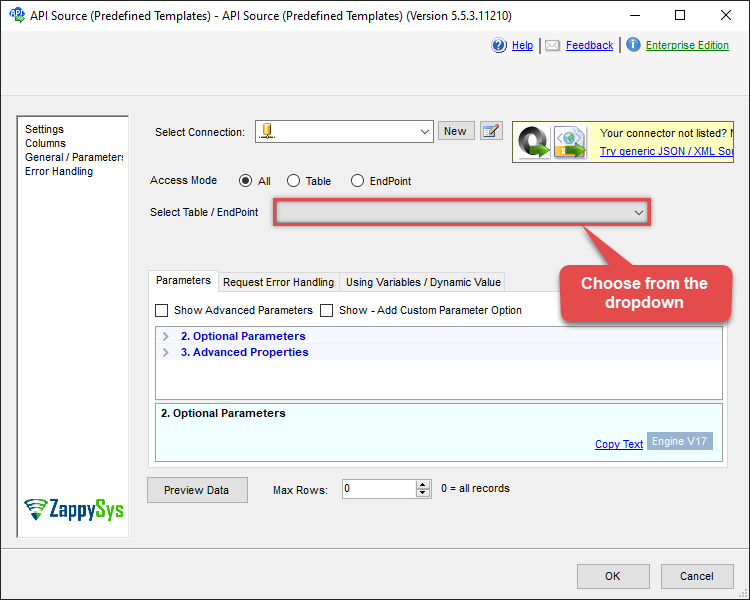
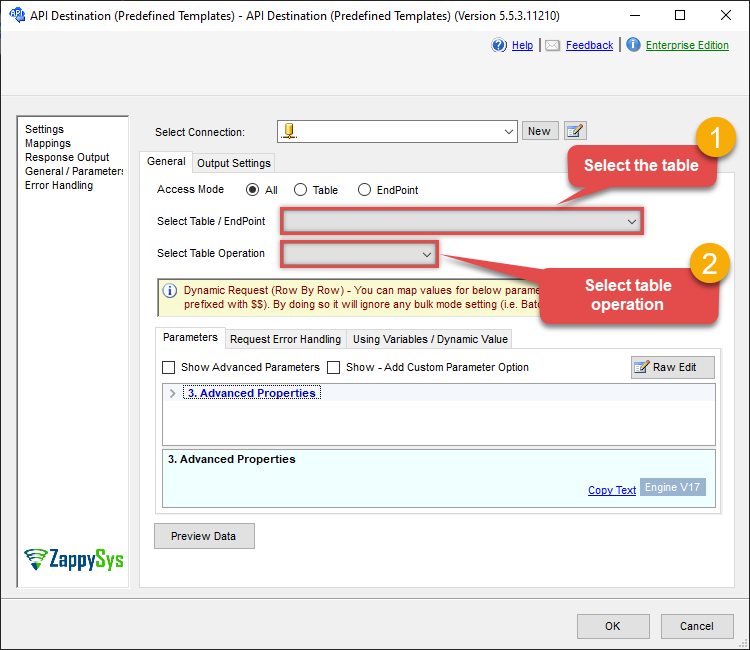
Use Google BigQuery Connector in API Source component to read data or in API Destination component to read/write data:
Read from [Dynamic Table] table using API Source

| Optional Parameters | |
|---|---|
| ArrayTransformType | TransformComplexTwoDimensionalArray |
| ArrayTransRowValueFilter | $.f[*].v |
Read/write to [Dynamic Table] table using API Destination
| Optional Parameters | |
|---|---|
| ArrayTransformType | TransformComplexTwoDimensionalArray |
| ArrayTransRowValueFilter | $.f[*].v |
ODBC application
Use these SQL queries in your ODBC application data source:
Query using simple SQL (Native SQL)
<p><strong>Native SQL</strong> — the SQL runs on the BigQuery side (server-side). Prefix the SQL with <code>#DirectSQL</code> to use this mode. Example queries a public dataset table (<code>bigquery-public-data.samples.wikipedia</code>); you can use your own or other free datasets (e.g. <code>nyc-tlc.yellow.trips</code>). Table name has three parts: <code>[Project.]Dataset.Table</code>.</p>
#DirectSQL
SELECT *
FROM bigquery-public-data.samples.wikipedia
LIMIT 1000
Query using complex SQL (Native SQL)
<p><strong>Native SQL</strong> — the SQL runs on the BigQuery side (server-side). Prefix with <code>#DirectSQL</code> to use this mode. Example uses <code>GROUP BY</code> and <code>ORDER BY</code> with the public dataset <code>bigquery-public-data.usa_names.usa_1910_2013</code>.</p>
#DirectSQL
SELECT name, gender, SUM(number) AS total
FROM bigquery-public-data.usa_names.usa_1910_2013
GROUP BY name, gender
ORDER BY total DESC
LIMIT 10
Delete multiple records (DML) (Native SQL)
<p><strong>Native SQL</strong> — the SQL runs on the BigQuery side (server-side). Prefix with <code>#DirectSQL</code> to use this mode. Runs a <code>DELETE</code> statement; use your own dataset and table in place of <code>TestDataset.MyTable</code>.</p>
#DirectSQL
DELETE FROM TestDataset.MyTable
WHERE Id > 5
Query with CAST unix TIMESTAMP as datetime (Native SQL)
<p><strong>Native SQL</strong> — the SQL runs on the BigQuery side (server-side). Prefix with <code>#DirectSQL</code> to use this mode. Shows how to return a timestamp column as date or datetime using <code>CAST(col_timestamp AS DATE)</code> or <code>CAST(col_timestamp AS DATETIME)</code>.</p>
#DirectSQL
SELECT id, col_timestamp, CAST(col_timestamp AS DATE) AS timestamp_as_date, CAST(col_timestamp AS DATETIME) AS timestamp_as_datetime
FROM MyProject.MyDataset.MyTable
LIMIT 10
Create table / run DDL (Native SQL)
<p><strong>Native SQL</strong> — the SQL runs on the BigQuery side (server-side). Prefix with <code>#DirectSQL</code> to use this mode. Runs a DDL statement such as <code>CREATE TABLE</code>.</p>
#DirectSQL
CREATE TABLE TestDataset.Table1 (ID INT64, Name STRING, BirthDate DATETIME, Active BOOL)
UPDATE table data for complex types (RECORD, Geography, JSON) (Native SQL)
<p><strong>Native SQL</strong> — the SQL runs on the BigQuery side (server-side). Prefix with <code>#DirectSQL</code> to use this mode. Runs an <code>UPDATE</code> (or other DML) with complex types such as RECORD (array), Geography, and JSON.</p>
#DirectSQL
UPDATE TestDataset.DataTypeTest
SET ColTime='23:59:59.123456',
 ColGeography=ST_GEOGPOINT(34.150480, -84.233870),
 ColRecord=(1,"AA","Column3 data"),
 ColBigNumeric=1222222222222222222.123456789123456789123456789123456789,
 ColJson= JSON_ARRAY('{"doc":1, "values":[{"id":1},{"id":2}]}')
WHERE ColInteger=1
INSERT datetime / Unix timestamp values (Native SQL)
<p><strong>Native SQL</strong> — the SQL runs on the BigQuery side (server-side). Prefix with <code>#DirectSQL</code> to use this mode. Shows how to insert datetime or Unix timestamp values into a TIMESTAMP column (datetime strings or Unix epoch, with or without milliseconds). Use the <code>_DT</code> alias on the column if your ETL tool expects a datetime type.</p>
#DirectSQL
--DateTime Without milliseconds
INSERT INTO TestDataset.DataTypeTest (ColInteger,ColString,ColTimestamp) VALUES(1004,'My date time','2025-01-31T23:59:59');

--DateTime with milliseconds
INSERT INTO TestDataset.DataTypeTest (ColInteger,ColString,ColTimestamp) VALUES(1004,'My date time','2025-01-31T23:59:59.1234');

--DateTime alias field (e.g. {your-timestamp-column}_DT) - Useful if ETL tool needs DateTime datatype rather than Numeric Unix Epoch
INSERT INTO TestDataset.DataTypeTest (ColInteger,ColString,ColTimestamp_DT) VALUES(1004,'My date time','2025-01-31T23:59:59');

--Unix Epoch format (without milliseconds)
INSERT INTO TestDataset.DataTypeTest (ColInteger,ColString,ColTimestamp) VALUES(1006,'My date time',1738367999);

--Unix Epoch format (with milliseconds)
INSERT INTO TestDataset.DataTypeTest (ColInteger,ColString,ColTimestamp) VALUES(1006,'My date time',1738367999.12345);
DROP table (if exists) / other DDL (Native SQL)
<p><strong>Native SQL</strong> — the SQL runs on the BigQuery side (server-side). Prefix with <code>#DirectSQL</code> to use this mode. Runs a DDL statement such as <code>DROP TABLE IF EXISTS</code>.</p>
#DirectSQL
DROP TABLE IF EXISTS Myproject.Mydataset.Mytable
Call stored procedure (Native SQL)
<p><strong>Native SQL</strong> — the SQL runs on the BigQuery side (server-side). Prefix with <code>#DirectSQL</code> to use this mode. Runs a BigQuery stored procedure with parameters; example assumes a procedure <code>usp_GetData</code> in <code>TestDataset</code>.</p>
#DirectSQL
CALL TestDataset.usp_GetData(1)
INSERT single row
<p>Inserts a single row using ZappySys query syntax. You can optionally use <code>WITH(DatasetId='...', ProjectId='...', Output='*')</code>.</p>
INSERT INTO MyBQTable1(SomeBQCol1, SomeBQCol2) VALUES(1,'AAA')
--WITH(DatasetId='TestDataset',Output='*')
--WITH(DatasetId='TestDataset',ProjectId='MyProjectId',Output='*')
INSERT multiple rows from SQL Server
<p>Bulk insert into a BigQuery table from Microsoft SQL Server. The column list is taken from the source query; use SQL aliases so column names match the target table.</p>
INSERT INTO MyBQTable1
SOURCE(
    'MSSQL'
  , 'Data Source=localhost;Initial Catalog=tempdb;Integrated Security=true'
  , 'SELECT Col1 AS SomeBQCol1, Col2 AS SomeBQCol2 FROM SomeTable WHERE SomeCol=123'
)
--WITH(DatasetId='TestDataset',Output='*')
--WITH(DatasetId='TestDataset',ProjectId='MyProjectId',Output='*')
INSERT multiple rows from any ODBC source (DSN)
<p>Bulk insert into a BigQuery table from any ODBC source (DSN). The column list comes from the source query; use aliases so names match the target table.</p>
INSERT INTO MyBQTable1
SOURCE(
    'ODBC'
  , 'DSN=MyDsn'
  , 'SELECT Col1 AS SomeBQCol1, Col2 AS SomeBQCol2 FROM SomeTable WHERE SomeCol=123'
)
WITH(DatasetId='TestDataset')
INSERT multiple rows from JSON files / API
<p>Bulk insert into a BigQuery table from JSON (URL or file). Column list comes from the source query; use aliases to match the target table. In the code, an ODBC connection to a JSON source is used (e.g. ZappySys ODBC JSON driver); you can use a similar approach with CSV or XML sources.</p>
INSERT INTO MyBQTable1
SOURCE(
    'ODBC'
  , 'Driver={ZappySys JSON Driver};Src=''https://some-url/get-data'''
  , 'SELECT Col1 AS SomeBQCol1, Col2 AS SomeBQCol2 FROM _root_'
)
--WITH(DatasetId='TestDataset',Output='*')
--WITH(DatasetId='TestDataset',ProjectId='MyProjectId',Output='*')
SQL Server
Use these SQL queries in SQL Server after you create a data source in Data Gateway:
Query using simple SQL (Native SQL)
<p><strong>Native SQL</strong> — the SQL runs on the BigQuery side (server-side). Prefix the SQL with <code>#DirectSQL</code> to use this mode. Example queries a public dataset table (<code>bigquery-public-data.samples.wikipedia</code>); you can use your own or other free datasets (e.g. <code>nyc-tlc.yellow.trips</code>). Table name has three parts: <code>[Project.]Dataset.Table</code>.</p>
DECLARE @MyQuery NVARCHAR(MAX) = '#DirectSQL
SELECT *
FROM bigquery-public-data.samples.wikipedia
LIMIT 1000';

EXEC (@MyQuery) AT [LS_TO_GOOGLE_BIGQUERY_IN_GATEWAY];
Query using complex SQL (Native SQL)
<p><strong>Native SQL</strong> — the SQL runs on the BigQuery side (server-side). Prefix with <code>#DirectSQL</code> to use this mode. Example uses <code>GROUP BY</code> and <code>ORDER BY</code> with the public dataset <code>bigquery-public-data.usa_names.usa_1910_2013</code>.</p>
DECLARE @MyQuery NVARCHAR(MAX) = '#DirectSQL
SELECT name, gender, SUM(number) AS total
FROM bigquery-public-data.usa_names.usa_1910_2013
GROUP BY name, gender
ORDER BY total DESC
LIMIT 10';

EXEC (@MyQuery) AT [LS_TO_GOOGLE_BIGQUERY_IN_GATEWAY];
Delete multiple records (DML) (Native SQL)
<p><strong>Native SQL</strong> — the SQL runs on the BigQuery side (server-side). Prefix with <code>#DirectSQL</code> to use this mode. Runs a <code>DELETE</code> statement; use your own dataset and table in place of <code>TestDataset.MyTable</code>.</p>
DECLARE @MyQuery NVARCHAR(MAX) = '#DirectSQL
DELETE FROM TestDataset.MyTable
WHERE Id > 5';

EXEC (@MyQuery) AT [LS_TO_GOOGLE_BIGQUERY_IN_GATEWAY];
Query with CAST unix TIMESTAMP as datetime (Native SQL)
<p><strong>Native SQL</strong> — the SQL runs on the BigQuery side (server-side). Prefix with <code>#DirectSQL</code> to use this mode. Shows how to return a timestamp column as date or datetime using <code>CAST(col_timestamp AS DATE)</code> or <code>CAST(col_timestamp AS DATETIME)</code>.</p>
DECLARE @MyQuery NVARCHAR(MAX) = '#DirectSQL
SELECT id, col_timestamp, CAST(col_timestamp AS DATE) AS timestamp_as_date, CAST(col_timestamp AS DATETIME) AS timestamp_as_datetime
FROM MyProject.MyDataset.MyTable
LIMIT 10';

EXEC (@MyQuery) AT [LS_TO_GOOGLE_BIGQUERY_IN_GATEWAY];
Create table / run DDL (Native SQL)
<p><strong>Native SQL</strong> — the SQL runs on the BigQuery side (server-side). Prefix with <code>#DirectSQL</code> to use this mode. Runs a DDL statement such as <code>CREATE TABLE</code>.</p>
DECLARE @MyQuery NVARCHAR(MAX) = '#DirectSQL
CREATE TABLE TestDataset.Table1 (ID INT64, Name STRING, BirthDate DATETIME, Active BOOL)';

EXEC (@MyQuery) AT [LS_TO_GOOGLE_BIGQUERY_IN_GATEWAY];
UPDATE table data for complex types (RECORD, Geography, JSON) (Native SQL)
<p><strong>Native SQL</strong> — the SQL runs on the BigQuery side (server-side). Prefix with <code>#DirectSQL</code> to use this mode. Runs an <code>UPDATE</code> (or other DML) with complex types such as RECORD (array), Geography, and JSON.</p>
DECLARE @MyQuery NVARCHAR(MAX) = '#DirectSQL
UPDATE TestDataset.DataTypeTest
SET ColTime=''23:59:59.123456'',
 ColGeography=ST_GEOGPOINT(34.150480, -84.233870),
 ColRecord=(1,"AA","Column3 data"),
 ColBigNumeric=1222222222222222222.123456789123456789123456789123456789,
 ColJson= JSON_ARRAY(''{"doc":1, "values":[{"id":1},{"id":2}]}'')
WHERE ColInteger=1';

EXEC (@MyQuery) AT [LS_TO_GOOGLE_BIGQUERY_IN_GATEWAY];
INSERT datetime / Unix timestamp values (Native SQL)
<p><strong>Native SQL</strong> — the SQL runs on the BigQuery side (server-side). Prefix with <code>#DirectSQL</code> to use this mode. Shows how to insert datetime or Unix timestamp values into a TIMESTAMP column (datetime strings or Unix epoch, with or without milliseconds). Use the <code>_DT</code> alias on the column if your ETL tool expects a datetime type.</p>
DECLARE @MyQuery NVARCHAR(MAX) = '#DirectSQL
--DateTime Without milliseconds
INSERT INTO TestDataset.DataTypeTest (ColInteger,ColString,ColTimestamp) VALUES(1004,''My date time'',''2025-01-31T23:59:59'');

--DateTime with milliseconds
INSERT INTO TestDataset.DataTypeTest (ColInteger,ColString,ColTimestamp) VALUES(1004,''My date time'',''2025-01-31T23:59:59.1234'');

--DateTime alias field (e.g. {your-timestamp-column}_DT) - Useful if ETL tool needs DateTime datatype rather than Numeric Unix Epoch
INSERT INTO TestDataset.DataTypeTest (ColInteger,ColString,ColTimestamp_DT) VALUES(1004,''My date time'',''2025-01-31T23:59:59'');

--Unix Epoch format (without milliseconds)
INSERT INTO TestDataset.DataTypeTest (ColInteger,ColString,ColTimestamp) VALUES(1006,''My date time'',1738367999);

--Unix Epoch format (with milliseconds)
INSERT INTO TestDataset.DataTypeTest (ColInteger,ColString,ColTimestamp) VALUES(1006,''My date time'',1738367999.12345);';

EXEC (@MyQuery) AT [LS_TO_GOOGLE_BIGQUERY_IN_GATEWAY];
DROP table (if exists) / other DDL (Native SQL)
<p><strong>Native SQL</strong> — the SQL runs on the BigQuery side (server-side). Prefix with <code>#DirectSQL</code> to use this mode. Runs a DDL statement such as <code>DROP TABLE IF EXISTS</code>.</p>
DECLARE @MyQuery NVARCHAR(MAX) = '#DirectSQL
DROP TABLE IF EXISTS Myproject.Mydataset.Mytable';

EXEC (@MyQuery) AT [LS_TO_GOOGLE_BIGQUERY_IN_GATEWAY];
Call stored procedure (Native SQL)
<p><strong>Native SQL</strong> — the SQL runs on the BigQuery side (server-side). Prefix with <code>#DirectSQL</code> to use this mode. Runs a BigQuery stored procedure with parameters; example assumes a procedure <code>usp_GetData</code> in <code>TestDataset</code>.</p>
DECLARE @MyQuery NVARCHAR(MAX) = '#DirectSQL
CALL TestDataset.usp_GetData(1)';

EXEC (@MyQuery) AT [LS_TO_GOOGLE_BIGQUERY_IN_GATEWAY];
INSERT single row
<p>Inserts a single row using ZappySys query syntax. You can optionally use <code>WITH(DatasetId='...', ProjectId='...', Output='*')</code>.</p>
DECLARE @MyQuery NVARCHAR(MAX) = 'INSERT INTO MyBQTable1(SomeBQCol1, SomeBQCol2) VALUES(1,''AAA'')
--WITH(DatasetId=''TestDataset'',Output=''*'')
--WITH(DatasetId=''TestDataset'',ProjectId=''MyProjectId'',Output=''*'')';

EXEC (@MyQuery) AT [LS_TO_GOOGLE_BIGQUERY_IN_GATEWAY];
INSERT multiple rows from SQL Server
<p>Bulk insert into a BigQuery table from Microsoft SQL Server. The column list is taken from the source query; use SQL aliases so column names match the target table.</p>
DECLARE @MyQuery NVARCHAR(MAX) = 'INSERT INTO MyBQTable1
SOURCE(
    ''MSSQL''
  , ''Data Source=localhost;Initial Catalog=tempdb;Integrated Security=true''
  , ''SELECT Col1 AS SomeBQCol1, Col2 AS SomeBQCol2 FROM SomeTable WHERE SomeCol=123''
)
--WITH(DatasetId=''TestDataset'',Output=''*'')
--WITH(DatasetId=''TestDataset'',ProjectId=''MyProjectId'',Output=''*'')';

EXEC (@MyQuery) AT [LS_TO_GOOGLE_BIGQUERY_IN_GATEWAY];
INSERT multiple rows from any ODBC source (DSN)
<p>Bulk insert into a BigQuery table from any ODBC source (DSN). The column list comes from the source query; use aliases so names match the target table.</p>
DECLARE @MyQuery NVARCHAR(MAX) = 'INSERT INTO MyBQTable1
SOURCE(
    ''ODBC''
  , ''DSN=MyDsn''
  , ''SELECT Col1 AS SomeBQCol1, Col2 AS SomeBQCol2 FROM SomeTable WHERE SomeCol=123''
)
WITH(DatasetId=''TestDataset'')';

EXEC (@MyQuery) AT [LS_TO_GOOGLE_BIGQUERY_IN_GATEWAY];
INSERT multiple rows from JSON files / API
<p>Bulk insert into a BigQuery table from JSON (URL or file). Column list comes from the source query; use aliases to match the target table. In the code, an ODBC connection to a JSON source is used (e.g. ZappySys ODBC JSON driver); you can use a similar approach with CSV or XML sources.</p>
DECLARE @MyQuery NVARCHAR(MAX) = 'INSERT INTO MyBQTable1
SOURCE(
    ''ODBC''
  , ''Driver={ZappySys JSON Driver};Src=''''https://some-url/get-data''''''
  , ''SELECT Col1 AS SomeBQCol1, Col2 AS SomeBQCol2 FROM _root_''
)
--WITH(DatasetId=''TestDataset'',Output=''*'')
--WITH(DatasetId=''TestDataset'',ProjectId=''MyProjectId'',Output=''*'')';

EXEC (@MyQuery) AT [LS_TO_GOOGLE_BIGQUERY_IN_GATEWAY];